Reinhardsbrunn Castle: A Former Royal Palace in Germany
Site at a Glance
- Rating
- 4.3
- Popularity
- Low
- Country
- Germany
- Primary era
- Modern
- External website
- Open
- Eras represented
- Modern
- Civilizations
- Duchy of Saxe-Coburg and Gotha
- Site type
- Domestic
- Remains
- Palace
On this page10 sections
History
Reinhardsbrunn Castle is a former royal palace in Germany, located in Reinhardsbrunn, now part of Friedrichroda in Thuringia. Duke Ernest I of Saxe-Coburg and Gotha built the palace in 1827 in the English style over the ruins of a Benedictine abbey founded in 1085. The complex later became associated with the British royal family through the meetings of Queen Victoria and Albert of Saxe-Coburg and Gotha.
The medieval abbey
The monastery was founded in 1085 by the Thuringian count Ludwig der Springer near his ancestral Schauenburg Castle. It developed connections with the monasteries of Hirsau and Cluny. The Hirsau Reform, an eleventh- and twelfth-century movement for stricter monastic discipline and the renewal of Benedictine religious life, made Reinhardsbrunn an important religious center in Thuringia. In 1092, the monastery came under papal protection.
Reinhardsbrunn served as an abbey and burial place for the Ludowingers, the medieval ruling dynasty of Thuringia. Its history was also linked to the Investiture Controversy, a major medieval conflict over whether secular rulers or the papacy could appoint bishops and other church officials. Between 1156 and 1168, the librarian Sindold assembled a collection of letters. These included correspondence involving the monastery and the counts’ family, together with material on letter-writing models, stylistic training, and the theory of composition.
The Reinhardsbrunn Chronicle was compiled between 1340 and 1349. It described events from the sixth century to 1338, including the foundation and history of the monastery, the Ludowinger family, the County of Thuringia, and the change from Ludowinger to Wettin rule. The chronicle also extended its account toward the later German Empire, the German nation-state that existed from 1871 to 1918, and served as a model for sources that have since been lost.
Decline and destruction
The monastery began to decline from the start of the thirteenth century. The extinction of the Ludowinger dynasty in 1247 weakened its position, and a fire in 1292 caused further damage. Reinhardsbrunn nevertheless continued to serve on several occasions as a burial place under the Wettins, who succeeded the Ludowingers as landgraves of Thuringia. A landgrave was a high-ranking territorial ruler in the Holy Roman Empire, broadly comparable to a prince.
During the German Peasants’ War, a widespread central European revolt of 1524 and 1525, the monastery was looted and destroyed. The monks fled to Gotha, and ownership was sold to the Elector of Saxony. The former abbey buildings then fell into disuse over the following decades.
The palace and modern uses
After inheriting the site, Duke Ernest I of Saxe-Coburg and Gotha built a pleasure palace there in 1827, incorporating the ruins of the former abbey beneath the new complex. A landscaped park was established around the palace in 1850. Ernest I’s son, Albert of Saxe-Coburg and Gotha, met Queen Victoria at Reinhardsbrunn several times, and Victoria met her future husband there.
The royal family retained ownership until the Second World War. After a period in state ownership, Soviet forces briefly used the palace and estate as a military hospital. The government of the German Democratic Republic, the socialist state that governed East Germany from 1949 to 1990, later assigned the complex several functions. It was first used as a training center and became a hotel in 1961.
In 1952, the gravestones of the Thuringian counts were transferred to St George’s Church in Eisenach. After 1991, the palace and its furnishings passed into private ownership. The complex closed in 2001, after which its subsequent fate was described as uncertain.
Remains
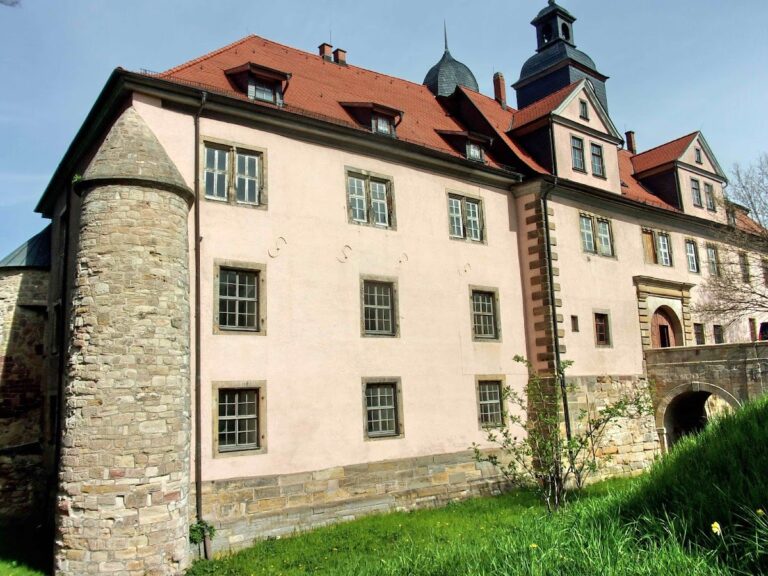
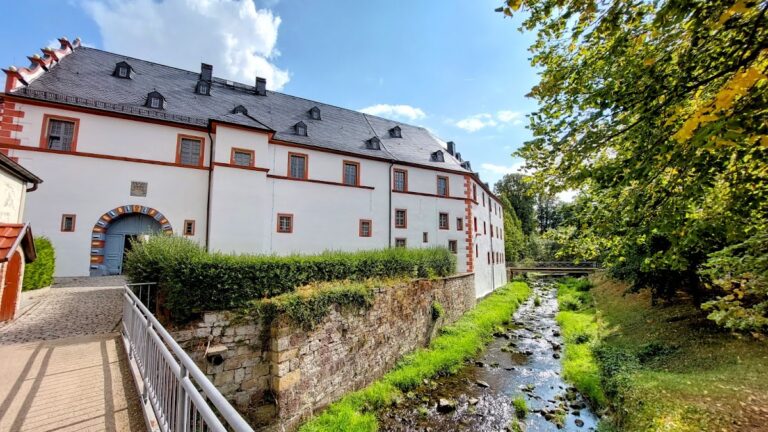
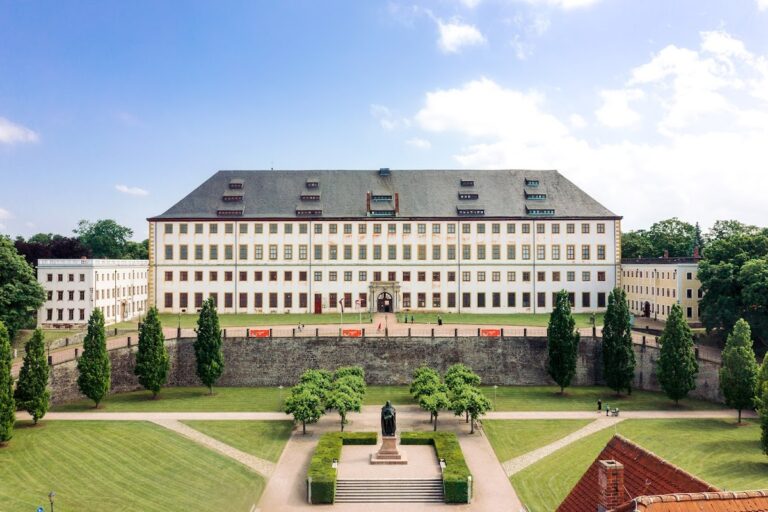
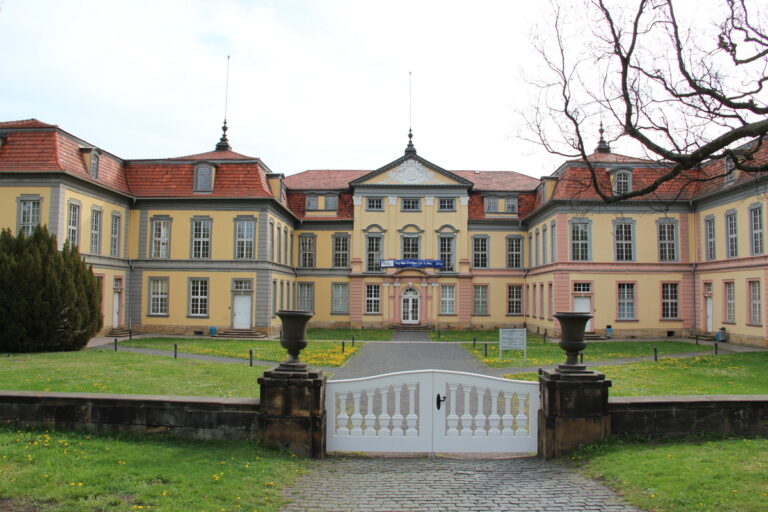
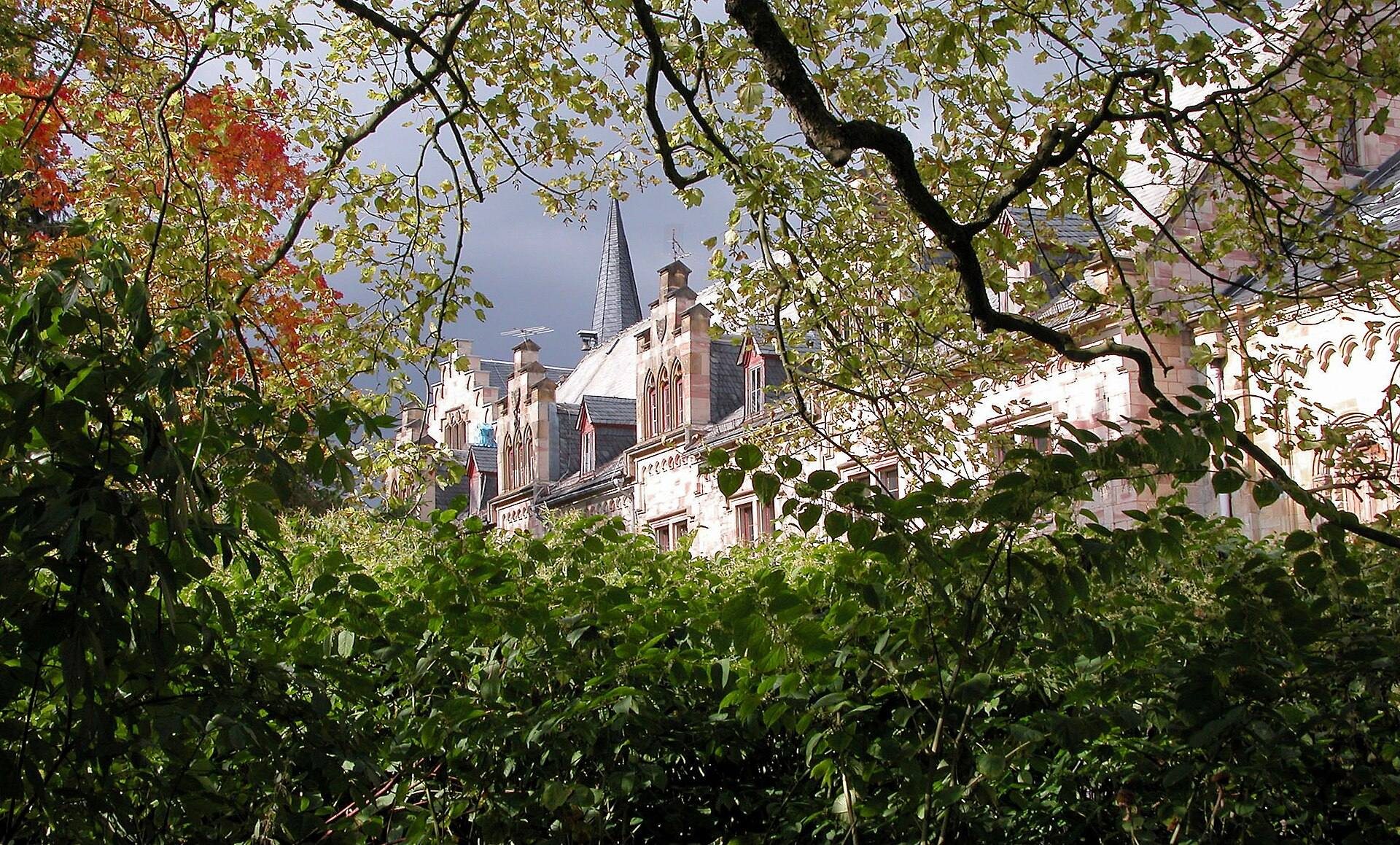
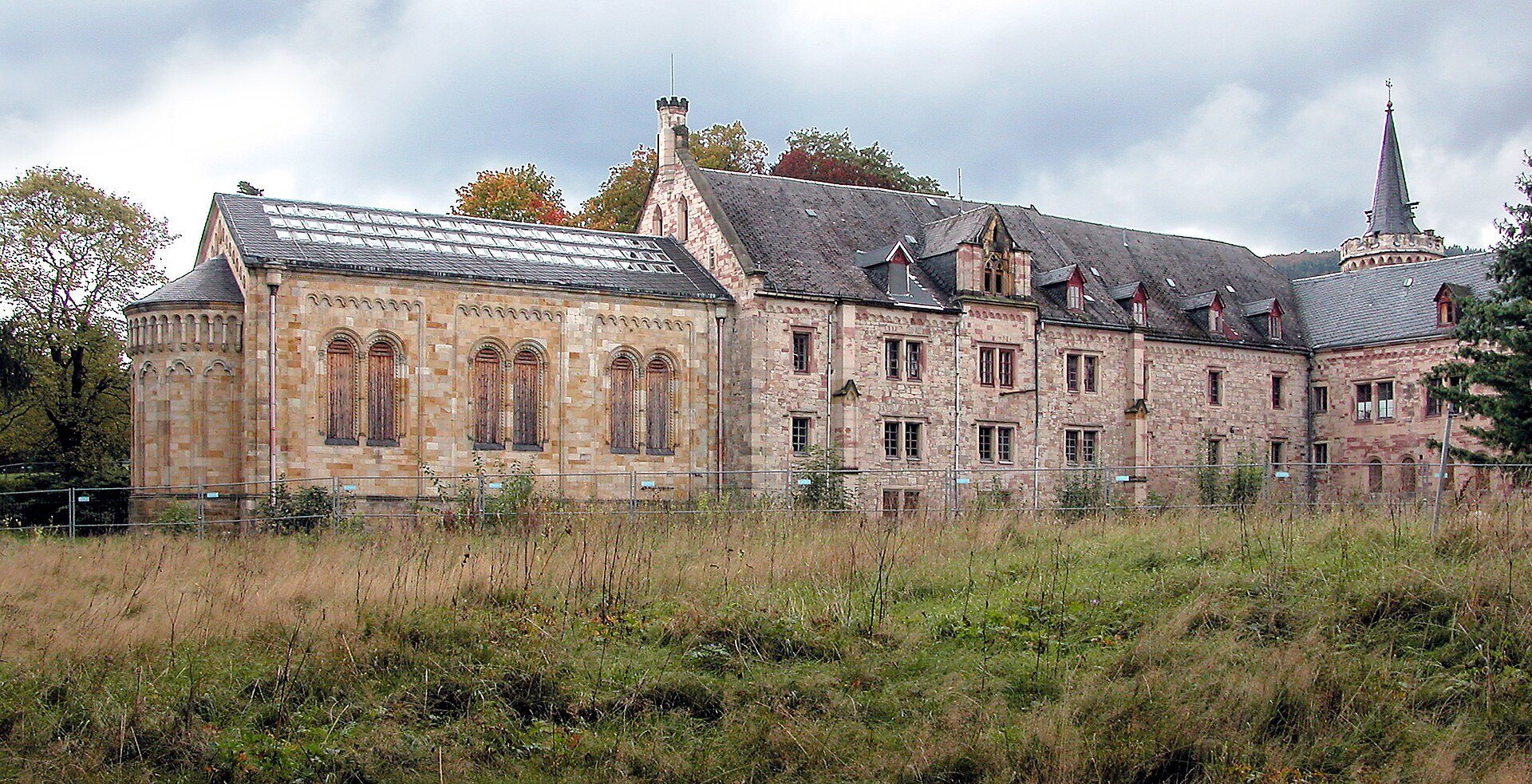
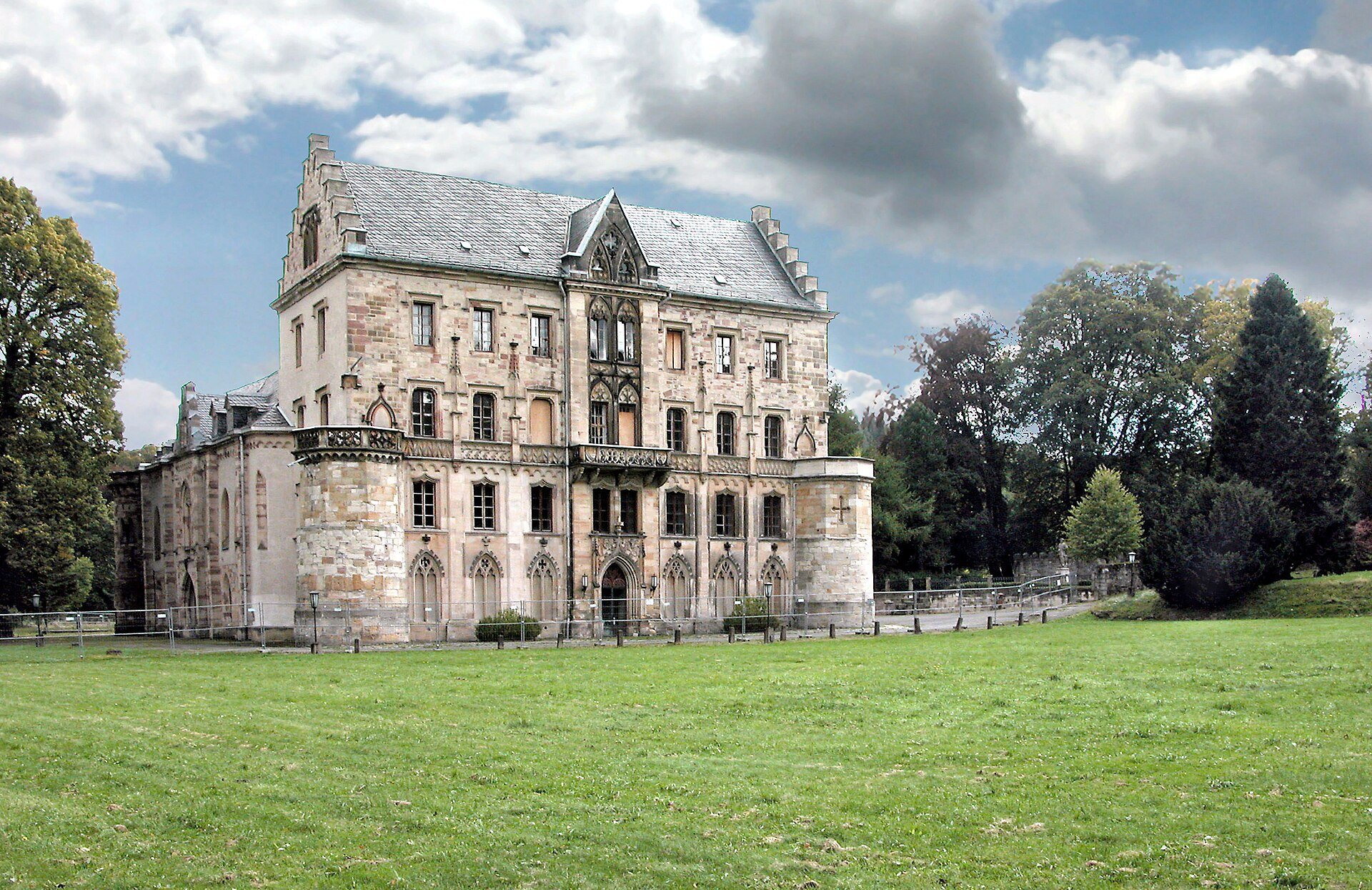
Reinhardsbrunn Castle is an English-style palace complex built over the remains of the medieval Benedictine abbey. Its grounds include a landscaped park established in 1850. The surviving ensemble contains the main palace, a chapel, a connecting gallery, a secondary building known as the Knights’ House, stables, and a tower.
Palace complex
Main palace
The main palace was constructed in 1827 over the ruins of the former abbey. Its English architectural style reflects the nineteenth-century transformation of the monastic site into a pleasure palace. A portal forms one of the building’s documented decorative features.
Palace chapel
The complex includes a palace chapel with its own portal and separately identified decorative details. The chapel forms part of the palace ensemble created above the medieval abbey remains.
Connecting gallery and Knights’ House
A gallery connects the main building with a secondary building called the Knights’ House. The Knights’ House has a documented rear facade that forms a distinct architectural aspect of the complex.
Stables and tower
Stables and a tower are also included within the palace complex. Together with the principal buildings and the landscaped park, they form the surviving architectural setting of Reinhardsbrunn Castle.