Warabi Castle: A Medieval Flat Castle in Japan
Site at a Glance
- Rating
- 3.8
- Popularity
- Low
- Country
- Japan
- Primary era
- Medieval
- External website
- Open
- Eras represented
- Medieval
- Civilizations
- Ashikaga shogunate
- Site type
- Military
- Remains
- Castle
On this page10 sections
History
Warabi Castle, also known as Warabi Palace, is a medieval flat castle in Warabi, Japan, built during the fourteenth-century Nanboku-cho period, an era of conflict between the Northern and Southern Imperial Courts. Shibukawa Yoshiyuki, a member of the Ashikaga family, established it as a base in the lowland around Warabi. His great-grandson, Shibukawa Yoshikane, later used the castle in struggles connected with rival political authorities in the Kanto region.
The Shibukawa stronghold and the Kanto conflicts
In 1457, Ashikaga Yoshimasa sent Yoshikane to the Kanto as Kanto tandai, a Muromachi-shogunate official responsible for representing and enforcing shogunal authority in the region. Yoshikane tried to recruit troops at Warabi Castle, but this proved difficult because much of Adachi District lay within the influence of the Koga Kubō. Based at Koga, the Koga Kubō represented a rival Ashikaga political authority in the Kanto.
Yoshikane lost his position in 1462 after opposing the Ogigayatsu Uesugi, a branch of the powerful Uesugi family. Warabi nevertheless remained the residence of the Shibukawa family, whose political standing was comparable to that of a kanrei, a senior shogunal official. In practice, the castle came under Ogigayatsu Uesugi influence.
During the Nagao Kageharu Rebellion, which began in 1476, local warriors from Musashi responded to Nagao Kageharu. Among them was Toyoshima Yasutsune of nearby Shakujii Castle. Yoshikane appears to have remained aligned with the Ogigayatsu Uesugi and fought alongside Ota Dokan in battles including the Battle of Yodohara.
Contested control in the sixteenth century
In 1524, Yoshikane’s son, Shibukawa Yoshitaka, held Warabi Castle when it was taken by Hōjō Ujitsuna during the Hōjō invasion of Musashi. Two years later, Uesugi Tomooki, supported by Mariya Jokan and Satomi Yoshitoyo, defeated the Hōjō forces and recovered the castle.
After Hōjō Ujiyasu defeated Uesugi Tomosada at the Battle of Kawagoe in 1546, Yoshitaka entered the service of the Later Hōjō, a major Warring States dynasty that controlled much of the Kanto. Warabi stood between the spheres of the Ogigayatsu Uesugi and the Later Hōjō. The Uesugi used it as a base for efforts to recover Edo Castle, while the Later Hōjō treated it as a foothold for attacks against Kawagoe Castle. Its political allegiance therefore changed repeatedly as control of the region shifted.
In 1567, Yoshitaka’s son, Shibukawa Yoshimoto, was killed at the Battle of Mifuneyama. The Warabi branch of the Shibukawa family then came to an end in the area. Its retainers and followers dispersed, and many of those who stayed became farmers. Tradition holds that Yoshimoto’s wife drowned herself in Lake Haruna after his death.
Abandonment, traditions, and later use
Warabi Castle was later abandoned without a resident lord. The Tokugawa family reused the site as a palace associated with hawking. Warabi also functioned as a transport center during the Warring States period, with a regular market. After the Nakasendo, one of Japan’s principal early-modern highways linking Edo and Kyoto through the inland route, was developed, Warabi prospered again as a post town, a settlement serving travelers along an official highway.
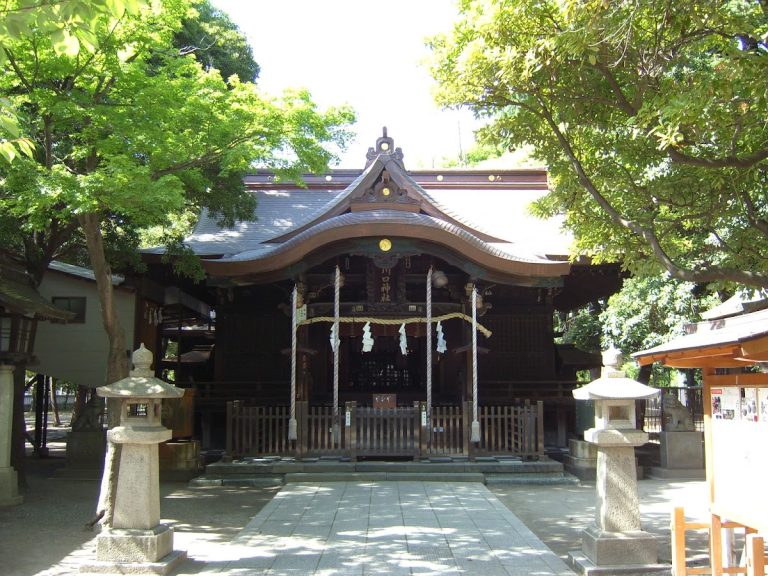
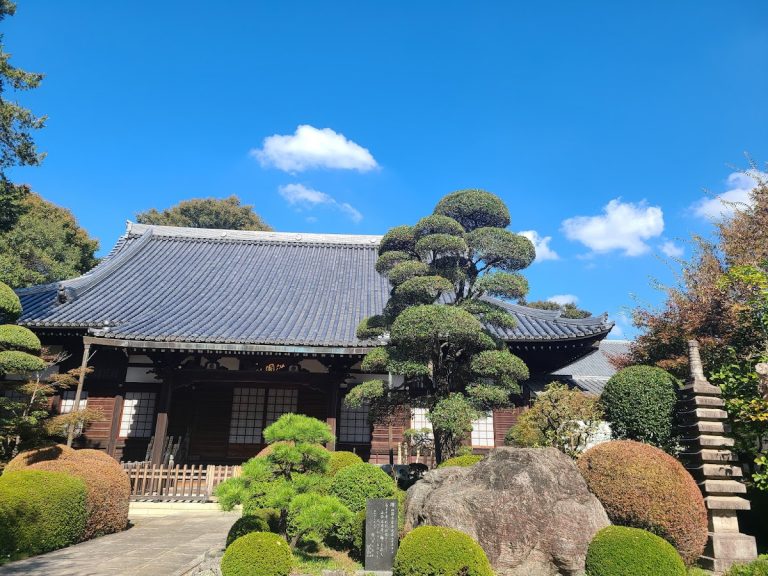
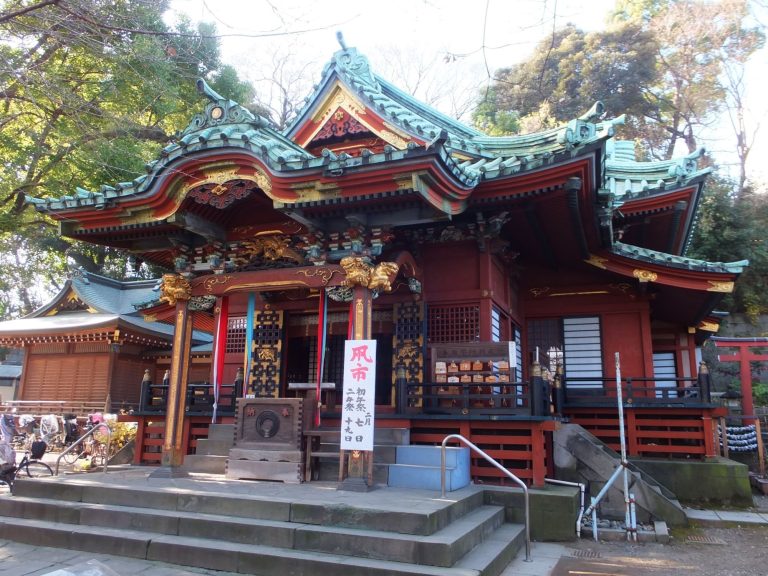
In 1816, descendants of former retainers established a tomb site for Yoshimoto and his wife at Hojuin near the castle. The memorial marked the 250th anniversary of Yoshimoto’s death. Local tradition also holds that the Shibukawa family originally enshrined Hachiman as the castle’s guardian deity at Warabi Shrine. Another tradition says that Yoshimoto’s wife became a dragon spirit. This belief lies behind the Ryutaiin legend that rain fell at Warabi when people traveled to Haruna Shrine to pray for rain. Journeys between Warabi and Lake Haruna for rainmaking continued until the early Showa period.
The traditional account that the Warabi Shibukawa family ended when its members were killed by the Satomi at Mifuneyama has been questioned by later documents. These indicate that members of the family may subsequently have changed sides and supported Masaki Noritoki during a rebellion within the Satomi domain. A newer interpretation proposes that the family fled to Awa Province after losing Warabi Castle to the Later Hōjō and entered Satomi service as guest retainers.
Modern preservation
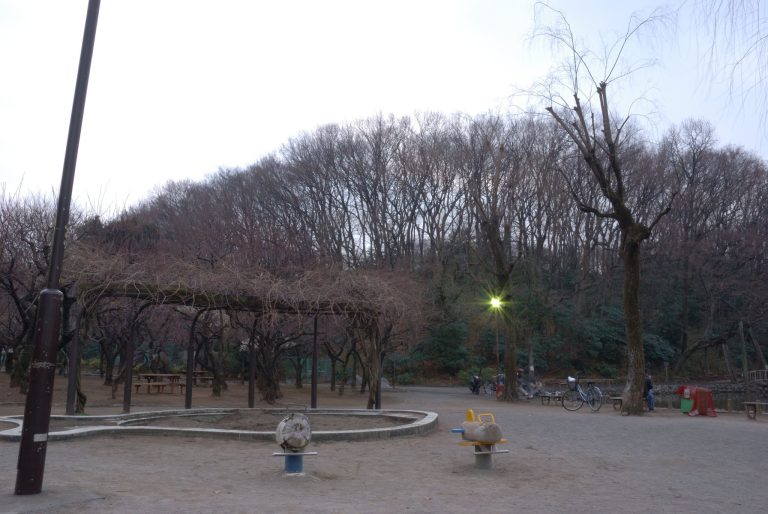
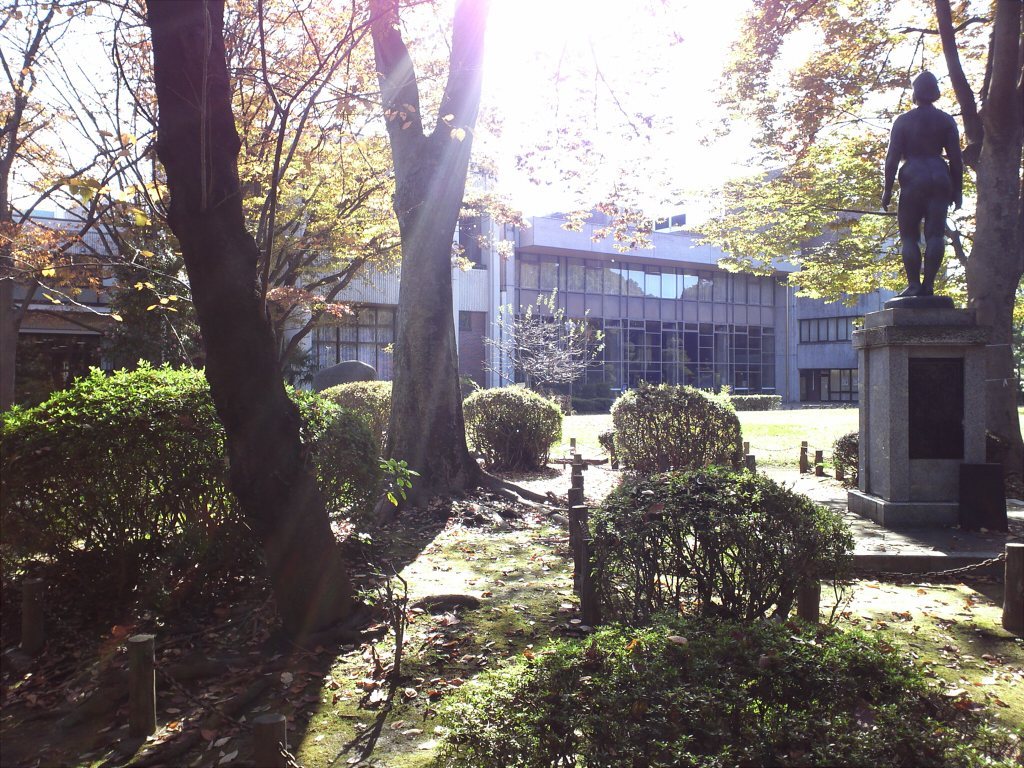
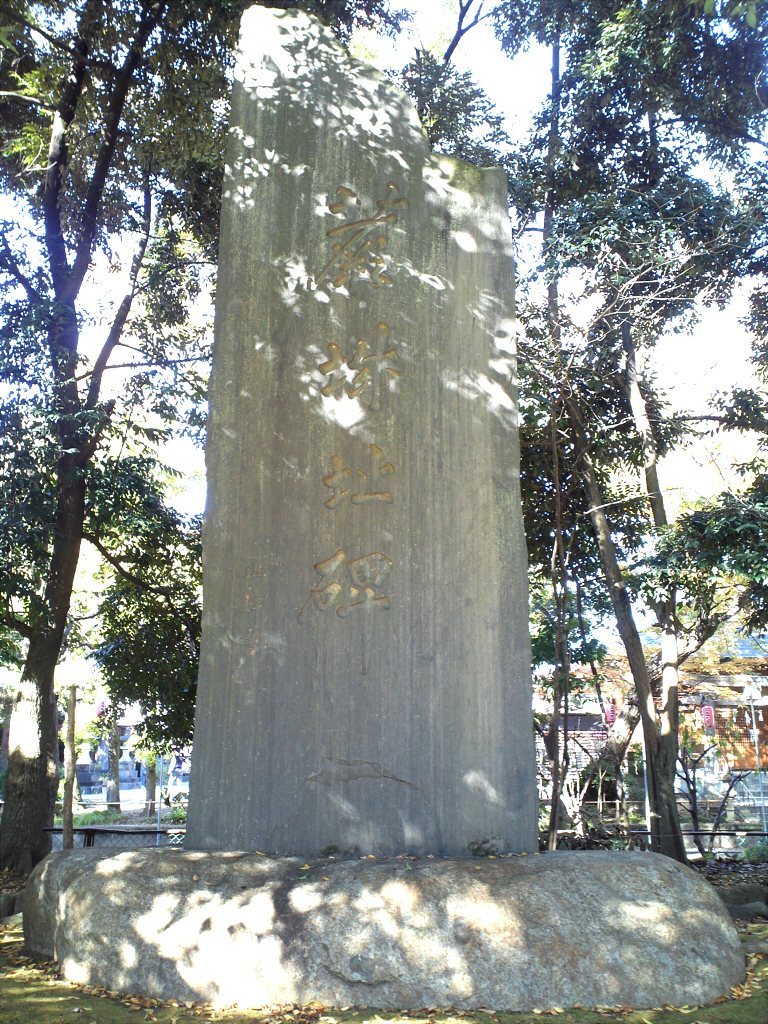
The former main enclosure was designated a Saitama Prefecture historic site in 1925 and a Saitama Prefecture historic landmark in 1961. Urban development later reduced the visible remains, and in 1974 the castle area was redeveloped as Warabi Castle Ruins Park and Warabi Civic Hall. The main castle site is now maintained as the park and retains prefectural historic-landmark status.
Remains
Warabi Castle was built on a slight rise in lowland surrounded by marshes and deep wet fields. It was a flat castle with two connected enclosed areas rather than a mountain stronghold, and it had no keep. The former principal enclosure, or honmaru, was approximately 12,200 square meters inside its defenses. A second enclosure lay to the south, creating a linked two-enclosure plan.
Enclosures and defenses
The principal enclosure was enclosed by a moat approximately 11.8 meters wide and an earthen rampart about 8.2 meters wide. The southern outer enclosure had its own moat and earthen rampart and covered approximately 21,650 square meters. Together, these defenses formed the castle’s main spatial organization across the slight rise.
Principal enclosure
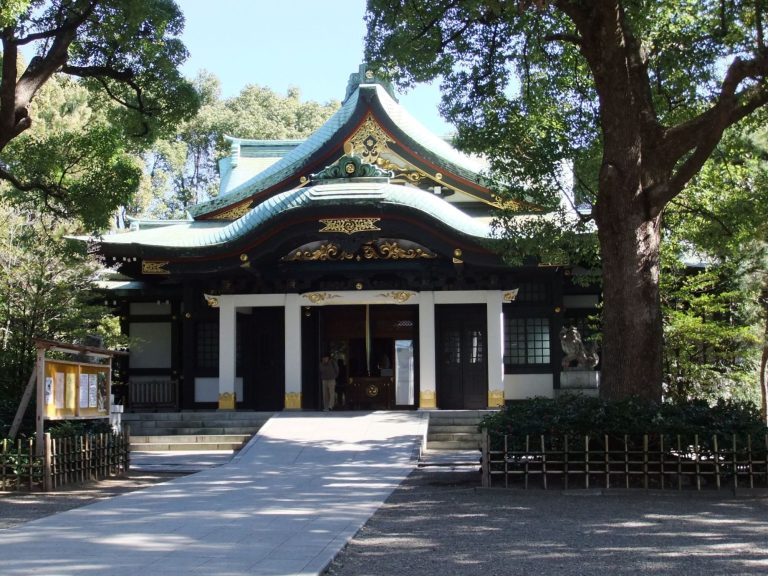
The former honmaru area is now occupied by Warabi Castle Ruins Park, Warabi Civic Hall, and adjacent Warabi Shrine. Their combined area is considered to correspond approximately to the former main enclosure. Most of the enclosure’s physical traces have disappeared as the surrounding urban area developed, but part of the moat, including a water moat, survives.
Fortified entrance and horse sortie
A drawing known as the Plan of Warabi Palace, traditionally dated to around 1846, shows a fortified entrance and a horse sortie on the south side of the principal enclosure. A horse sortie was a protected projecting area that allowed mounted troops to move out through a gate. These features are considered to have been added by Yoshikane at the same time as the outer enclosure.
Surviving landscape traces
Historic place-names preserve aspects of the former castle layout. Names translated as “Masugata at the Palace Site,” “Fortified Position,” “Takayama,” “Inside the Moat,” and “Boshi” survive in the area. Warabi Shrine stands beside the castle-ruins park and remains associated with the former site through the tradition that it began as the Shibukawa family’s guardian shrine.