Ōji Shrine: A Historic Shinto Shrine in Tokyo


Site at a Glance
- Rating
- 4.2
- Popularity
- Medium
- Country
- Japan
- Primary era
- Early Modern
- External website
- Open
- Eras represented
- Early Modern
- Civilizations
- Tokugawa
- Site type
- Religious
- Remains
- Sanctuary
On this page18 sections
History
Ōji Shrine is a Shinto shrine in Kita City, Tokyo, Japan, whose medieval foundation tradition links it with the Toyoshima family and the worship of the Ōji Okami. Shinto is Japan’s indigenous religious tradition, centered on kami, or sacred beings and powers, worshipped at shrines. Although its exact foundation date is unknown, the shrine’s history reaches back to the eleventh century and its present location was established in the early fourteenth century.
Early traditions and the Toyoshima family
A foundation tradition connects Ōji Shrine with Minamoto no Yoshiie, an eleventh-century Minamoto military leader associated with campaigns in northeastern Japan. During his campaign in Oshu between 1058 and 1065, Yoshiie is said to have practiced the Buddhist rite of Kinrin Butcho. He later donated his armor to the shrine.
The shrine’s early development was closely associated with the Toyoshima family. In 1318, Hira Yukiyasu, an official of the family, is thought to have donated a volume of the Great Perfection of Wisdom Sutra. In 1322, Toyoshima Kagemura, the lord of Toyoshima District, invited the shrine to its present location and established it as the ujigami of Toyoshima, Adachi, Tama, Kodama, and Niikura districts. An ujigami is the protective kami of a community or territory. Other descriptions place this foundation broadly between 1321 and 1324.
The area was reportedly known as Kishimura during the medieval period and became known as Ōji after the shrine was invited there. Until the Edo period, the shrine was also called Ōji Gongen, Toyoshima Nyakuichi Ōji, and Toyoshima Kumano Gongen. The name Ōji derives from Hama-Ōji, the place from which the deities were invited.
Medieval status and estates
During the Sengoku period, a year-end prayer brought a return gift from Ashikaga Yoshiuji, a leader of the Ashikaga branch that ruled the Kanto region through the office of Koga Kubo. The gift indicates the standing Ōji Shrine held in the region. Its estate amounted to 28 kan and 860 mon, and included Shimohirakawa, Kamihirakawa, and Ushigome.
Hojo Ujiyasu guaranteed the shrine’s rights concerning its bamboo and timber in 1575. His son, Hojo Ujinao, confirmed the same protection in 1583. In 1591, Tokugawa Ieyasu, founder of the Tokugawa shogunate, confirmed an estate of 200 koku for the shrine. This endowment remained unchanged throughout the Edo period.
Tokugawa patronage
In the winter of 1634, shogun Tokugawa Iemitsu had the shrine buildings constructed and brought Toshogu and Asuka Myojin, formerly enshrined at Asukayama, into the precincts. He also ordered a picture scroll describing the shrine’s origins. Completed in 1639, the Illustrated Origin Scroll of Nyakuichi Ōji had text by Hayashi Razan, calligraphy by Nishiki Gonbei, and paintings by Kano Naonobu. The original was later destroyed by fire, while a copy is held by the Paper Museum.
Shogunal patronage continued through repeated rebuilding. The shrine buildings were reconstructed in 1697 under Tokugawa Tsunayoshi, in 1782 under Tokugawa Ieharu, and in 1820 under Tokugawa Ienari. At one stage, the precinct contained 17 subsidiary shrines.
Tokugawa Yoshimune had a particular attachment to Ōji Shrine because his family originated in the Kishu Tokugawa house, linking him with Kii Province. In 1737 he donated Asukayama to the shrine and ordered many cherry trees to be planted there. The area later became Asukayama Park.
Modern religious and cultural history
After the transfer of the capital to Tokyo, Ōji Shrine was designated a quasi-imperial shrine in 1868. It became a village shrine in 1872 and, in 1912, a shrine receiving state offerings of food and cloth. Its former Buddhist administrative temple was Kinrinji. A bettoji was a Buddhist temple responsible for administering a Shinto shrine before the modern separation of Shinto and Buddhism.
The shrine is one of the Tokyo Ten Shrines and is regarded within that group as the northern guardian shrine. Its deities are Izanagi-no-Mikoto, Izanami-no-Mikoto, Amaterasu-Omikami, Hayatama-no-O-no-Mikoto, and Kotosaka-no-O-no-Mikoto, collectively called the Ōji Okami. Izanagi and Izanami are primordial kami associated with the creation of the Japanese islands and the divine genealogy, while Amaterasu-Omikami is the Shinto sun kami and a central deity of the imperial tradition.
The annual festival takes place in August and includes a mikoshi procession and the performance of Ōji Shrine Dengakumai. Dengaku is a traditional Japanese performance combining music and dance, historically associated with religious celebrations. Ōji Dengaku is recognized as one of Japan’s three great dengaku dance traditions and is designated a cultural property by Kita Ward. The shrine’s ginkgo is designated a cultural property of Tokyo and became a Tokyo Natural Monument in 1939.
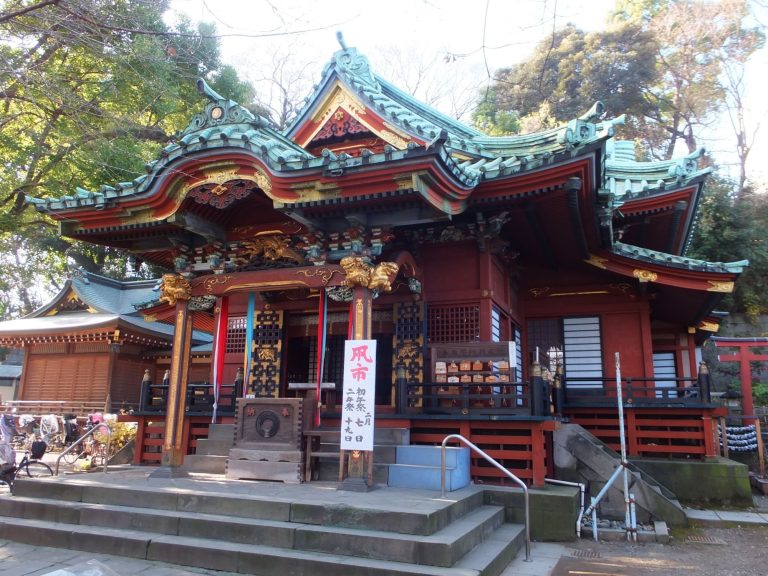
Most of the shrine buildings were destroyed during the bombing of Tokyo in World War II. The buildings and precincts were reconstructed in stages from 1959 to 1964 and again in 1982, preserving the shrine as a functioning religious and cultural site.
Remains
The precinct occupies a hill on the left bank of the Shakujii River, known as the Otonashi River near the shrine, west of Ōji Station. Its area is given as approximately 3,000 tsubo, about 9,917 square meters, although other inventories give 3,183 tsubo, or about 10,522 square meters. The main approach begins at a large torii and continues along a short sando toward the sanctuary. A chozuya, a facility for ritual hand and mouth purification, stands on the right side of the approach.
Principal shrine buildings
Main sanctuary
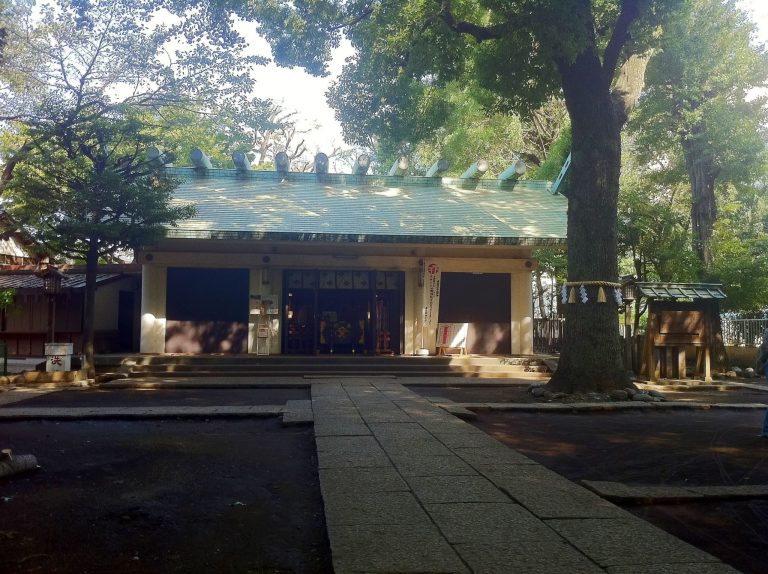
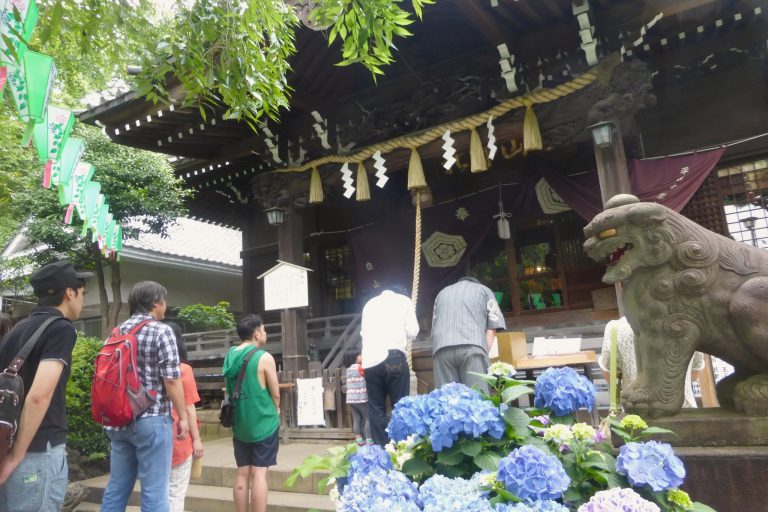
The main sanctuary covers about 6 tsubo, approximately 19.83 square meters. It is described as being in the Gongen-zukuri style and is also identified as Ishi-no-ma-zukuri. These are Shinto arrangements in which the sanctuary and worship spaces are linked by an intermediate connecting section. At Ōji Shrine, the main sanctuary, worship hall, and offertory hall are joined beneath one roof in an H-shaped plan.
Torii and approach
The entrance is marked by a large Myojin-style torii with curved upper lintels. Built from Inada granite from Ibaraki Prefecture, it stands approximately 8.67 meters high. A shrine gate formerly occupied this location before it was destroyed during World War II. A rear entrance links the precinct with Otonashi Shinsui Park by a long stairway.
Guardian figures
Two guardian komainu stand beside the approach. The figure on the right when facing the sanctuary is identified as the father and stands on a temari ball. The figure on the left is identified as the mother and protects a young komainu, representing joint parental care of children.
Festival and subsidiary features
Mikoshi storehouse
A mikoshi, a portable shrine carried in procession during a festival, was dedicated to Ōji Shrine in 2017. It is approximately 0.91 meters long and weighs about 550 kilograms. Its carvings depict imagery connected with the shrine’s dengaku dance. A storehouse for the mikoshi was constructed in 2019.
Seki Shrine
Seki Shrine is a small subsidiary shrine on the left side of the sando. It is dedicated to Semimaru, a legendary Japanese musician and poet traditionally associated with the biwa, a Japanese lute. Seki Shrine is associated with hair-related occupations and with the biwa. Its building was reconstructed in 1959 after the earlier structure was destroyed during World War II.
Hair monument
A hair monument within the precincts was erected on May 24, 1961, by people working in hair-related trades. It commemorates a Buddhist legend in which a poor woman cut off her hair to provide oil for a lamp when Shakyamuni, the historical Buddha, entered Jetavana monastery, an ancient Buddhist monastic park in India. The lamp continued to shine despite a strong wind.
Trees and historical markers
Ginkgo tree
A large ginkgo stands beside the precinct on the hill above the Otonashi River, to the right of the approach. It is generally thought to have been planted around the time of the shrine’s medieval foundation and is suspected to be more than 600 years old. One record gives its height as 24.2 meters and its trunk circumference as 5.2 meters, while a 1924 measurement gave a height of 19.69 meters and a circumference of 6.36 meters.
The ginkgo survived the World War II bombing that destroyed much of the shrine, although the upper part of its trunk was damaged. A stone bearing inscriptions stands beside it. Treated as a Tangible Cultural Property of Tokyo, the stone supports the interpretation that the Toyoshima family contributed to founding the shrine between 1321 and 1324.
Asukayama monument
A stone monument erected on August 13, 1930, bears a haiku by a former mayor of Ōji Town concerning the cherry blossoms of Asukayama, the nearby area associated with Tokugawa Yoshimune’s planting program.
Castanopsis tree tradition
A large castanopsis tree in the precincts was associated with a tradition that Ota Dokan took shelter beneath it during a storm. Dokan was a fifteenth-century samurai, Buddhist monk, and designer and builder of Edo Castle. The tree was destroyed, probably during World War II.