Kawaguchi Shrine: A Shinto Tutelary Shrine in Japan


Site at a Glance
- Rating
- 3.9
- Popularity
- Low
- Country
- Japan
- Primary era
- Unclassified
- External website
- Open
- Eras represented
- Unclassified
- Civilizations
- Unclassified
- Site type
- Religious
- Remains
- Sanctuary
On this page7 sections
History
Kawaguchi Shrine is a Shinto shrine in Kawaguchi, Japan, serving as the ujigami, or community tutelary shrine, for 13 communities in the Chuo, Koei, and Namiki districts. It is also revered as Kawaguchi’s general tutelary shrine, a role that extends its religious association across the city. The original foundation records were lost in flooding, so the shrine’s beginnings remain uncertain. Shrine tradition places its establishment in the Tengyō era, from 938 to 947, by Musashi no Takehiba, a deputy official of Adachi District.
Early tradition and the Hikawa name
The shrine was originally called Hikawa Shrine and was also known as Hikawa Daimyōjin. Its traditional foundation belongs to a period when local shrines served as religious centers for communities and their lands. Shinto is Japan’s indigenous religious tradition, centered on reverence for kami, including deities associated with nature, occupations, ancestors, and historical figures. In Kawaguchi, the shrine’s later associations brought together several such religious traditions.
Incorporation and changing status
In 1873, the shrine was classified as a village shrine. It later incorporated a Tenjin Shrine dedicated to Sugawara no Michizane, three Inari shrines dedicated to Ukanomitama no Mikoto and Ukemochi no Mikoto, and a Kanayama Shrine dedicated to Kanayamahiko no Mikoto. Sugawara no Michizane was a Heian-period scholar and court official later revered as Tenjin, a kami associated especially with learning. Ukanomitama and Ukemochi are associated with food and agricultural abundance, while Kanayamahiko is connected with mining and metalworking. The shrine took the name Kawaguchi Shrine in 1909.
After Kawaguchi became a city in 1933, the shrine became the city’s general tutelary shrine, or chinju, serving a broader locality. In 1935, it was elevated to prefectural-shrine status, a formal rank within Japan’s former state-shrine classification system before 1945.
Deities, festivals, and local memory
The principal deities are Susanoo-no-Mikoto, Sugawara no Michizane, Ukanomitama no Mikoto, Ukemochi no Mikoto, and Kanayamahiko no Mikoto. Susanoo is a major Shinto kami associated in mythology with storms, the sea, and the defeat of the serpent Yamata no Orochi. At Kawaguchi Shrine, Kanayamahiko is regarded as a guardian deity of the city’s flourishing foundry industry, linking the shrine’s religious life with a defining local occupation.
The annual observances include the Toshigoi Festival on February 17, the Kanayama Shrine Festival on the second Saturday of May, the Kawaguchi Shrine Festival on October 19 and 20, the Niiname Festival on November 23, and the Ōtoshi Festival, also called Okameichi, on December 15. Lion dances are offered at the kagura hall during both the Kanayama Shrine and Kawaguchi Shrine festivals. Kagura is a Shinto ritual performance of music and dance presented to the kami, and a kagura hall is the building used for it. The December festival is accompanied by numerous street stalls near the shrine.
The precincts also preserve memories connected with the Russo-Japanese War. A bust commemorates Koike Kōsaburō, a Kawaguchi-born first-class naval engine man who was killed while serving aboard the Fukui Maru during the Second Port Arthur Harbor Blockade Operation. The Gaisen Bridge Monument records the history of a bridge built to commemorate victory in that war. Both the monument and the surviving portion of the bridge were designated Kawaguchi municipal cultural properties in 2009.
Remains
Shrine buildings and ritual space
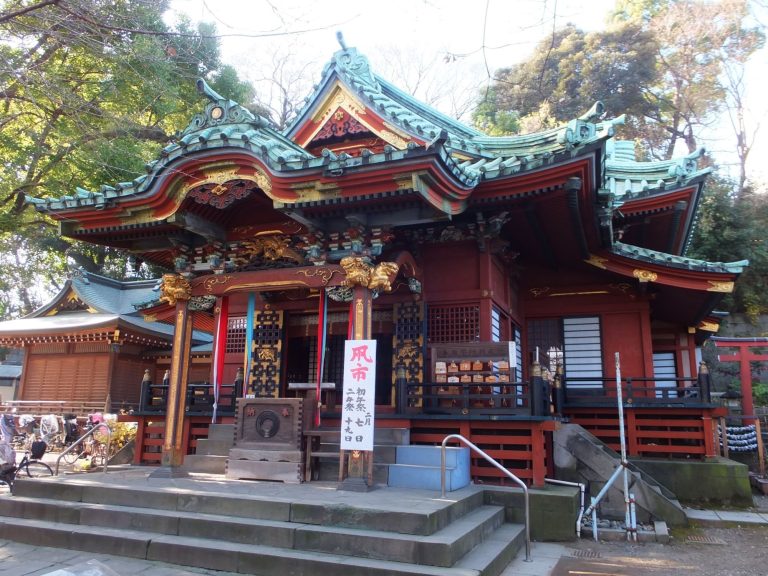
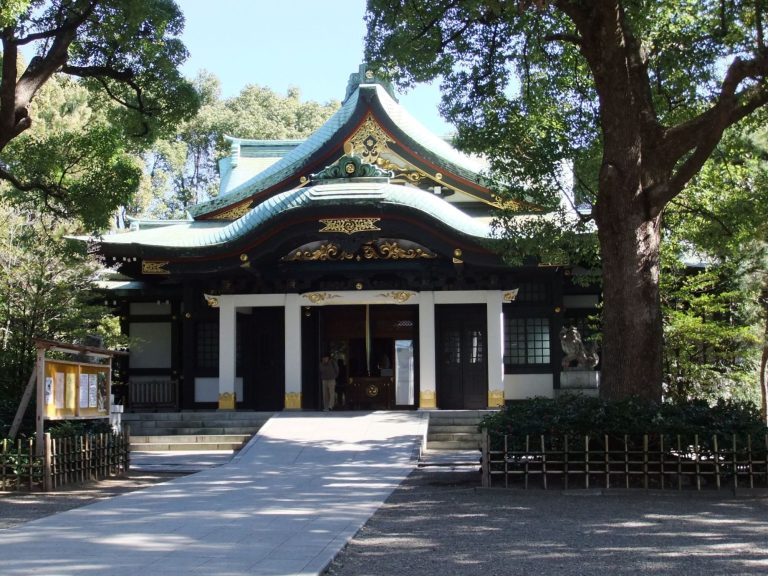
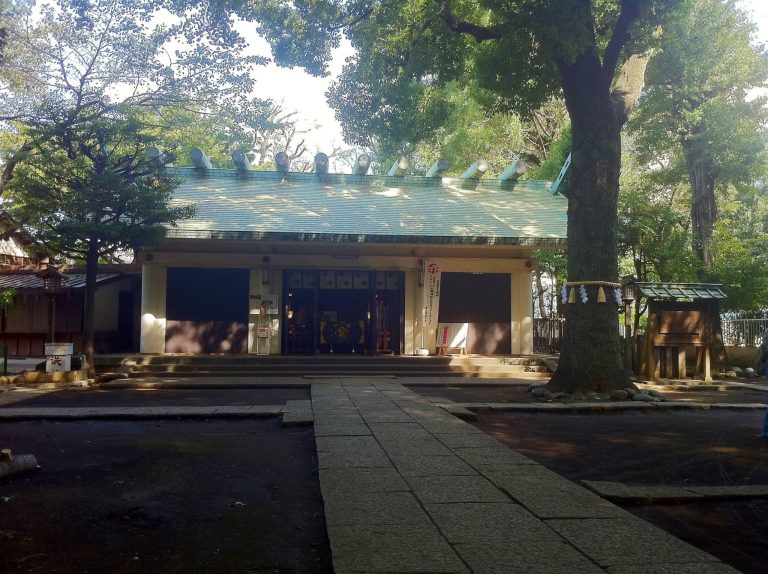
The shrine precincts contain a principal shrine building and a kagura hall. The kagura hall remains the setting for lion dances performed during the Kanayama Shrine Festival and the Kawaguchi Shrine Festival. These buildings form the principal architectural elements identified within the precincts, combining the shrine’s central religious space with a dedicated structure for ritual performance.
Commemorative features
A bust of Koike Kōsaburō stands within the shrine precincts. It commemorates his service and death aboard the Fukui Maru during the Russo-Japanese War. The precincts also contain the Gaisen Bridge Monument, which preserves the history of a bridge erected to mark victory in the conflict. The bridge no longer survives as a complete structure, although a railing from one side remains near the Kawaguchi Post Office. The monument and this surviving bridge element connect the shrine grounds with Kawaguchi’s modern commemorative history.
Nearby sites