Kloster Rebdorf: A Former Augustinian Canon Monastery in Eichstätt, Germany
Site at a Glance
- Rating
- 4.7
- Popularity
- Very Low
- Country
- Germany
- Primary era
- Early Modern
- Eras represented
- Medieval, Early Modern, Modern
- Civilizations
- German, Holy Roman Empire
- Site type
- Religious
- Remains
- Monastery
On this page13 sections
History
Kloster Rebdorf is a former Augustinian canon monastery in Eichstätt, Germany, founded around 1156 by Konrad I of Morsbach, Bishop of Eichstätt, as a collegiate foundation dedicated to Saint John the Baptist. The complex grew from an earlier settlement and church, became an important religious and economic institution, and was later transformed by war, secularization, institutional use, and renewed monastic activity.
Foundation and medieval growth
Rebdorf was first mentioned in 1055, and a church in the village was consecrated in 1063. In 1153, King Frederick Barbarossa transferred the imperial village to Konrad I of Morsbach, the Bishop of Eichstätt. Konrad founded the monastery approximately three years later as an Augustinian canon foundation, a community of clergy following the rule associated with Saint Augustine while serving in a collegiate religious institution.
The foundation developed both as a religious community and as a landholder. Bishop Konrad enriched it with property, although Bishop-elect Egilolf temporarily withdrew these goods. Bishop Otto restored them at the Eichstätt diocesan synod of 1186. By 1239, the foundation possessed property in 47 places within the prince-bishopric, a territory governed by a bishop who also exercised secular authority.
Count Gebhard VII of Hirschberg, the last count of Hirschberg, died on 4 March 1305 and was buried in the collegiate church. In 1296 he had donated the patronage rights of the parishes of Kottingwörth, Oening, Aha, and Dornhausen to the provost and convent. In June 1307, Bishop Philipp of Eichstätt incorporated those parishes into the monastery and its religious community.
Reform and humanist scholarship
By the fifteenth century, the foundation was considered in need of reform. After prolonged resistance, it joined the Windesheim Congregation in 1458. This was a reform network of Augustinian communities that promoted stricter religious discipline and intellectual life. The reform was advanced by canons from Kirschgarten near Worms.
During the humanist period, the priors Hieronymus Rotenpeck and Kilian Leib gave Rebdorf an important intellectual position. The canons also cared for the neighboring Augustinian canonesses’ foundation at Marienstein, established in 1460.
Rebdorf’s former library was one of Germany’s most important ecclesiastical libraries. During the fifteenth-century reform movement, it formed part of a network of monasteries that copied and circulated mystical and ascetic writings. Manuscript connections linked it with the reform monasteries of Pillenreuth and Tegernsee, including the transmission of works by Johannes Tauler. Under Prior Kilian Leib, the collection was expanded in the sixteenth century to support humanist scholarship and continued to grow afterward.
Around 1800, the library held approximately 30,000 volumes, nearly 800 manuscripts, numerous incunabula, meaning books printed in Europe before 1501, and a Gutenberg Bible. During the Coalition Wars, the European conflicts fought against revolutionary and Napoleonic France from the 1790s to 1815, the French army under General Dominique Joba looted the library in the summer of 1800. Secularization in 1806 ended the library as an institution. Its surviving holdings are now dispersed across Europe and the United States, while some entered the court-garden library through the Royal Library of Eichstätt.
War, secularization, and institutional use
Rebdorf suffered severe damage during the Thirty Years’ War, the major European conflict of 1618 to 1648. The complex was rebuilt and reshaped in the eighteenth century. The church received its Baroque transformation in 1732, and new convent buildings were constructed under the direction of Gabriel de Gabrieli, the Eichstätt building director.
The monastery was dissolved on 6 August 1806 during Bavarian secularization, the state suppression and transfer of ecclesiastical institutions and property. Its holdings included 191 Tagwerk of meadows, 533 Tagwerk of arable land, and 2,040 Tagwerk of woodland. The church was secularized, its furnishings were removed, and some altars were sold to Hausen and Rögling.
After several changes of ownership, Duke Auguste de Beauharnais of Leuchtenberg acquired the buildings in 1824. The Bavarian state took them over in 1855 and established a workhouse there in 1857. Until 1859, the institution was subordinate to the forced-labor institution at Kaisheim. In 1923, 480 prisoners were held at Rebdorf.
On 21 May 1945, the American military government confiscated the workhouse and established a refugee camp, mainly for Lithuanians. The buildings deteriorated during this period, and refugees removed much of their furnishings. The camp included a Lithuanian secondary school, where the future Lithuanian president Valdas Adamkus completed his secondary education in 1946. The military government returned the complex to the Free State of Bavaria in 1949.
Return to religious and educational use
The first division of the Bavarian riot police was established at Rebdorf in 1951 and remained there until 1956, while the complex continued to function as a workhouse. In 1958, the Missionaries of the Sacred Heart purchased the buildings and restored their monastic use. Three brothers still lived there in 2023.
Between 1959 and 1963, the Munich architect Franz Kießling restored the monastery and church. A boys’ secondary school with boarding facilities opened in 1959, and Kießling added an eastern extension in 1977. The Diocese of Eichstätt assumed responsibility for the school in 1990 and bought the complex from the order in 2003. The boarding school continued until 2007.
The educational complex expanded with a new dining hall in 2013, the relocation of the Maria-Ward secondary school from Eichstätt to Rebdorf in 2014, and a triple sports hall designed by the diocesan architect Richard Breitenhuber in 2017. The two secondary schools later formed a school center. The open spaces were redesigned between 2012 and 2016 by Wolfgang Weinzierl, a landscape architect from Ingolstadt. In March 2023, the Diocese of Eichstätt announced its intention to withdraw as operator of the Rebdorf secondary schools.
The monastery church was restored by the Bavarian State Office for Monument Protection from 1961 to 1963. Its roof and roof structure were renovated between 2007 and 2009, followed by an interior renovation from 2010 or 2011 to October 2013. The church is the parish church of Saint John in Rebdorf. In 2003, the parish counted 787 Catholics in Rebdorf and 1,801 when Marienstein, Wasserzell, Blumenberg in Eichstätt, and the Marienstein children’s village were included. The church is also associated with the Rebdorf curacy, a local Catholic pastoral district that is not necessarily an independent parish.
Remains
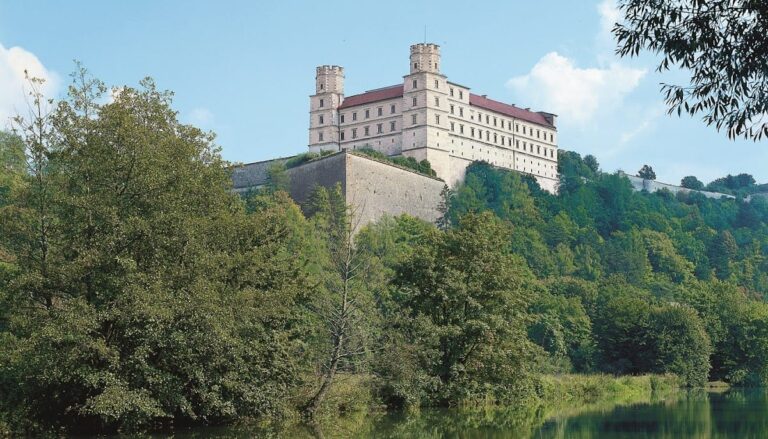
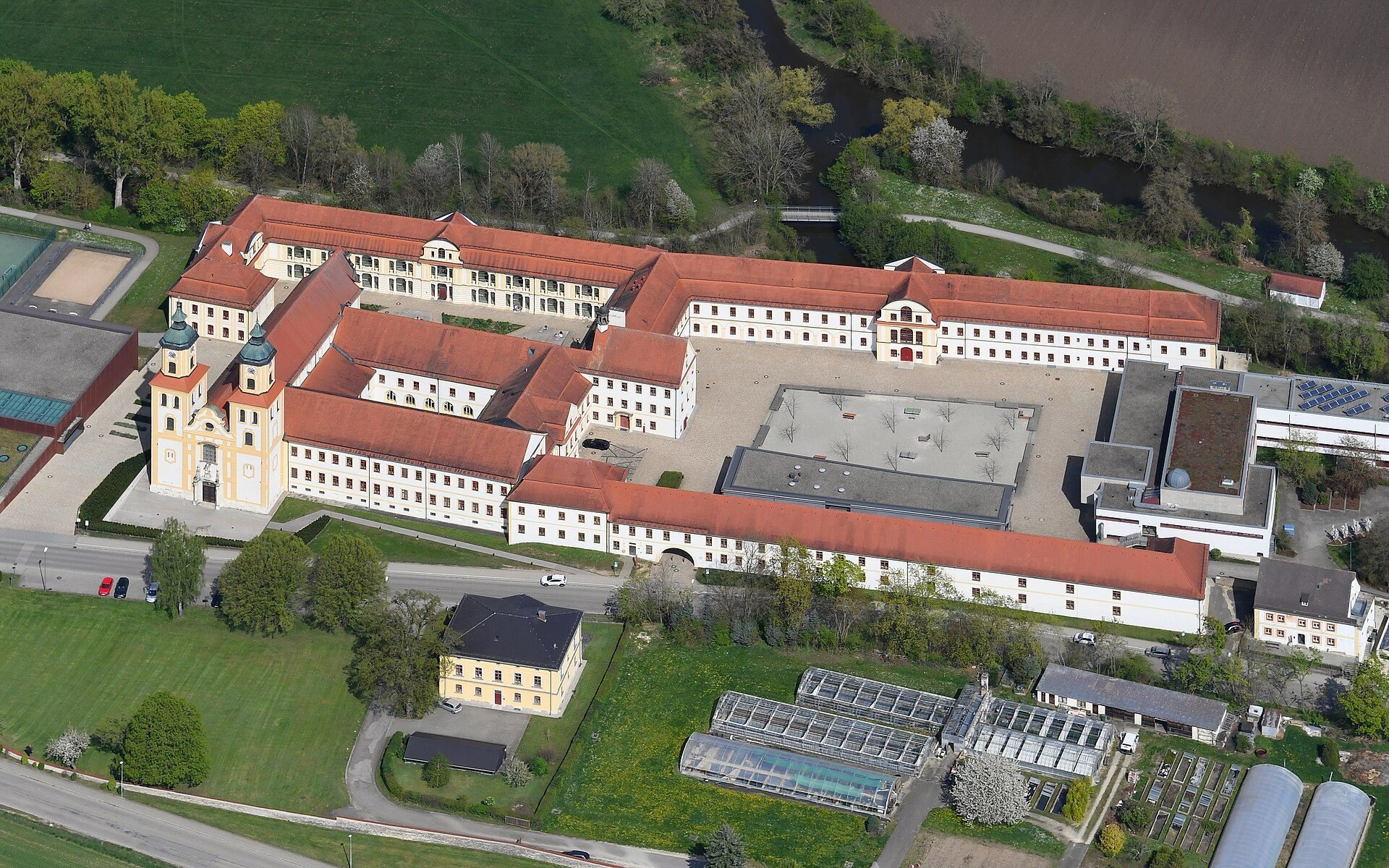
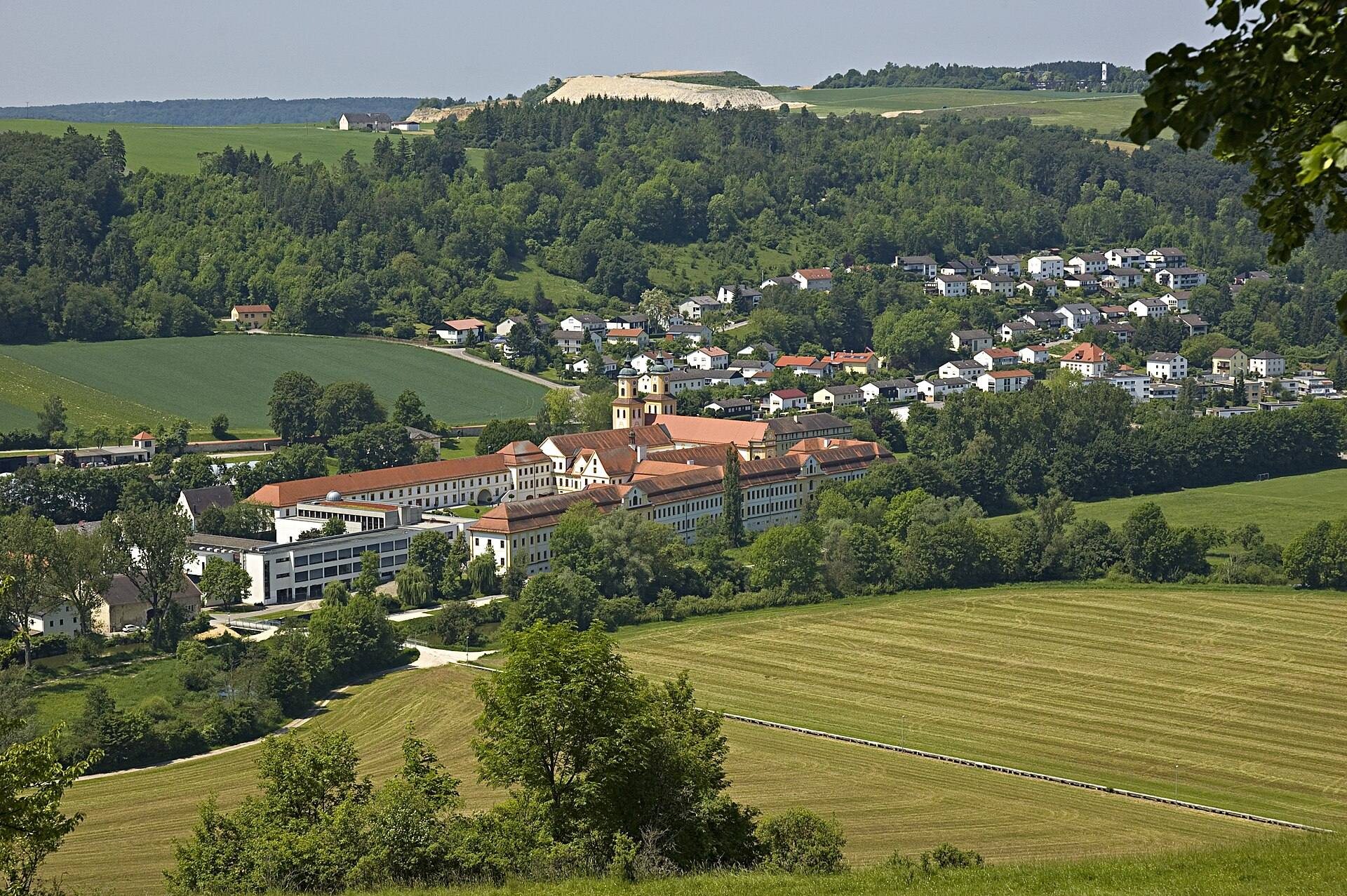
The former monastery complex stands beside the Altmühl and includes the church, convent buildings, a medieval cloister, the former refectory, the former prelature, the Gabrielihof courtyard, later school buildings, and modern educational facilities. The eighteenth-century convent buildings present a castle-like facade 183 metres long on the side facing the river. A historic flood footbridge crosses the meadows between the complex and the foot of the eastern Altmühl slope, while a branch railway runs through the wider setting between Eichstätt station and Eichstätt town.
Church and medieval core
Church of Saint John the Baptist
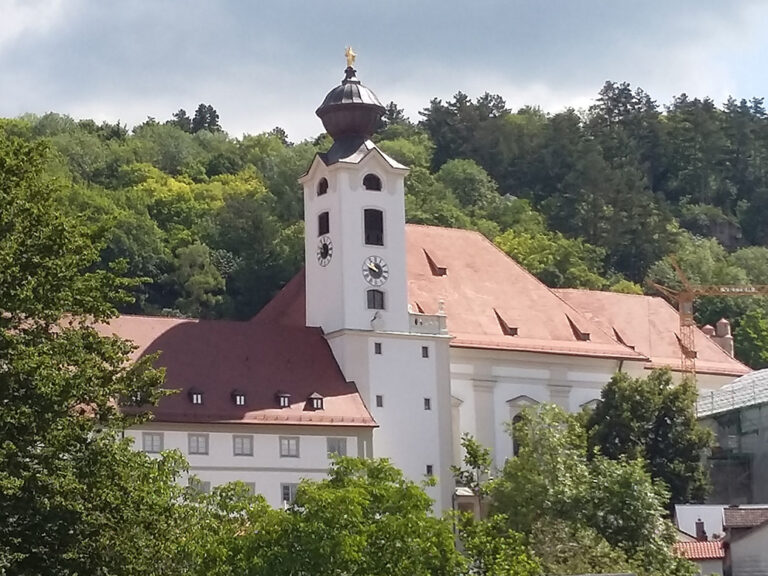
Construction of the church began in the second half of the twelfth century. The lower sections of its towers date from the first half of the thirteenth century. Their upper parts were altered in the fifteenth century and received Baroque treatment in the eighteenth century. Matthias Seybold carried out the church’s Baroque transformation between 1732 and 1734.
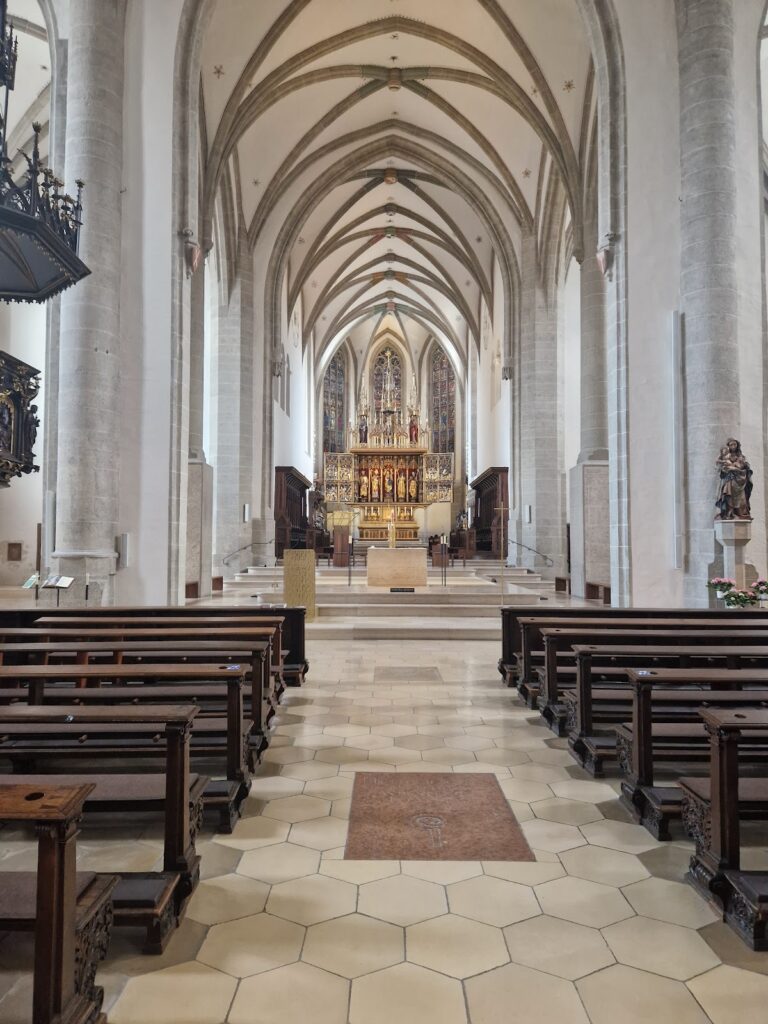
Joseph Dietrich painted the church’s frescoes between 1732 and 1734. During the interior renovation completed in October 2013, the wall and ceiling paintings and the stucco were restored toward the appearance associated with the Baroque transformation. Paint layers applied over the original colors during the 1961 restoration were removed in 2012, revealing the earlier Baroque colors. The church’s organ was built in 1979 by the Sandtner organ-building company and has two manuals and a pedal.
Altars and memorials
The high altar contains a central Crucifixion group made by Andreas Frosch in 1519 and loaned from Donauwörth. A Late Gothic Madonna forms the center of the left side altar. Tombstones distributed throughout the church date from the fifteenth century and commemorate people connected with the monastery.
Convent buildings and courtyard
Medieval cloister and refectory
The medieval cloister, the covered walk and courtyard-centered circulation space of a monastery, is connected to the former refectory, or communal dining hall. The refectory contains substantial Baroque stucco. Together, these spaces preserve the relationship between the community’s circulation area and its shared dining room.
Former prelature and Gabrielihof
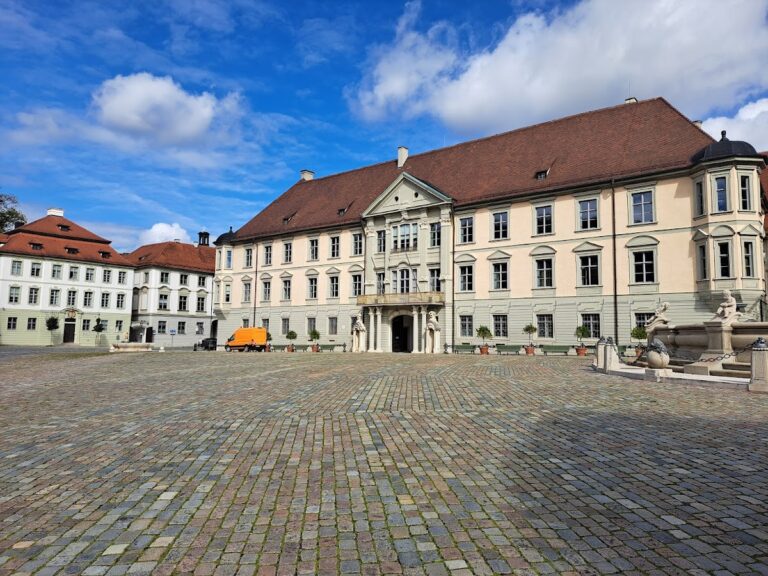
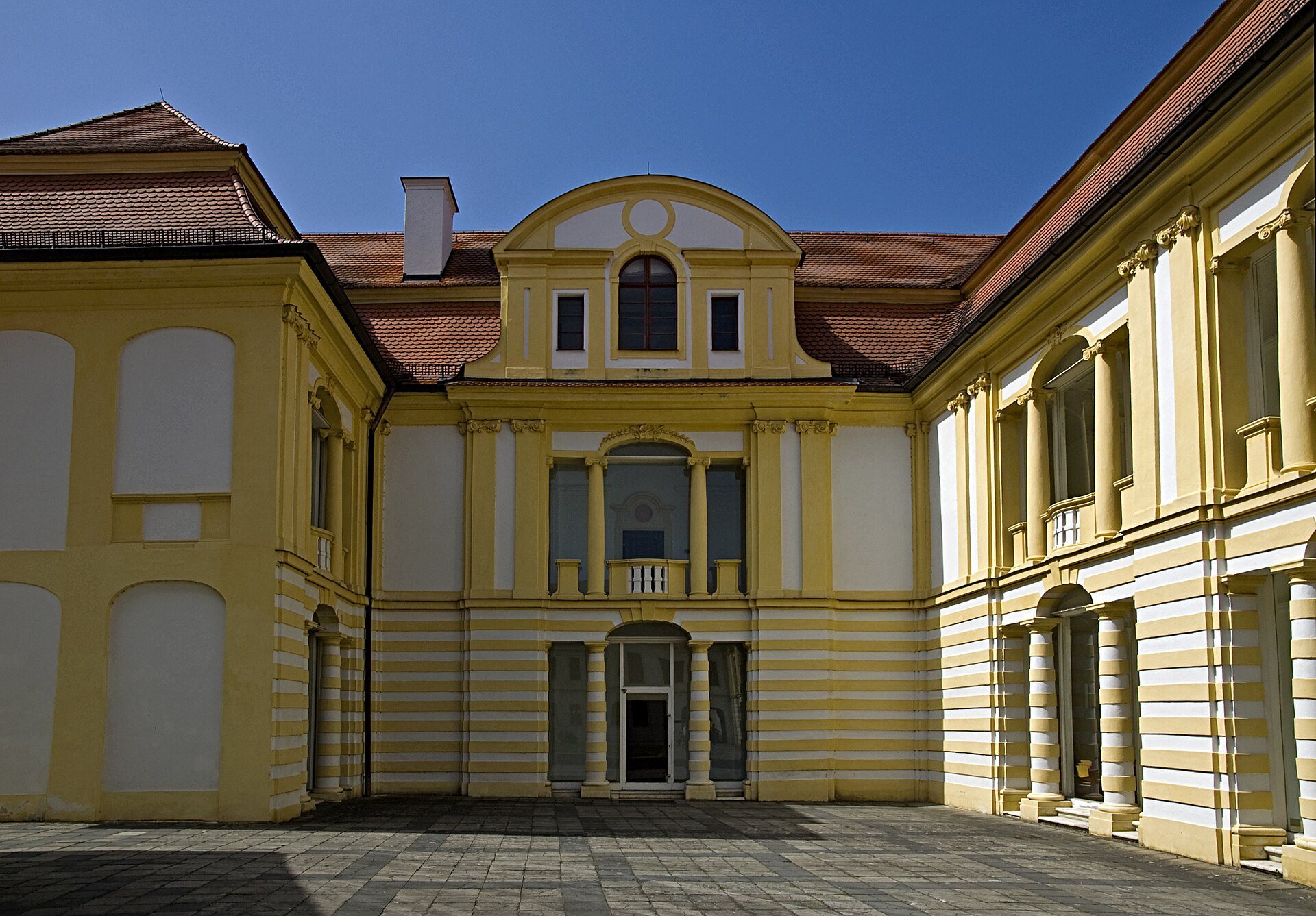
The former prelature, the residence and administrative area associated with the senior cleric heading the foundation, has a representative Rococo facade dating from around 1730. Inside is a festival hall from 1731 decorated with stucco and frescoes. Behind the church, the Gabrielihof courtyard has arcades.
Educational buildings and wider setting
The eastern part of the complex is occupied by a school extension. A new dining hall was built in the courtyard in 2013, and a triple sports hall was completed in 2017. The open spaces were redesigned between 2012 and 2016. The flood footbridge crosses the meadow between the former monastery and the eastern Altmühl slope, and the railway branch line, in use since 1885 and converted to standard gauge in 1932, passes through the same wider setting.