Manwoldae: The Principal Royal Palace of Goryeo in Kaesong
Site at a Glance
- Popularity
- Very Low
- Country
- North Korea
- Primary era
- Medieval
- External website
- Open
- Eras represented
- Medieval
- Civilizations
- Goryeo
- Site type
- Domestic
- Remains
- Palace
On this page10 sections
History
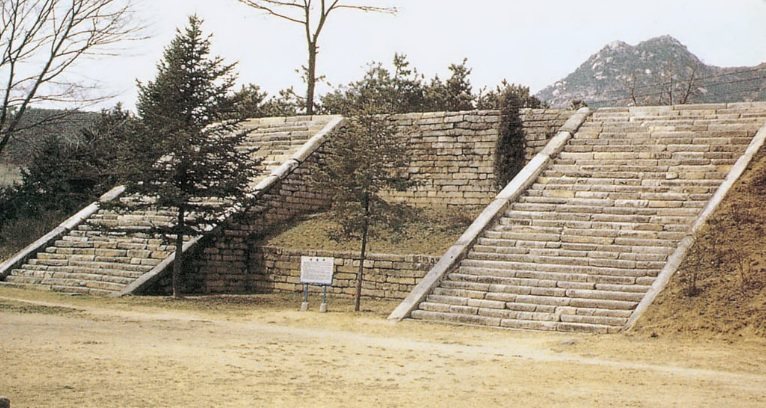
Manwoldae is the ruined principal royal palace of the Goryeo Dynasty in Kaesong, North Korea. Palace construction began in 919, at the beginning of the Goryeo period, when the dynasty made Kaesong its capital. Goryeo ruled Korea from 918 to 1392 and gave the country its modern English name. The palace served as the center of royal life and government, combining the living quarters of the king and royal family with spaces for state affairs.
The Goryeo royal palace
The palace did not have an official formal name comparable to Gyeongbokgung, the principal palace of the later Joseon Dynasty. Because it functioned as an imperial palace, the name Manwoldae, meaning “Full Moon Platform,” was applied to its ruins during the fourteenth or fifteenth century, under Joseon rule. Mangwoldae is an alternative form of the name. Joseon followed Goryeo and governed Korea from 1392 to 1910.
Manwoldae was burned in 1011, 1126, 1171, 1225, and 1361. Its final destruction came during the Red Turban invasion of Kaesong in 1361. The Red Turbans were a rebel movement whose fourteenth-century invasions affected northern China and Korea. Their army sacked Kaesong and forced the Goryeo king to flee temporarily to Andong.
Later memory and archaeological work
Emperor Sunjong, the last emperor of Korea, visited the palace during a journey to Kaesong on 31 January 1909. Excavation later began under the supervision of the North Korean government and developed into an inter-Korean cultural project. Joint excavations started in 2007, and six rounds had taken place by 2015. The work was suspended in December 2011 and resumed in August 2014, with the 2015 campaign planned to continue for six months.
Manwoldae is designated National Treasure No. 122. Together with Kaesong Chomsongdae, it forms part of the UNESCO World Heritage property Historic Monuments and Sites in Kaesong, inscribed in 2013 under criteria (ii) and (iii).
Remains
Palace layout and royal buildings
Manwoldae stood south of Songak Mountain. Its position was probably chosen behind the mountain to express the principles of feng shui, a traditional East Asian system that interprets the relationship between buildings, mountains, water, direction, and auspicious landscape forces. The city walls and roads followed the local topography rather than a symmetrical plan.
Royal and administrative sections
The complex was divided into two principal sections. The Kungsŏng contained the king’s and royal family’s living quarters, while the Hwangsŏng was used for state affairs. Changhwa Hall and Wŏndŏk Hall contained shrines and residential spaces. Hoegyŏng Hall was the largest and most imposing building in the complex and contained the throne room.
Chomsongdae
Chomsongdae was a stone astronomical observatory used by royal astrologers. The ruins of Kaesong’s Chomsongdae stand immediately beside Manwoldae and form part of the same UNESCO World Heritage property. The surviving palace remains are foundations, while contemporary descriptions portray the buildings as exceptionally large, comparable in scale to buildings in China’s Forbidden City.
Decoration and architectural materials
The palace is thought to have followed dancheong, the traditional Korean practice of applying multicolored painted decoration to important wooden buildings. Compared with the surviving palaces of the later Joseon Dynasty, it reportedly included more multistory buildings, greater use of gold ornament, and more blue and white decoration. Comparable excavated tiles from the period support the view that the palace may have had blue celadon roof tiles. Celadon was a glazed ceramic associated with the refined green or blue-green wares produced in Korea during the Goryeo period.
Celadon vessels
Excavation uncovered a 25-centimeter celadon jar decorated with an inlaid monkey and tree design executed in gold underglaze. The National Museum of Korea holds the jar. Another find was a unique vase-like celadon cylinder about two feet high, decorated with peonies and vines. It formerly had openings at both the top and bottom, but its function remains uncertain. Interpretations have included a flowerpot and a vessel used for a ceremonial purpose.
Other excavated objects
Excavations have also produced ceramics, metal objects, ancestral tablets, mirrors, and more than 3,000 roofing tiles. A piece of metal type found in November 2015 was initially dated to the Goryeo period and bears traces of ink. Its date and manufacture remained subject to further study.