St. Mary’s Abbey: A Medieval Cistercian Monastery in Dublin
Site at a Glance
- Rating
- 4.8
- Popularity
- Very Low
- Country
- Ireland
- Primary era
- Medieval
- External website
- Open
- Eras represented
- Medieval
- Civilizations
- Unclassified
- Site type
- Religious
- Remains
- Monastery
On this page9 sections
History
St. Mary’s Abbey was a medieval monastery in Dublin, Ireland, traditionally founded in 846 by the Irish king Máel Sechnaill mac Máele Ruanaid. Originally Benedictine, it was refounded in 1139 as Ireland’s first Savignian monastery. The Savignian congregation, a monastic community founded at Savigny in Normandy, joined the Cistercian Order in 1147, and St. Mary’s then became a Cistercian abbey. It developed into one of Ireland’s largest and wealthiest monasteries and was described in the later Middle Ages as the richest Irish Cistercian abbey.
Foundation and Cistercian Affiliation
St. Mary’s successively depended on the mother houses of Savigny, Combermere, and Buildwas, while its wider Cistercian connection was linked to Clairvaux. Its principal daughter houses were Dunbrody, founded in 1171, and Abbeylara, founded in 1214. The abbey was repeatedly drawn into disputes with Mellifont over which institution should be regarded as Ireland’s first Cistercian foundation. In 1313, the Cistercian General Chapter, the order’s central governing assembly, formally described St. Mary’s as the first Irish Cistercian foundation.
Medieval Wealth and Conflict
During the Middle Ages, the abbey was involved in Dublin’s commercial and jurisdictional affairs. Its farms had direct access to Dublin markets, while its extensive liberties included rights connected with the recovery of goods from shipwrecks along the County Dublin coast. The abbey also administered lands in territories controlled by the “hostile Irish,” a contemporary English description for areas outside English control. These economic and jurisdictional privileges helped make St. Mary’s a major institutional power.
A major fire in 1303 or 1304 destroyed much of the abbey and church, including the cloister buildings and bell tower. The rebuilding that followed enlarged the monastery. The fire also destroyed city records and pleadings from the Chancery court that had been stored in the abbey. In 1316, Robert de Nottingham, then Mayor of Dublin, attacked the monastery while Richard Óg de Burgh, Earl of Ulster, was visiting. The monks were suspected of supporting Edward Bruce, and the abbey was laid waste.
Walter Champfleur led St. Mary’s from 1467 for more than thirty years. He was an adviser to Thomas Butler, 7th Earl of Ormond, and briefly served as Keeper of the Great Seal of Ireland in 1482 and 1483. This office involved custody of the seal used to authenticate government instruments. Within the Cistercian Order, Champfleur was remembered as an aged, prudent, and learned abbot who attempted, without success, to reform Irish Cistercian discipline.
Rebellion and Dissolution
On 11 June 1534, Thomas FitzGerald, known as Silken Thomas, began his rebellion against Henry VIII in the abbey’s Chapter House. During a meeting of the Privy Council, he threw down his Sword of State, openly declaring his defiance. FitzGerald was an Anglo-Irish nobleman whose revolt challenged Henry VIII’s authority in Ireland.
The abbey was dissolved in 1539, when Abbot William Laundie relinquished his office. The sale of its movable and landed property raised 192 pounds. The church was later given to John Travers, who used it as an arsenal and as a source of building stone. Much of the monastic land was sold or leased for residences and businesses, and parts of the complex were assigned or leased to other proprietors, including James Fitzgerald.
Later Transformation and Rediscovery
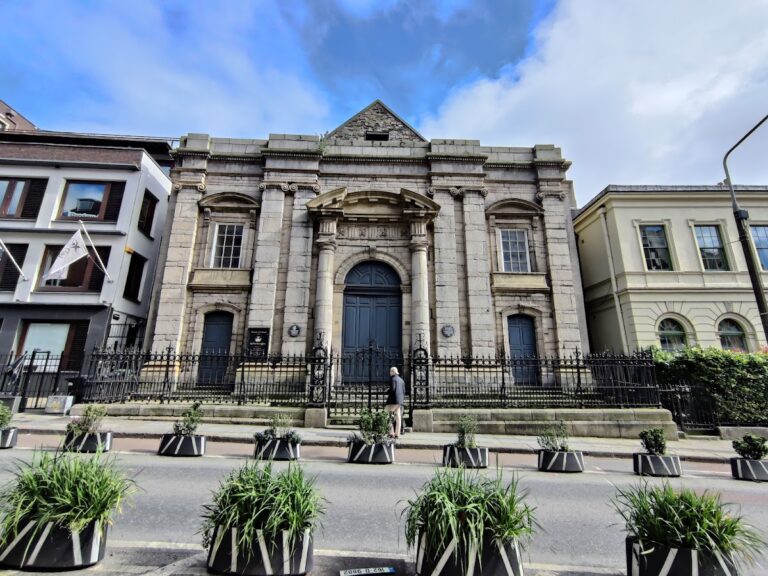
The former abbey lands continued to change after the Dissolution. The Moore family used the site as a Dublin residence during the seventeenth century. Parts of the former monastic property later contained nonconformist chapels, including one associated with the Burghers and another associated with the Seceders, or Non-Burghers. From 1836 to 1892, a synagogue occupied part of the site. Former abbey lands at Glasnevin were acquired around 1832 for what became Glasnevin Cemetery.
Stone from the ruins was used in 1676 to build Essex Bridge, now called Grattan Bridge. By about 1680, most of the abbey had disappeared or had fallen into ruin during the redevelopment of Dublin’s north bank. The Chapter House survived because its surroundings were buried beneath about two metres of rubble. It was later concealed beneath a bakery and used for storing potatoes and grain before being rediscovered in 1880.
The Office of Public Works assumed responsibility for the Chapter House in 1940 and carried out conservation work. It was declared a National Monument in 1941 and remains a protected National Monument managed by Heritage Ireland. In 2023, excavation connected with hotel construction uncovered the remains of more than 100 skeletons dating to the early eleventh century. A manuscript produced at the abbey in 1304 was acquired by Trinity College Dublin in 2014.
Remains
The Monastic Precinct
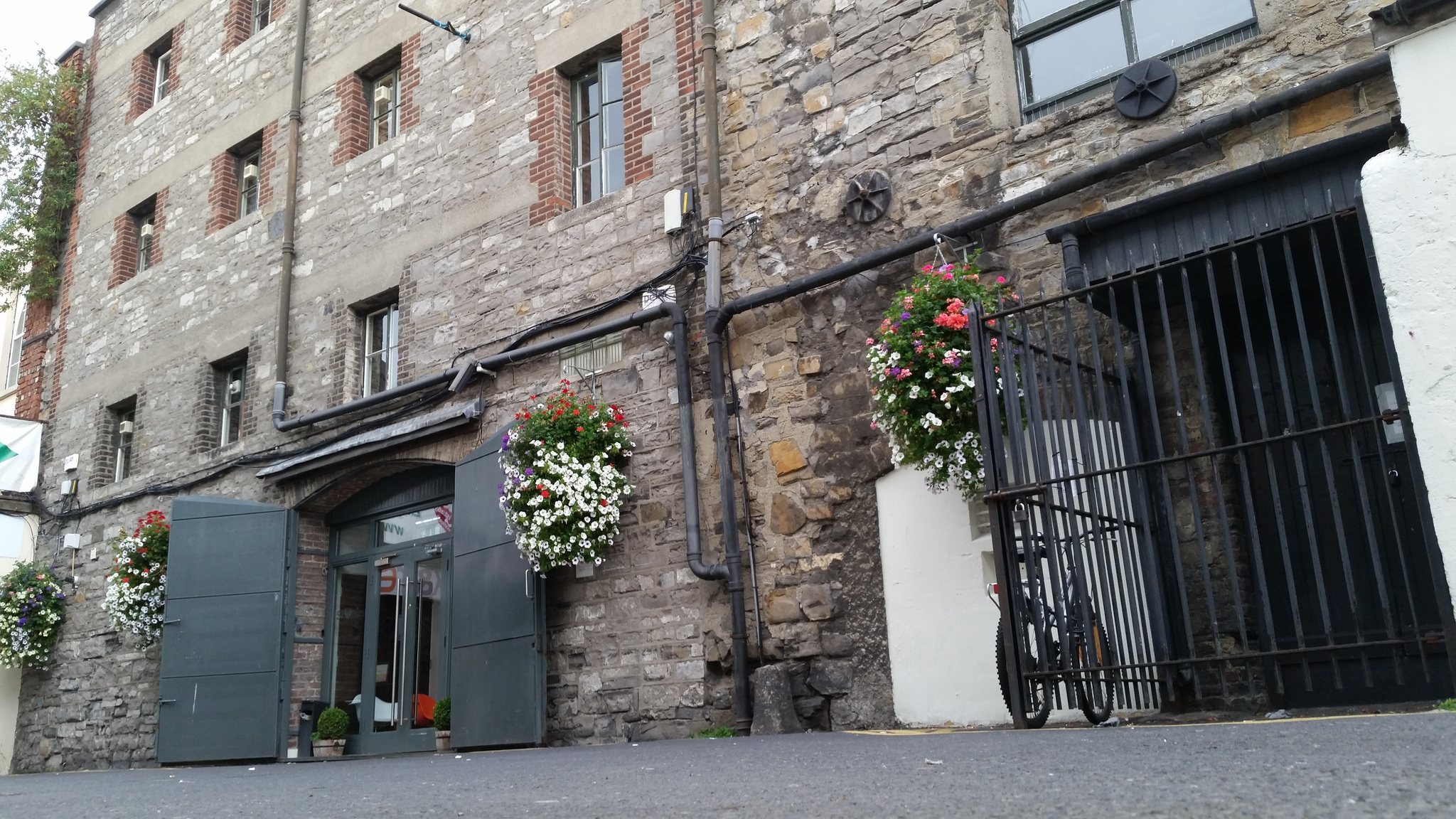
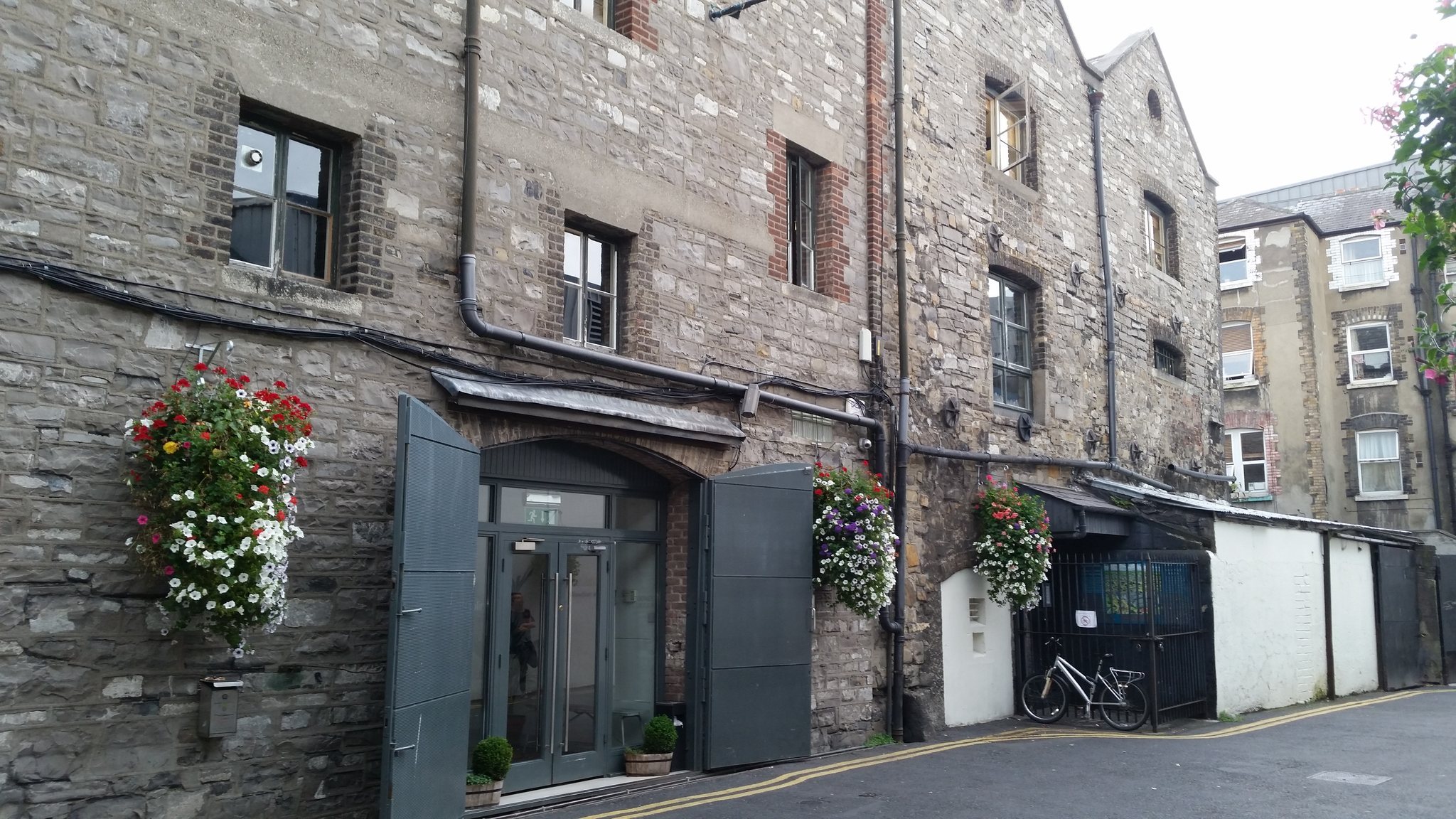
St. Mary’s Abbey stood on the north bank of the River Liffey, outside the walls of medieval Dublin and opposite the old city. Its territory extended from Oxmantown along the Liffey towards the sea. The monastic precinct roughly occupied the block bounded by Capel Street, Mary’s Lane, Arran Street East, and the street now called Mary’s Abbey. The original complex is almost entirely destroyed, although portions of adjoining walls survive.
The Chapter House
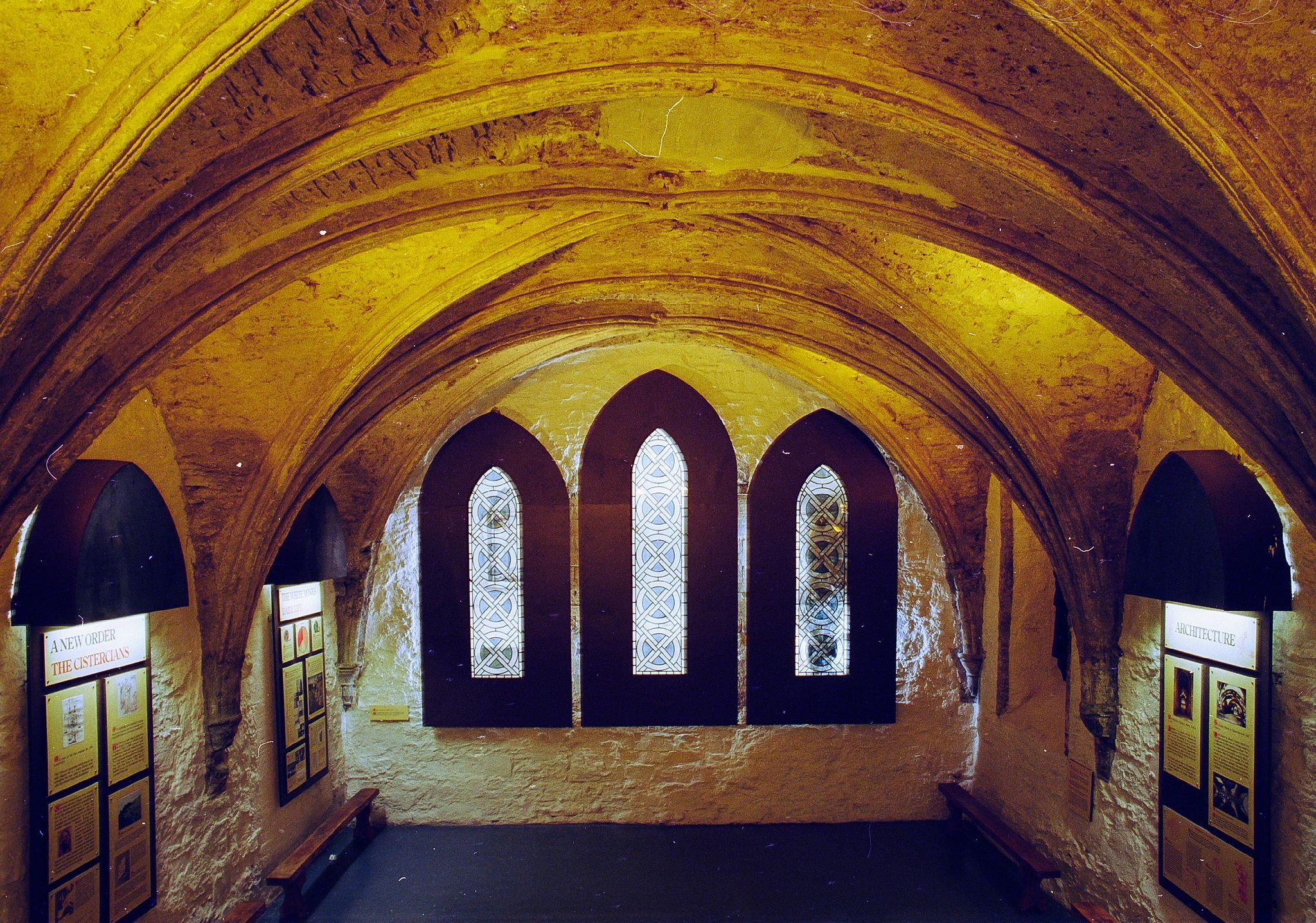
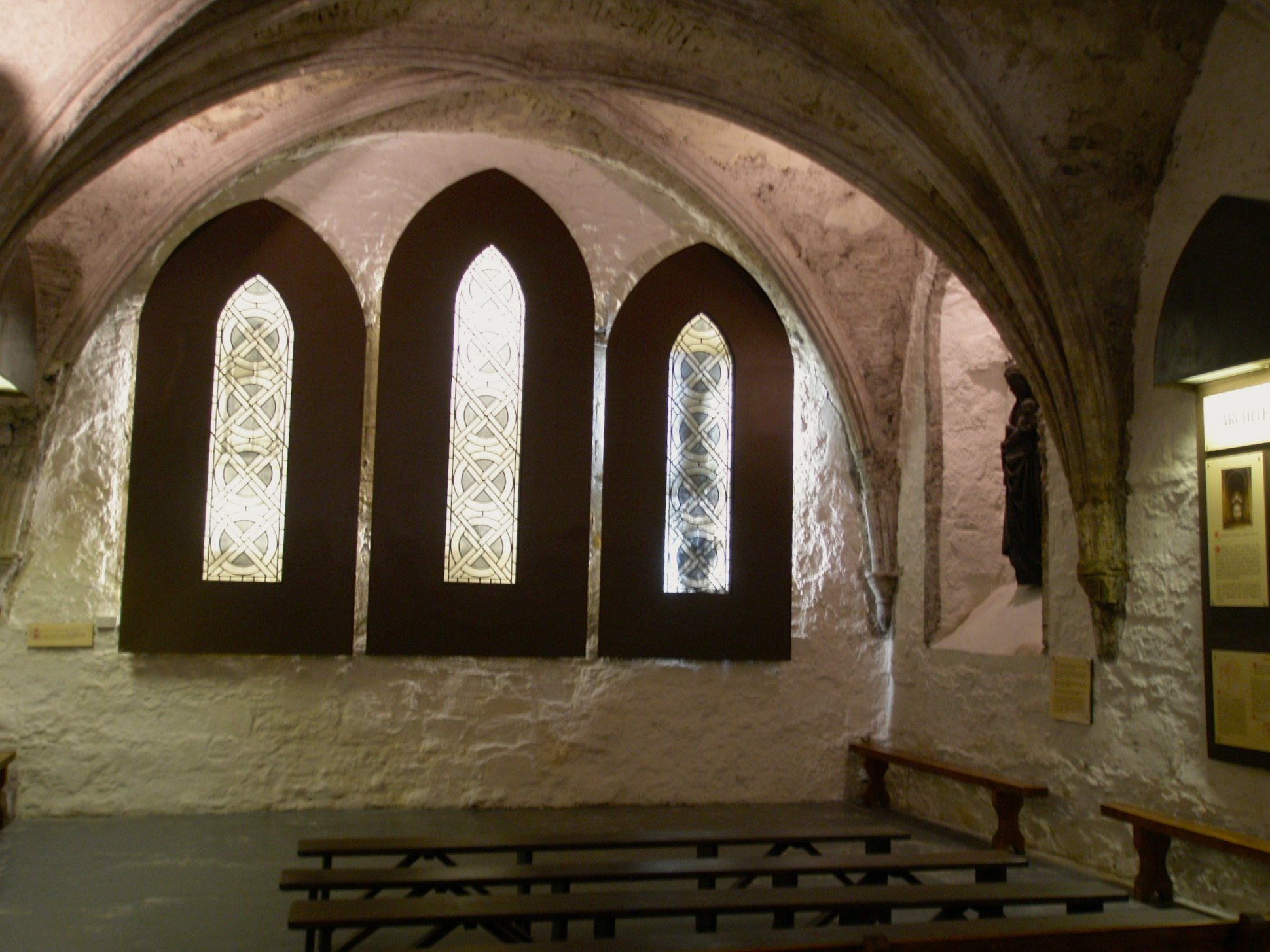
The Chapter House is the only substantially intact surviving part of the original abbey. A chapter house was the room where a monastic community met for administrative business, disciplinary matters, and the reading of its rules. Built of sandstone, the room has three lancet windows and a cross-ribbed vault. Lancet windows are narrow openings with pointed arches, while a cross-ribbed vault is a ceiling supported by intersecting stone ribs. The entrance from Meetinghouse Lane is reached by a stone staircase, and interpretive panels inside explain the abbey’s history.
The building’s survival resulted from the burial of its surroundings beneath rubble during the late seventeenth-century redevelopment. Its later concealment beneath a bakery and use as a storage space helped preserve the structure until its rediscovery in 1880. Conservation work followed after the Office of Public Works took responsibility for it in 1940.
Associated Objects and Later Buildings
An oak statue of the Virgin associated with St. Mary’s Abbey survives in the Carmelite church on Whitefriar Street. Before Father Spratt identified and moved it in 1835, the statue had been reused as a pig trough. Parts of the former abbey site were also occupied by two nonconformist chapels. The former Union Chapel later housed a synagogue at 12 Mary’s Abbey, before the congregation moved to Adelaide Road in 1892.