Franciscan Monastery in Sanok: A Historic Monastic and Parish Complex in Poland
Site at a Glance
- Rating
- 4.8
- Popularity
- Low
- Country
- Poland
- Primary era
- Early Modern
- External website
- Open
- Eras represented
- Medieval, Early Modern, Modern
- Civilizations
- Austria-Hungary, Habsburg, Hungarian, Kingdom of Poland, Polish–Lithuanian Commonwealth
- Site type
- Religious
- Remains
- Monastery
On this page17 sections
History
The Franciscan Monastery in Sanok, Poland, is a Roman Catholic monastic and parish complex founded during the late fourteenth century under the patronage of Duke Władysław II of Opole. Its first church was built in 1372–1376, and the Franciscan presence was formally established by a privilege dated 27 February 1377. The church and monastery became an enduring center of worship and religious life in Sanok, later serving as a parish church, a place of noble assemblies, and a site of education and charitable activity.
Foundation and relocation inside the city
Władysław II, then governor of Red Ruthenia, instructed the Archbishop of Lviv, Maciej, and Sanok’s burgrave, also named Maciej, to provide the Franciscans with a manor and construct a church outside the city walls. The original wooden church was dedicated to the Virgin Mary and served by Minorites brought from Lviv. Eryk of Winsen organized the church and the surrounding diocese.
In 1384, Princess Elizabeth, sister of Casimir III the Great and mother of Louis I of Hungary, authorized the friars to move inside Sanok. She donated land for the new foundation, which was enlarged with additional urban plots. The Franciscans erected another wooden church and monastery, with a masonry sacristy, and dedicated the church to the Finding of the Holy Cross. Documents confirming the foundation and donation are dated 5 July 1384.
Queen Elizabeth of Bosnia ordered Sanok’s starosta, council, and townspeople to protect the friars when the rector of Saint Michael’s Church attempted to take possession of the monastery. In 1387, the cleric and public notary Chartman Ghyr reconfirmed the foundation documents at Krosno in the presence of Bishop Eryk of Winsen.
Fires and the formation of the present complex
Sanok suffered major fires in 1457, 1470, 1514, and 1566. The Franciscan church survived the fire of 1566, but a fire attributed to Tatar forces destroyed it in 1604. Reconstruction was completed in 1606 through the efforts of Sanok chamberlain Piotr II Bal, producing a single-nave masonry church in the Baroque style. The dedication later changed from the Finding of the Holy Cross to the Exaltation of the Holy Cross.
The monastery hosted the noble assemblies of the Sanok Land in 1612. Another fire in 1632 damaged both church and monastery, which were rebuilt in quarried stone between 1632 and 1640. The year 1640 marks the basic form of the surviving complex. Wooden monastery buildings were gradually replaced with masonry construction from 1717. Further wings were built between 1722 and 1747 and again between 1758 and 1775. Fires also affected the complex in 1676 and 1743, while the Brotherhood of Saint Ivo was established there in 1766. A transverse monastery wing was added in 1790.
Parish, imperial, and nineteenth-century changes
After Saint Michael the Archangel Parish Church burned on 30 September 1782, the Franciscan church served as Sanok’s parish church until 19 December 1886. The parish was transferred to the Franciscan church, although its administration did not formally pass to the friars. During this period, the monastery guardians also acted as parish priests. The Parish of the Transfiguration was established in 1886.
Under the imperial authorities of Joseph II, part of the monastery was converted into a detention facility and district court because Sanok lacked a prison. Some church property was confiscated. Emperor Franz Joseph I attended Mass in the church on 1 November 1851 during his journey through Galicia and Bukovina.
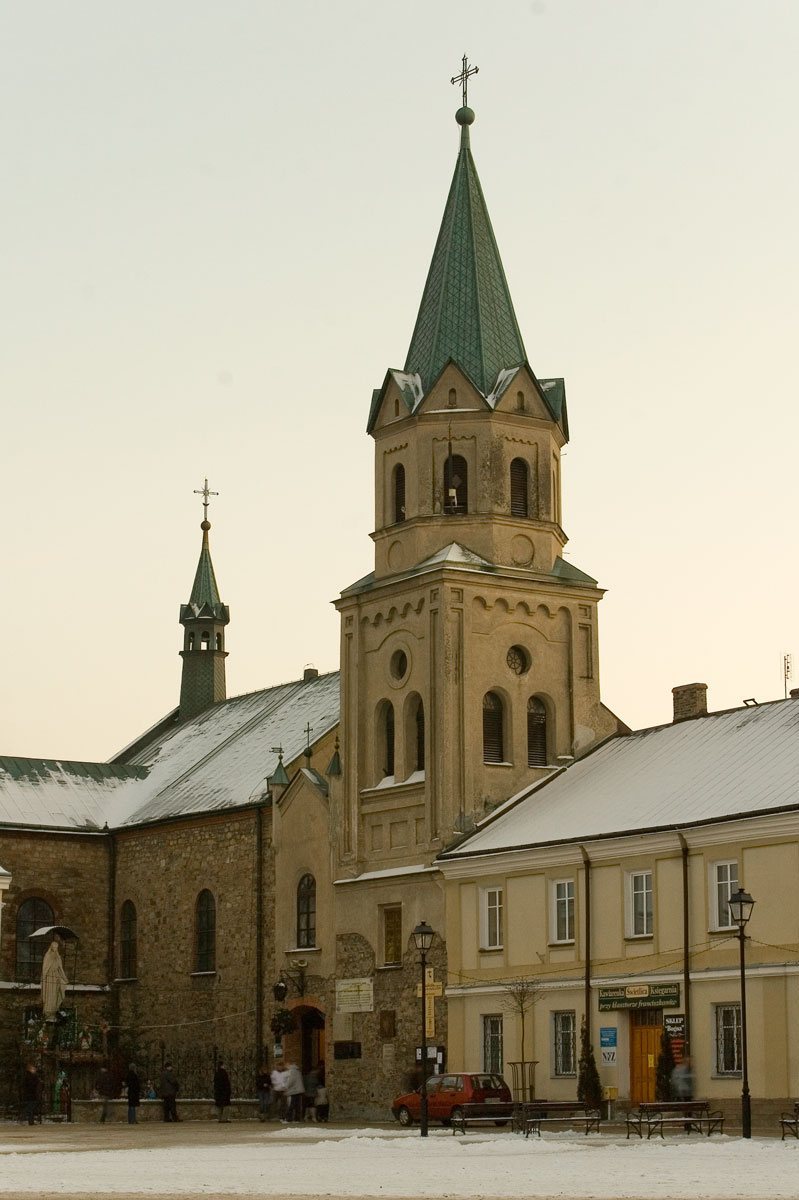
A devastating fire on the night of 9–10 May 1872 damaged the church and destroyed almost one-third of Sanok. The vaults and roof were rebuilt, but the alterations reduced the building’s Baroque character. Restoration was completed in 1886, with a lowered vault, altered windows, and a new entrance to a chapel. The damaged tower was reconstructed by autumn 1895 to a design by Władysław Beksiński, with Karol Gerardis as contractor. It was almost doubled in height, a sanctus turret was added in 1896, and two further tower levels and a new tower roof were introduced in 1905.
Leon Piniński, governor of the Kingdom of Galicia and Lodomeria, visited the monastery in 1900. A landslide affected the hill beneath the church on 18 May 1914, and the chapels were heightened in 1920. Between 1935 and 1939, Władysław Lisowski painted the church’s interior polychrome decoration, including scenes of Saint Francis sending friars into the world, the Virgin Mary receiving homage from people of different social classes, and the Finding of the Holy Cross. Local residents and clergy appear among the painted figures, including Lisowski, Antoni Jędrzejowski, Father Teofil Bazan, Mayor Maksymilian Słuszkiewicz, and members of the Nehring and Borczyk families.
Education, occupation, and communist-era restrictions
During the Second Polish Republic, the monastery housed a Minor Franciscan Seminary from 1921 to 1923 and a soup kitchen from about 1920. Until the early 1930s, the Sanok convent belonged to the Franciscan province in Lviv. It was then transferred to the Franciscan Province of Saint Anthony of Padua and Blessed James of Strepa of the Order of Friars Minor Conventual in Krakow.
During the German occupation and for about a year after the Second World War, the monastery housed the Polish Public Commercial School. The eastern front passed through the area in 1944 and damaged the complex’s roofing, which was later repaired by Kazimierz Niemiec. On 3 October 1946, the Sanok guardian was arrested and taken to Rzeszow for allegedly allowing meetings of the underground Home Army at the monastery. He was released after four days and left Sanok in November. The postwar communist authorities also confiscated the friars’ fuel allowance.
A further Minor Franciscan Seminary was established in 1945. From 1950, its students were barred from continuing their education in the state school, and the communist authorities closed the seminary on 3 July 1952. Part of the monastery used by the seminary was seized and later recovered by the Franciscans.
In 1950, the state nationalized the Franciscans’ 34-hectare farm at 10 Zagrody Street, leaving the order approximately 2 hectares. The state purchased part of the remaining land in 1973 for a secondary school, where Franciscans served as catechists until 1984. A public chapel on the remaining land later became the Chapel of Saint Maximilian Maria Kolbe and was transferred to the Diocese of Przemysl in 1984.
Religious renewal and conservation
In 1954, the restored icon of Our Lady of Grace was transferred from the nearby Greek Catholic cathedral to the Franciscan church and ceremonially consecrated. Its history in Sanok is associated with a tradition that Count Krzysztof Tarnawski brought it from the Moscow region in 1596. On 3 May 1956, the church received the additional title of Our Lady of Consolation, and the second Sunday of May became its indulgence feast.
Bishop Ignacy Tokarczuk re-established the parish of the Exaltation of the Holy Cross and Our Lady of Consolation under Franciscan administration on 1 July 1969. In 2005, Archbishop Józef Michalik established the church as the Sanctuary of Our Lady of Consolation, Lady of the Sanok Land. A sanctuary is a church formally recognized as a place of particular religious devotion, often associated with a revered image.
Lisowski restored the altars in 1946, 1961, and 1962. The church, monastery, mid-nineteenth-century barn with its stone and wooden treadmill, and eighteenth- or nineteenth-century masonry enclosure entered Sanok’s monument register in 1972. The complex had already been listed in the provincial register in 1967 and is also included in the municipal register. A historic-status plaque was placed on the facade in 1978.
A church fire on 6 January 1976 was extinguished before causing major destruction. The six-hundredth anniversary of the Franciscans’ arrival in Sanok was commemorated with a solemn Mass in 1977, and copper sheeting was installed on the church and monastery roofs during the 1980s. Archaeological and conservation work in 1998–1999 uncovered a medieval cemetery and fourteenth-century walls. Renovation continued from 2000 to 2003, including work on the altars and images of Saint Anthony of Padua and Our Lady of Consolation. Structural stabilization of the escarpment beneath the complex began in 2019 because of numerous cracks in the buildings.
The monastery remains a Franciscan parish seat administered by the Krakow province of the Order of Friars Minor Conventual. Saint Zygmunt Gorazdowski was baptized in the church on 9 November 1845. Cardinal Karol Wojtyła concelebrated Mass there on 1 April 1966, while Cardinal Józef Glemp took part in the 1996 celebrations marking four centuries of the cult of Our Lady of Consolation. The complex also contains a tomb for Sanok’s Franciscan friars in the Central Cemetery.
Remains
Church and exterior form
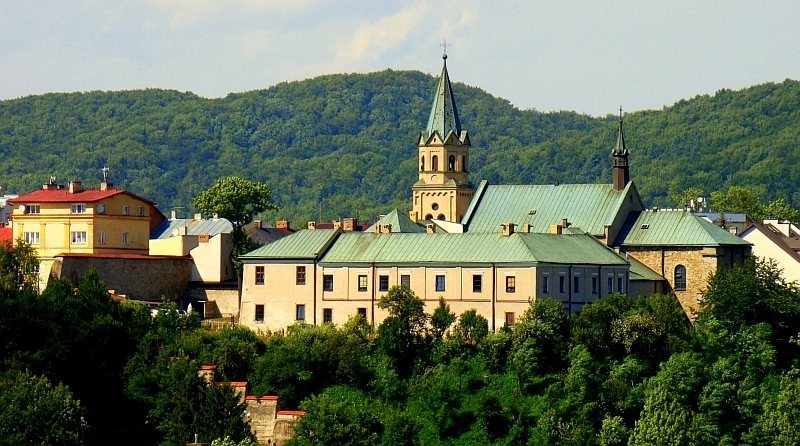
The complex stands on a steep escarpment rising from Podgórze Street in the western part of Sanok’s Błonie district. The church adjoins the monastery on its northern side, while the monastery extends south of it. The main entrance opens toward the southeastern corner of the Market Square. The east-facing church has a rectangular chancel, a main nave, and two side chapels, producing a plan broadly resembling a Latin cross. Its windows have semicircular tops, and crypts lie beneath the church and chapels.
The church is built principally of stone and presents a Romanesque Revival appearance resulting from nineteenth-century rebuilding. Romanesque Revival architecture uses forms inspired by medieval Romanesque buildings. The lower part of the tower is made of quarried stone, while its two upper levels are brick. The earlier dome and Baroque roof were replaced after the 1872 fire. In 1976–1977, plaster was removed from the tower and Market Square facade, leaving the lower stonework exposed while the upper sections were replastered.
Monastery buildings and chapels
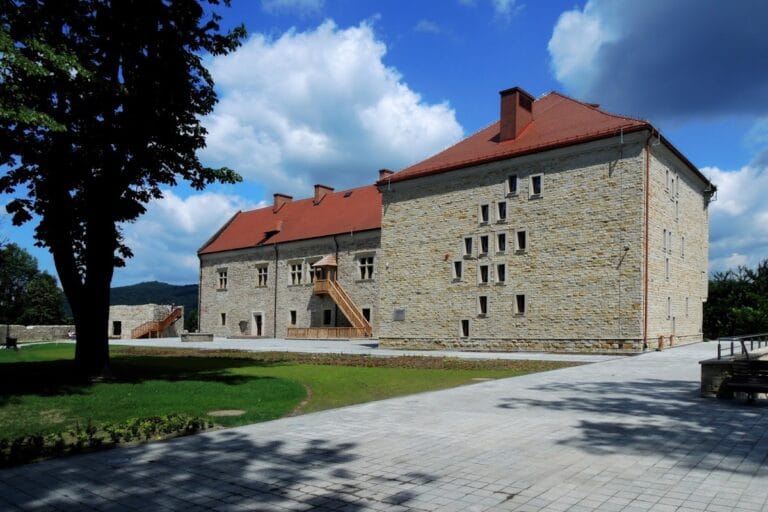
The monastery originally had three wings arranged around one garden and now has two gardens. Since the nineteenth-century reconstruction, it has had a single upper story. Cross-vaulted cloisters on the ground floor lead from the garden to the church porch, sacristy, and chancel, creating a circulation route around the complex. The monastery includes a southern-wing refectory, a monastic chapel, a library, and the sacristy. The sacristy was renovated in 1900–1901, painted by Father Cyryl Sadowski, and repainted in 1970 by Tadeusz Turkowski and Kazimierz Florek.
Saint Francis of Assisi Chapel
The southern Saint Francis of Assisi Chapel adjoins the sacristy on the right side of the nave. Józef Kopaczek renovated it in 1935, and Władysław Lisowski painted its polychromes in 1935–1936. The scenes show Saint Kinga and Bolesław the Chaste entering the Third Franciscan Order, Saint Anthony giving alms to the poor, and Saint Francis preaching to birds. Restoration begun in 1999 uncovered original Baroque decoration from the late seventeenth or early eighteenth century, and the restored chapel was dedicated on 4 October 1999.
Saint Maximilian Kolbe Chapel
The northern Saint Maximilian Kolbe Chapel was formerly associated with Our Lady of Consolation, Saint Joseph, and Our Lady of the Rosary. It was renovated in 1908, when its interior was plastered and its brick exterior replaced with stone, and again in 1935–1936. Its altar, with alabaster columns and a design by Lisowski, was completed by 1937. Bronisław Naczas painted the image of Saint Maximilian Kolbe in 1971, and the chapel was renovated again by July 2004.
Saint Zygmunt Gorazdowski Chapel
The eastern cloister contains the Saint Zygmunt Gorazdowski Chapel, also called the Rylski Chapel or Garden Chapel. The Rylski family funded it, and it was renovated in 1901, reconstructed in 1977, and undergoing polychrome restoration in 2012. A crucifix from the early eighteenth century is preserved in this chapel.
Altars, paintings, and liturgical furnishings
Main altar and chancel
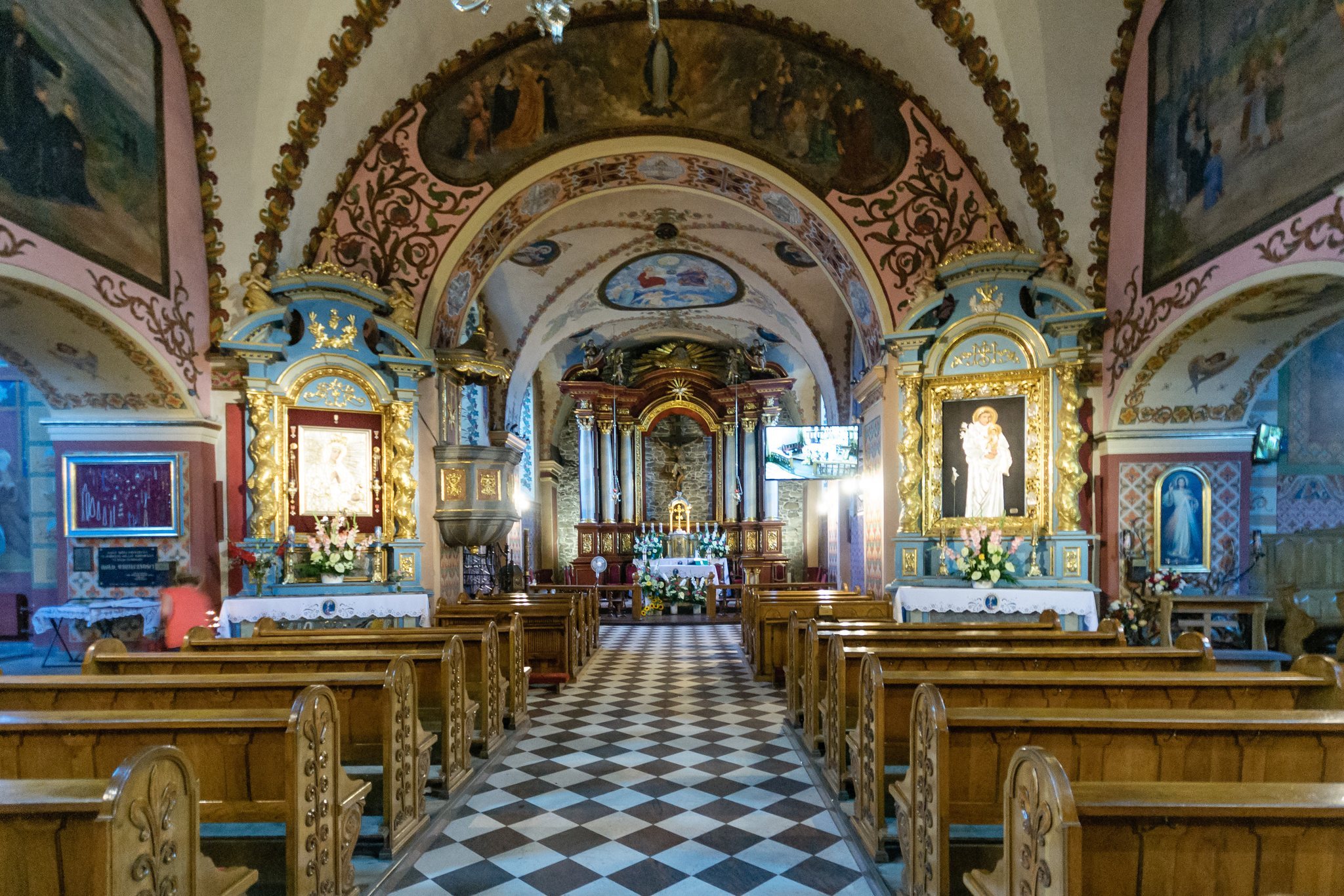
The present main altar was rebuilt after the 1872 fire in 1887 to a design by Ferdynand Majerski of Przemysl. Six columns support its composition, which includes a late-Baroque crucifix associated with cult and votive offerings as early as 1694, a dove representing the Holy Spirit, and a depiction of God the Father in glory. Statues of Saint Bonaventure and Thomas Aquinas, made by Majerski in 1887, stand at the sides, while four angels occupy the pillar capitals. The altar was painted to resemble red marble in the late nineteenth century.
The ceiling above the altar depicts the Holy Trinity and the four Evangelists. Their symbols appear in the chancel polychromes: Matthew is represented by a human head, Luke by an ox, Mark by a lion, and John by an eagle. The arch toward the altar displays the Sanok coat of arms, the Holy Spirit, and the Polish Eagle. The arch toward the nave depicts the Immaculate Virgin Mary alongside figures including Father Teofil Bazan and Antoni Borczyk.
A wooden baptismal font made by Jan Penar in 1996 stands in the chancel. Artur Olechniewicz designed its decoration and polychromes, which represent Franciscan and Sanok-associated figures including Francis and Clare of Assisi, Maximilian Kolbe, Blessed James of Strepa, Saint Zygmunt Gorazdowski, and the martyrs Fathers Michal Tomaszek and Zbigniew Strzalkowski.
Pulpit, choir, and seating
The original pulpit stood on the right side of the chancel and was moved to the left in 1887. The present pulpit was made by Majerski in 1889 and has two angel figures on its canopy. Józef Nowak funded its stairs in 1897, together with a nearby wooden choir stall. Two stalls were moved to the Saint Francis Chapel in 1977. The wooden choir loft dates from 1888 and was made by Majerski, while the historic organ was made in the same year by Jan Śliwiński. Since late 2005, the tower has contained an eight-bell carillon, a coordinated set of bells played melodically, weighing 250 kilograms in total.
Side altars and sacred images
The right-hand side altar contains a painting of Saint Anthony of Padua known from the seventeenth century. Its twisted columns have leaf and grape decoration and are topped by angels. Lisowski repainted the altar in a rosewood color in 1937. The image shows Saint Anthony holding three lilies and the Christ Child, while the shutter contains a Sacred Heart of Jesus painted by Tabiński of Rzeszow in 1888.
The left-hand side altar contains an image of Our Lady of Consolation from around 1700. The oil painting on canvas shows the Virgin and Child and is covered by a golden robe. The Byzantine icon of Our Lady of Grace was transferred to the church in 1954 and is associated with the tradition of its arrival in Sanok in 1596.
The nave polychromes show Saint Francis receiving the Portiuncula indulgence from Jesus and the Virgin Mary, as well as the Finding of the Holy Cross near the choir. Other figures include Francis of Assisi, Blessed James of Strepa, Louis of France, Clare, Blessed Salomea, and Elizabeth. The church also contains an eighteenth-century wooden statue of the Virgin and Child, an early nineteenth-century classicist umbraculum, and a painting of Saint Joseph by Genowefa Stepek from 1964.
Other furnishings include a painting of Saint Valentine by Lisowski dated 1927, Stations of the Cross made in 1938 by the Saint Adalbert Works in Poznan, four wooden confessionals from 1906, and fourteen eighteenth-century paintings of the Passion of Christ in the cloisters. The porch doors, made by Stanislaw Piątkiewicz in 1898, bear reliefs of Francis of Assisi, Anthony of Padua, Franciscan emblems, and angels. The porch also contains a figure of Anthony with the Christ Child and a 1927 painting of Saint Therese of Lisieux by Antoni Zientkiewicz.
Memorials, inscriptions, and archaeological remains
The monastery contains a portrait of Elizabeth of Poland donated in 1882 and a stone plaque from 1847 commemorating the monastery’s foundation and the construction of its upper story. Other memorials include a plaque recording the solemn reburial of bones in 1758, the epitaph of Maria Amalia Mniszech, a late-Baroque black-marble epitaph for Jan Ignacy Lewicki and Marcjanna Tarnawiecka, and the epitaph of Father Hieronim Konopka near the church crypt.
A plaque commemorating the 1569 Union of Lublin was installed in 1869 and moved to the church’s front wall in 1893. Further memorials include an epitaph for Kazimierz Wiktor made in 1908, a plaque commemorating the 966–1966 millennium, and plaques marking the 1996 four-hundredth anniversary of the cult of Our Lady of Consolation. A plaque identifies the church as the Sanctuary of Our Lady of Consolation, Lady of the Sanok Land.
In the garden beside the townhouse at 18 Market Square stands a statue of the Immaculate Virgin Mary made by Edward Kość of Jasło. Its inscription commemorates six hundred years of the Franciscans in Sanok in 1977, and the statue was repainted in 2012. Its pedestal belonged to an earlier statue of Christ made in 1898 by Stanislaw Piątkiewicz from cement and hydraulic lime, modeled on Bertel Thorvaldsen’s Christ. Archaeological work around the church complex uncovered a medieval cemetery and fourteenth-century walls. The church and monastery remain on an unstable escarpment, where stabilization work begun in 2019 addressed cracking in the buildings.