Sanok Castle: A Medieval Royal Residence in Poland



Site at a Glance
- Rating
- 4.7
- Popularity
- Medium
- Country
- Poland
- Primary era
- Medieval
- External website
- Open
- Eras represented
- Medieval, Early Modern, Modern
- Civilizations
- German, Habsburg, Kingdom of Poland, Polish–Lithuanian Commonwealth
- Site type
- Military
- Remains
- Castle
On this page17 sections
History
Sanok Castle is a medieval royal residence in Poland, rebuilt as a Renaissance royal complex in the sixteenth century on a hill above the San River. Its history reaches back to an early medieval defensive stronghold and reflects Sanok’s changing political, legal, military, and cultural roles.
Early Stronghold and Royal Castle
The earliest recorded reference to Sanok dates from 1150, when the Ruthenian Hypatian Codex described King Géza II of Hungary’s campaign in Ruthenia and the capture of Sanok and Przemyśl. Archaeological investigations have confirmed an early medieval defensive stronghold on the northern side of the castle hill. This earlier settlement was destroyed during the Tatar invasion of 1241.
Sanok was fortified again in the fourteenth century, after the recovery of Red Ruthenia by the Polish crown. A new defensive castle or royal palace was built on the hilltop, probably under Casimir III the Great, the fourteenth-century Polish king whose reign included the consolidation and fortification of these territories. The complex was enclosed by defensive walls and is generally dated to the fourteenth century.
Sanok received Magdeburg town law in 1339 from the Piast duke Bolesław Jerzy Trojdenowicz. Magdeburg law was a medieval system of municipal government and justice used widely in Central and Eastern Europe. Casimir III visited the castle three times during his reign. Władysław of Opole, a Silesian Piast prince and political official, also stayed there repeatedly and founded Sanok’s Franciscan monastery.
Royal Residence and Administrative Centre
During the reign of Władysław II Jagiełło, the castle hosted the wedding feast for his marriage to Elizabeth Granowska on 2 May 1417. From Jagiełło’s reign onward, it served as a royal dower residence for royal wives. Queen Sophia of Halshany lived there until her death in 1461.
From the early fifteenth century to the middle of the sixteenth century, the castle accommodated the Sanok district office and several courts. These included the district, land, and higher courts operating under Magdeburg law. The starosta, a royal or state official responsible for administering a district, and the castellans of Sanok also exercised their offices there. In 1425, the Higher Court of German Law was established at the castle.
The Gothic castle was rebuilt in Renaissance style between 1523 and 1548 at the order of Queen Bona Sforza, the Italian-born queen of Poland and wife of Sigismund I the Old. Marshal Mikołaj Wolski directed the work. During this period, the Orthodox Church of Saint Demetrius, recorded in 1435, was demolished. Archaeologists later found the remains of its cemetery.
Queen Isabella Jagiellon of Hungary lived at Sanok Castle from 1555 to 1556 after fleeing Transylvania. The complex was enlarged again at the end of the sixteenth century and around the turn of the seventeenth and eighteenth centuries. In the second half of the seventeenth century, it belonged to the Sanok starosty.
War, Partition, and Nineteenth-Century Administration
The castle’s last recorded defense took place in 1809 during the Napoleonic Wars, the conflicts that followed Napoleon’s expansion across Europe. Franciszek Ksawery Krasicki used a ruse to stop advancing Austrian troops. During the period when Poland was divided among neighboring powers, the castle housed the Sanok district office and later the office of the Sanok county starosty.
Emperor Franz Joseph I visited Sanok on 31 October and 1 November 1851. A commemorative plaque for the visit was placed on the castle in 1908. During the nineteenth century, the castle carried the city’s building number 1 because Sanok’s numbering began there.
War Damage and the Museum
During the Russian occupation of Sanok in the First World War, Russian-appointed city administrator Rodionov briefly occupied rooms in December 1914, followed by his successor Popov in early 1915. Russian troops burned the southern wing in 1915, and the remaining ruins were later dismantled.
In the interwar period, the castle was rebuilt and became the home of the Museum of the Sanok Region, founded in 1934 by the Society of Friends of the Sanok Region. Its early collections concerned the region, weapons, Sanok and its castle, furniture, and craft objects. The building also accommodated the County Road Administration, the County School Council, and the residence of the Sanok starosta. In May 1933, Bishop Gregory Lakota, appointed ordinary bishop of the Lemko diocese newly established in Sanok, received offices there. From 1934, historian Adam Fastnacht conducted research on the Sanok region in connection with the museum.
The castle was looted in September 1939. During the German occupation it housed a Lemko Museum. Until June 1941, the castle stood opposite the Molotov Line, a Soviet frontier fortification system built before Germany invaded the Soviet Union. German forces incorporated the castle hill into the Galician Border Position, part of the frontier defenses of the General Government, the German occupation administration established in central and southeastern Poland. Two German shelters were installed beneath the courtyard in 1940 and 1941.
In August 1944, local German authorities removed surviving early monuments of Polish culture from the castle. Some were recovered after the war near Legnica and transferred to the Central Archives of Historical Records and the Rzeszów archive. From 1945, the Historical Museum’s holdings included collections returned after the war and approximately 200 icons from Lemko and neighboring villages. An icon is a sacred painted image used in Eastern Christian religious practice.
The castle housed a military hospital until 1946 and later a gunsmith’s workshop. A decision to restore the building was taken in 1965. The castle itself entered the regional monument register in 1952. In 1972, the wider castle complex, including its park, earthworks, surviving ramparts, western ditch, defensive structures, well, and hill area, was added to Sanok’s updated monument register. Further protections for the surviving defensive works and surroundings were recorded in 2013.
Conservation and Present Cultural Role
Archaeological investigations took place in several campaigns between 1942 and 2012, including work in 1942–1943, 1961–1963, 1977–1978, 1981–1984, and 1997–2012. The investigations examined the castle’s development and its associated cemeteries, including the cemetery beside the castle chapel and the burial ground linked to Saint Demetrius.
Renovation and conservation between 2000 and 2004 adapted the interiors for exhibitions and the museum’s expanding collections. Reconstruction of the former southern wing began in February 2010 for the Zdzisław Beksiński Gallery. The work was criticized for its low-quality stone and historically inaccurate masonry and architectural arrangements.
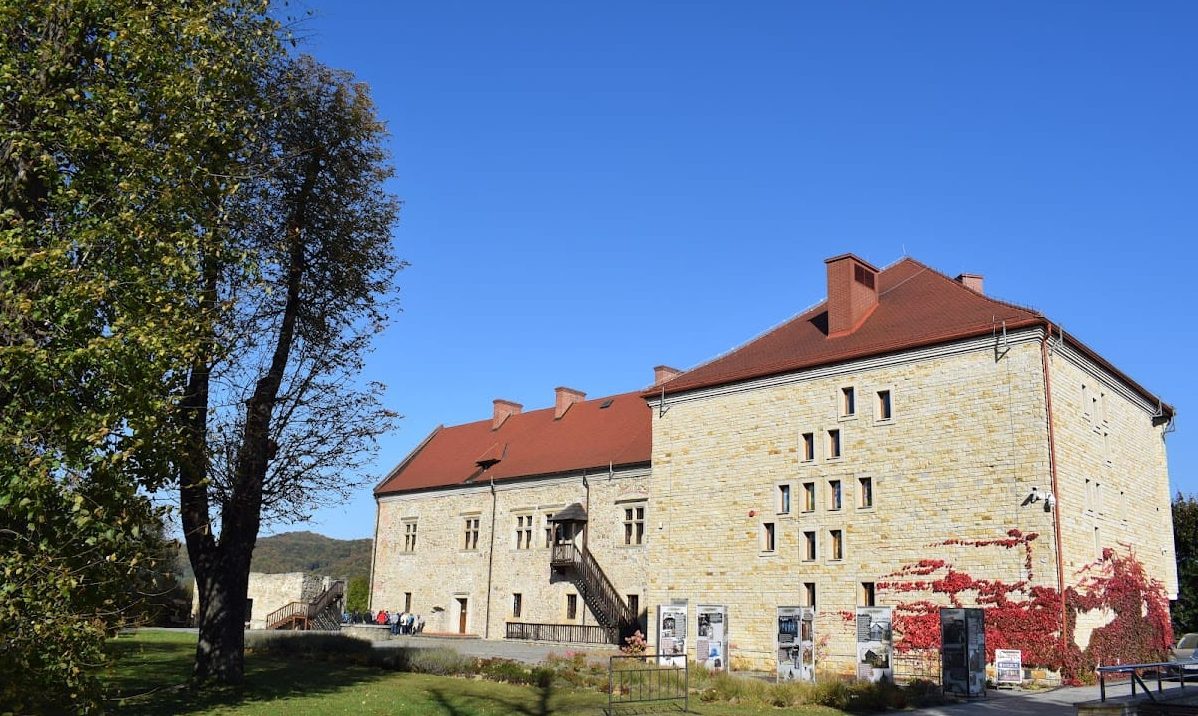
Sanok Castle is now the seat of the Historical Museum in Sanok. The Zdzisław Beksiński Gallery was established in 2010 and ceremonially opened on 19 May 2012 in the reconstructed wing. Beksiński, a Polish painter, draftsman, sculptor, photographer, and graphic artist known for dark and often dystopian imagery, donated about 300 works to the museum during his lifetime. After his death, the museum received a further 20 late works, approximately 1,000 photographs and graphic works, and his estate. The collection includes several thousand paintings, reliefs, sculptures, drawings, prints, and photographs, along with multimedia recordings, letters, and films concerning his family life.
Remains
Sanok Castle stands 317 metres above sea level on a hill beside the San River, or, in the local description, the Płowiecki Stream, at the foot of a steep eastern slope. The early medieval stronghold occupied the northern part of the hill. The later royal complex developed on the hilltop as a two-storey castle enclosed by defensive walls. Its surviving architectural character is Renaissance and Classicist, reflecting the sixteenth-century rebuilding and later changes.
Castle Buildings and Defensive Landscape
Royal Castle
The medieval complex probably began as a wooden stronghold and was later enclosed by a defensive wall. The royal palace or castle that followed occupied the hilltop within its own defensive enclosure. Courts met in the cellars, while officials used the upper floors. A separate tower beside the castle held people sentenced for offenses, and a separate building beside the bridge housed the district records.
Later Wings
The southern wing was added during the expansion at the end of the sixteenth century. A northern wing followed around the turn of the seventeenth and eighteenth centuries or in the early eighteenth century. Another southern wing, built under Austrian authorities for the enlarged Sanok district administration, was burned by Russian troops in 1915. Its remaining ruins were later dismantled.
Earthworks and Well
The castle complex includes a park, earthworks, remnants of ramparts, a western ditch, other defensive structures, and a castle well. The well and the surrounding defensive works are treated as separate protected components of the monument complex. Conservation work in 2000–2004 exposed the foundation footing of the structure known as the Casimir Tower.
German Shelters
Two German shelters lie beneath the castle courtyard, including a concrete bunker associated with the Galician Border Position. The bunker’s entrances are on the eastern and western sides of the hill. These structures formed part of the frontier defenses before Germany attacked the Soviet Union.
Cemeteries and Museum Collections
Saint Demetrius Cemetery
Archaeologists discovered in 2005 the remains of a cemetery associated with the demolished Orthodox Church of Saint Demetrius. Earlier investigations also examined a cemetery beside the castle chapel, adding evidence of the religious features that accompanied the royal and administrative complex.
Historical Collections
The Historical Museum’s collections include returned Polish cultural property and approximately 200 icons from Lemko and neighboring villages. Its icon collection brings together nearly all the icons made in southeastern Poland between the fourteenth and twentieth centuries. These objects form part of the museum use established in the castle after the Second World War.
Zdzisław Beksiński Gallery
The Zdzisław Beksiński Gallery occupies specially adapted space in the reconstructed southern wing. It displays the artist’s paintings, drawings, sculptures, photographs, and prints. The holdings comprise several thousand items and constitute the largest collection of Beksiński’s work.
Small Castle
A building constructed near the castle late in the twentieth century is known by the nickname “Small Castle.” It forms part of the later built environment surrounding the historic complex.