Fontainejean Abbey: A Cistercian Monastery and Courtenay Burial Place in France
Site at a Glance
- Rating
- 3.5
- Popularity
- Very Low
- Country
- France
- Primary era
- Medieval
- Eras represented
- Medieval
- Civilizations
- French
- Site type
- Religious
- Remains
- Monastery
On this page13 sections
History
Fontainejean Abbey is a Cistercian monastery in France, located near Saint-Maurice-sur-Aveyron, that was founded around 1124. Established within the reforming Cistercian tradition, which emphasized communal discipline, manual labor, agricultural development, and austere architecture, it became the eighth daughter house of Pontigny Abbey and remained under its institutional lineage. The foundation was initiated by Milon de Courtenay, lord of Cerdagne, whose patronage shaped the abbey’s early development.
Foundation and early development
The first abbot, Étienne, arrived from Cîteaux with twelve religious on 20 March 1124. The first community lived in cells made from branches and worshipped in an oratory dedicated to Saint Mary Magdalene. With Milon de Courtenay providing land, money, and labor, the monks drained the marshy valley, sent part of its water into the Aveyron, and directed the remainder into the Ru des Fontaines. This channel powered the community’s mill and supported the agricultural organization of the new monastery.
Construction on the reclaimed ground began around 1140. In 1148, Pierre I de Courtenay, brother of King Louis VII, designated Fontainejean a royal abbey, and a charter of 1197 confirmed his donations. The abbey church was consecrated to Notre-Dame in 1173, although the date of its construction remains uncertain.
Religious and dynastic importance
Fontainejean developed into a prosperous religious and educational center. It had 80 monks and 400 students by 1189, while in 1209 it housed about 200 religious and 400 students. Its economy rested on agricultural granges, including Loisy, La Breuille, Chevaux, Perthuis, Les Deux-Forêts, La Tuilerie, Tourteville, and La Croix-Lambert, as well as sixteen ponds.
Guillaume de Donjeon, an early abbot, later became archbishop of Bourges. He died in 1209 and was canonized by Pope Innocent III in 1217. His canonization increased Fontainejean’s renown and drew pilgrims from across Europe.
The House of Courtenay, a powerful medieval aristocratic dynasty whose French branch sought royal recognition, chose Fontainejean as its dynastic burial place. Robert I de Courtenay-Champignelles named the abbey as his burial place in a charter of 1225. The monastery subsequently became a family necropolis, serving a function comparable to Saint-Denis for the French royal family.
War and financial decline
During the Hundred Years’ War, the prolonged conflict between the English and French crowns, the English commander Robert Knolles destroyed the monastery around 1359. The monks may have taken refuge at the abbey’s substantial property in Montargis, which contained several houses, an inn, and a chapel.
From about 1370, Fontainejean declined financially. The monks sold church ornaments and leased their lands, while war damage affected their estates. Disputes with neighboring secular authorities concerned dues, jurisdiction, water use, rents, a mill, and other rights. An agreement settled a conflict with the lord of Saint-Maurice-sur-Aveyron in 1401.
In 1376, King Charles V granted 500 gold francs to support Fontainejean and rebuild the chapel at Montargis. In return, the monks were required to celebrate a perpetual daily mass for him there. Jean III Gombault, abbot of Fontainejean, administered the foundation under the authority of Pierre, abbot of Pontigny. A house at Gien was also demolished during the conflict, and its materials were used to rebuild the castle of the Countess of Alençon and Étampes. She compensated the abbey in 1378 with one arpent of woodland in the forest of Ouzouer-sur-Trézée.
English forces pillaged and devastated the abbey again in 1422. The wider conflict caused the loss of other possessions, although later donations provided some compensation.
Commendatory rule and religious conflict
The chapel of Saint Lawrence was built between 1506 and 1524. From 1551, the abbey was governed under the commendatory system, which assigned its revenues and nominal abbacy to a high-ranking churchman who did not necessarily reside in the monastery. Odet de Coligny, bishop of Beauvais and cardinal of Châtillon, became its first commendatory abbot.
After Odet de Coligny converted to Calvinism in 1561, his brother Dandelot burned the abbey’s cartulary, a collection of copied charters and legal records, and massacred the monks in 1562. Protestant troops occupied Fontainejean that year, and the abbey church was ruined. Odet de Coligny married Isabelle de Hauteville at Fontainejean in 1564.
In 1768, the heart of Hélène de Courtenay, princess of Bauffremont and the last descendant of the French Courtenay line, was transferred from Paris to the abbey church. The church was restored in the eighteenth century by Ange-Jacques Gabriel, but the abbey was devastated during the French Revolution. Only three religious remained in 1790, when the monastery was suppressed.
Demolition and preservation
The church was sold as national property in 1794 after its roof and bell-tower spire had been dismantled. In 1810, an owner bought the remaining property and sold its stones individually. Material from the abbey was later reused in numerous churches and private houses. The Courtenay tombs and the graves of the religious were destroyed, while sculptures, columns, and burial elements were sold. Excavations in 1858 recovered fragments of statues and human bones.
The surviving abbey remains were entered on the supplementary inventory of historic monuments on 6 October 1925.
Remains
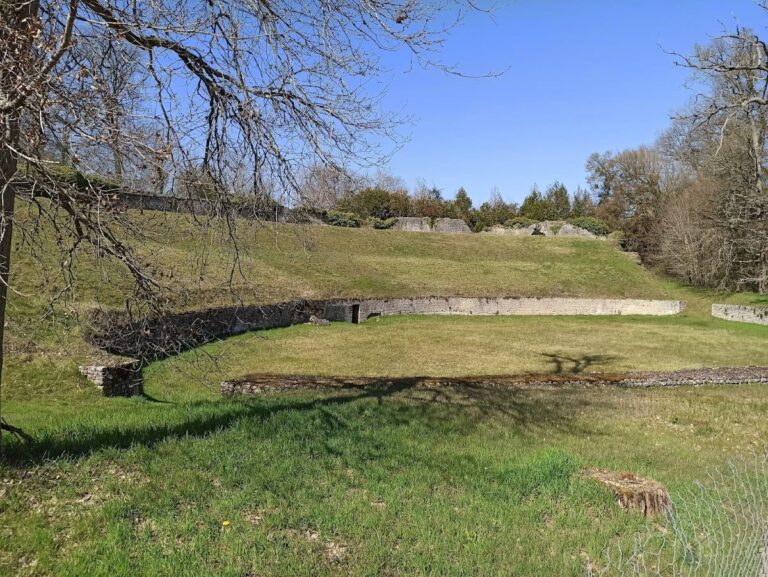
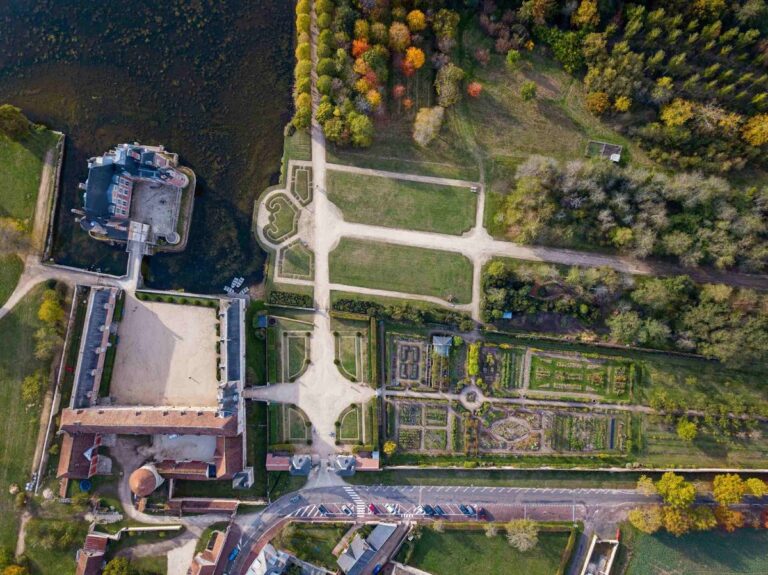
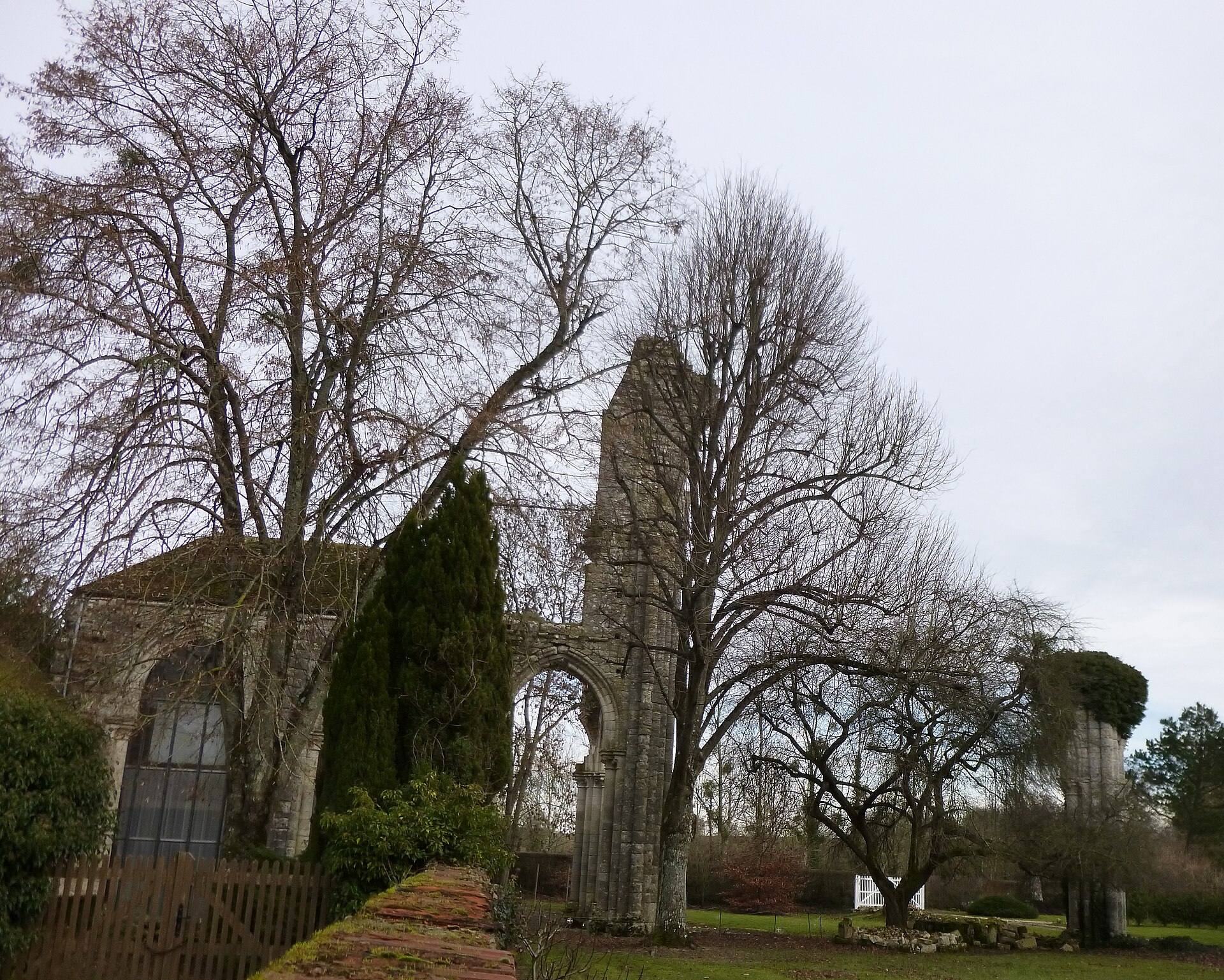
The ruins stand at Fontainejean, about three kilometers east of the center of Saint-Maurice-sur-Aveyron in the Gâtinais region of the Loiret. The site lies beside the Aveyron River in a former marshy valley. Its surviving elements preserve parts of the church, a thirteenth-century grange, and traces of the water management that supported the early monastery.
Church ruins and funerary remains
Church structure and portal
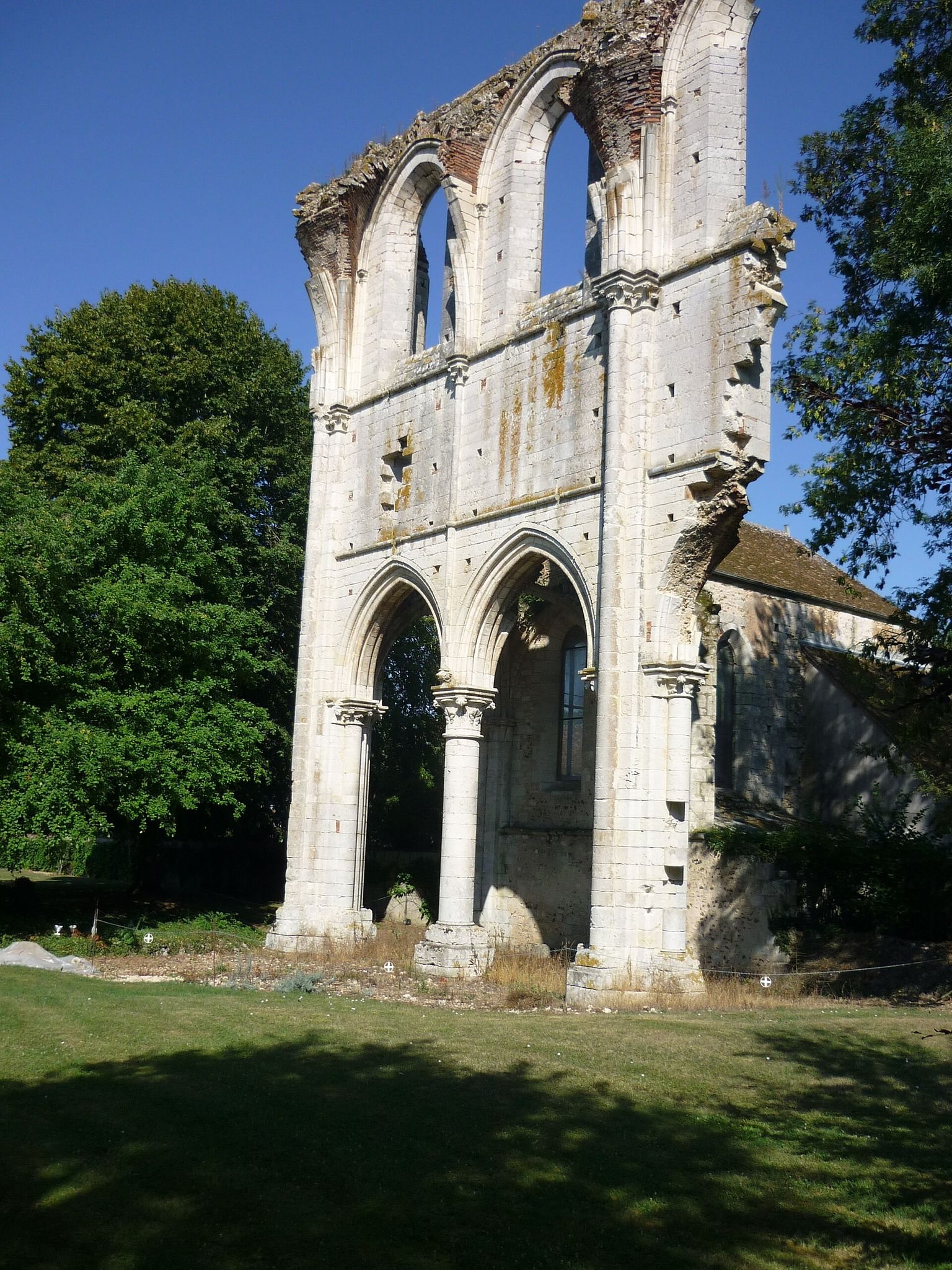
The abbey church was approximately 84 meters long and 30 meters high. Parts of the left transept, including its chapels, and a section of the choir wall survive. The ruins also preserve a monumental portal with arcades and moldings, together with two superimposed levels of paired columns. Three pillars retain their capitals. Rounded Romanesque forms appear alongside pointed early Gothic features, reflecting the architectural transition between the two styles.
The church’s construction date remains disputed. Dates associated with an inscription on the high altar include 1133 and 1173, while another architectural study proposed 1233. The 1925 monument inventory assigned the church broadly to the early thirteenth century. One interpretation proposes two successive buildings, an earlier Romanesque church followed by a later early Gothic structure. The later church may have incorporated the Romanesque Porte des Morts at the end of the left transept, where the doorway was still visible.
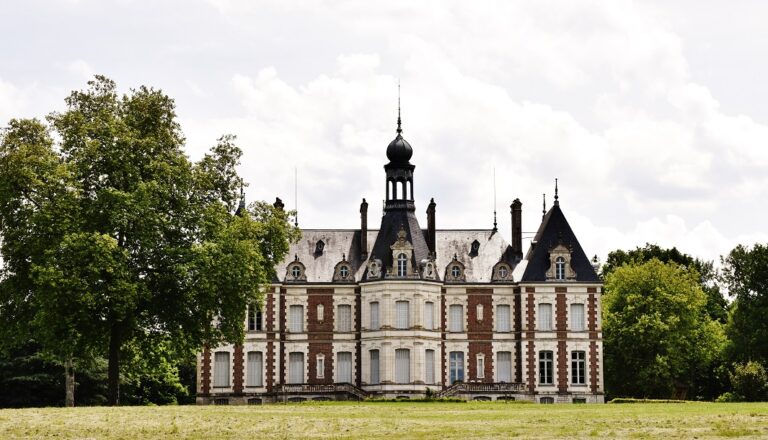
By 1834, only four pillars and a large pointed arch remained. The arch collapsed in 1862, and one pillar disappeared in 1890. The abbey residence was demolished around 1840 and replaced by a country house on the property.
Courtenay mausoleum
A mausoleum with black-marble columns stood beside the altar. It contained the remains of Jacques II and Jean II de Courtenay, who were buried there in 1617 and 1637. Their kneeling statues, dressed in court mantles, stood above the monument. The church altar was decorated with fleurs-de-lis, an emblem associated with the Virgin Mary.
By 1910, a plaque marked the deposit of Hélène de Courtenay’s heart in the church. The ruins also retained a grille from the abbey, three black-marble columns from the Courtenay mausoleum, and relics of saints.
Grange and water management
Thirteenth-century grange
Part of a thirteenth-century abbey grange survives on the property. A grange was a monastic agricultural estate containing farmland, buildings, livestock facilities, and related water resources. Fontainejean’s wider agricultural network included the granges of Loisy, La Breuille, Chevaux, Perthuis, Les Deux-Forêts, La Tuilerie, Tourteville, and La Croix-Lambert.
Marsh drainage and mill water
The original settlement occupied a marshy valley that the monks drained during the abbey’s foundation. Some water was directed into the Aveyron, while the rest entered the Ru des Fontaines and powered the monks’ mill. Sixteen ponds formed part of the agricultural resources associated with the abbey.