Presidential Palace of Nanjing: A Historic Governmental Complex in China
Site at a Glance
- Rating
- 4.3
- Popularity
- Low
- Country
- China
- Primary era
- Modern
- Eras represented
- Early Modern, Modern
- Civilizations
- Chinese
- Site type
- Civic
- Remains
- Palace
On this page23 sections
History
The Presidential Palace of Nanjing is a historic governmental complex in China that developed from Ming dynasty princely residences into a Qing administrative center and a headquarters of successive Republican governments. Its surviving buildings mainly date from the late nineteenth century through the 1930s, reflecting the political transformations that shaped modern Chinese history.
From Ming residences to the Qing viceroy’s office
The site began as a group of princely residences west of the Ming Palace, the imperial palace complex in Nanjing during the Ming dynasty. Among them was the manor of Zhu Gaoxu, the Prince of Han.
During the Qing dynasty, China’s last imperial dynasty, the complex became the Office of the Viceroy of the Two Lower Yangtze Provinces. A viceroy was a senior imperial governor responsible for a large region. The jurisdiction of this office covered areas corresponding to present-day Jiangsu, Shanghai, Anhui, and Jiangxi.
When the Qianlong Emperor visited the Lower Yangtze, he used the office as a detached palace together with the Imperial Silk House. The modern Daxinggong Metro station preserves the memory of this former imperial function in its name.
The Taiping and late Qing transformations
In 1853, forces of the Taiping Rebellion captured Nanjing. This nineteenth-century civil and religious war established the Taiping Heavenly Kingdom across parts of southern and eastern China. Led by Hong Xiuquan, whose ruling title was the Heavenly King, the movement enlarged the complex and converted it into Hong Xiuquan’s Palace of the Heavenly King, also known as the Celestial Palace.
Qing forces recaptured Nanjing in 1864. Zeng Guofan, a Qing official and military commander who helped suppress the rebellion, ordered most of the palace buildings burned. A new palatial residence was constructed in 1870, followed by imposing neoclassical government buildings for the Qing governor-general.
Revolution and the provisional presidency
The Xinhai Revolution of 1911 ended China’s imperial system and led to the establishment of the Republic of China. After the revolution, Sun Yat-sen was sworn in as provisional president at the former governor-general’s palace. He maintained his offices there for a period, and the site became one of the birthplaces of the Republic of China.
Sun used the Commission House, also called the West Garden Hall, as his provisional presidential office from 1 January 1912. The first cabinet council of the provisional government met there. The building had been initiated in 1909 by Duanfang, the eightieth Viceroy of Liangjiang, after his visit to Europe, and was completed under Zhang Renjun, the last viceroy of Liangjiang. From 1927, it served as the seat of the Military Affairs Commission, the Nationalist Government’s leading military institution.
The Nationalist Government in Nanjing
The palace was not officially used again by the Republic of China until 1927, when the Kuomintang’s Northern Expedition captured Nanjing. The Kuomintang was the Nationalist political party that governed from Nanjing during the principal period represented at the palace. The complex and adjacent buildings became the headquarters of the Nationalist Government, with Chiang Kai-shek’s office located there.
The Executive Yuan, the Republic of China’s highest executive administrative body, occupied buildings in the East Garden from 1928 to 1937. After the government moved to Chongqing in November 1937, the buildings housed several ministries under Wang Jingwei’s Japanese-supported Reorganized National Government.
During the Second Sino-Japanese War, fought from 1937 to 1945, Chiang Kai-shek’s government operated from Chongqing while Wang Jingwei’s collaborationist regime occupied the complex. After Japan’s surrender in 1945, Chiang Kai-shek’s Nationalist Government returned to Nanjing. Following the promulgation of the Republic of China’s Constitution in 1947, the headquarters was renamed the Presidential Palace.
Change of government and museum use
Communist forces captured Nanjing and the palace in April 1949, near the end of the Chinese Civil War. The Nationalist Government first moved to Guangzhou and, after leaving Chengdu in December 1949, transferred the functions of the presidential seat to the Presidential Office Building in Taipei. The Nanjing complex subsequently became the headquarters of the Jiangsu Provincial Government and lost its presidential function.
In the late 1980s, the complex was converted into the China Modern History Museum. Its displays focus on twentieth-century modern Chinese history, including the histories of the Republic of China from 1912 to 1949 and the People’s Republic of China. In 2005, Kuomintang chairperson Lien Chan visited the museum during a trip to mainland China, symbolically marking the party’s return to the palace after 58 years.
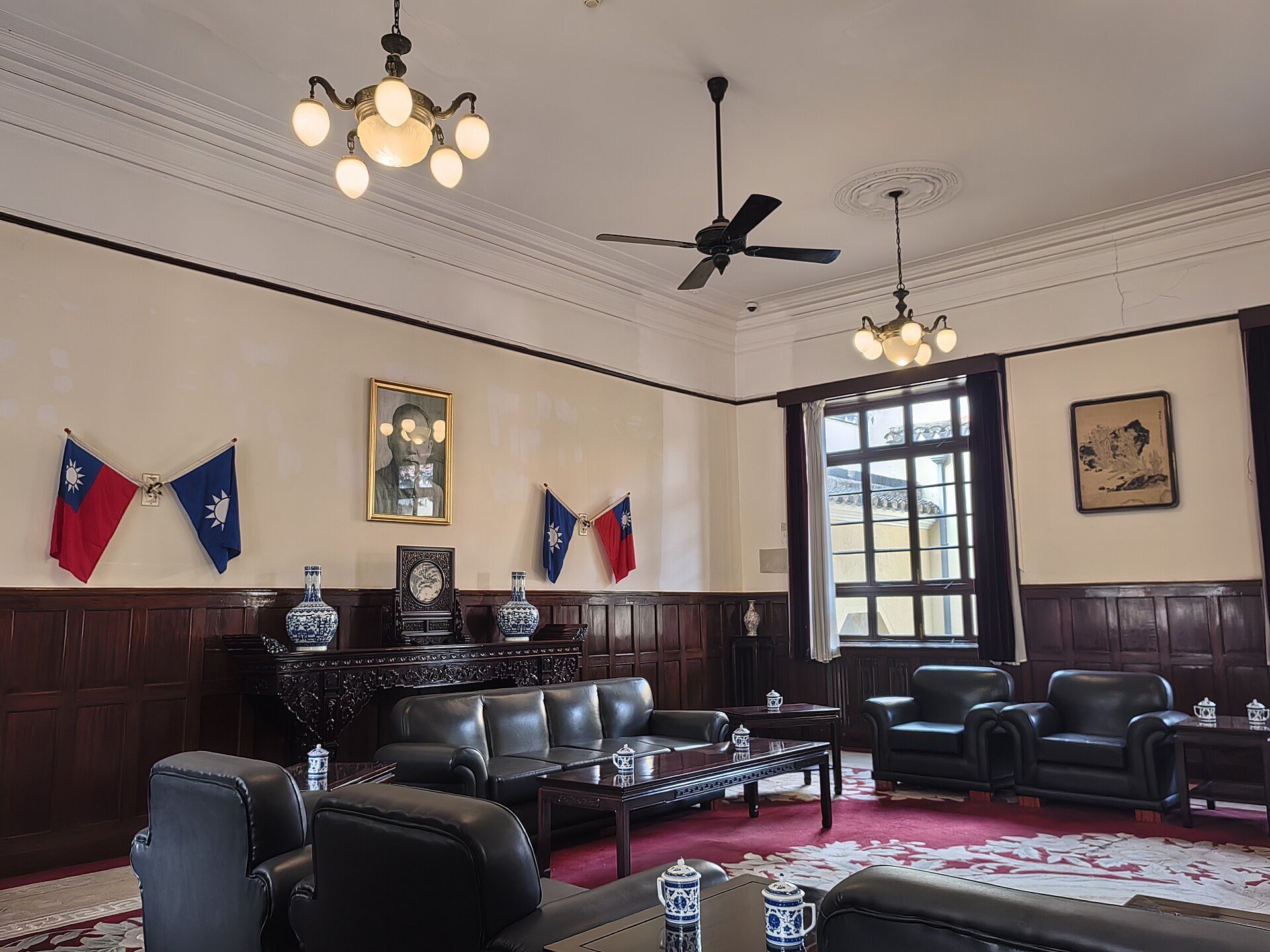
The former palace is an important historical landmark and one of the largest surviving complexes of modern Chinese buildings dating from 1840 to 1949. It is also one of the few places in the People’s Republic of China where the flag of the Republic of China is displayed.
Remains
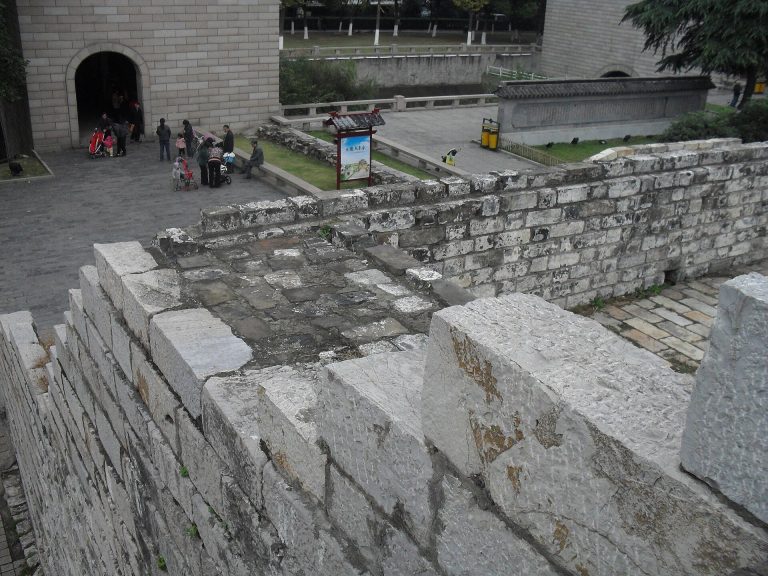
The complex occupies approximately 90,000 square metres and is organized around a central axis, the West Garden, and the East Garden. Its surviving structures were built or rebuilt mainly between 1870 and the 1930s, combining traditional Chinese buildings, classical southern Chinese garden design, Western-style civic architecture, and reinforced concrete construction.
Central axis and ceremonial buildings
Main gate
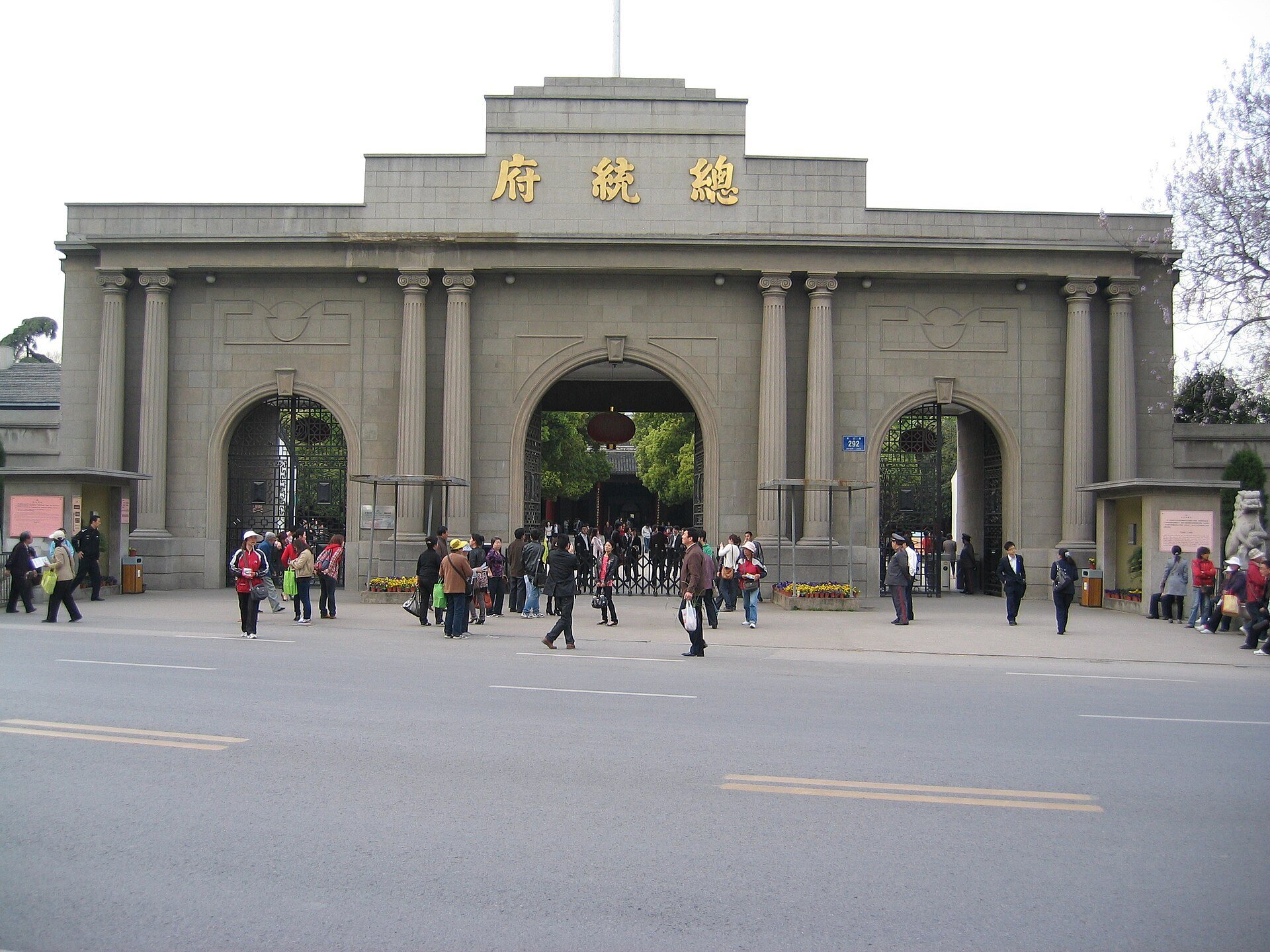
The central axis begins at the present main gate, rebuilt in 1929 in a Western style with Ionic columns and two stone lions. The gate replaced an earlier entrance that had belonged to the Qing viceroy’s office, then served as the Gate of True God’s Glorious Light, the principal entrance to the Heavenly King’s Palace. That earlier gate was destroyed after the Qing recaptured Nanjing, rebuilt in 1870 as the viceroy’s main gate, and demolished when the National Revolutionary Army captured Nanjing in 1927.
The inscription on the 1929 gate identified the Nationalist Government from 1929 to 1937 and from 1946 to 1948. During the Japanese occupation, the entrance served the Legislative Yuan and Control Yuan under Wang Jingwei’s regime. After the constitutional changes and presidential election of 1948, its inscription was changed to Presidential Palace, the name still used for the gate.
Main hall and adjoining halls
The main hall stands immediately north of the entrance. Rebuilt in 1870 on the site of the Supreme Hall of the Glorious Light, it served as a ceremonial hall for both the Qing viceroy and the Taiping Heavenly King. From 1927, it hosted functions of the Nationalist Government and the Office of the President. The traditional Chinese-style building bears a board inscribed with the words “What is under heaven is for all,” written by Sun Yat-sen.
A corridor behind the main hall connects it with the second hall. An auditorium stands west of the corridor on the ruins of the Warm Pavilion, while the Heavenly King’s Throne Room lies to the east. The Warm Pavilion, northwest of the main hall, hosted the inauguration ceremony of the provisional president in January 1912.
The second hall, also called the central hall, was rebuilt in the late nineteenth century on the site of the Heavenly King’s inner court. It later hosted minor ceremonies under the Nationalist Government and connects by an aisle to the reception hall.
Reception hall and Kirin Gate
The Western-style reception hall, also called the Hall of Character Eight, was built in 1917 by Feng Guozhang, who was then vice president of the Republic of China. After the Northern Expedition, it received civilian and foreign guests of the Nationalist Government. Agreements between the Chinese Communist Party and the Kuomintang were signed there before the Chinese Civil War. Chiang Kai-shek, Lin Sen, and Li Zongren also rested in the hall before ceremonies, and Chiang sometimes worked there instead of in the Presidential Building.
The red Kirin Gate north of the reception hall traditionally opened only when the president passed through it. It leads toward the House of Government Affairs, the former office building of the chairman of the Nationalist Government.
Government offices
House of Government Affairs
The House of Government Affairs, also called the House of Government Officials and the House of Documentary Affairs, was built in 1925 by Sun Chuanfang, then the military governor of Jiangsu. It originally housed the Jiangsu military governor’s office. From 1928 to 1935, it became the office building of the chairman of the Nationalist Government and other officials. Chiang Kai-shek’s office occupied the second floor during his chairmanship from 1928 to 1931.
From 1946 to 1949, the building housed the Government Affairs office, where articles were drafted and confidential documents reviewed. Chen Bulei used it as his office. It now contains the Museum of the President and Vice President and collections associated with the Nationalist Government. A courtyard connects it with the Presidential Building.
Presidential Building
The Presidential Building, also called Zichao House or the Concrete House, stands at the northern end of the complex. It is a six-storey reinforced-concrete structure designed by Yu Binglie, head of the architecture department at National Central University. Construction began in 1934 and was completed in December 1935. It was among Nanjing’s tallest buildings during the 1930s.
Lin Sen used the building as the office of the chairman of the Nationalist Government until the Japanese capture of Nanjing. From 1940 to 1945, it housed the Legislative Yuan and Control Yuan of the Reorganized National Government. After the Nationalist Government recovered Nanjing in 1946, it again served as the government’s office. Following the presidential inauguration of 1948, it became the seat of the president of the Republic of China until the People’s Liberation Army took control of the building in April 1949.
Lin Sen planted two cedars on opposite sides of the courtyard in front of the building in 1934. The eastern cedar died in 2005 and was felled in 2013. The first floor contained the secretary-general’s office, while the presidential and vice-presidential offices were on the second floor and the State Affairs Council meeting room was on the third.
Presidential and vice-presidential offices
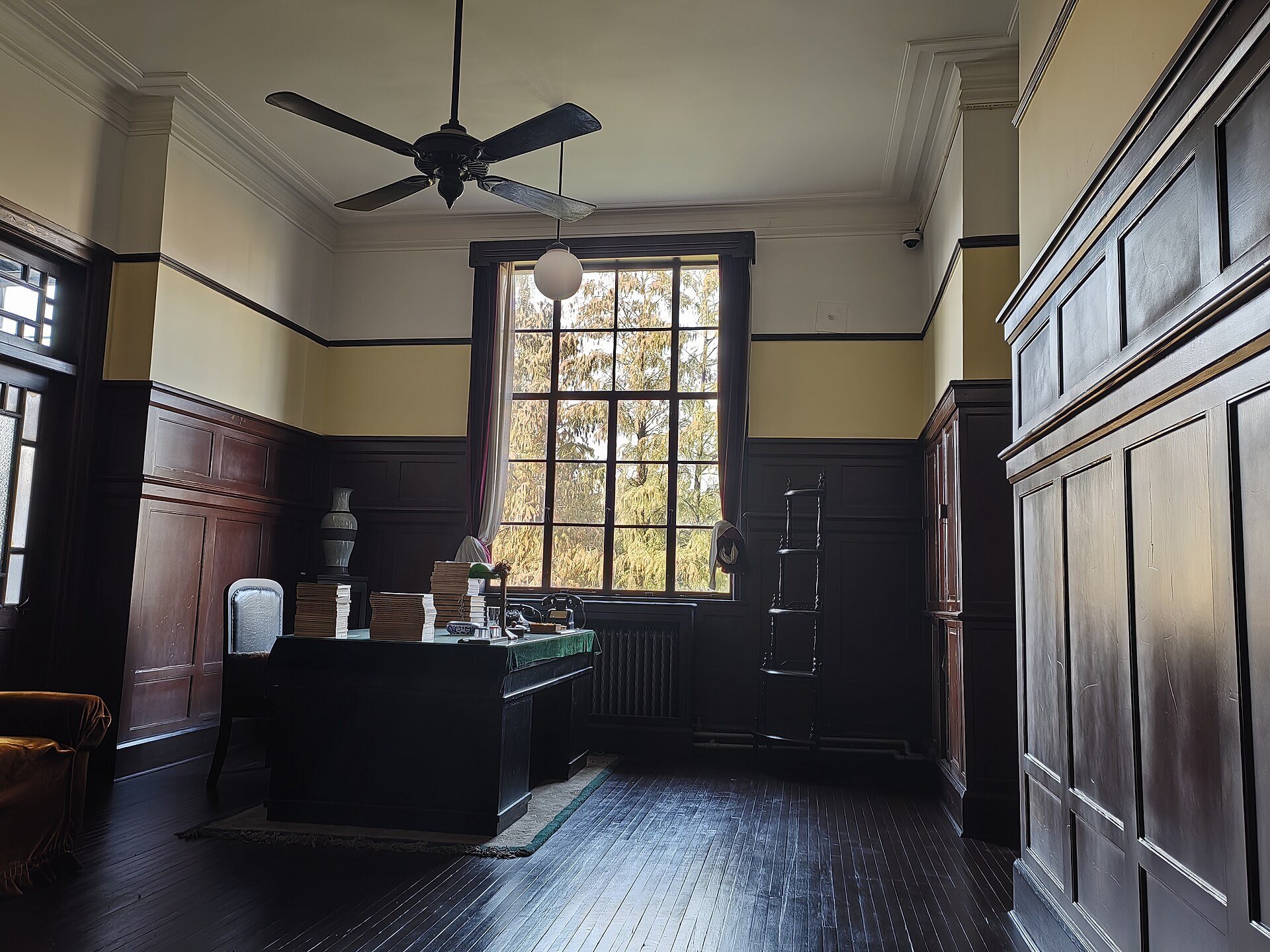
The Presidential Office occupied the southeast corner of the second floor from 20 May 1948. It is also called Chiang Kai-shek’s Office because he was the only president to use it as his presidential office. The suite consisted of three rooms, with the central room serving as the principal workplace. Its furnishings included a large side-positioned secretaire, a French-made hanging lamp, and a large photograph of Chiang above a brown sofa. An Otis elevator stood nearby.
The vice-presidential office stood opposite the Presidential Office and is also known as Li Zongren’s Office. It served as the vice-presidential office from 20 May 1948, although Li generally worked from his residence in Gulou to avoid meeting Chiang Kai-shek.
State Affairs Council room
The State Affairs Council room on the third floor was associated with domestic administration, including the publication of laws and orders and the appointment of officials. Its north wall bears a horizontal board inscribed with words translated as “fidelity, filialness, benevolence, kindness, good faith, calm and peace,” written by Lin Sen in 1935. A glass bottle and numerous teacups stood on the desk, and a record identified the bottle as Chiang Kai-shek’s because he preferred drinking water to tea.
Executive Houses
The Executive Houses stood on the north side of the East Garden and served as the seat of the Executive Yuan from 1928 to 1937. After the Executive Yuan moved to Chongqing, the buildings housed the Ministries of Railways and Transportation and Communications under Wang Jingwei, followed later by the Ministries of Social Affairs and Water Conservancy.
The complex was divided into northern and southern blocks. The North Executive House mainly contained the premier’s office from 1928 to 1934. The South Executive House contained it from 1934 to 1937, after its completion. Chiang Kai-shek, Wang Jingwei, H. H. Kung, and T. V. Soong worked in the premier’s office in the South Block.
West Garden
The West Garden, also called Xu Garden, is a classical southern Chinese garden immediately west of the central axis. This type of designed landscape is organized around water, pavilions, rockwork, and carefully framed views. The garden is arranged around Taiping Lake and includes the Marble Boat, Paulownia Melody House, Tower of Beautiful Sunset, Ripples Pavilion, Palm Pavilion, Mandarin Duck Pavilion, Provisional President’s Living Room, and Attic of Joy. Most of its lakeside buildings were constructed during the 1870s.
Marble Boat
The Marble Boat is the oldest surviving structure in the complex. Built during the Qianlong Emperor’s visit to Jiangning, the former name of Nanjing, it is a 14.5-metre-long stone structure designed to resemble a wooden boat. Its name, referring to an unmoored boat, was presented as a metaphor for the firmness of the Qing dynasty’s regime.
Attic of Joy
The Attic of Joy, also called the Pavilion of Forgetting to Fly or the Waterside Pavilion, was rebuilt in 1870 on the eastern lakeshore. Its name refers to the belief that birds seeing the attractive view would become so happy that they would forget how to fly. During the 1930s, it housed one of the offices of the Military Affairs Commission.
Commission House
The yellow Commission House, also called the West Garden Hall and the Office of the Provisional President, was built from 1909 to 1910. Sun Yat-sen used it as his provisional president’s office from 1 January 1912, and the first cabinet council of the provisional government met there. From 1927, the building served as the seat of the Military Affairs Commission.
General Staff House
The General Staff House was built in 1935 as the headquarters of Ho Ying-chin, chief of the Nationalist Government’s General Staff. It now functions as an exhibition hall on Sun Yat-sen and the provisional government in Nanjing.
East Garden
The East Garden, also called the Restored Garden, began as an additional garden of the Qing viceroy’s office and became the eastern garden of the Celestial Palace during the Taiping period. Qing forces destroyed it after recapturing Nanjing. Minor office buildings attached to the Executive Yuan were later erected there and demolished during the 2000s. The garden was partly reconstructed in 2003 on the basis of historical information and surviving remains, together with buildings including a warehouse.