Morimond Abbey: A Cistercian Monastery and Centre of Expansion in France
Site at a Glance
- Rating
- 3.8
- Popularity
- Very Low
- Country
- France
- Primary era
- Medieval
- Eras represented
- Medieval, Early Modern
- Civilizations
- County of Champagne, French
- Site type
- Religious
- Remains
- Monastery
On this page11 sections
History
Morimond Abbey is a Cistercian abbey in France, located at Parnoy-en-Bassigny in the Flambart valley. It was founded in 1115 by Odelric of Aigremont and his wife, Adeline of Choiseul, with monks sent from Cîteaux, the mother house of the Cistercian reform movement. The foundation belonged to a tradition that emphasized austerity, manual labour, communal discipline, and a simpler monastic life. Although 1115 is the traditional foundation date, modern studies allow a foundation around 1117–1118 because Morimond does not appear in the first version of the Cistercian Charter of Charity.
Foundation and early development
The new monastery followed an earlier oratory at Vieux-Morim, where a solitary named John had waited for disciples. Bishop Joceran of Langres encouraged him to place the community under Cîteaux. In 1115, Bishop Guillenc of Langres approved the foundation, while Odelric and Adeline granted land at Morimond and Waldenvillers. Simon II of Clefmont later confirmed the foundation.
The first monks lived in huts while constructing wooden buildings, clearing the land, cultivating fields, and draining the wet valley. The original oratory was moved closer to the monastery in 1130, and the first abbey church was consecrated in 1154. The name Morimond derives from the Latin phrase mori mundo, meaning “to die to the world,” an expression of the Cistercian ideal of renouncing worldly life.
Morimond was the fourth of Cîteaux’s primary daughter abbeys, after La Ferté, Pontigny, and Clairvaux. A daughter abbey was a monastery founded from and institutionally linked to an earlier house. Morimond was later recognized as a primary abbey by papal bulls issued by Alexander III in 1163 and 1165.
Leadership and the Cistercian network
Arnold I’s early administration was disrupted by a dispute with Odelric’s eldest son over land donated to the abbey. Arnold withdrew towards Jerusalem with several companions and died in Flanders in January 1126. Stephen Harding then installed Gauthier I as abbot, obtained renewed confirmation of the foundation and its donations, and required Arnold’s companions to return to Morimond.
In 1119, Arnold I worked with Stephen Harding on the Charter of Charity. This text defined mutual assistance between Cistercian houses, the relationship between mother and daughter abbeys, the general chapter, and annual visitation. In 1123, at the request of Frederick I, Archbishop of Cologne, Arnold sent monks to establish Kamp Abbey. Under Gauthier I, Ebrach was founded in 1126 and Theuley in 1130. Further foundations associated with Morimond included Heiligenkreuz, Morimondo, Aiguebelle, Escaladieu, Dore, Silvacane, Jędrzejów, Balamand, Sulejów, Wąchock, Koprzywnica, and San Pedro de Gumiel.
Morimond’s position between Champagne and Lorraine made it an important base for Cistercian expansion towards central and eastern Europe. It founded or sponsored houses in France, Germany, Poland, Bohemia, Spain, Cyprus, England, and other regions. Its first daughter abbey was Bellevaux, founded in 1119. Morimond continued participating in new foundations for nearly two centuries, and by the end of the eighteenth century its affiliation included 213 men’s abbeys and nearly 700 establishments of both sexes.
In August 1132, Gauthier I admitted about fifteen young noblemen who had sought shelter at the abbey. Among them were Henry of Carinthia, Herbert of Moravia, Conrad of Thuringia, and Otto of Freising. The recruits were sent to Paris to continue their studies. Otto became abbot of Morimond in 1138 before becoming bishop of Freising. His example encouraged further aristocratic involvement. Evrard of Einberg, Count of Mons, entered Morimond as a lay worker and later became a monk; in 1142 he founded Einberg Abbey and Mont Saint-Georges in Thuringia.
Morimond also developed links with Iberian religious-military institutions. These organizations combined monastic discipline with military service during the medieval Christian campaigns in Iberia. Papal documents placed the Order of Calatrava under Morimond’s spiritual jurisdiction in 1187, the Order of Alcantara in 1214, and the Order of Christ in Portugal in 1319. In 1187, at the request of Alfonso VIII of Castile, Calatrava’s direct affiliation was transferred from Escaladieu to Morimond. The abbey was later associated with the Orders of Saint Maurice and Saint Lazarus in Savoy.
Landholding, industry, and religious life
Morimond received pilgrims because it stood between Champagne and Lorraine. A lantern burned at one of its monastic granges to guide travellers, while the abbey provided visitors with lodging and food. Its religious activities were supported by extensive endowments and economic rights. By 1160, the abbey possessed ten granges, the freehold of Levécourt, rights to salt from the salines of Moyen-Vie, holdings in about twelve villages, and rights of use, fishing, and grazing in the forests of roughly sixty villages.
Later donations brought land, farms, iron-mining rights, saltworks, and forges. The abbey’s economic complex included more than twenty mills on the Meuse, Moselle, and Saône, an iron mine, two metallurgical works, a glassworks, charcoal-burning sites, wine presses, vineyards near Dijon, forests, lime kilns, salt rights at Salins, urban houses, livestock, and granges worked by about 160 labourers. By the end of the thirteenth century, Morimond had fifteen granges, more than 200 horses, about 200 oxen, numerous cattle and calves, and around twenty piggeries, each holding between 200 and 300 pigs.
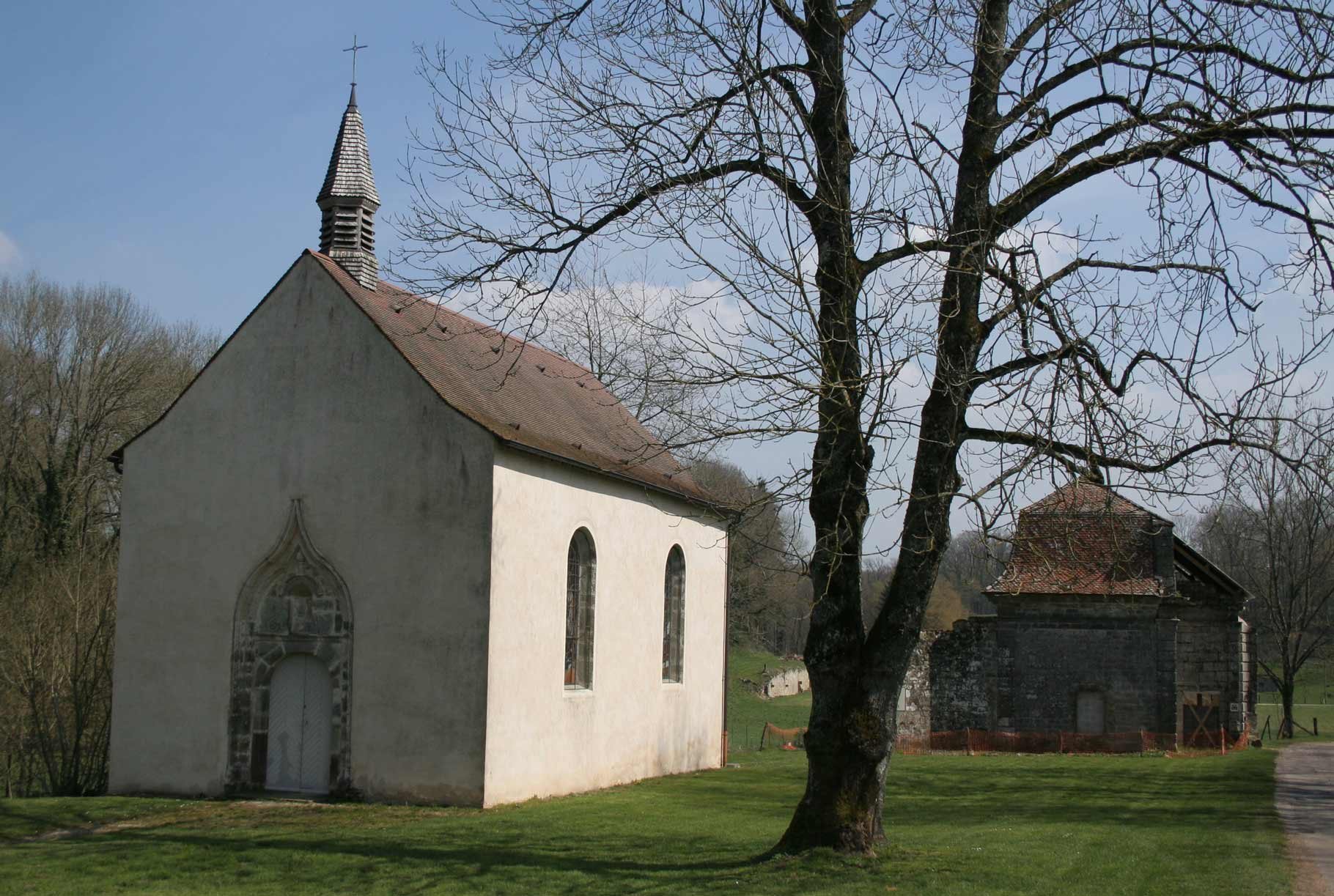
A separate establishment at Belfays housed the former wives of men who entered the monastery, but it was destroyed during the fourteenth century. Outside the abbey enclosure, the monks built a chapel dedicated to Saint Ursula for workers living on or cultivating the abbey’s lands. Relics of Saint Ursula were brought to the chapel.
War, suppression, and later conservation
Morimond suffered major depredations during the French Wars of Religion in 1572, a period of civil and religious conflict in France, and during the Thirty Years’ War in 1636, the wider European conflict that devastated much of central Europe. The monks took refuge in their urban house at Langres and returned permanently in 1678. Extensive transformations then continued through the eighteenth century.
In 1790, the community numbered twenty-five monks. During the French Revolution, the monks surrendered the abbey’s archives and valuables to officials of Bourbonne-les-Bains. Abbot Antoine Chautan and the remaining religious community were expelled in 1791. The buildings were dismantled for building materials and sold as national property. The church was temporarily retained as a brewery, but it gradually became ruinous during the nineteenth century.
Some of the abbey’s hydraulic works were reused for later industries, including a nail-making works below the Grand Étang and large mills beneath the U-shaped canal. The Association of the Friends of Morimond was founded in 1990 by Jean Favre to maintain the abandoned site, support archaeological excavations, and restore the Sainte-Ursule Chapel. Excavations have been organized since 1998 with state cultural support and volunteer assistance. The entire site was entered on France’s supplementary inventory of Historic Monuments in 1925.
Remains
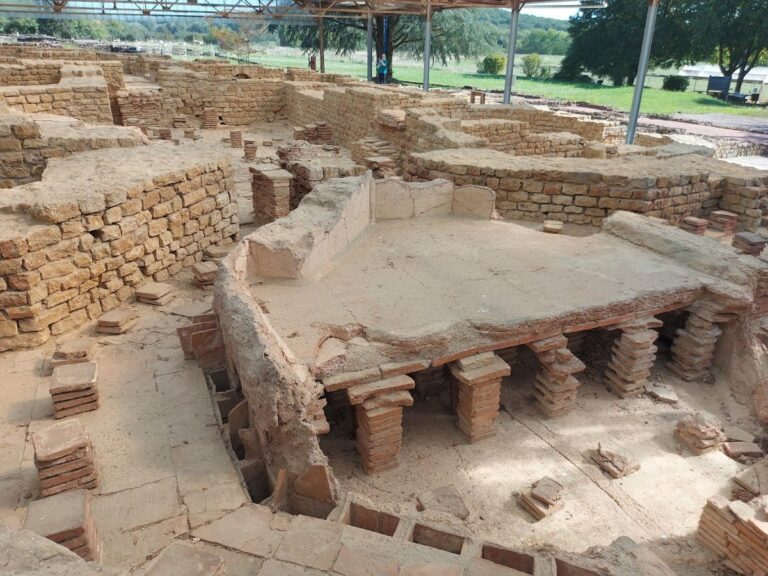
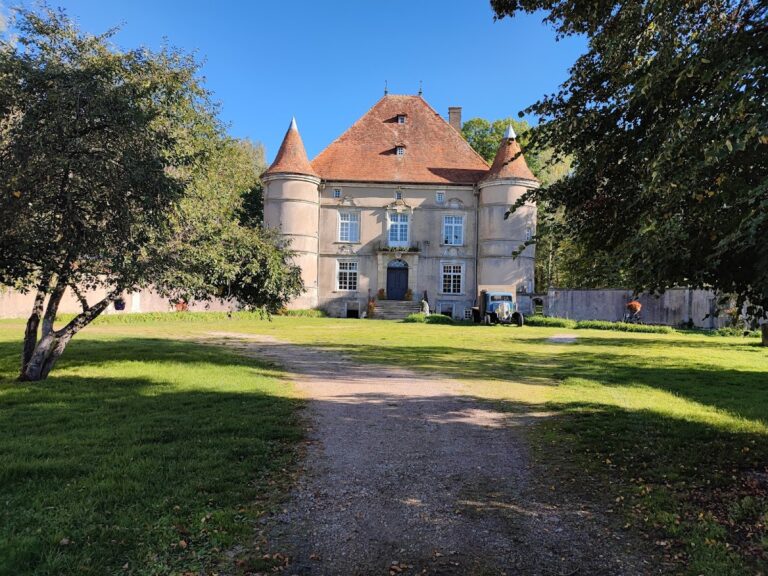
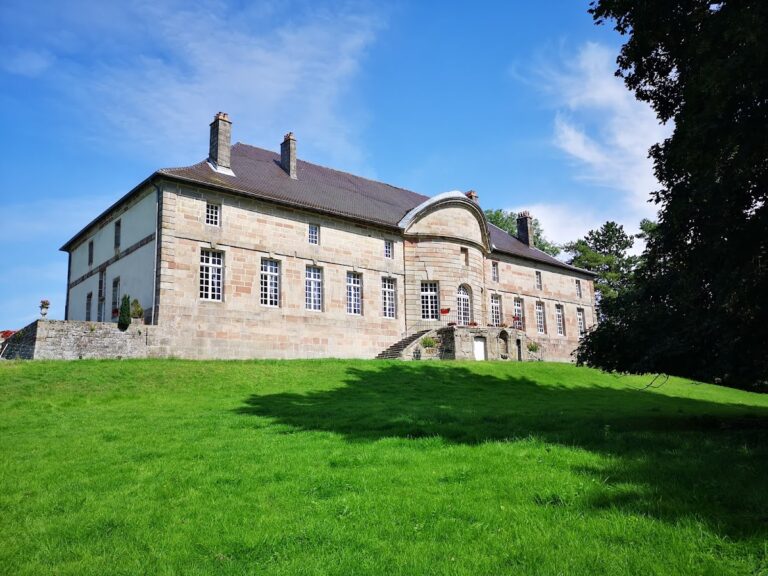
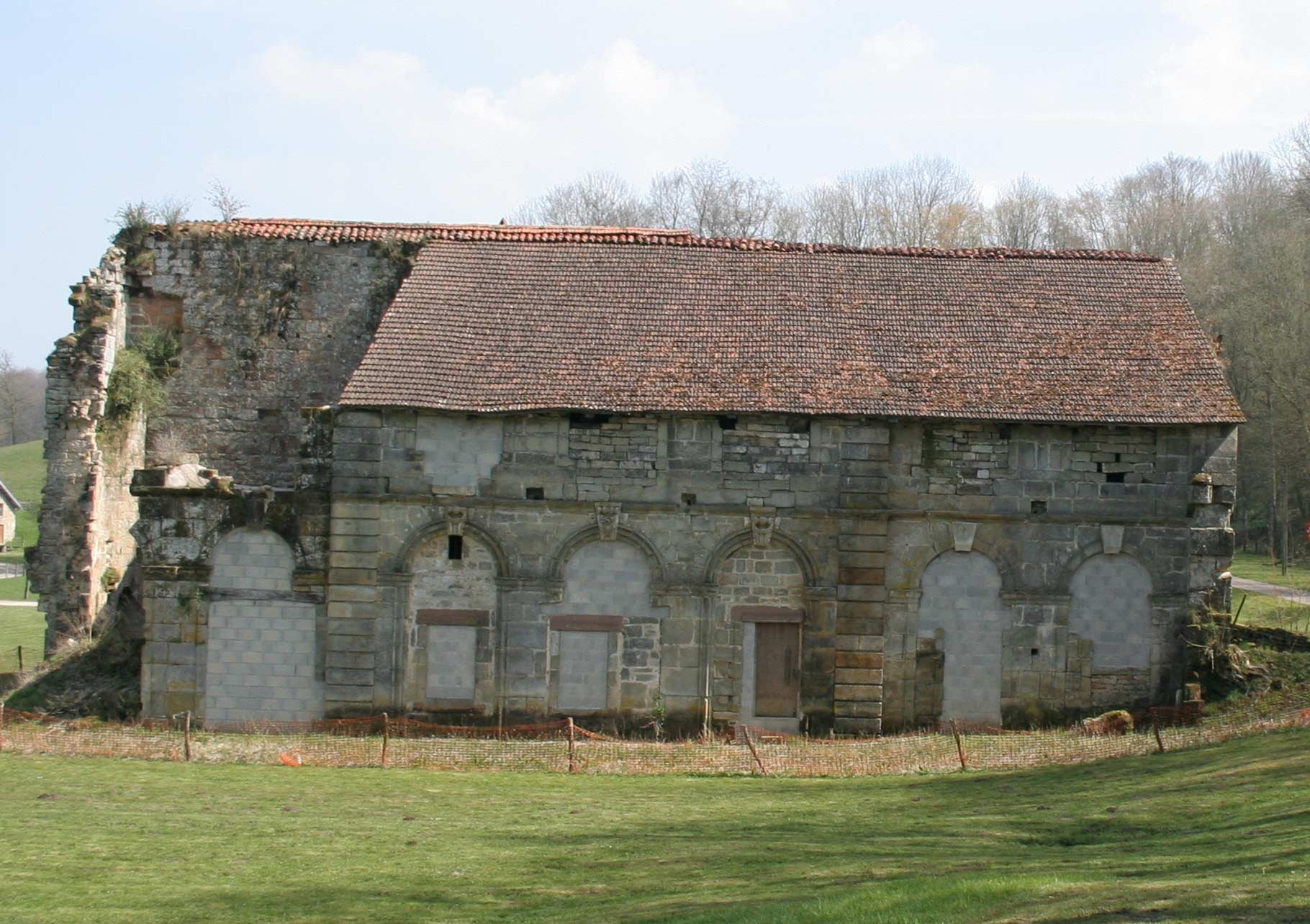
The surviving remains combine fragments of the medieval monastery with eighteenth-century buildings and extensive waterworks. The site preserves evidence of the former church, library, entrance complex, hydraulic installations, granges, and later industrial reuse. Only part of the medieval fabric survives, but the remaining structures and archaeological traces reveal the scale and organization of the abbey.
Church and monastic buildings
Abbey church
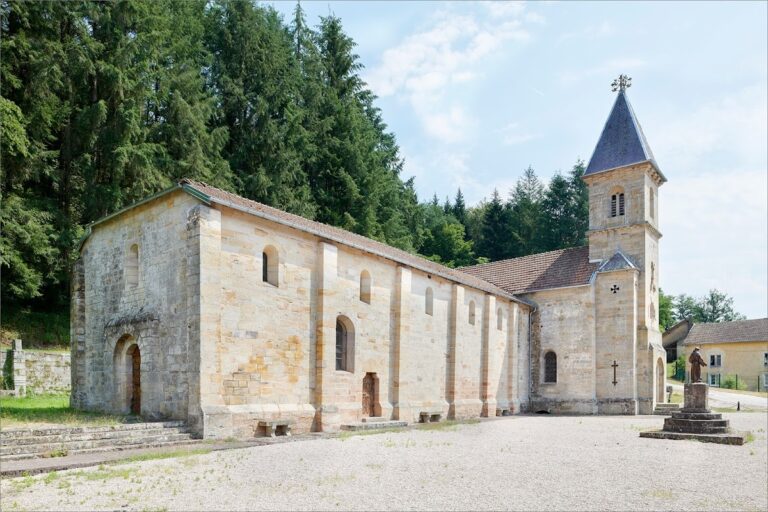
The abbey church followed a Latin-cross plan and a restrained Cistercian design without towers or elaborate ornament. It had a nave, transept, closed choir, two side aisles, and chapels alongside the choir. The aisles ended at the transept rather than continuing around the choir, which had no ambulatory, or passage around the rear of the choir.
The second abbey church was begun under Abbot Guy I in 1230 and completed by 1251. Its dedication was celebrated on 7 September 1253 by Guy of Rochefort. The nave measured 50 metres in length, 10 metres in width, and 25 metres in height. Its ribbed vault, a vaulted ceiling carried by intersecting stone ribs, rested on twelve pillars. The choir and transept were each 30 metres long, while the two side aisles were each 5 metres wide and 10 metres high. The facade had three doorways and a rose window, and the interior contained numerous tomb slabs.
Under the last abbots, the church received a picture gallery, a large tower replacing the original bell tower, a large organ, carved choir stalls, and a baldachin, or canopy over an important sacred feature, measuring 20 metres high and 6 metres wide. The organ, dated 1715, was transferred to Langres Cathedral during the French Revolution. Only a fragment of the north aisle of the medieval church now survives.
Later buildings and collections
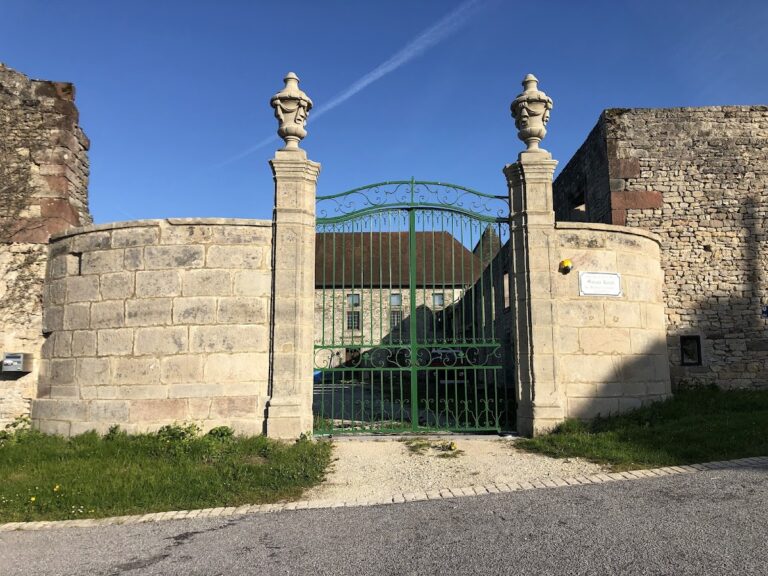
Other surviving or partly surviving structures include the fifteenth-century Sainte-Ursule Chapel and eighteenth-century buildings such as the entrance gate, library, pavilions, and arcades. The Sainte-Ursule Chapel stood outside the abbey enclosure and served workers responsible for the remote estates. The abbey library eventually held about 6,000 volumes. After the Revolution, approximately two-thirds of the collection became part of the library at Chaumont.
Water management and industrial remains
Morimond’s hydraulic system included three ponds covering about 35 hectares in total. The principal abbey pond collected water from five smaller ponds and supplied irrigation, fish ponds, and mechanical power. Water drove sawmills, fulling mills for processing cloth, oil mills, tanneries, and other mills. The monks also created ponds and related waterworks in the surrounding region, including the ponds of Fraucourt and Morimond, the Moulin-Rouge pond near Ravennefontaines, ponds near Montigny, Defoy at Lavilleneuve, and the Petit-Étang near Choiseul.
Beneath the abbey, a vaulted underground sewer network extended for more than one kilometre, with some sections more than 3 metres wide. The remaining hydraulic installations also preserve evidence of the former forges and mills. Later industries reused parts of this system, including the nail-making works below the Grand Étang and the mills beneath the U-shaped canal.
Estates and associated structures
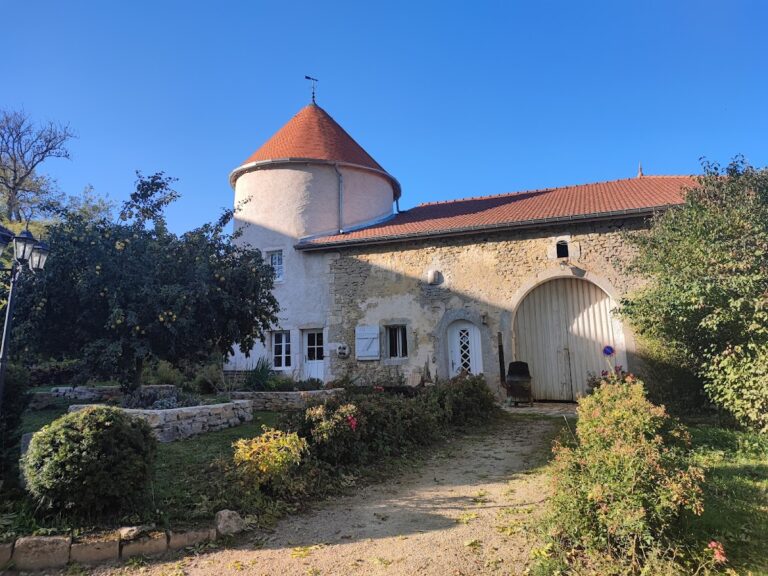
The abbey’s managed landscape included vineyards on the Gouttes hillside, vegetable gardens, cleared woodland, and granges on distant estates. A typical grange consisted of an enclosed courtyard with two large gates. Stables and servants’ quarters stood on one side, while the brothers’ building occupied the other, all within a walled sacred enclosure.
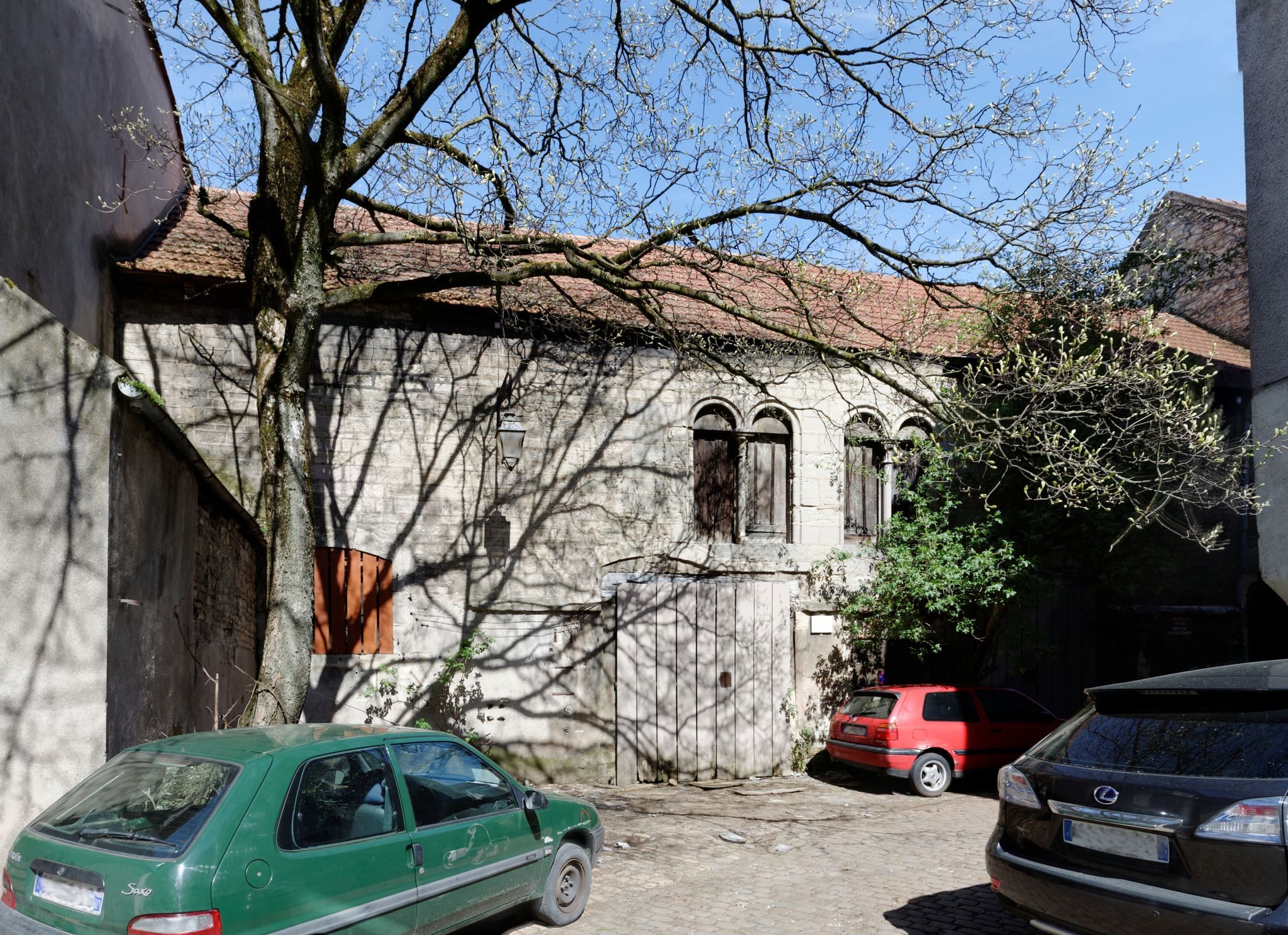
The material remains also include the abbey seal and a dependent Morimond cellar in Dijon. Together with the surviving entrance complex, library, arcades, hydraulic works, and eighteenth-century buildings, these associated remains preserve the institutional and economic reach of the former Cistercian monastery.