Trnová Castle: A Bohemian Estate and Cultural Monument in Czechia
Site at a Glance
- Rating
- 4.6
- Popularity
- Low
- Country
- Czechia
- Primary era
- Early Modern
- External website
- Open
- Eras represented
- Early Modern, Modern
- Civilizations
- Austrian Empire, Habsburg, Holy Roman Empire, Kingdom of Bohemia
- Site type
- Domestic
- Remains
- Castle
On this page14 sections
History
Trnová Castle is a historic castle in Czechia, founded in the seventeenth century as a Baroque residence connected with Dominican friars from St. Giles in Prague. Its development from a religious lodging into a manorial estate, educational centre, and private residence reflects several major changes in the history of the property.
Baroque Foundation and Manorial Estate
The oldest section was built in 1688 to accommodate Dominican friars, members of a Catholic order traditionally associated with preaching and theological study. During the 1720s, a manorial estate was established within the castle complex. On 12 November 1759, the estate was purchased for 20,300 gulden by the knight Kristián Josef Paulin von Gfässer, lord of Bratronice.
During his thirty-year ownership, the residence began to be called a castle and was substantially enlarged. Jan Ferdinand of Schönfeld acquired it in 1789. In 1791, his estate established a basic elementary school and the first agricultural school in Bohemia. The agricultural school taught boys between 12 and 18 years of age, combining instruction with practical work on the manorial estate.
The Škroup and Daněk Periods
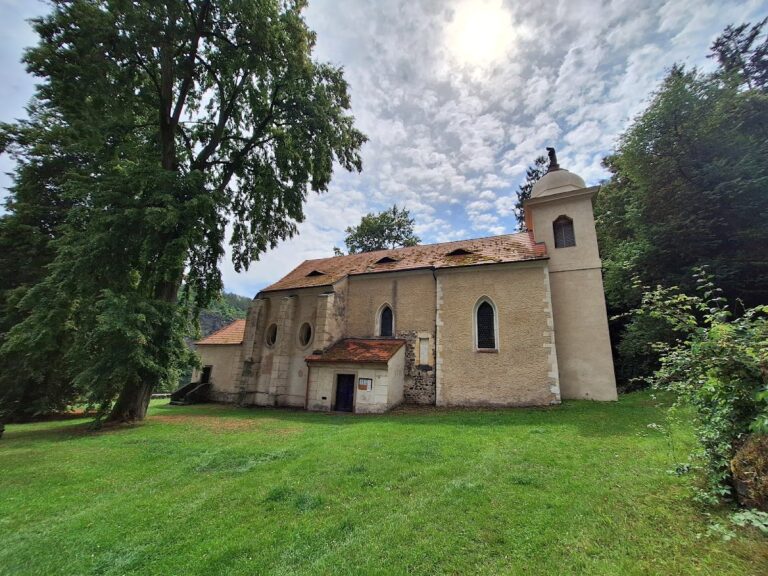
Václav Škroup acquired the estate in 1838. His brother František Škroup, a Czech composer and conductor known for composing the melody of Kde domov můj, frequently stayed at Trnová. He first lodged with the local priest and later, during the 1850s, stayed at his brother’s estate. Local tradition connects the melody with the Kazatelna viewpoint above the Vltava valley, now called Škroup’s Viewpoint. The Škroup family tomb is located in the Church of the Holy Spirit.
Vincenc, also known as Čeněk, Daněk owned Trnová from 1860 to 1864. He carried out a Romantic-style reconstruction before acquiring the larger Tloskov Castle. Daněk was an industrialist who had founded an engineering factory in Karlín in 1854, a business that later formed the basis of the ČKD industrial conglomerate.
Estate Administration and Ema Destinnová
Maximilián, Baron Scharschmied of Adlerstreu, operated a brewery at the castle until 1895. At the beginning of the twentieth century, Karel Košťál owned the property, whose estate also included a gendarmerie station and a two-class school.
Václav Schloger purchased the estate on 10 August 1907 and focused its agricultural activity on grain cultivation, cattle breeding, and supplying milk to Prague. The opera singer Ema Destinnová frequently stayed at Trnová from 1907 or 1908 until 1911. Schloger reserved an entire wing for her. During these stays, she hunted, fished, rode horses, received visitors, and met representatives of the Young Czech political movement associated with Dr. Kramář.
Nationalization, Decline, and Reconstruction
On 12 February 1948, a review commission examined the Trnová estate, then owned by V. and B. Schloger and covering 399 hectares. It ordered the confiscation of agricultural land exceeding 50 hectares. The estate was nationalized in 1949, and the Ministry of Agriculture established a regional inspectorate of the Czechoslovak State Farms national enterprise at Trnová. The inspectorate was transferred to Pardubice in 1951.
The first unified agricultural cooperative in the district was established at Trnová in 1950. The castle later served as an archive and warehouse before being adapted for an agricultural vocational school for horse breeders and professional riders. It entered private ownership in 1967. In 1988, it belonged to a state farm and was in a severely deteriorated condition.
After 1989, the castle, estate, and land were returned to the Schloger family through restitution, the legal return of property confiscated by the state. The Ministry of Culture of the Czech Republic declared Trnová Castle a cultural monument in 1995. Ivan Pilip and his wife purchased it in 2006 and reconstructed it over the following two years, restoring the property from complete ruin to functional use. At the end of 2020, the castle was sold to the Czech-Danish family of Markéta and Finn Hansen.
Remains
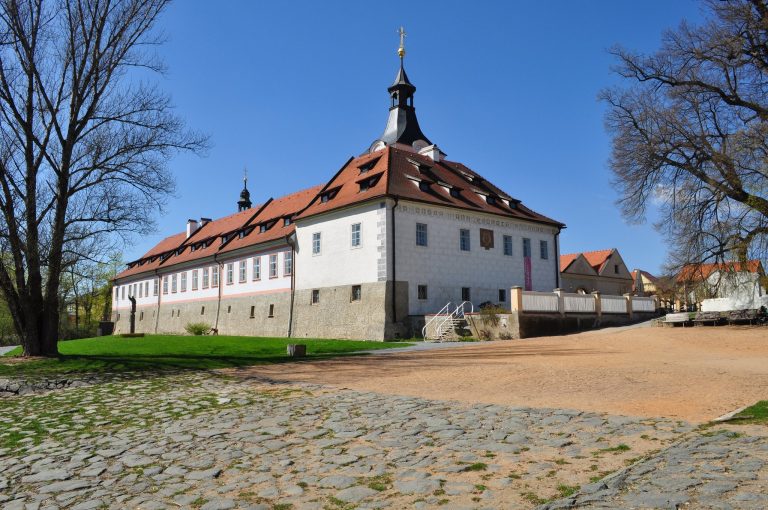
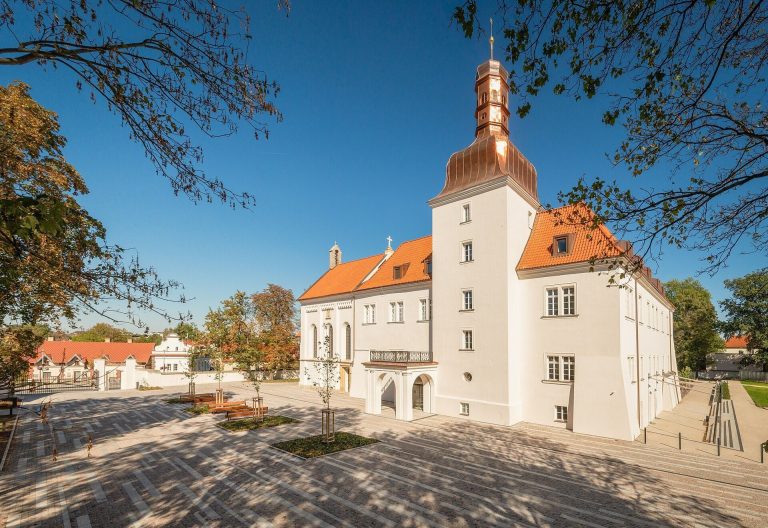
Trnová Castle consists of a Baroque core that was enlarged into a two-storey Classical residence and later altered in a Romantic style. The surviving complex includes the original single-storey building, the stone structure used by the agricultural school, and additions from the nineteenth-century reconstruction. The building was severely deteriorated by 1988 and underwent extensive reconstruction after 2006.
Baroque and Classical Core
Oldest Baroque Building
The oldest part is a single-storey Baroque building with a rectangular ground plan. Its mansard roof, formed with a steeper lower slope and a shallower upper slope, contains dormer windows that provide additional space beneath the roof. The vaulted rooms on the ground floor have survived from this early phase.
Classical Enlargement
The residence was substantially expanded during Kristián Josef Paulin von Gfässer’s ownership. The enlarged Classical castle had two storeys and transformed the earlier Baroque lodging into a larger residential complex.
Agricultural School Building
The agricultural school founded in 1791 occupied a separate stone building that has survived. Its presence preserves a physical connection with the estate’s early role in practical agricultural education.
Romantic Reconstruction
Clock Tower and End Projections
Vincenc Daněk’s reconstruction of 1860 to 1864 added a clock tower and built projecting sections at both ends of the original Baroque building. These changes altered the external form of the earlier residence while retaining its historic core.
Ceremonial Hall and Loggia
The upper floor gained a ceremonial hall with a terrace and staircase. The reconstruction also introduced an open loggia, small corner turrets, and raised surrounds around the windows. Together, these additions gave the castle its Romantic appearance and expanded its formal residential spaces.
Later Adaptations
After nationalization, the castle was adapted successively for use as an archive, a warehouse, and an agricultural vocational school for horse breeders and professional riders. The wing reserved for Ema Destinnová during her stays between 1907 or 1908 and 1911 formed part of the later castle complex. Reconstruction after 2006 restored the building from complete ruin and returned the property to functional use.