Shrewsbury Abbey: A Norman Benedictine Abbey and Parish Church
Site at a Glance
- Rating
- 4.6
- Popularity
- Low
- Country
- United Kingdom
- Primary era
- Medieval
- External website
- Open
- Eras represented
- Medieval, Modern
- Civilizations
- English, Norman
- Site type
- Religious
- Remains
- Church
On this page14 sections
History
Shrewsbury Abbey is a former Benedictine monastery and surviving parish church in Shrewsbury, United Kingdom, founded in the Norman period beside an earlier chapel. Formally the Abbey of Saint Peter and Saint Paul and now the Abbey Church of the Holy Cross, it became a substantial religious, political and economic institution before the Dissolution of the Monasteries in the sixteenth century.
From Saxon chapel to Norman abbey
The abbey originated beside a small chapel dedicated to Saint Peter outside Shrewsbury’s east gate. Siward, son of Ethelgar and a close relative of Edward the Confessor, built the chapel before the Norman Conquest, the takeover of England by William, Duke of Normandy, in 1066. It was probably a wooden parish church, although the Domesday Book, the great survey of landholding and taxable resources completed in 1086, suggests that it may already have operated as a small monastery.
After receiving Shropshire from William the Conqueror in 1071, Roger de Montgomery entrusted the church to his clerk Odelerius of Orleans. Odelerius persuaded Roger to establish a Benedictine monastery there. The Benedictines followed the Rule of Saint Benedict, which governed communal worship, discipline, work and study, and their abbeys were also major landholding institutions.
On 25 February 1083, Roger publicly committed himself to founding the abbey by placing his gloves on Saint Peter’s altar. He granted the entire suburb outside the east gate for its construction. Reginald and Frodo, monks from Saint-Martin-de-Sées in Normandy, formed the nucleus of the new community and began planning the monastic accommodation with Odelerius and Warin, the sheriff of Shropshire. The abbey was probably sufficiently complete by late 1087, when regular monastic life began under its first abbot, Fulchred of Sées.
During its early years, Shrewsbury remained closely associated with Saint-Martin-de-Sées before becoming independent. Roger de Montgomery, his son Robert of Bellême and other associates granted the monastery property and privileges. Its endowment included rural manors, urban property, mills, church tithes and advowsons, the legal rights to nominate parish priests. In 1086 its recorded income was £46 18s. The abbey’s estates and revenues later extended through Shropshire and into Staffordshire, Lancashire, Cheshire and Cambridgeshire, and included churches, salt pans, fisheries, orchards, a vineyard and a sand-pit.
Royal patronage and economic expansion
Robert of Bellême’s rebellion against Henry I in 1102 changed the abbey’s political circumstances. The Crown confiscated Robert’s lands and acquired the abbey’s patronage, weakening its local protection and provoking prolonged disputes over donated properties such as Cheney Longville and Betton in Berrington. Henry I nevertheless confirmed some of the abbey’s holdings, protected its exemptions from customs and supported Abbot Fulchred in disputes with royal forest officials.
In the early twelfth century Henry I confirmed the privileges of Abbot Godfrey and granted the monastery rights over milling in Shrewsbury. The monks received the miller’s fee for grain ground in the town, giving them a milling monopoly, together with fishing rights at both of the town’s bridges. Opposition from the townspeople eventually brought the monopoly to an end in 1267.
The abbey’s urban role increased during the thirteenth century as it expanded its holdings in Abbey Foregate, the market and other parts of Shrewsbury. Its rural estates were generally leased to small farmers or managed as demesne lands by lay bailiffs and stewards rather than cultivated by the monks themselves. During the early fourteenth century, the abbey increasingly replaced demesne farming with leases. Its Shropshire demesnes declined from 21 carucates in 1291 to 12 in 1355. A carucate was a medieval measure of land, generally representing the area that one plough team could cultivate in a year.
Saint Winifred and the medieval religious community
In 1137–1138, Robert of Shrewsbury, then prior under Abbots Herbert and Ralph, arranged the translation of Saint Winifred’s remains from Gwytherin in Wales to Shrewsbury. The relics were carried on foot for about a week, placed temporarily in Saint Giles’s Church and then taken in procession to the abbey, where further miracles were reported. They were subsequently enshrined at the abbey.
Robert wrote a life of Saint Winifred soon after the translation and later became the abbey’s fifth abbot. His promotion of her cult helped establish Shrewsbury as an important pilgrimage centre from the fourteenth century onward. Saint Winifred was a Welsh Christian saint whose cult was also associated with Holywell. The abbey acquired relics connected with Saint Thomas Becket, the archbishop of Canterbury murdered in 1170, and apparently during the abbacy of Nicholas Stevens it received the relics of Saint Beuno from Rhewl. The abbey was fined but allowed to retain them.
The cults of Saint Winifred, Saint Beuno and Saint Elerius became increasingly important in the later Middle Ages. Saint Beuno was traditionally regarded as Saint Winifred’s uncle and spiritual adviser, while Saint Elerius was regarded as her spiritual director. Henry V proposed a chapel dedicated to Saint Winifred, papal support was granted in 1463, and Abbot Thomas Mynde developed the project from 1487 with help from a guild of men and women.
The community generally contained between 12 and 18 monks in the later Middle Ages. One monk normally served at Morville Priory, a dependent cell between Bridgnorth and Much Wenlock. The abbey also maintained chantries and chapels. These included the Chapel of Saint Mary behind the high altar, which contained Roger de Montgomery’s tomb; a chantry for Ralph of Shrewsbury, Bishop of Bath and Wells, established in 1343–1344; and a chantry for John Burley founded in 1414. A chantry was an endowed foundation for continuing prayers and Masses for a named person’s soul.
In 1333, at the request of Edward III and Queen Philippa, the pope allowed revenues from Wrockwardine church to support the theological education of two monks at a university. The provision was later reduced to one monk. Shrewsbury also maintained intellectual connections with Oxford, and Abbot Thomas Prestbury served as chancellor of Oxford University from 1409 to 1412.
Crisis, rebuilding and political authority
The economic crisis of the early fourteenth century and repeated outbreaks of the Black Death damaged the abbey’s resources. Plague reduced the labour force, contributed to the disrepair of buildings and created a shortage of priests. In 1365 the pope authorised Abbot Nicholas Stevens and the prior of Coventry to ordain ten priests each to compensate for the shortage.
Major rebuilding took place at the west end of the abbey during the fourteenth century. The great west window was probably glazed around 1388, during Nicholas Stevens’s abbacy, and he may also have directed other alterations. In 1389 Richard II granted the abbey a charter, citing both his devotion to Saint Winifred and his regard for Stevens.
Stevens also attempted to annex Sandwell Priory in Staffordshire to Shrewsbury Abbey. The dispute involved the assault and later abduction of John de Kyngeston in 1370 and 1379, the installation of a Shrewsbury monk as prior and further armed intervention after 1397. Stevens largely escaped punishment. During his administration the abbey acquired Saint Beuno’s relics and built a new shrine for Saint Winifred.
Abbot Thomas Prestbury attempted unsuccessfully to mediate before the Battle of Shrewsbury in 1403. He had earlier been placed in the custody of the Abbot of Westminster and was suspected of Lancastrian sympathies after becoming abbot in 1399. The abbots also held important political and administrative positions. After the Crown confiscated Robert of Bellême’s lands, the abbot became a tenant-in-chief and had to attend Parliament. Abbot Luke of Wenlock acquired a London residence for parliamentary and political business, and the Abbot of Shrewsbury was among the 28 abbots summoned to Parliament during Edward III’s reign. From 1397 the abbots were reportedly permitted to use the mitre and other pontifical insignia.
Late medieval decline and the Dissolution
In the late fifteenth and early sixteenth centuries, visitations under Abbot Richard Baker recorded debts, inadequate accounts, decaying buildings and leases made without chapter approval. The infirmary was in ruins, and its window glass was removed for the subprior’s private chamber. In 1508 Abbot Richard Lye granted substantial supplies, timber, tithes and property to his sister Joan and her husband, John Copeland.
Under Abbot Thomas Boteler, complaints included further decay, lax accounting, the diversion of revenues intended for Oxford study, the Saint Winifred chantry and choir books, and the disappearance of the infirmary. The Valor Ecclesiasticus of 1535 assessed the abbey’s annual income at £527 15s. 5 3/4d., including £414 1s. 3 1/4d. from temporal estates in 26 Shropshire manors and seven manors in other counties. By 1536 the abbey had no students at Oxford despite its earlier educational endowments.
Henry VIII considered creating a cathedral for Shropshire by converting Shrewsbury Abbey, but the plan was not implemented. The abbey surrendered on 24 January 1540 during the Dissolution of the Monasteries, the suppression of England’s religious houses under Henry VIII and the confiscation and redistribution of their property. The abbot received a pension of £80, while the 17 monks received a combined total of £87 6s. 8d.
Parish church and later history
After the Dissolution, the abbey site and lands were leased and then sold in 1546 to Edward Watson and Henry Herdson. They sold the property the following day to William Langley. It later passed from the Langley family to Edward Baldwin and then to the Powys family. The western part of the monastic church continued as a parish church after 1540. Its patronage, originally controlled by the abbey and later by the Crown, passed to Thomas Noel Hill, 2nd Baron Berwick, in 1797. The parish was incorporated into Shrewsbury’s civic authority by the municipal charter of 1586.
The church appears to have been damaged when Shrewsbury was fortified after Parliamentarian forces took the town in 1645 during the English Civil War, the conflict that divided supporters of Parliament and the Crown in the 1640s. Repairs in 1649 addressed breaches in the north side and east end, using stone from demolished abbey buildings. During the Puritan period, opposition to the veneration of saints and relics led to the common use of the name Abbey Foregate Church.
Removal of the lead roof after the Reformation caused severe decay and the collapse of parts of the building. Further destruction affected the monastic complex, especially when Thomas Telford’s A5 road was built through the abbey grounds around 1836. The church was restored during the nineteenth century, including work to recover the clerestory and a major redesign of the east end by John Loughborough Pearson. The restoration of 1886–1894 was formally dedicated in May 1894.
The churchyard became Shrewsbury’s first public cemetery under an Act of Parliament obtained in 1840 and was consecrated in 1841. It held 148 burials before being sold back to the abbey church in 1888, by which time the municipal cemetery on Longden Road, opened in 1856, was more heavily used. A late nineteenth-century proposal to make the church a cathedral was reconsidered, but legislation drafted in 1922 was defeated in the House of Lords in 1926.
The Abbey Church of the Holy Cross was listed as a Grade I building on 10 January 1953, while the abbey site, including the pulpit, is a scheduled monument. It remains a Church of England parish church and the mother church of Holy Cross parish within the Diocese of Lichfield. Memorials in the church commemorate parishioners killed in the two world wars, including the war poet Wilfred Owen. In 1993 the Wilfred Owen Association erected the memorial sculpture Symmetry in the churchyard, designed by Paul de Monchaux and incorporating a line from Owen’s poem Strange Meeting. The area around the abbey has also been prone to flooding in recent times.
Remains
The surviving medieval church
Nave and western structures
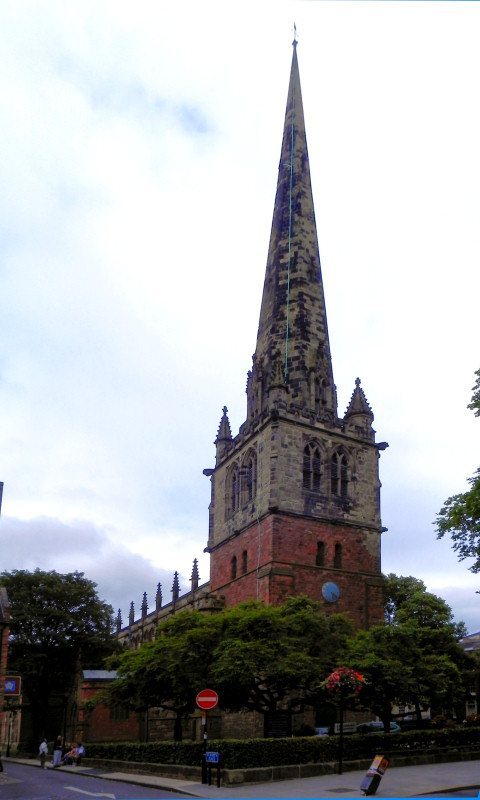
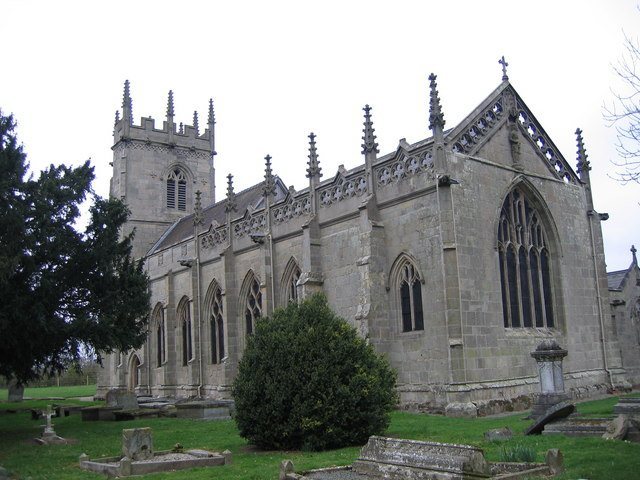
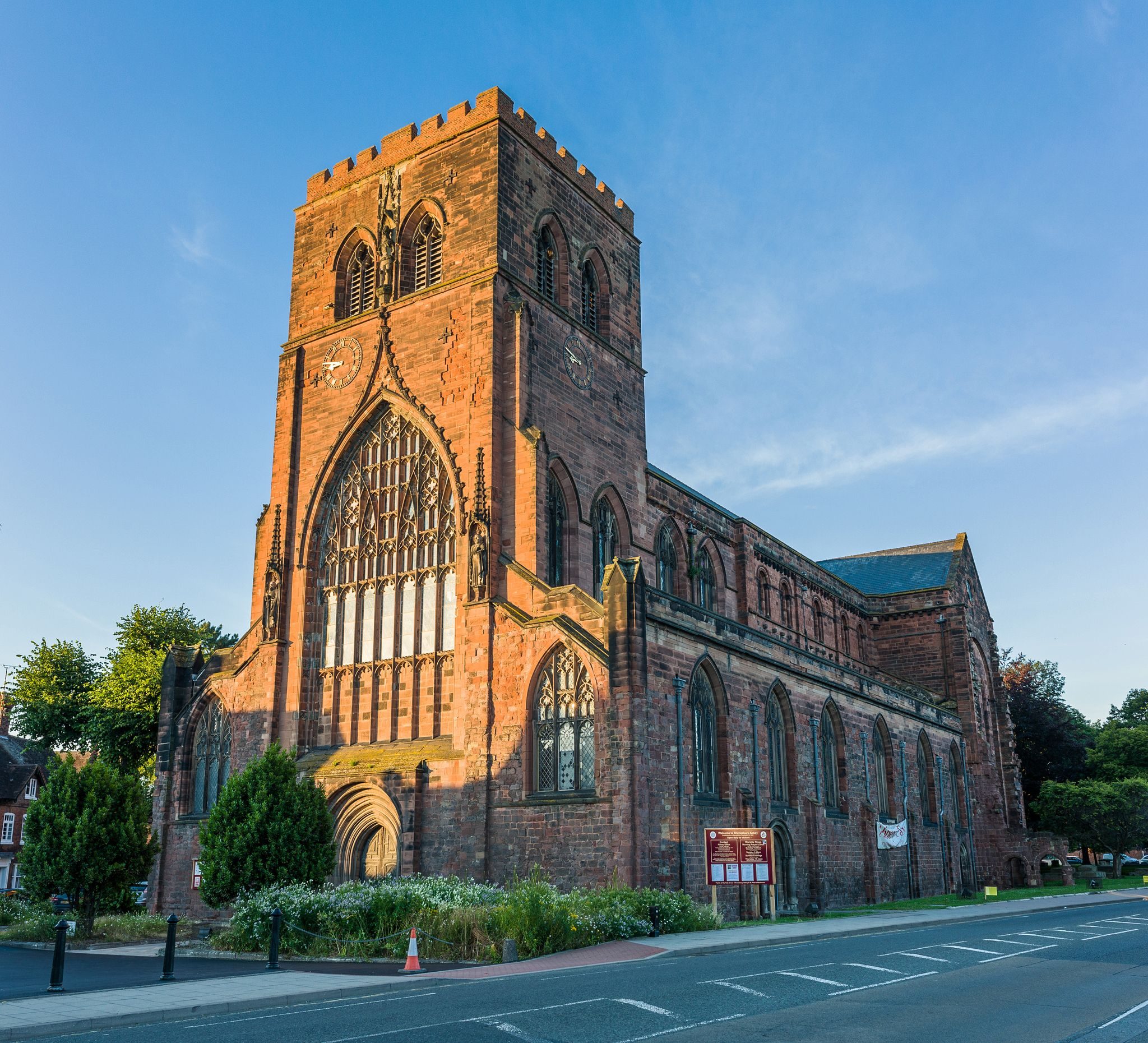
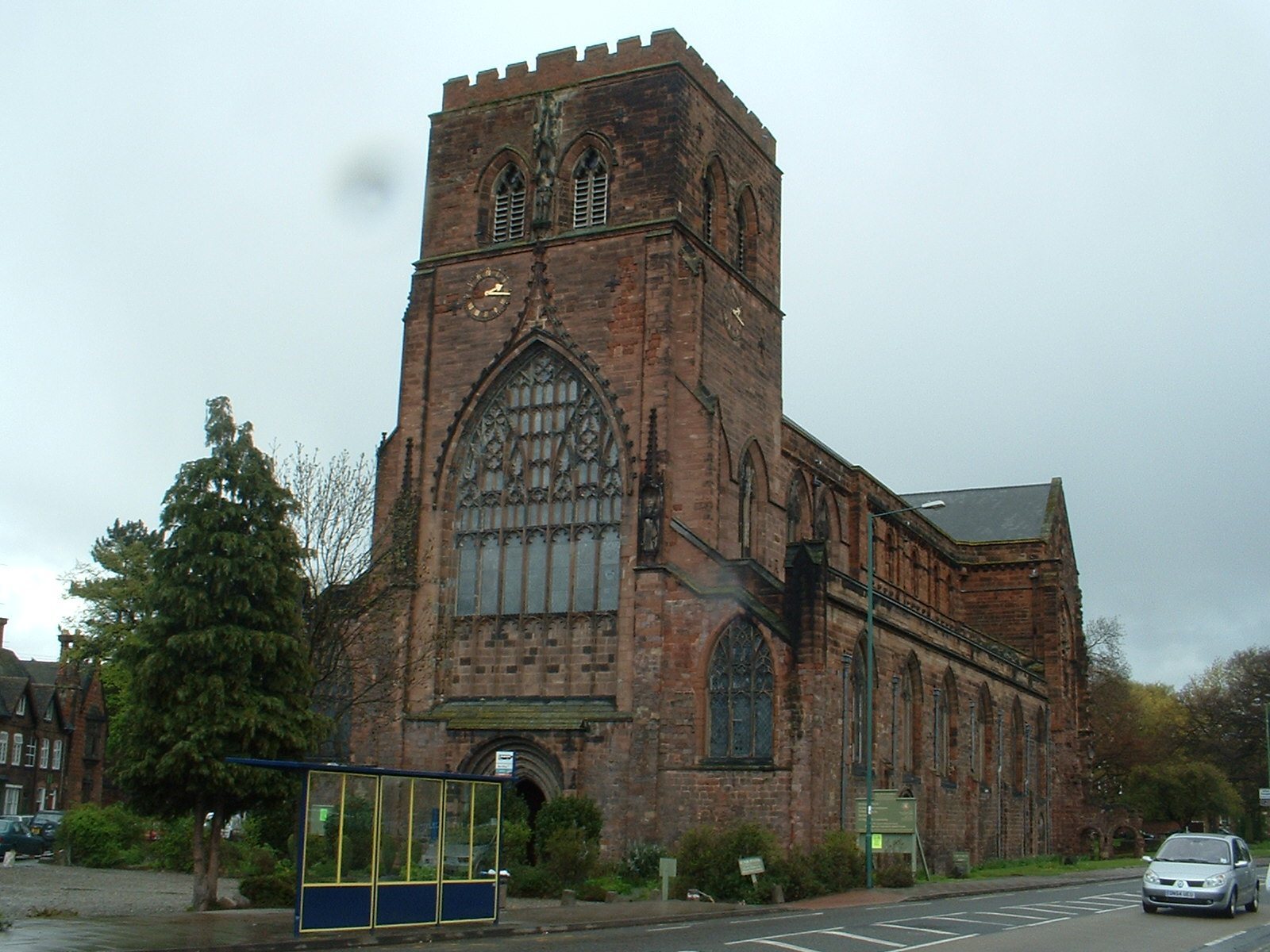
The surviving church is built chiefly of red sandstone and combines Romanesque and Gothic work. The western portion of the medieval abbey church forms the present nave, side aisles, porch and west tower. Short, thick piers in the eastern half of the nave preserve important parts of the original Norman building, while remnants of the original transepts also survive.
The Norman clerestory, the upper row of windows above the aisle roofs, survived into the seventeenth century. It was later dismantled, and the roof was rebuilt immediately above the triforium, the interior gallery or arcade below the clerestory. These alterations help explain the present relationship between the surviving medieval masonry and the later roof line.
East end and cemetery
The east end was redesigned in the nineteenth century with a chancel and sanctuary. The present cemetery covers much of the former eastern end of the monastic church, linking the surviving parish building with the earlier plan of the abbey. The churchyard also contains the memorial sculpture Symmetry, erected in 1993 in memory of Wilfred Owen and incorporating words from Strange Meeting.
Monastic buildings and sculpture
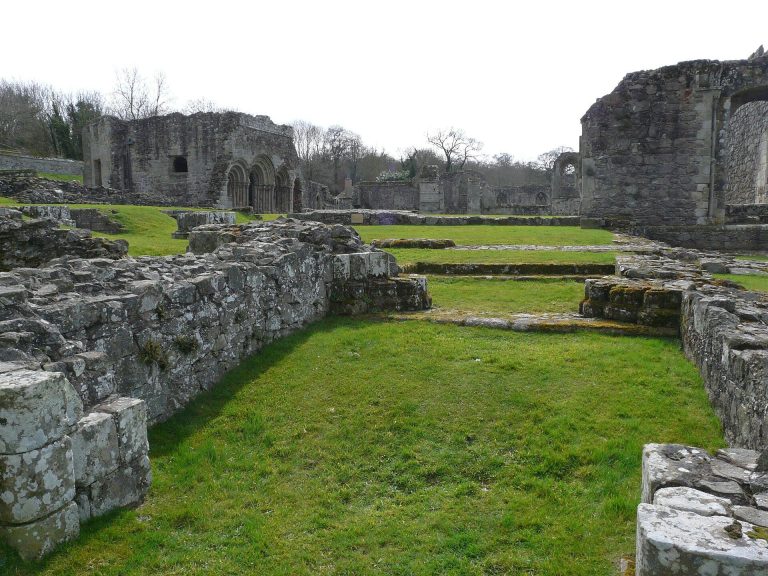
The surviving remains of the former monastic buildings include the old refectory pulpit, visible across the road from the church, and one wall of an abbey building incorporated into another structure. Considerable monastic remains were still standing in 1743. Three sculpted stone figures representing John the Baptist, Saint Winifred and Saint Beuno were found in a garden, restored and returned to their original position in the screen.
Relics, burials and memorials
The church formerly housed the shrine and relics of Saint Winifred, whose cult shaped the abbey’s medieval pilgrimage function. It also held relics associated with Saint Thomas Becket, including a rochet, a blood-stained cloth and items of clothing, as well as relics of Saint Beuno. These objects connected the church’s physical interior with the devotional practices that developed around its saints and shrines.
Burials associated with the abbey include Roger de Montgomery, first Earl of Shrewsbury; Hugh of Montgomery, second Earl of Shrewsbury; and William FitzAlan, Lord of Oswestry. Stone war memorial tablets stand on opposite walls at the west end of the church. The First World War tablet includes Lieutenant W. E. S. Owen, M.C., of the Manchester Regiment.
Bells, clock and organ
At the Dissolution, the abbey possessed two rings of five bells, one in the present tower and another in a central tower. George Oldfield of Nottingham cast a ring of eight bells in 1673, and these were replaced over time by the present bells. They were rung full-circle until at least 1895. In 1909 they were removed and rehung without wheels in a new frame because of concerns about the tower’s safety. An Ellacombe apparatus, a mechanism that allows one person to sound bells by pulling ropes connected to their clappers, operates them.
The present ring includes a treble and second cast by Thomas Mears II of London in 1825, a third by John Taylor and Company of Loughborough in 1884, a fourth by John Briant of Hertford in 1812, and a fifth by Charles and George Mears of London in 1846. The sixth was cast by Abel Rudhall of Gloucester in 1745, the seventh by John Warner and Sons of London in 1877, and the tenor by Abraham Rudhall of Gloucester in 1713.
A clock made by J. B. Joyce and Company was installed in 1909 after being donated by the Shropshire Horticultural Society. The church organ was built by William Hill and Son in 1911 and was initially designed on the scale of a cathedral organ, although the original scheme was not completed. Renovation in 2020–2021 replaced its tubular pneumatic actions with electric pneumatics, cleaned the instrument and pipework, restored the choir-organ expression box, repositioned reservoirs and blowers, renewed the wind trunking, installed additional pipework and chests, and restored and electrified the original console.