Birka and Hovgården: Viking-Age Trading and Royal Centers in Sweden
Site at a Glance
- Rating
- 4.2
- Popularity
- Medium
- Country
- Sweden
- Primary era
- Medieval
- External website
- Open
- Eras represented
- Bronze Age, Medieval, Modern
- Civilizations
- Swedish
- Site type
- City
On this page22 sections
History
Birka and Hovgården are a Viking-Age archaeological complex in Sweden, established on Björkö and Adelsö respectively during the 8th century. The two settlements formed a commercial and political center during the period of Scandinavian maritime expansion, trade, raiding, settlement, and political change conventionally dated from the late 8th to the 11th century. Birka became a major trading and craft center, while Hovgården served as a royal estate and a base for governing the settlement.
Before Birka
The wider area had a long history before the Viking Age. Bronze Age cairns stood on the former island of Grönsö, and a cemetery northwest of Hovgården was used approximately between AD 600 and 1100. Birka’s predecessor was Helgö, an island trading and craft center active from approximately AD 200 to 800. Helgö was probably associated with the royal residence at Hundhamra, but Birka eventually eclipsed it.
Birka was probably founded around the middle or later part of the 8th century, although its exact foundation date is uncertain. Its position was strategically suited to maritime exchange. Routes connected the settlement with the Baltic, Svealand, Södertälje, Gamla Uppsala, Bergslagen, and the region of present-day Stockholm. Its protected position in the waterways of Lake Mälar helped it develop into a concentrated center of commerce and production.
Trade and administration
Birka’s early commercial contacts focused largely on western Europe, including Dorestad and Wolin. From the late 9th century, trade increasingly turned toward the east, including regions in present-day Russia and the Muslim world. This change was connected with Varangian expansion and the routes along the Volga and Dnieper.
The settlement exported iron, furs, antler, walrus ivory, amber, honey, eiderdown, and other goods. Enslaved people were also exported to eastern markets. Imports included pottery, glass, silk, Byzantine-style embroidery, silver, and other luxury products. Birka depended on surrounding farms for food, fuel, and building materials, and as much as roughly one-quarter of the Mälardalen region may have been needed to supply the settlement.
Birka probably held a special legal and administrative status granted by the Swedish king or a local ruler. Its assembly, or Thing, dealt with political decisions, disputes, and legal matters, while a prefect administered the settlement. Legal protection extended to free inhabitants, including foreigners. The Björkö or Bjarkey law probably influenced later Scandinavian merchant-town laws and Swedish municipal privileges. Birka is therefore sometimes described as Sweden’s first town or as a proto-city, meaning a large specialized settlement with concentrated trade, craft production, and administration but without all the institutions of a later medieval city.
Hovgården was established in connection with Birka as a royal estate. It was probably the residence of the king or one of several contemporary kings, and it was associated with the assembly and with the political administration of Birka. The extent of the authority exercised by its rulers over Sweden as a whole remains uncertain.
Conflict and Christian missions
Birka and Hovgården may have stood in tension with the religious and political authorities of Gamla Uppsala. During a succession conflict in the 840s, Anund II of Uppsala attacked or threatened Birka. Hergeir, Birka’s prefect, negotiated with him and offered one hundred pounds of silver from the inhabitants. The settlement was ultimately spared.
King Björn II probably ruled from Hovgården during the first Christian mission to Birka, while his brother Anund II was associated with Gamla Uppsala. By the time of the second mission, Olof I of Sweden was ruling. The political relationship between the rulers of Hovgården, the Munsö dynasty, and the Suione aristocracy remains partly interpretive.
Ansgar, a Frankish monk and missionary, came to Birka in AD 829 to promote Christianity. King Björn II gave him permission to preach at Hauge. Ansgar did not convert the king, but he baptized Hergeir, the settlement’s prefect, and remained for approximately eighteen months.
Bishop Gauzbert and Nithard continued the Christian mission. In AD 845, Nithard was killed and Gauzbert’s residence was burned, forcing Gauzbert into exile. Ansgar sent the hermit Ardgar to Birka around AD 850 or 851, then returned with Erimbert in AD 852 or 853. After negotiations with the king and the Thing, he received permission to preach and build a church.
Christian priests continued their work after Ansgar’s departure, although resistance from adherents of pre-Christian Norse religion remained strong. Archbishop Unni of Hamburg-Bremen died at Birka in AD 936 while on a mission, showing that efforts to establish Christianity in the region continued into the 10th century. Information about these missions comes especially from the near-contemporary account of Ansgar’s life written by his companion and successor Rimbert, as well as from later medieval historical writing.
Decline and the later royal estate
Birka declined rapidly around AD 970. Coins from AD 962 have been found at the settlement, but the abundant Anglo-Saxon issues of the 980s have not. Some occupation may have continued into the 11th century, but the period of prosperity had ended. In the 1060s, Adalvard the Younger was said to have found Birka abandoned while searching for Archbishop Unni’s grave.
The reasons for the abandonment remain uncertain and probably involved several factors. Post-glacial land uplift altered the shorelines and closed navigation channels. Eastern trade may have been disrupted by conflicts in the Volga region, and a destructive battle may also have affected the settlement. Commercial functions and population may have shifted to Sigtuna, founded around the same period.
Hovgården retained its royal significance after Birka’s decline. A runestone erected around AD 1070 refers to a king, and the estate was recorded as a royal domain in AD 1200. Adelsö Church was built nearby in the 12th century. Around AD 1270, Magnus III of Sweden commissioned Alsnö hus, probably as a summer residence, on or beside the former Viking royal site. The Ordinance of Alsnö, issued in AD 1279 or 1280, helped define the legal status of the Swedish nobility. The palace was destroyed at the end of the 14th century, possibly during attacks by the Victual Brothers.
Rediscovery and protection
After Birka and Hovgården were abandoned, the sites were largely forgotten for several centuries. Johan Hadorph conducted the first recorded investigations at Birka around 1680. Alexander Seton resumed excavations in 1825, particularly in the Hemlanden cemetery, and the Ansgar Cross was erected in 1834.
Hjalmar Stolpe began extensive excavations in 1871 after identifying the Black Earth while searching for amber. His work focused on the settlement and Hemlanden cemetery and brought Birka to international attention when an archaeology congress was held there in 1874. Among the finds was a silver hoard of approximately 450 Islamic coins, discovered in 1872.
Research later expanded to Hovgården and to the fort and Garrison at Birka. Bengt Thordeman investigated Alsnö hus between 1916 and 1920 and identified evidence of a Viking settlement beneath or near the medieval palace. Hanna Rydh studied graves at Hovgården. Holger Arbman excavated at both sites, identified the Garrison, and published the first major analysis of Stolpe’s finds in Birka I in the early 1940s. Greta Arwidsson completed the inventory in Birka II, published in three volumes between 1984 and 1988.
Excavations at Hovgården in 1966, 1969 to 1971, and 1992 to 1994 investigated Viking-period structures and the Viking and medieval harbors. From the 1970s, research at Birka became more systematic, and from 1999 it expanded particularly around the fort and Garrison. The Swedish state acquired a substantial part of Björkö between 1912 and 1914 for heritage protection, while active restoration began in 1931. Birka and Hovgården were inscribed together on the UNESCO World Heritage List in 1993 under criteria (iii) and (iv), recognizing their exceptionally well-preserved evidence for Viking commercial networks and Birka’s importance as a Viking trading town.
Remains
Birka settlement and defenses
The Black Earth
Birka’s principal inhabited area, known as the Black Earth, covers approximately seven hectares. This dark, organic-rich occupation layer formed through prolonged settlement and reaches up to two metres in thickness. It lies between the former shoreline on the west and the enclosure wall on the east, while phosphorus concentrations indicate that habitation extended beyond the wall toward the northeast across approximately thirteen hectares.
The settlement was divided into plots by streets and drainage ditches. A typical plot contained one or two timber-framed houses together with workshops or shops. Walls were made from wattle and daub, and roofs used thatch, wood, or turf. Later agriculture disturbed parts of the upper layer, but the high pH and phosphorus content helped preserve bronze and iron objects, coins, glass, ceramics, bone, textiles, and food remains. Animal bones show that residents consumed cattle, pigs, sheep, goats, birds, and fish.
Harbors and enclosure wall
The western side of Birka formed a shallow bay used as an anchorage. The names Kugghamn and Korshamn indicate additional harbor areas, and another harbor may have been located at Salviksgropen. Excavations in 1969 to 1971 uncovered a quay near the Black Earth made from rough stones approximately three by ten metres in size, together with wooden posts. Rectangular stone structures at Kugghamn and Korshamn were probably similar quays.
A semi-circular enclosure wall protected the settlement. Approximately 450 metres remain visible, while the original wall probably continued southward to the fort, giving it a total length of about 700 metres. The missing section was probably damaged or destroyed by agriculture. The wall was hollow, with two parallel stone faces and a core of earth and turf. Wooden palisades and towers probably stood at the gates, and several older burial mounds were incorporated into its course. Construction took place in stages after AD 900. One section dates to after AD 925 because a coin from that year was found beneath it, and an earlier wall may have been destroyed and rebuilt as the settlement expanded.
A wooden barrier extended the defenses into the water, protecting the western bay and harbor. It probably consisted of upright posts and floating gates that controlled access. Some posts remain visible when the water level is low.
Borgen and the Garrison
The fort known as Borgen occupies a high point south of the settlement. Its semi-circular rampart is approximately 350 metres long, two to three metres high, and seven to eight metres thick. A natural cliff interrupts the western side, which formerly overlooked the sea. The rampart was also a hollow construction and probably carried a wooden parapet or battlements.
Borgen appears to have been founded around the time of Birka. Its initial rampart burned in the early 9th century, while a more substantial later rampart suffered several fires between the late 10th and early 11th centuries. The later rampart incorporated burial mounds, including a large mid-8th-century grave containing a man and a horse. The burial probably belonged to a high-status person associated with the families who established Birka.
Two openings in the northern enclosure wall probably served as gates. The northwestern gate led toward four terraces descending to the lake. This area, later called the Garrison, contained buildings from the early 9th century until the end of Birka’s occupation and was enclosed by palisades.
Warriors’ Hall
The Garrison included probable dwellings, a forge, and the Warriors’ Hall, built in the second half of the 10th century. The hall measured approximately 19 by 9.5 metres. Its double walls consisted of an outer timber frame and an inner wattle-and-daub wall, while two rows of pillars supported the roof. The interior was probably divided into two rooms, each with a hearth.
High-status objects in the northwestern part of the hall suggest a place of honor. The building may also have been used for animal or object sacrifices, possibly to Odin, a principal god of pre-Christian Norse religion associated with warfare, rulership, wisdom, and the dead. Chests, locks, weapons, and armor were recovered from the Garrison, many showing eastern influences.
The Warriors’ Hall and other Garrison buildings appear to have burned near the end of the 10th century. Scattered weapons indicate a violent confrontation, possibly involving attackers arriving by sea, although the connection between this event and Birka’s abandonment remains uncertain.
Birka’s cemeteries and finds
Burial grounds
Björkö contains at least 2,500 graves. Hemlanden, northeast of the Black Earth, contains about 1,600 burials. Bjorgs Hage and Kvarnbacka, south of the fort, contain about 400, with another cemetery between the fort and the Black Earth. Approximately 1,100 graves have been studied, although some contain more than one individual.
The burial grounds include cremations beneath mounds, stone-ship formations, triangular cairns, inhumations with complete skeletons, and 111 chamber graves. A chamber grave placed the deceased and grave goods inside a wooden chamber, usually beneath a mound. These burials were probably reserved for wealthy or high-status individuals, and their unusually high concentration suggests wider European influence.
Burial customs and dates vary across the island. Cremations occur mainly at Hemlanden and south of the fort, while inhumations and chamber graves are especially common near the enclosure wall and between the fort and the Black Earth. The oldest burials are generally south of the fort, while many 10th-century burials are located at Hemlanden. Grave goods include wool and linen clothing, bronze brooches, silk fragments, weapons, jewelry, luxury objects, and horses. Chamber graves represent about ten percent of the excavated graves but contain more than half of the total value of recovered objects.
Notable grave finds
Chamber grave Bj 581 contained a sword, axe, spear, arrows, shields, a knife, and two horses with riding equipment. Genetic analysis published in 2017 identified the human remains as female, supporting the interpretation of a high-status woman buried with military equipment. The interpretation of the burial as that of a warrior has also been debated because of uncertainties concerning the bones and aspects of the analysis.
Other finds include a Mjöllnir pendant, the hammer associated with the Norse god Thor, from a chamber grave at Hemlanden; a ring bearing a Kufic inscription meaning “Allah” from a grave north of the fort; turtle brooches from Hemlanden; and silver clothing fasteners shaped as riders from a chamber grave beneath the enclosure wall.
Hovgården and the royal estate
Royal mounds and assembly site
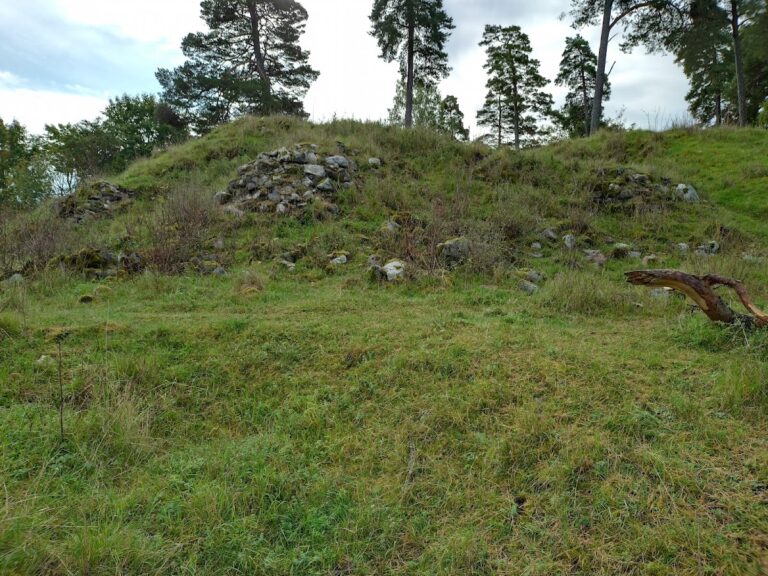
Large burial mounds lie north of Adelsö Church. Three royal mounds include one approximately 45 metres in diameter and five to six metres high. They are traditionally regarded as royal graves, although their dates are unknown and some may be older than the Viking-period royal estate. A flatter mound approximately 25 metres in diameter lies west of the royal mounds and is probably the former assembly site, or Thing mound.
Farther north, the Skopintull mound was excavated in 1917 and dated to the early 10th century. It contained the cremated remains of a man and woman in a boat, together with dogs, horses, and numerous valuable objects indicating high status and wealth.
Viking buildings and harbor
Excavations between 1991 and 1994 revealed a Viking-period building immediately east of, and partly covered by, the ruins of Alsnö hus. It stood on a small hill overlooking the bay and resembled the great hall in Birka’s Garrison.
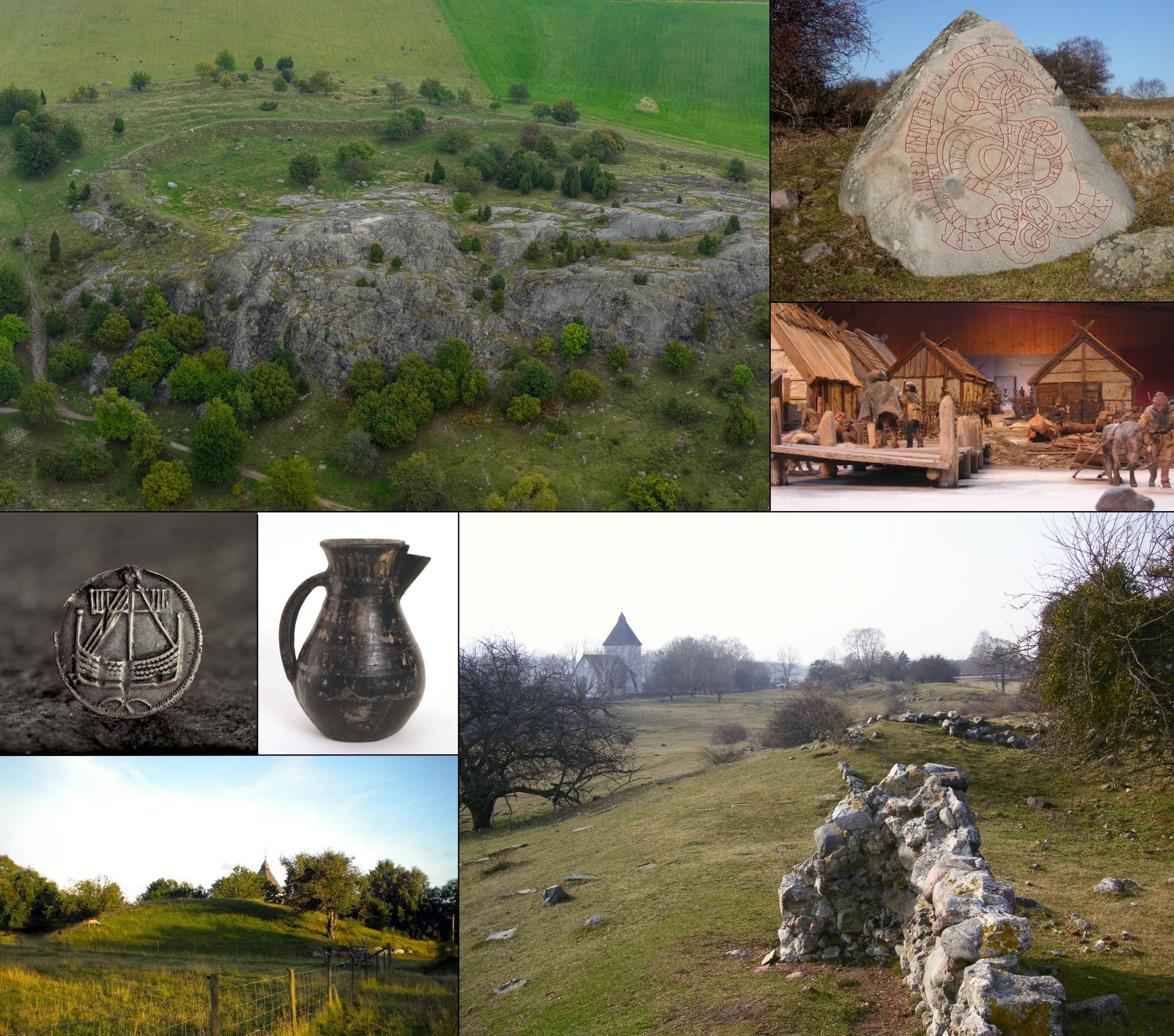
During the Viking Age, the depression between Adelsö Church and Alsnö hus formed a bay. Excavation identified it as the Viking harbor, with a stone quay approximately 30 to 40 metres long on its eastern side. A nearby building was interpreted as a workshop, possibly used by a goldsmith. The Hovgården runestone stands near the harbor and dates to the 1070s. Its reference to a king has been interpreted as evidence that the royal residence remained active after Birka was abandoned.
Alsnö hus and later buildings
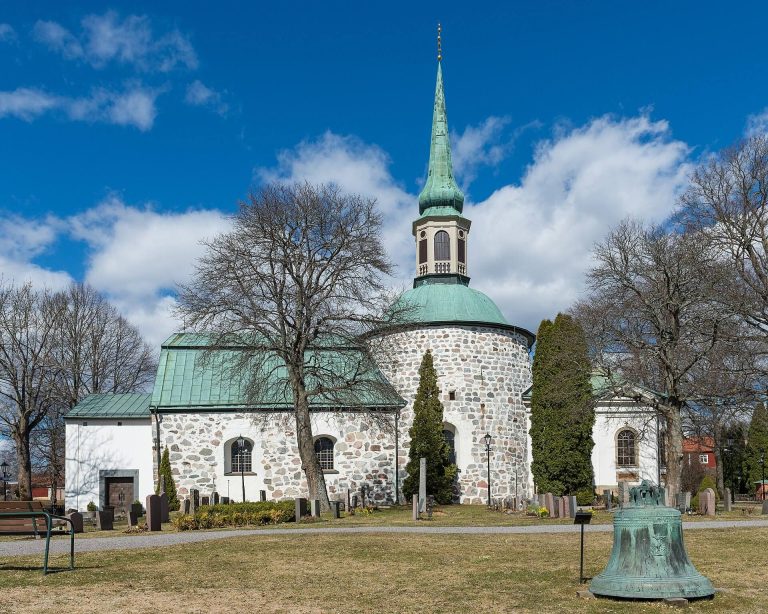
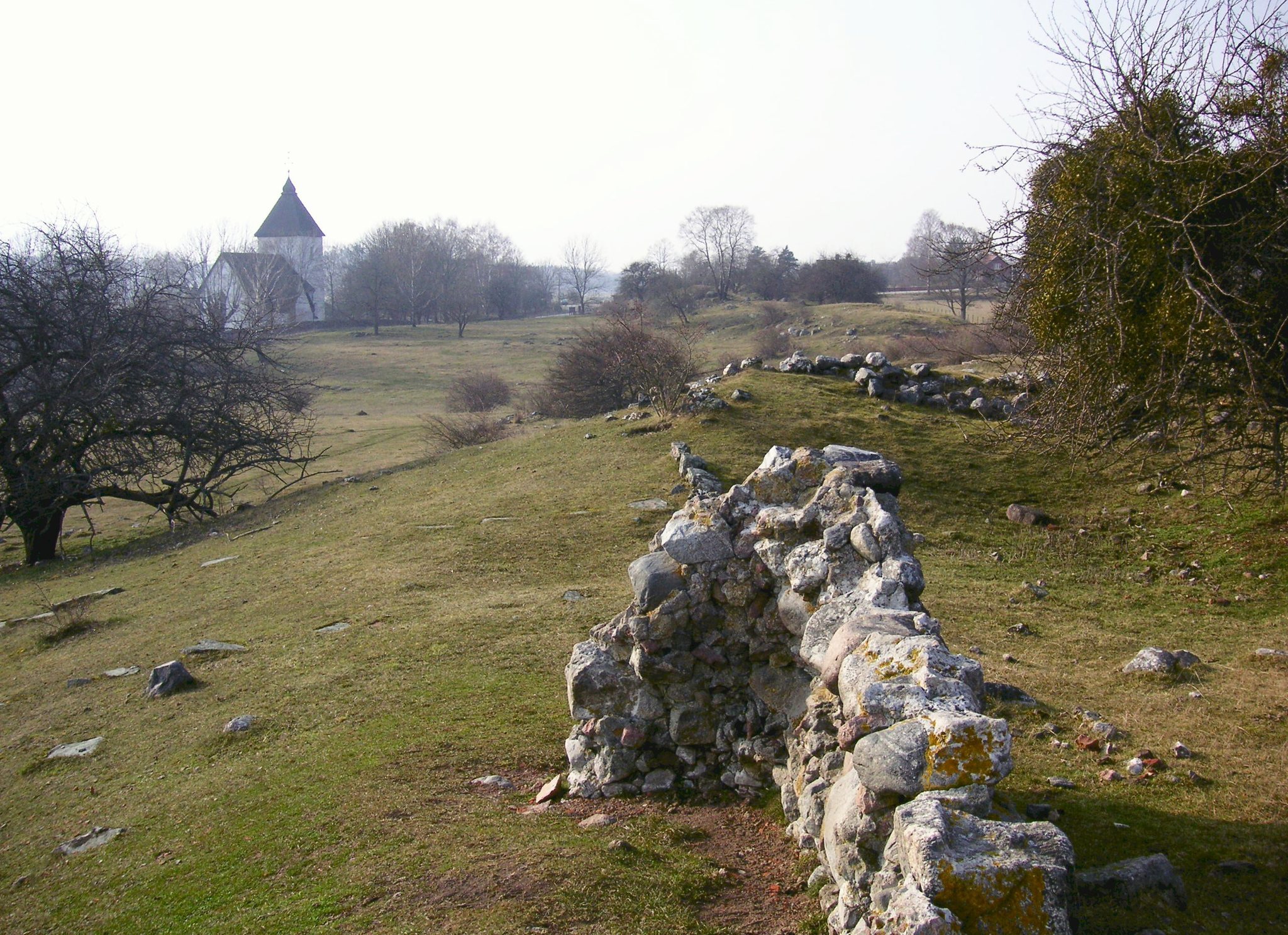
Adelsö Church dates from the 12th century. The surviving remains of Alsnö hus form a rectangular building approximately 30 by 13.5 metres, with a partly subterranean stone level and an upper structure of brick. The building probably had two stories. Its ground floor contained a kitchen and another room, while the upper hall was used to receive guests.
Two smaller buildings stood near Alsnö hus. One was probably contemporary with the palace and the other somewhat earlier. A medieval harbor lay just downstream from the Viking harbor and still forms a bay.
Later commemorative features
Ansgar Cross and chapel
The Ansgar Cross was erected within the former fort in 1834 to commemorate Ansgar’s first visit. An Ansgar Chapel, designed by Lars Israel Wahlman and dedicated in 1930, stands southeast of the settlement. It is built of local red sandstone and decorated with sculptures by Carl Eldh.
Museum and reconstructions
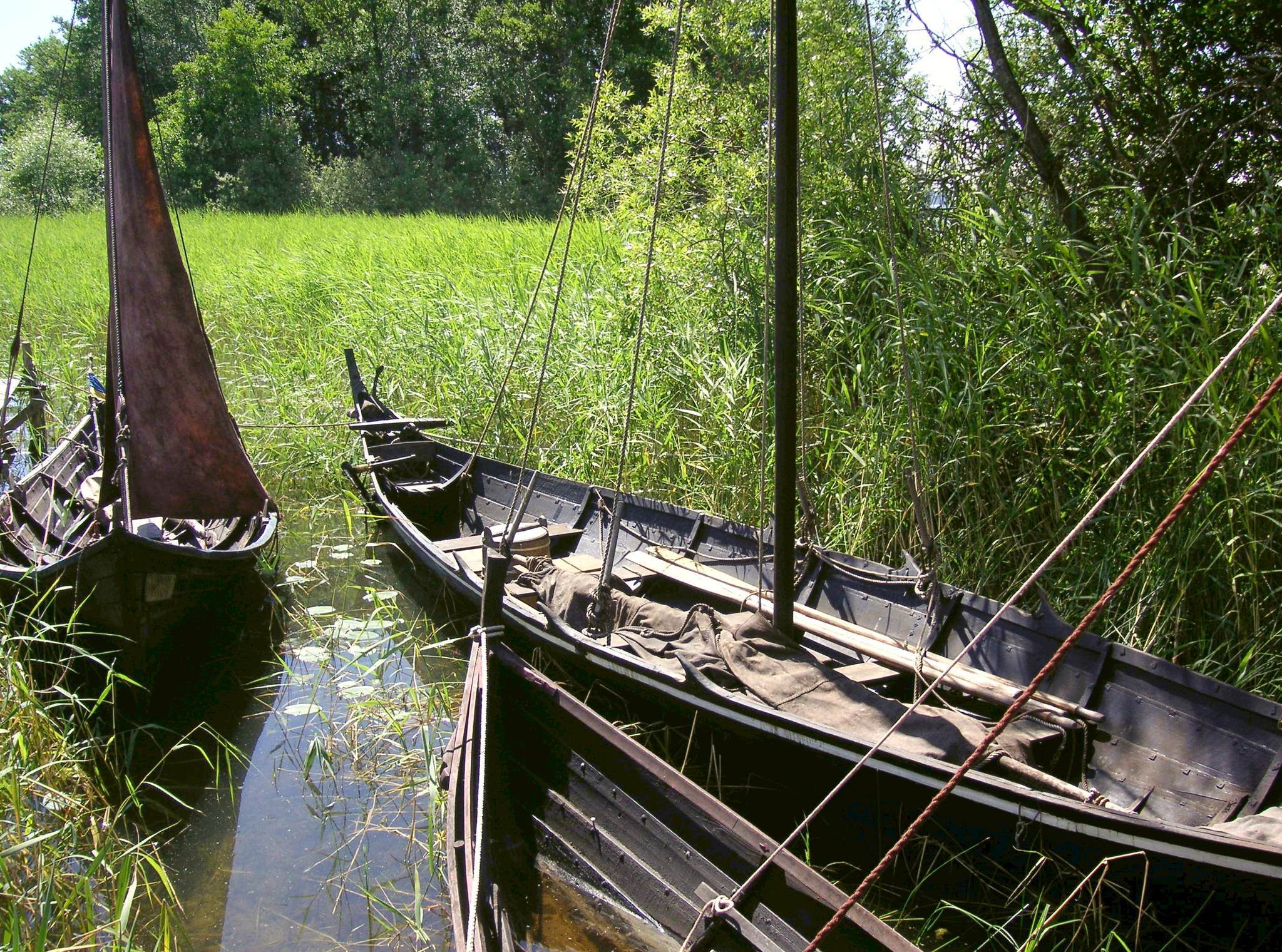
The site includes the Birka Museum, reconstructions of Viking houses, and areas where Viking house construction, boatbuilding, and crafts have been demonstrated. Many archaeological finds are preserved for security at the Swedish History Museum and the Royal Coin Cabinet in Stockholm rather than at the Birka Museum.