Weingarten Abbey: Benedictine Monastery and Welf Burial Place in Germany
Site at a Glance
- Rating
- 4.7
- Popularity
- Low
- Country
- Germany
- Primary era
- Early Modern
- External website
- Open
- Eras represented
- Medieval, Early Modern
- Civilizations
- Holy Roman Empire
- Site type
- Religious
- Remains
- Monastery
On this page18 sections
History
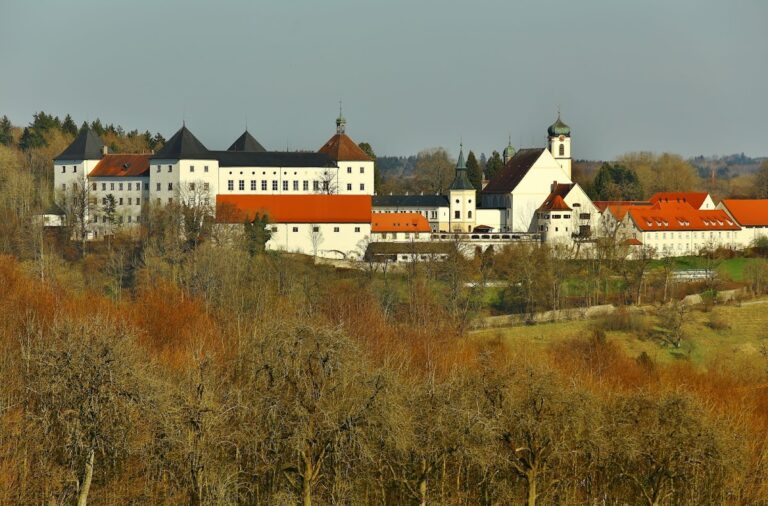
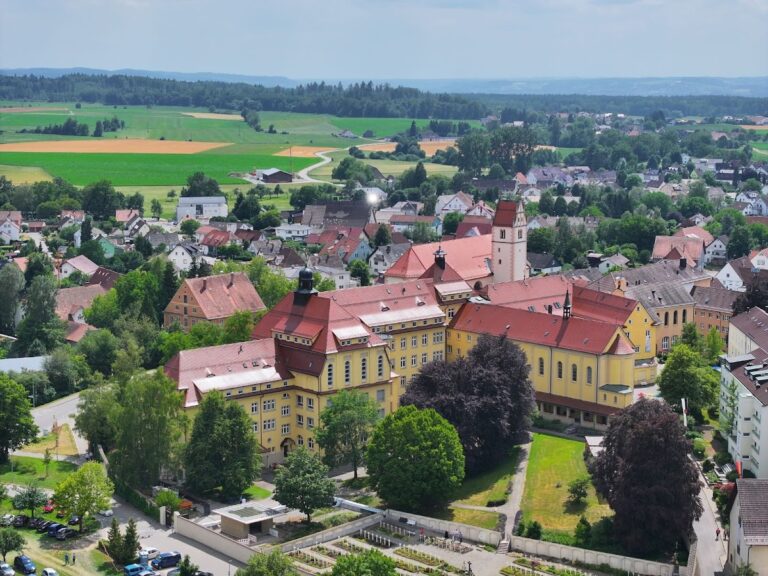
Weingarten Abbey is a former Benedictine abbey in Weingarten, Germany, founded in 1056 by Welf IV and settled by monks from Altomünster. It developed on Martinsberg at the site of a tenth-century Welf palatine complex and was rebuilt in the Romanesque period before receiving its present Baroque basilica between 1715 and 1724. As the Welfs’ family monastery and burial place, and later an imperial abbey directly subject to the Holy Roman Emperor, Weingarten became one of the most influential monasteries in southern Germany.
Welf foundations and early growth
Before the abbey was founded, the site belonged to a palatine complex associated with the Swabian Welfs. A palatine complex was a ruler’s residential and administrative centre, and this one had developed on the site of an earlier Alamannic aristocratic settlement beside a Germanic sanctuary. The predecessor nunnery at Altdorf, the settlement’s former name, had been established around the tenth century. A fire destroyed it in 1053, and its nuns were transferred to Altomünster.
Welf IV founded the male monastery at the site in 1056, bringing Benedictine monks from Altomünster. The abbey became the Welfs’ house monastery and burial place. Judith, Welf IV’s wife, gave it a Holy Blood relic around 1090. Devotion to the relic brought substantial gifts of land and entire villages. An early surviving charter records the transfer of the settlement of Berg to the monastery.
The Hirsau Reform, a Benedictine movement that promoted stricter discipline and greater independence from secular control, helped begin an early period of prosperity after 1088. Weingarten received the right to elect its own abbot in 1094. The name Weingarten appears from about 1123, replacing the older name Altdorf, which continued in use until 1865.
Romanesque rebuilding and intellectual life
Between 1124 and 1182, the monastery and its Romanesque abbey church were rebuilt. The abbey school, library, writing room, and artistic workshops developed into important centres of learning and manuscript production. The monks produced the Welf Chronicle at Weingarten around 1190, while the monk known as the Monk of Weingarten wrote a history of the Welfs at the monastery between 1169 and 1177.
The abbey’s connection with the Welf dynasty remained visible in the Welf crypt, where twelve members of the older Swabian Welf line who died between 990 and 1126 were buried. In 1178, Welf VI sold his possessions north of the Alps to Emperor Frederick I Barbarossa. Weingarten consequently entered Staufer possession and came under the protective jurisdiction of the Staufers, the medieval dynasty that supplied several Holy Roman Emperors.
Imperial independence and reform
In 1274, King Rudolf of Habsburg confirmed Weingarten as an imperial abbey. An imperial abbey was a monastery directly subject to the Holy Roman Emperor rather than to a local territorial ruler. Its abbot could exercise authority over a territory and take part in imperial institutions. Weingarten therefore held a special political position, separate from the authority of a territorial lord.
Abbot Johannes Blarer reformed the convent in the early fifteenth century and built a library hall. After a fire, the abbey church was rebuilt between 1477 and 1487. Austria temporarily occupied the abbey in 1499, but Abbot Gerwig Blarer secured its imperial immediacy from Austria in 1533. From 1555, the abbot was a permanent representative at the Ordinary Imperial Deputation Diet.
Under Abbot Georg Wegelin, who served from 1587 to 1627, monastic life was permanently restored. Wegelin was later regarded as the abbey’s “second founder.” Weingarten helped establish the Upper Swabian Benedictine Congregation in 1603 and maintained close relations with the Benedictine University of Salzburg. Gabriel Bucelinus was among its notable scholars. In 1671, he received papal permission to establish the Brotherhood of the Holy Blood at Weingarten.
Territorial power and Baroque transformation
At its greatest extent, the abbey controlled about 306 square kilometres and approximately 11,000 inhabitants. Its estates reached from the Allgäu to the middle Lake Constance region and the Alpine area. Forests, vineyards, farms, and villages formed part of its possessions, making Weingarten one of the richest monasteries in southern Germany.
Abbot Sebastian Hyller oversaw the replacement of the Romanesque church from 1715 to 1724. From 1727, the monastery complex was expanded according to an ideal plan, although only part of that plan was completed. Continuing construction placed the abbey heavily in debt. The new church and the planned monastic complex expressed the abbey’s religious and political standing, while the unfinished scheme also reflected the financial burden of the works.
Dissolution and changing uses
The abbey and its imperial territory were dissolved during the secularization of 1802–03, when ecclesiastical possessions were transferred to secular authorities. The former possessions initially passed to Nassau-Orange-Fulda and in 1806 became part of the Kingdom of Württemberg. The former monastery buildings were later used as a factory, an orphanage, and military barracks, including the Schlossbaukaserne.
Benedictines from Beuron Archabbey and from the Beuron-affiliated Abbey of Erdington re-established the monastery in 1922. The community reached 160 monks in 1936, its largest recorded size, but National Socialist authorities expelled the monks in 1940. They returned after the Second World War, and about 70 monks lived at Weingarten again during the 1960s.
From 1922, the monks assembled a natural-history and ethnographic collection that eventually exceeded 20,000 objects in mineralogy, palaeontology, archaeology, ethnography, and zoology. After the monastery was dissolved, the Auberlehaus Museum in Trossingen took responsibility for the collection. Some objects are displayed, while most are kept for research and temporary exhibitions.
Late monastic period and continuing pilgrimage
The abbey belonged to the Beuronese Congregation, a federation of Benedictine monasteries associated with the nineteenth-century renewal centred on Beuron Archabbey. Its monks maintained two liturgical traditions: some followed the Roman Rite of the Latin Church, while others followed the Byzantine Rite of the Byzantine churches. Their work included worship, pastoral care in the parish of St Martin, care of pilgrims to the Holy Blood relic, hospitality for retreatants and guests, and ecumenical relations with the Eastern Churches.
The community declined from about 70 monks in the 1960s to four in 2009. The remaining Benedictines left on 16 October 2010 after attempts to recruit new monks had failed. The Diocese of Rottenburg-Stuttgart became the successor tenant of the former abbey buildings, while the abbey continued formally under the administration of the president of the Beuronese Congregation.
After the monks’ departure, parts of the complex were used by the Diocese of Rottenburg-Stuttgart, the diocesan academy, and the Weingarten University of Education. The former monastic enclosure served as refugee accommodation from 2013, while other parts were used for initial refugee reception between 2014 and 2016. The former abbey complex and basilica are owned by the state of Baden-Württemberg. Since 1956, the former abbey church has held the papal title of minor basilica, an honorific for a church of particular historical, devotional, or liturgical importance.
The Holy Blood pilgrimage continues to shape Weingarten’s religious identity. On Blood Friday, the Friday after Ascension Day, the relic is carried through the town and surrounding fields in the annual Blutritt, a mounted procession. Authorities prohibited the procession in 1812, but it resumed every year from 1849.
Remains
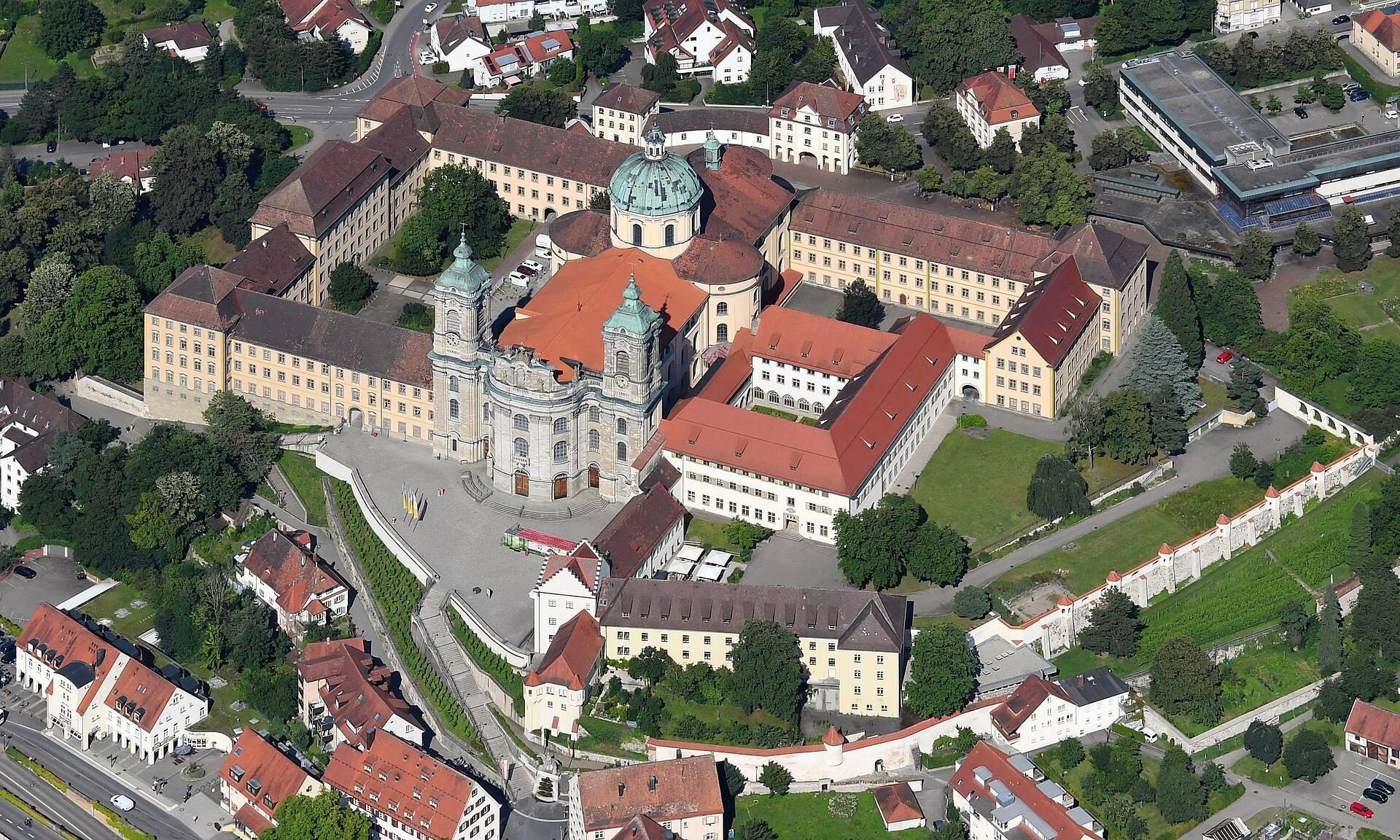
Weingarten Abbey occupies Martinsberg, where the monastery and church stand over the former Welf palatine complex and the earlier Alamannic settlement. The surviving complex combines the present Basilica of St Martin, remnants of the Romanesque church, the former monastic enclosure, courtyards, academic and guest buildings, administrative spaces, and associated agricultural and infrastructural features. The Baroque church was intended to form the centre of a much larger ideal monastery, but the full design was never completed.
The basilica and surviving Romanesque fabric
Basilica of St Martin
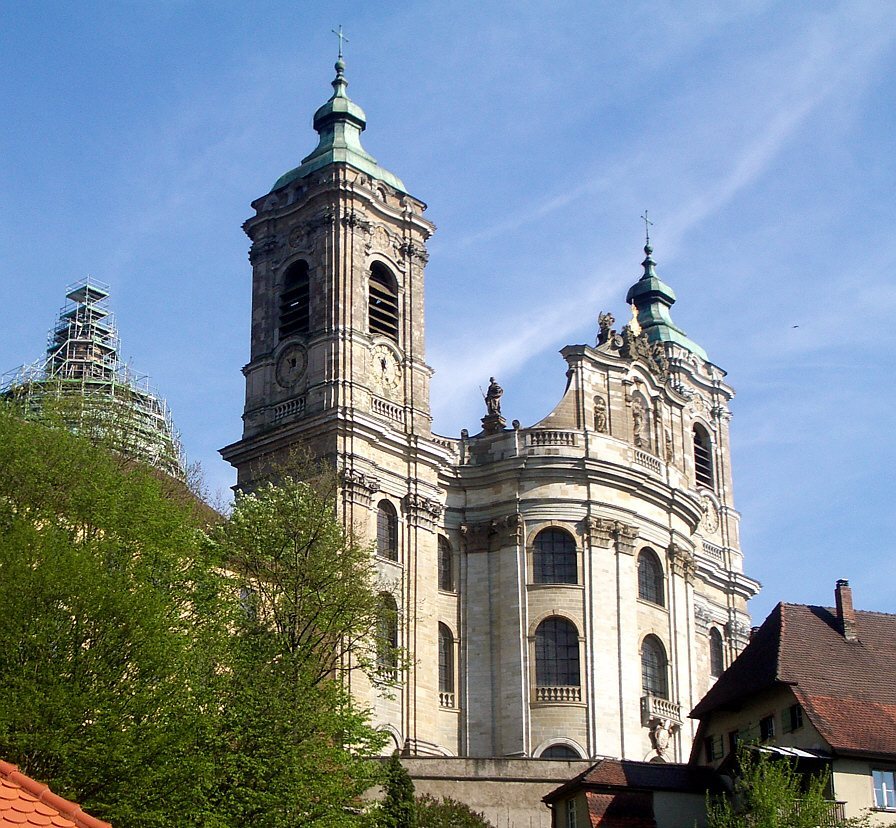
The present Basilica of St Martin replaced the Romanesque abbey church built between 1124 and 1182. Most of the earlier building was demolished from 1715, and Franz Beer designed the replacement in a richly decorated Italian-German Baroque style. Built between 1715 and 1724, the basilica measures 102 metres in length. Its scale was conceived as approximately half that of St Peter’s Basilica in Rome, and it is known as the “Swabian St Peter’s.” It has two bell towers and is the longest Baroque church in Germany.
Cosmas Damian Asam painted the basilica’s frescoes. The southern end of the western forecourt retains a section of the southern wall of the right aisle of the Romanesque church. The wall was deliberately preserved when the older church was demolished in 1715, leaving a physical link between the medieval building and its Baroque replacement.
Gabler organ
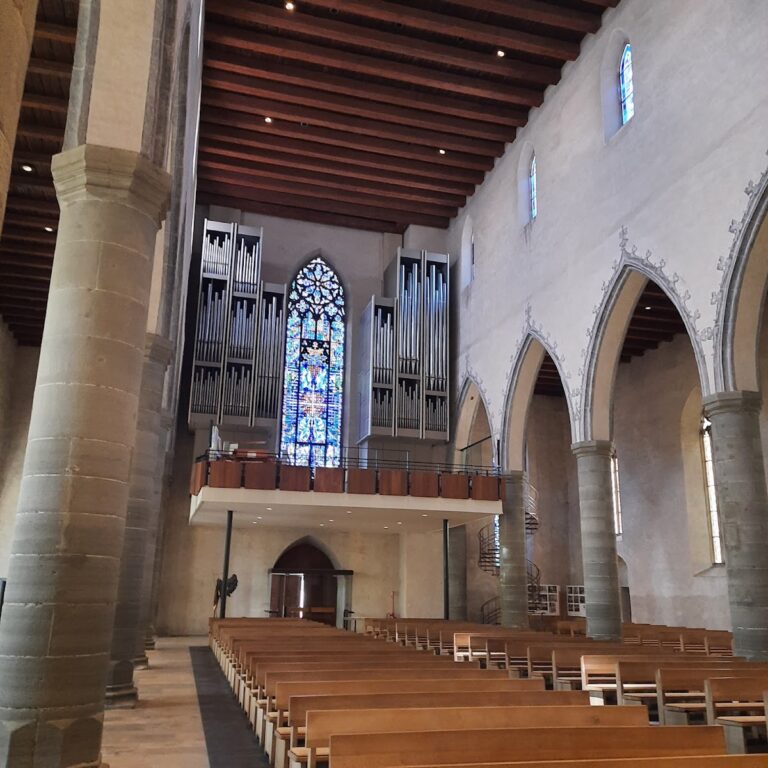
The basilica contains the Gabler organ, built by Joseph Gabler of Ochsenhausen between 1735 and 1750. It has 60 registers distributed across four manuals and a pedal, together comprising 169 ranks, 63 voices, and 6,666 pipes. Six windows in the west facade had to remain unobstructed during construction. Gabler arranged the organ around them in an elaborate design regarded as a major achievement of organ building.
Holy Blood relic
The Holy Blood relic is preserved in a treasury at the basilica’s high altar. It consists of a gold double cross set with 65 gemstones and containing a glass tube. According to tradition, the tube holds a drop of Christ’s blood mixed with earth from Golgotha. At the Holy Blood altar, the relic is displayed behind glass on a red velvet cushion.
The relic is associated with the relic of Mantua and remains in the basilica rather than belonging to the Benedictine order. Its history and related devotional objects are presented in the Museum of Monastic Culture in Weingarten.
Monastic buildings and planned expansion
Monastic enclosure and eastern wing
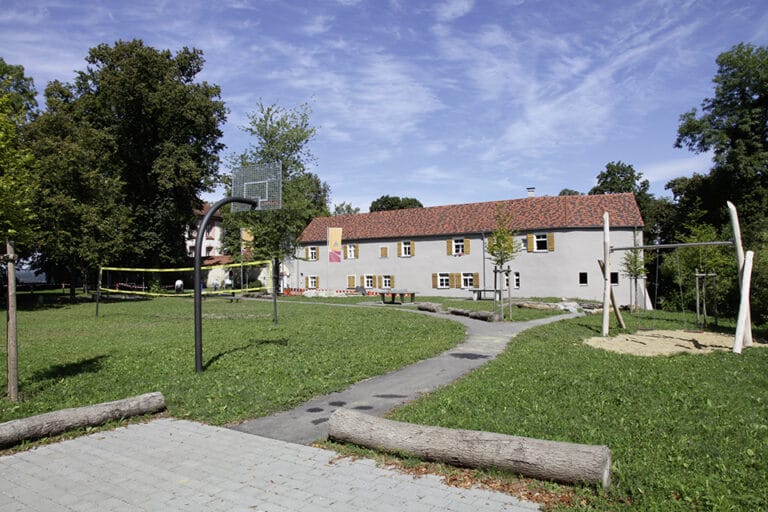
The former monastic precinct includes the community wing with its cloister and enclosure, courtyards, the academy and its guesthouses, the administration and lecture spaces of the Weingarten University of Education, and the basilica’s parish house. The basilica was intended to stand at the centre of an ideal monastic complex. Construction began around the wider plan in 1727, but the northern wing was stopped by a building ban issued on 27 April 1728 because it was considered to obstruct the imperial road, or via regia.
Building continued south of the basilica. The eastern wing, known as the Seminar Building and now occupied by the diocesan academy, was completed in 1732. Its surviving relationship to the church reflects the partial realization of the planned Baroque enclosure.
Associated estates and watercourse
The former abbey precinct also includes agricultural and infrastructural remains connected with the monastery. These include the Rösslerhof, the Nessenreben estate, the artificial Still Bach watercourse that powered several mills, and the former monastic pharmacy in Karlstrasse. Together, these features represent the practical agricultural, industrial, and service networks that supported the abbey beyond its central enclosure.
Manuscripts and dynastic memory
Berthold Sacramentary
The Berthold Sacramentary, produced in the first quarter of the thirteenth century, is the abbey’s most celebrated surviving work of manuscript illumination. It is now held by the Pierpont Morgan Library in New York and preserves evidence of the artistic culture that developed in Weingarten’s medieval writing and book-production workshop.
Welf memorial
A copy of the Braunschweig Lion has stood in the courtyard north of the basilica since 1999. The monument refers to the Welfs and to Altdorf’s former role as their dynastic centre, recalling the family connection that shaped the foundation, burial traditions, and political history of the abbey.