St Olave Hart Street: The Medieval Ward Church of Tower Ward
Site at a Glance
- Rating
- 4.8
- Popularity
- Low
- Country
- United Kingdom
- Primary era
- Medieval
- External website
- Open
- Eras represented
- Medieval, Early Modern, Modern
- Civilizations
- British, English
- Site type
- Religious
- Remains
- Church
On this page11 sections
History
St Olave Hart Street is an Anglican parish church in London, United Kingdom, and the Ward Church of Tower Ward in the City of London. Dedicated to Olaf II of Norway, it occupies a site associated with a church from the late twelfth or thirteenth century, while the present building dates from about 1450 and is in the Perpendicular Gothic style, the late-medieval English Gothic style known for strong vertical lines and broad window openings. The church belongs to the Church of England and the Diocese of London, having formerly been Roman Catholic until 1538.
Medieval origins and the Norwegian dedication
A church called St Olave-towards-the-Tower was recorded here in the late twelfth or thirteenth century. The stone church probably replaced an earlier wooden building, was rebuilt in the thirteenth century, and underwent substantial rebuilding again during the fifteenth century. Its dedication is to Olaf II Haraldsson, the medieval king of Norway who became Norway’s patron saint after his death. The church was apparently built on or near the site of the 1014 Battle of London Bridge, where Olaf fought alongside Aethelred the Unready, the Anglo-Saxon king who opposed Danish attacks in the early eleventh century. The dedication also reflected the presence of Scandinavian merchants in this part of London.
The wool merchant Richard Cely Sr. became an important benefactor during the church’s fifteenth-century rebuilding. He died in 1482 and held the church’s advowson, the legal right to present a candidate for a parish benefice. That right later passed to his son, Richard Cely Jr. Cely Sr. left money for a steeple and an altar, and the Cely family merchant mark remained carved in the nave until the Second World War.
Reformation and Tudor connections
St Olave became an Anglican church during the Reformation, when it ceased to be Roman Catholic in 1538. Its parish records preserve connections with prominent Tudor figures and households. On 15 May 1554, while still Princess Elizabeth, Elizabeth held a thanksgiving service there after her release from the Tower of London. The parish maintained an annual thanksgiving service for the anniversary for 290 years.
The register records the burial of an Inuk man captured during Martin Frobisher’s first Northwest Passage expedition in 1576. An Inuk child captured on the following expedition, known as Nutaaq, was buried at St Olave in late November 1577. The same records include the 1585 baptism of Elizabeth, daughter of the poet Sir Philip Sidney, and the 1590 baptism of Robert Devereux, 3rd Earl of Essex, at the house of Sir Francis Walsingham’s widow. Walsingham lived across from the church, and parish entries repeatedly refer to his house.
In 1586 the register recorded the burial of Mother Goose, a figure later associated with English pantomime tradition. A plaque commemorates the burial, although the person’s historical identity remains uncertain. The diplomat and intellectual Anthony Bacon was buried at St Olave in 1601. John Lumley, 1st Baron Lumley, died at his house beside the church in 1609, although his body was taken to Cheam in Surrey for burial. Ann Harrison, later Lady Fanshawe, was born in the parish in 1625 and baptised at St Olave on 7 April that year.
The seventeenth century and the Great Fire
St Olave survived the Great Fire of London in 1666 through a deliberate effort to clear the surrounding area. Sir William Penn ordered men from the nearby naval yards to demolish houses and create a firebreak. The flames came to approximately 100 yards of the church before the wind changed direction.
The church was closely connected with Samuel Pepys, the seventeenth-century naval administrator and diarist. He worshipped regularly at St Olave and called it “our own church.” In 1660 he paid for a gallery along the south wall and a covered stairway from the nearby Royal Navy offices. The gallery has since disappeared, but a memorial marks the stairway entrance. After Pepys’s wife, Elisabeth, died in 1669, he commissioned her marble bust from John Bushnell. Pepys was buried beside her in the nave in 1703.
St Olave also maintained long-standing relationships with Trinity House and the Worshipful Company of Clothworkers, historic London livery companies representing maritime administration and the cloth trade. The church was also associated with the Worshipful Company of Ironmongers. Members of Trinity House traditionally attended a service at St Olave on Trinity Sunday. During the plague of 1665, 365 victims were buried in the small churchyard. Mary Ramsay is traditionally identified as the woman who brought the plague to London, but that attribution is unverified; the parish register records her burial on 24 July 1665.
Later rebuilding and wartime destruction
The tower received major additions in 1732, when its upper stages were built in the Baroque style under the direction of John Widdows. A small brick sacristy was added beside Seething Lane in 1661 and 1662, while a contemporary passage linking the church with the Royal Navy offices survived until its demolition in 1853. The church accumulated monuments from earlier centuries, including memorials transferred from All Hallows Staining after its 1870 merger with St Olave and from St Katharine Coleman after that church was demolished in 1926.
St Olave suffered repeated damage during the London Blitz, the German bombing campaign against London that was particularly intense from 1940 to 1941. A nearby explosion destroyed the windows in September 1940. A direct hit on 17 April 1941 ruined much of the interior and left the north and east walls unstable. On 11 May an incendiary bomb burned out the tower, baptistry, and other buildings, while the eight bells melted in the fire.
Between 1948 and 1954, services took place in a temporary prefabricated church at the site of All Hallows Staining. The tower of that church served as its chancel while St Olave was restored. Restoration continued from 1951 until April 1954. King Haakon VII of Norway, who worshipped at St Olave during his exile while Germany occupied Norway from 1940 to 1945, laid a foundation stone known as the King’s Stone at the 1954 rededication. A fragment from the shrine of Olaf at Nidaros Cathedral in Trondheim was also placed before the sanctuary.
The church became a Grade I listed building on 4 January 1950. It is one of the few medieval City of London churches to have survived the Great Fire and, after the destruction of St Ethelburga’s Bishopsgate in 1993, has been described as the smallest surviving medieval church in England. Its Norwegian connection was renewed through Haakon VII’s wartime worship and the postwar rededication, while its institutional relationships with Trinity House and the Clothworkers’ Company continue.
Remains
Plan and medieval fabric
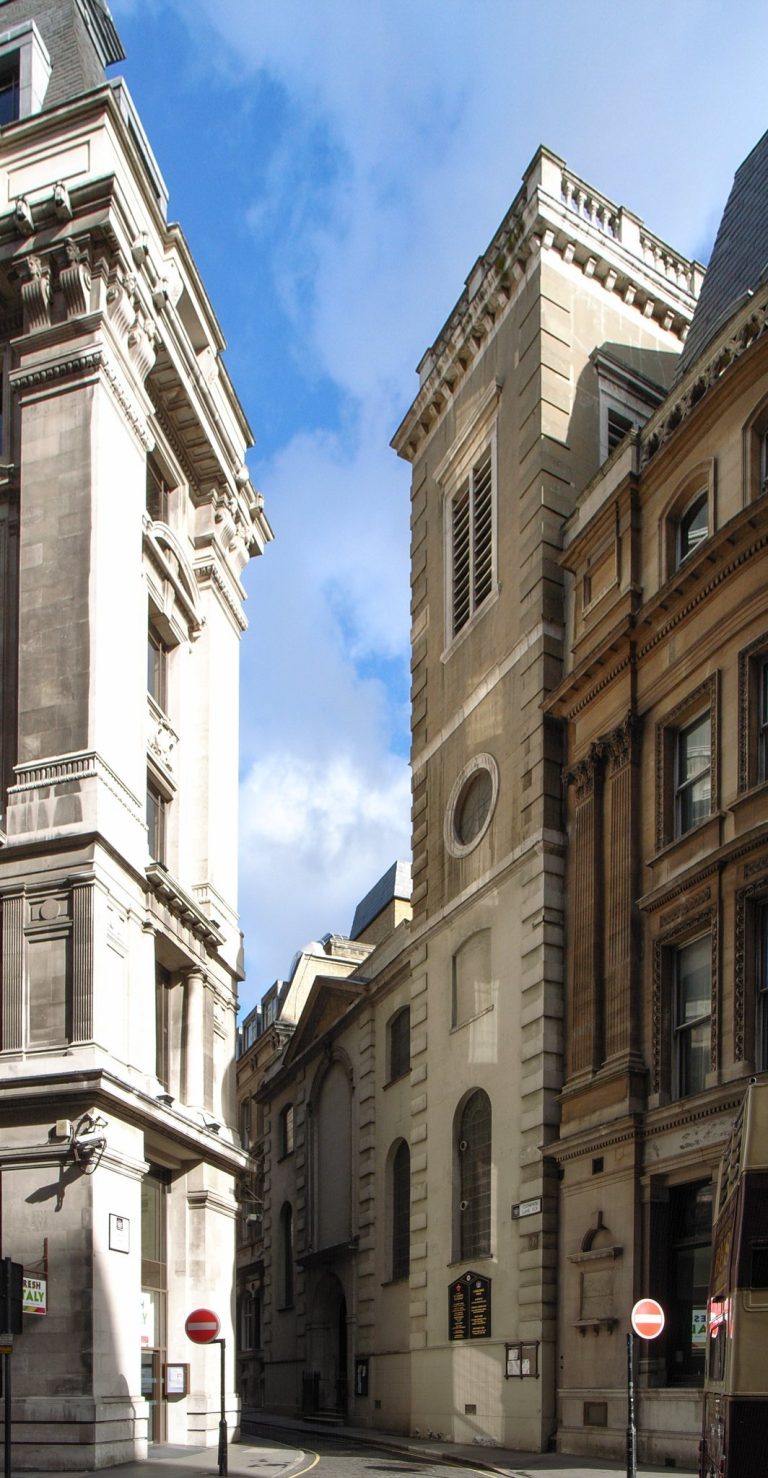
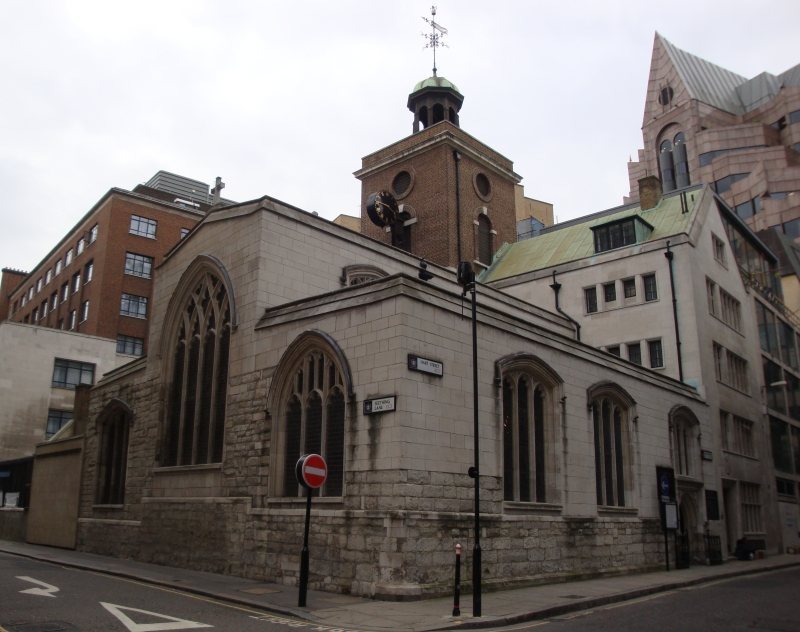
St Olave stands at the corner of Hart Street and Seething Lane near Fenchurch Street. Its modest exterior forms a nearly square building about 16.5 metres on each side. The church consists of a nave and two aisles running the full length of the building, with no externally visible chancel. The east wall angles towards the south, giving the plan an irregular shape. The walls are principally limestone, and older masonry is especially visible at the east end. The west wall of the nave behind the organ, together with a connected stretch of the north wall, survives from the thirteenth century. The aisles follow thirteenth-century models but were built mainly during the fifteenth and sixteenth centuries, with sections reconstructed between 1951 and 1954.
Inside, pointed arches divide the building into three bays, carried on columns of Purbeck limestone. A simple oak roof is decorated with carved bosses. The clerestory, the west-gallery area, and the postwar roof were rebuilt between 1951 and 1954 to designs by E. B. Glanfield. The new roof reproduced an earlier fifteenth- or seventeenth-century form, helping the reconstructed interior retain its historic character and intimate scale.
Crypt and tower
A two-part crypt beneath the western nave survives from a predecessor building dated to about 1270. Its rib vault incorporates the frame of a lancet window at the west, showing that part of the crypt originally stood above ground. A well within the crypt probably predates the westward extension that later brought it inside the church.
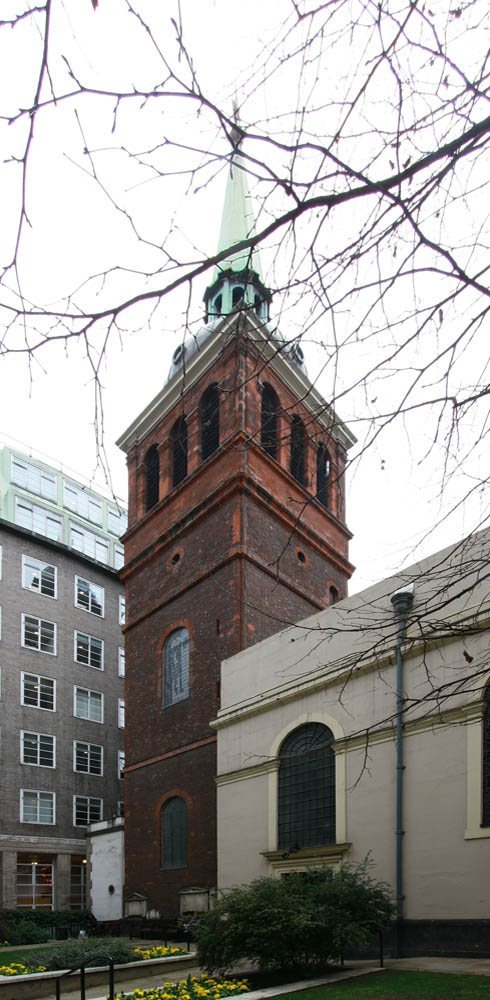
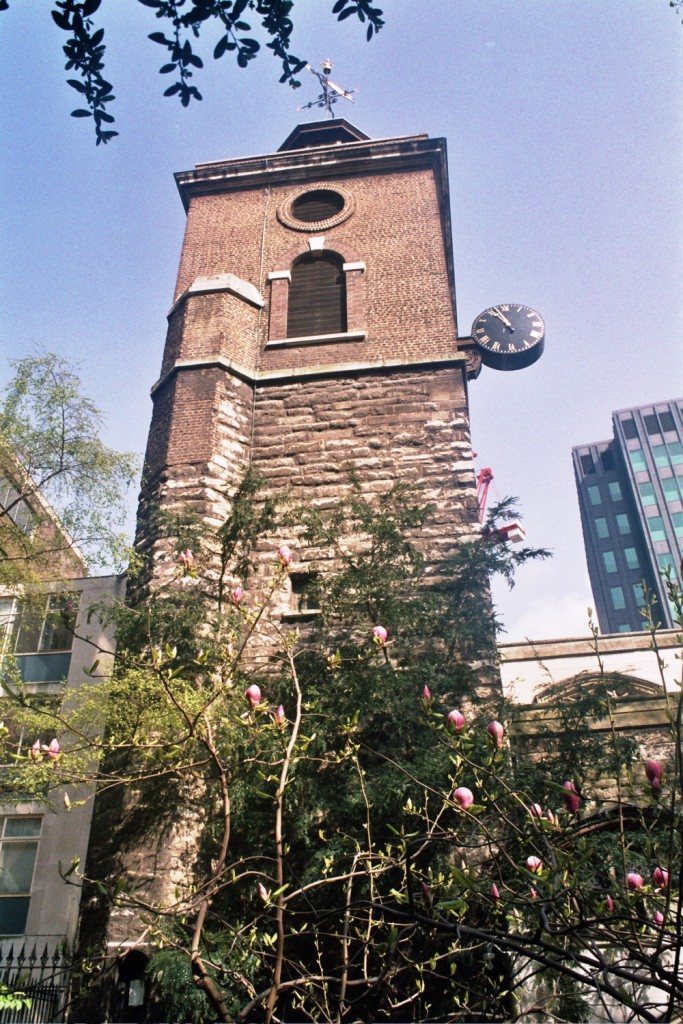
The square tower is built of stone and brick and has a small stair turret at the southwest corner. Its upper stages, added in 1732, have round-arched openings on each side, each surmounted by a smaller circular opening. The octagonal lantern is a postwar wooden reconstruction of an earlier form. Two masts carry British and Norwegian flags. The original eight bells, cast by the Whitechapel Bell Foundry in 1662 and 1694, melted in the tower fire of 11 May 1941. The same foundry recast their metal in the early 1950s, and the bells were hung in the rebuilt tower. The present peal comprises a Sanctus bell and eight bells for full-circle ringing; the tenor weighs 11 hundredweight, 3 quarters, and 23 pounds.
Churchyard and entrances
The churchyard lies south of the building behind enclosing walls and surrounding structures. It retains gravestones and is shaded by a large lime tree. The principal entrance is in Hart Street, whose present street level stands considerably higher than the historic level on which the church was built.
An entrance arch from Seething Lane into the churchyard dates from 1658 and was designed by Hendrik de Keyser, the Dutch architect and sculptor active in England and the Netherlands. Grinning skulls and bones cover the arch, while iron spikes project from the skulls. Charles Dickens described the churchyard in The Uncommercial Traveller and gave the church the sobriquet “St Ghastly Grim.”
Interior furnishings and memorials
The marble bust of Elisabeth Pepys by John Bushnell stands on the north wall of the sanctuary. It was placed so that Samuel Pepys could see it from his pew and faces the gallery formerly used by officials from the Navy Office. The pulpit is traditionally attributed to Grinling Gibbons, the noted seventeenth-century English woodcarver. A six-sided pulpit made in 1685 originally came from Christopher Wren’s demolished church of St Benet Gracechurch. The late-seventeenth-century communion rail is supported by crouching lions.
The postwar oak altarpiece was designed by Glanfield. Stained glass includes Arthur Buss’s 1954 east window, showing Jesus and the Apostles, and John Hayward’s 1970 heraldic window. Another east-side window depicts Elizabeth I with two bells. The 1781 organ by Samuel Green was destroyed in the Blitz. The John Compton Organ Company built its replacement in the west gallery in 1954 behind a large wooden grille. Three ranks were added in 1957, and Michael Mason overhauled the instrument in 1991. It now has 43 stops on three manuals and pedals, with electric action.
A tower memorial commemorates Monkhouse Davison and Abraham Newman, grocers of Fenchurch Street whose tea was shipped to Boston in 1773. The tea was seized and thrown into Boston Harbour during the Boston Tea Party, the protest against taxed tea associated with the origins of the American War of Independence.
Transferred monuments and parish associations
St Olave retains monuments from the sixteenth and seventeenth centuries, including objects transferred from All Hallows Staining and St Katharine Coleman. A statue of Elizabeth I and the memorial to Elisabeth Pepys are among the principal surviving examples. Peter Turner, a physician influenced by Paracelsian ideas, was buried at St Olave with his father, the physician and naturalist William Turner. Peter Turner’s memorial bust, installed in the southeast corner in 1614, disappeared after the Blitz, resurfaced at an art auction in April 2010, and returned to its original position in 2011 after negotiations through the Art Loss Register.
The parish records and memorials preserve the church’s connections with London’s political, literary, scientific, and maritime history. They include the burial of the two Inuit captives brought to London by Frobisher’s expeditions, the baptism of Elizabeth Sidney, and the records associated with Walsingham’s house opposite the church. Together with the surviving medieval fabric, wartime reconstruction, Norwegian memorials, and later furnishings, these features give St Olave Hart Street its distinctive historical character.