Attock Fort: A Mughal Fortress on Pakistan’s Indus Frontier
Site at a Glance
- Rating
- 4.4
- Popularity
- Low
- Country
- Pakistan
- Primary era
- Early Modern
- External website
- Open
- Eras represented
- Early Modern, Modern
- Civilizations
- Mughal, Sikh Empire
- Site type
- Military
- Remains
- Fort
On this page12 sections
History
Attock Fort is a sixteenth-century Mughal fortress in Pakistan, built at Attock Khurd during the reign of Emperor Akbar from 1581 to 1583. The Mughal Empire was the Islamic imperial state that ruled much of the Indian subcontinent during this period. The fort guarded the western frontier, defended against Afghan attacks, and secured passage across the Indus River, including the bridge at Attock. Construction was supervised by Khawaja Shamsuddin.
Mughal, Maratha, and Durrani Control
Attock’s position on the Indus crossing made it an important defensive point between the river and the route toward the Afghan frontier. In 1758, Maratha forces captured the fort under Tukojirao Holkar and other commanders. The Maratha Empire was a powerful South Asian state that expanded northward during the eighteenth century.
Ahmad Shah Durrani later retook Attock. After the Third Battle of Panipat in 1761, he halted the Maratha advance northward. The Durrani Empire, founded by Ahmad Shah Durrani, was an Afghan empire that contested Maratha and Sikh control across the region.
Sikh and British Fortification
Sikh forces conquered the fort from the Afghans during the Battle of Attock in 1813 under the command of Mokham Chand. The Sikh Empire was the nineteenth-century Punjabi state established under Sikh rule. During the following decades, Sikh authorities strengthened Attock, including through the addition of substantial bastions at its gates.
British forces captured the fort in 1849 during the Second Anglo-Sikh War and the annexation of Punjab. They further strengthened the position and constructed a permanent bridge across the Indus in 1880, reinforcing control of the crossing that the fort had been built to protect.
Pakistani Military Use
Control passed to Pakistan after the Partition of India in August 1947. The fort became the headquarters of the Pakistan Army’s 7th Division, and in 1956 it was transferred to the Special Services Group, Pakistan’s army special-operations force. The SSG continues to control the fort, which functions as a military base and is closed to visitors.
In 1999, General Pervez Musharraf imprisoned the elected Nawaz Sharif at Attock Fort after Musharraf’s military coup. The site has consequently remained associated with successive Mughal, Maratha, Durrani, Sikh, British, and Pakistani authorities, as well as with the long strategic contest over the Indus crossing and the approach to the Afghan frontier.
Remains
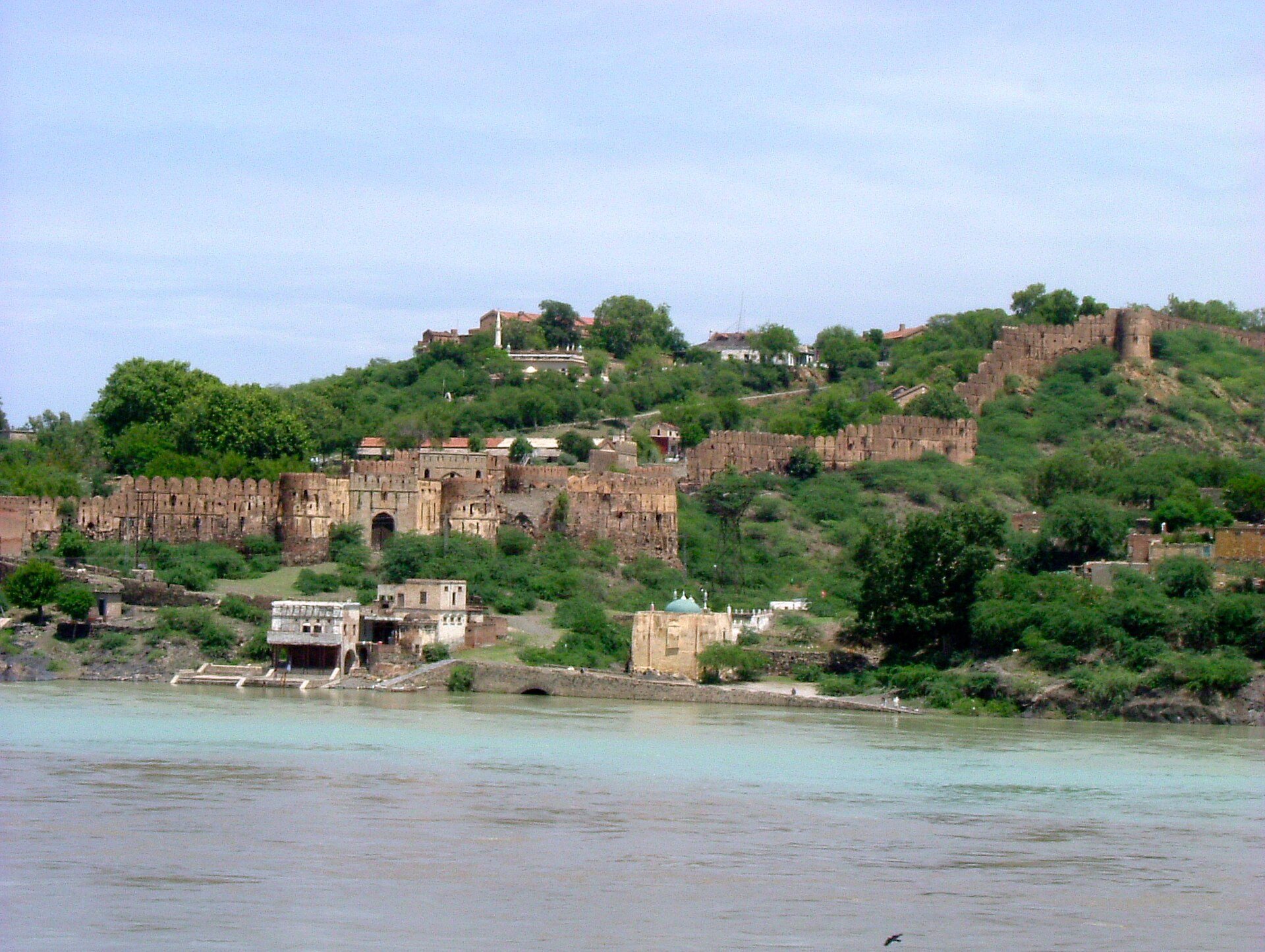
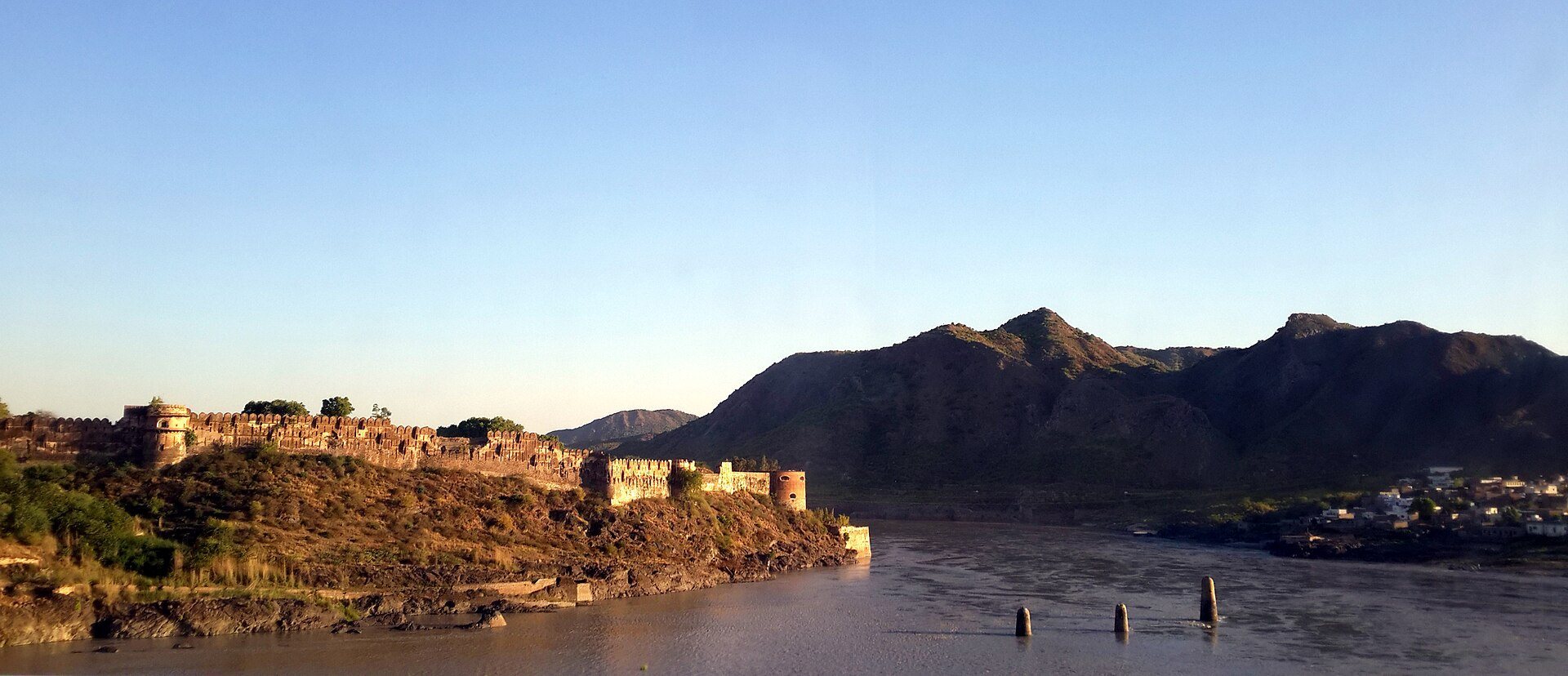
Attock Fort occupies the eastern bank of the Indus between the river and Peshawar Road. The river follows its northwestern walls, while the fort descends from the top of a hill toward the riverbank. Its approximately elliptical plan measures about 800 metres from end to end and 400 metres across, covering about 200 dunams. A dunam is a unit of land area used in parts of South Asia and the Middle East.
Layout and Defensive Walls
Perimeter and Gates
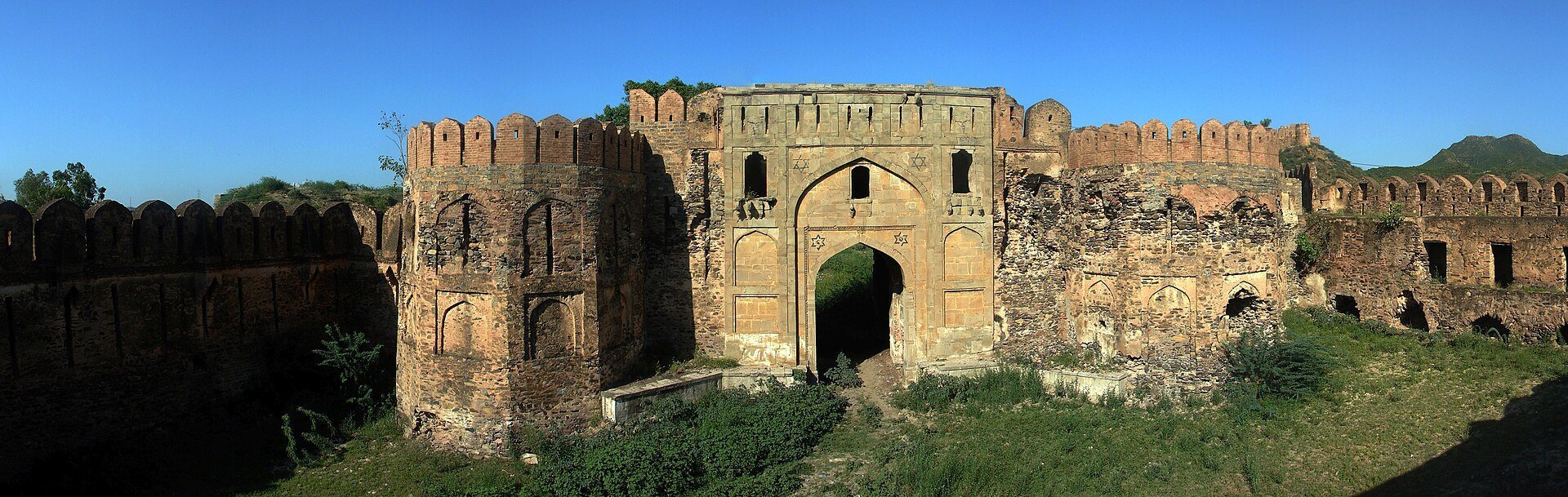
The perimeter wall is approximately 1,600 metres long and about 1.5 metres thick. Brick and stone form its principal materials. The gate system includes Delhi Gate, Lahore or Lahori Gate, Kabul or Kabuli Gate, Mori Gate, Aabi or Water Gate, and Mallahitola Gate. Delhi, Lahore, Kabul, and Mori gates are identified as the four principal entrances.
Bastions
Eight bastions reinforce the fortification. Most are circular, while one is rectangular. They stand near the gates and at other points along the perimeter wall. The Sikh-period additions included particularly high and massive bastions at the entrances.
Interior and Associated Structures
Upper and Lower Sections
The interior is divided into an upper section for soldiers and a lower section for common people. It contains numerous buildings, including structures erected before the twentieth century and later buildings used by serving soldiers.
Hammam and Caravanserai
A hammam, or bathhouse, stands near Delhi Gate. Immediately beside the fort is Begum Ki Sarai, a Mughal-period caravanserai, meaning a roadside lodging and service complex for travelers and caravans.
Indus Bridges
An earlier bridge over the Indus stood near the fort, and its remains survive. The British permanent bridge, built in 1880, also lies within the fort’s strategic sphere as one of the crossings connected with the defensive purpose of Attock.