Sher Garhi Palace: A Royal Residence and Political Center in Srinagar
Site at a Glance
- Rating
- 3.6
- Popularity
- Low
- Country
- India
- Primary era
- Early Modern
- Eras represented
- Early Modern, Modern
- Civilizations
- Durrani
- Site type
- Domestic
- Remains
- Palace
On this page15 sections
History
Sher Garhi Palace is a former royal residence in Srinagar, India, built under Afghan rule in 1772 as a fortress-palace combining English and Kashmiri architectural elements. Its name is commonly rendered as “Tiger Fortress,” although sher garhi brings together Persian and Urdu words meaning “lion” and “small fort” or “fortified residence.” Standing south of the Old City beside the Jhelum River, it became a long-standing center of political authority in Kashmir.
Afghan foundation
Construction began under Amir Khan Sher Jawan, also known as Jawansher Khan, the Afghan governor of Kashmir appointed by Timur Shah Durrani, the second ruler of the Durrani Empire. The Durrani Empire was the Afghan ruling state that controlled Kashmir during the eighteenth century. The new palace occupied the site of an earlier royal residence associated with Ananta, a king of the medieval Lohara dynasty who ruled Kashmir from about 1028 until his forced abdication in 1063.
Stones for the new construction are said to have come from the Pathar Masjid, a Mughal-period stone mosque in Srinagar’s Old City. The governor employed the Hanjis, Srinagar’s traditional boatmen community, in the building work. Their involvement reflected the importance of river and lake transport, as well as the labor connected with the waterways, to the palace’s construction and operation.
For decades, Sher Garhi served as the seat of the Afghan governors. The palace was also connected with the daily exercise of authority. People approached the ruler or ministers to present petitions, while the river steps received those arriving by boat. In this way, the complex functioned as both a royal residence and a place where government business was conducted.
Sikh and Dogra rule
In 1819, Sikh forces defeated the Kashmir authorities at the Battle of Shopian, an engagement that brought the region under Sikh control. Sikh governors then continued to use Sher Garhi. The palace later passed into the political world of the Dogra dynasty, which ruled the princely state of Jammu and Kashmir from the nineteenth century until the monarchy was abolished in 1952. A princely state was an internally governed Indian kingdom whose ruler acknowledged British paramountcy before independence.
The Dogra Maharajas used Sher Garhi as a royal residence and enlarged it during the nineteenth century. Under Ranbir Singh and Pratap Singh, Srinagar served as the state’s summer capital, while Jammu remained the winter capital. Extensive renovation took place during this period, reinforcing the palace’s place within the seasonal administration and court life of the Dogra state.
A temple dedicated to Lord Vishnu as Gadadhar was established within the grounds by one of the Dogra Maharajas. Gadadhar, meaning “holder of the mace,” is an epithet of Vishnu. The temple is managed by the Dharmarth Trust of Jammu and Kashmir, a religious trust founded by Gulab Singh in 1846 to support and manage Hindu temples in the region.
Administrative transformation
Sher Garhi’s role as the principal royal residence declined after Pratap Singh established Gulab Bhavan as a new summer residence in eastern Srinagar in 1910. Hari Singh later made Gulab Bhavan his principal residence, and Sher Garhi increasingly served administrative purposes. Civil services of the princely state occupied the complex, which became associated with the routine work of government as much as with royal residence.
After Kashmir’s accession to India, the complex became known as the Old Secretariat. It housed government departments, the state assembly, and the legislative council, and was also called the Old Assembly. Government offices began moving elsewhere during the 1950s, after which the palace gradually ceased to operate as an active administrative center.
An earthquake badly damaged the palace before 1940, and part of the complex was rebuilt, apparently during the 1930s. Fires in the 1970s and again in the early 2000s destroyed major sections, including much of the riverfront. Restoration began in 2015. Sher Garhi was declared a state-protected monument under SRO 270, a formal statutory rules and order, on 6 July 2017. A gallery opened in a restored eighteenth-century building in 2020, while another surviving riverfront wing became the Srinagar City Museum. The complex also contains the archival reference library of the Kashmir Department of Archives, Archaeology and Museums.
Remains
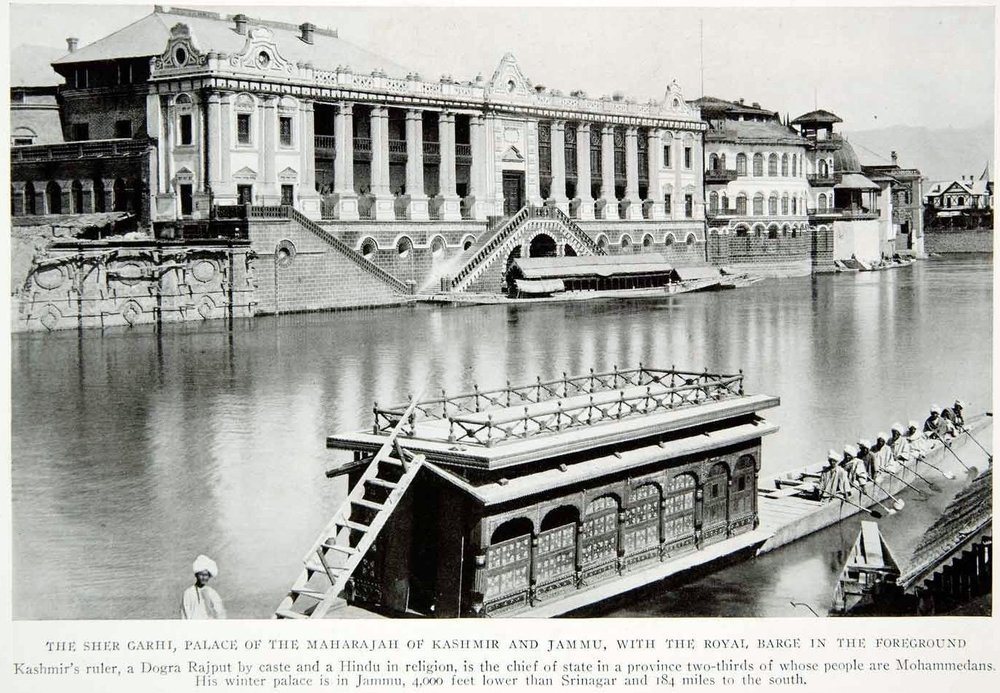
Sher Garhi was arranged as a quadrangular complex beside the Jhelum. Stone formed the principal building material, while wooden doors, ceilings, and roofs received intricate workmanship. The surviving architecture reflects a combination of English and Kashmiri forms. The riverfront, rebuilt around 1900 under Maharaja Pratap Singh, used a neoclassical design with Corinthian columns. Neoclassical architecture adapts forms associated with ancient Greek and Roman buildings, while Corinthian columns have elaborate capitals traditionally decorated with acanthus-leaf patterns.
Fortified riverfront and palace enclosure
River wall and boundaries
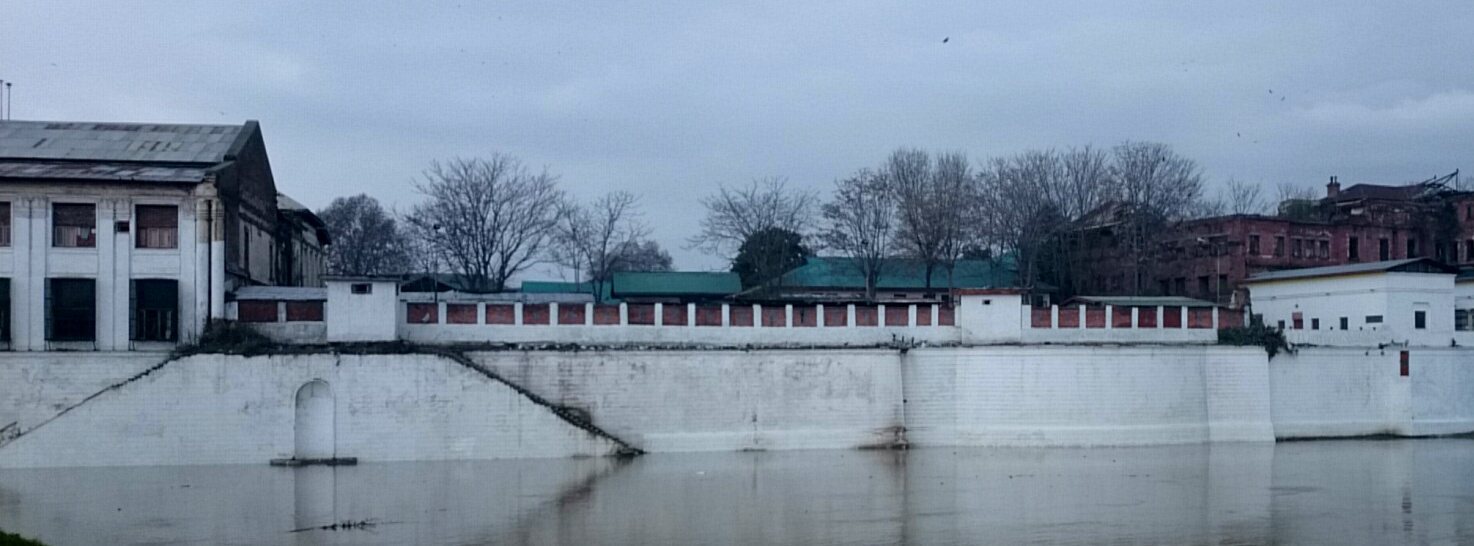
A description from 1879 places the palace on the left bank of the Jhelum, protected along the river by a long wall with openings for defense and by bastions rising about 20 to 30 feet above the general water level. Lightly built houses stood above the wall. A wide ditch protected the southern and western sides, while the Kut-i-Kul canal bounded the complex to the north. Together, these features defined the palace as a fortified royal enclosure as well as a residence.
River steps and guarded entrance
Wide stone steps rose from the water at the angle of the Baradarri and led into the palace. A guarded gateway at the top controlled entry to the private royal area, with a guardroom nearby. The steps also formed the physical approach used by people arriving by boat to meet the ruler or ministers, linking the river directly with the palace’s administrative and ceremonial functions.
Royal and administrative buildings
Officials’ residences and treasury
The interior contained residences for court officials, government offices, and barracks. A two-storey house built on the river wall served as the residence of the Dewan, a senior minister who could function as the chief minister or prime minister of a princely state. Beneath it stood a long, lofty building used as the government treasury. Its holdings included shawls, pashmina, coin, and other valuables.
Rang Mahal and Baradarri
The Rang Mahal formed part of the royal residence and was described as a distinctive wooden audience hall. Beside it stood the Baradarri, a large royal building with an irregular plan. It combined native architectural forms with a partly European character and included a large projecting bow. These buildings belonged to the ceremonial and residential heart of the complex, alongside the Darbar Hall, a formal court or audience hall.
Riverfront palace and state offices
The palace complex also included lofty columns, large walls, towers, a governor’s office, and the state treasury. The Jhelum-facing frontage received its neoclassical rebuilding around 1900, giving the river side a distinct architectural expression within the wider mixture of English and Kashmiri design. Fires later destroyed major portions of this riverfront, while one surviving river wing now houses the Srinagar City Museum.
Temple and surviving cultural spaces
Shri Gadadhar Ji Temple
The Shri Gadadhar Ji Temple stands directly beside the river within the palace grounds. Its domed roof is covered with gold. In 1879, William Wakefield called the building the Maharaj-ke-Mandir, while R. C. Arora referred to it as the “golden temple” in 1940. These names refer to the same structure and reflect its prominent gilt dome.
Old council building and museums
A restored eighteenth-century building known as the old council building, or Old Assembly, contains an art museum gallery. The gallery was intended to display about 1,500 miniature paintings from the SPS Museum and related departments. The complex’s other surviving riverfront wing houses the Srinagar City Museum, and the archival reference library of the Kashmir Department of Archives, Archaeology and Museums occupies part of the wider palace complex.