Santo Stefano Basilica: A Baroque Collegiate Church in Lavagna
Site at a Glance
- Rating
- 4.7
- Popularity
- Low
- Country
- Italy
- Primary era
- Early Modern
- Eras represented
- Medieval, Early Modern, Modern
- Civilizations
- Genoese, Italian, Kingdom of Sardinia
- Site type
- Religious
- Remains
- Basilica
On this page22 sections
History
Santo Stefano Basilica is a Roman Catholic collegiate and parish church in Lavagna, Italy. Dedicated to Saint Stephen the Protomartyr, traditionally regarded as Christianity’s first martyr, the present Baroque building was constructed between 1650 and 1668 on the site of an earlier church and the castle associated with the Fieschi family.
Early church and medieval jurisdiction
The first religious building on the site cannot be dated with certainty. Historical traditions place its foundation or earliest mention in the sixth century, around AD 568, and suggest that it may have stood beside an earlier signaling tower used by sailors and navigators approaching the port. From the eighth century, monks of the Order of Saint Columban of Luxeuil helped make the church an important regional parish. This Columbanian monastic tradition, associated with the monastery of Luxeuil in Gaul, contributed to the Christian organization of parts of early medieval western Europe.
A legal ruling of 994 records the church’s early jurisdiction over a broad group of local chapels and churches. These included the Church of Saint John the Baptist at Chiavari, within the territory that later belonged to the Diocese of Chiavari. Santo Stefano became a collegiate church in 1060, meaning that it was served by a chapter of clergy rather than solely by a monastic community. It was later placed under the protection of the Holy See by Pope Celestine III. Its chapter was the first collegiate institution outside Genoa and gave the church an important ecclesiastical position within the Archdiocese of Genoa.
The Fieschi lordship and destruction
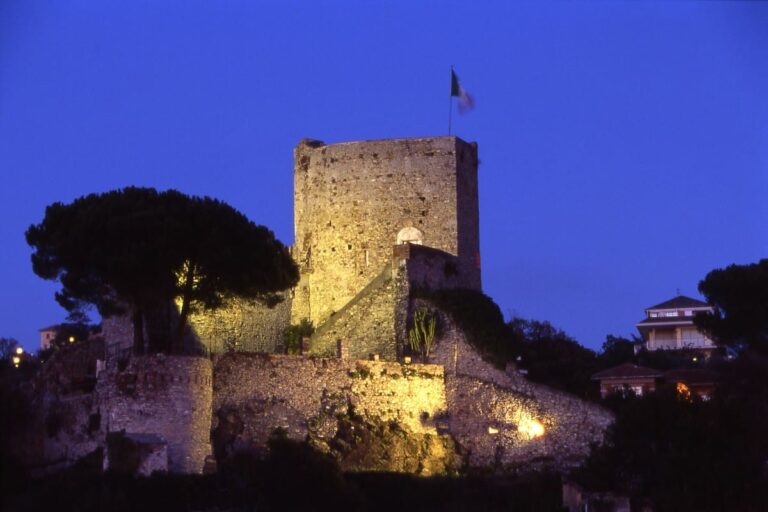
During the Middle Ages, the Fieschi, a prominent Ligurian noble family with major ecclesiastical and political influence in medieval Genoa and the Tigullio, treated Santo Stefano as a religious stronghold of their lordship. They built a castle beside the church and the earlier signaling tower, reinforcing their control of the surrounding territory.
The castle and signaling tower were destroyed either by Genoese soldiers around 1100 or, more probably, by Emperor Frederick II around 1200. The latter destruction has been connected with Frederick’s retaliation for an excommunication issued by Pope Innocent IV, who belonged to the Fieschi family. The precise date and agent remain uncertain. The predecessor church was restored for the last time in 1611 before being replaced by the present building.
Baroque rebuilding
The present church was promoted by the people of Lavagna with the support of Stefano Durazzo, Archbishop of Genoa and cardinal. Giovanni Battista Ghiso is credited with the work, perhaps following or adapting a design by Gian Lorenzo Bernini, one of the leading architects and sculptors of the Italian Baroque. A later study instead attributed the design to Francesco da Novi. A municipal tax on grain sales financed the beginning of construction, while the inhabitants of Lavagna contributed substantial voluntary labor.
The foundation stone was laid on 15 August 1650. During the work, the bell tower of the disused predecessor church collapsed on 1 November 1650. The two new bell towers were completed in 1657, and the building itself was finished in 1668. Solemn consecration took place on 18 October 1703.
Shaping the church and its status
The space below the church was enlarged in 1673. In 1749, the houses facing the marble facade were demolished to create a more theatrical approach. A slate staircase followed, later replaced in 1870 by a white-marble staircase with two lions bearing the municipal arms of Lavagna. In 1897, the marble Bignardello Loggia was built to provide access to the monumental cemetery behind the church without passing directly in front of the building. Later work revised its stairways and conserved its structural elements.
Pope Benedict XV elevated Santo Stefano to the rank of minor basilica through a papal bull dated 16 May 1921, with the elevation taking place in May of that year. A minor basilica is an honorific papal designation recognizing a church’s ecclesiastical importance. The facade was completed in 1936. Santo Stefano remains a collegiate and parish church of the Diocese of Chiavari.
Remains
Plan, facade, and surviving earlier fabric
The church occupies the site of the earlier religious building and Fieschi castle. The present structure retains the predecessor’s basic division into three naves, although the earlier church was oriented toward the west and had its bell tower on the east side. Traces of that building survive inside the parish house, especially the arches and pillars that formed its former choir.
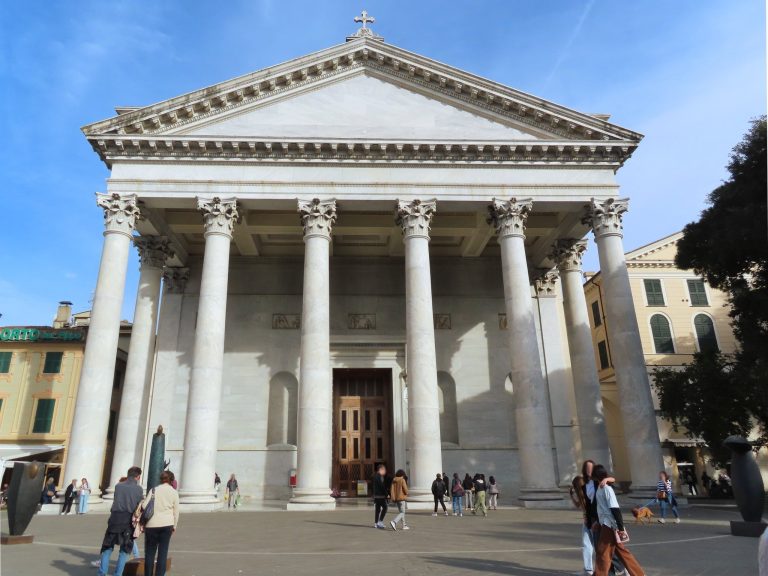
Marble facade and approach
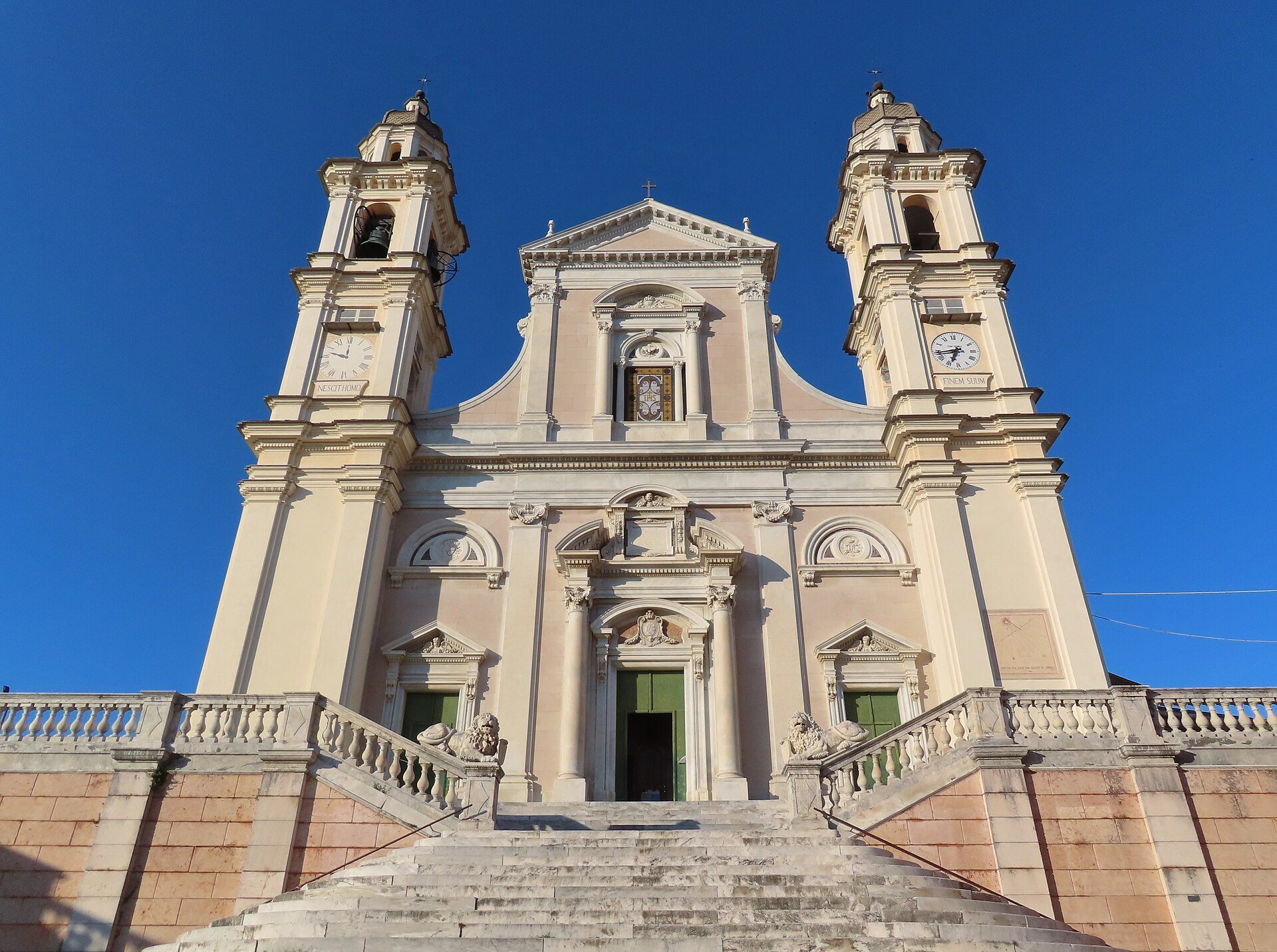
A marble-clad facade rises between two towers. The left tower holds the church’s eight bells, tuned in C3. The right tower contains the civic bell in E-flat 3 and two clock tympani, which are unused. A long marble staircase leads to the entrance, with two lions at its lower end supporting Lavagna’s municipal arms. Before the facade lies a polychrome pavement made from marine pebbles.
Interior structure
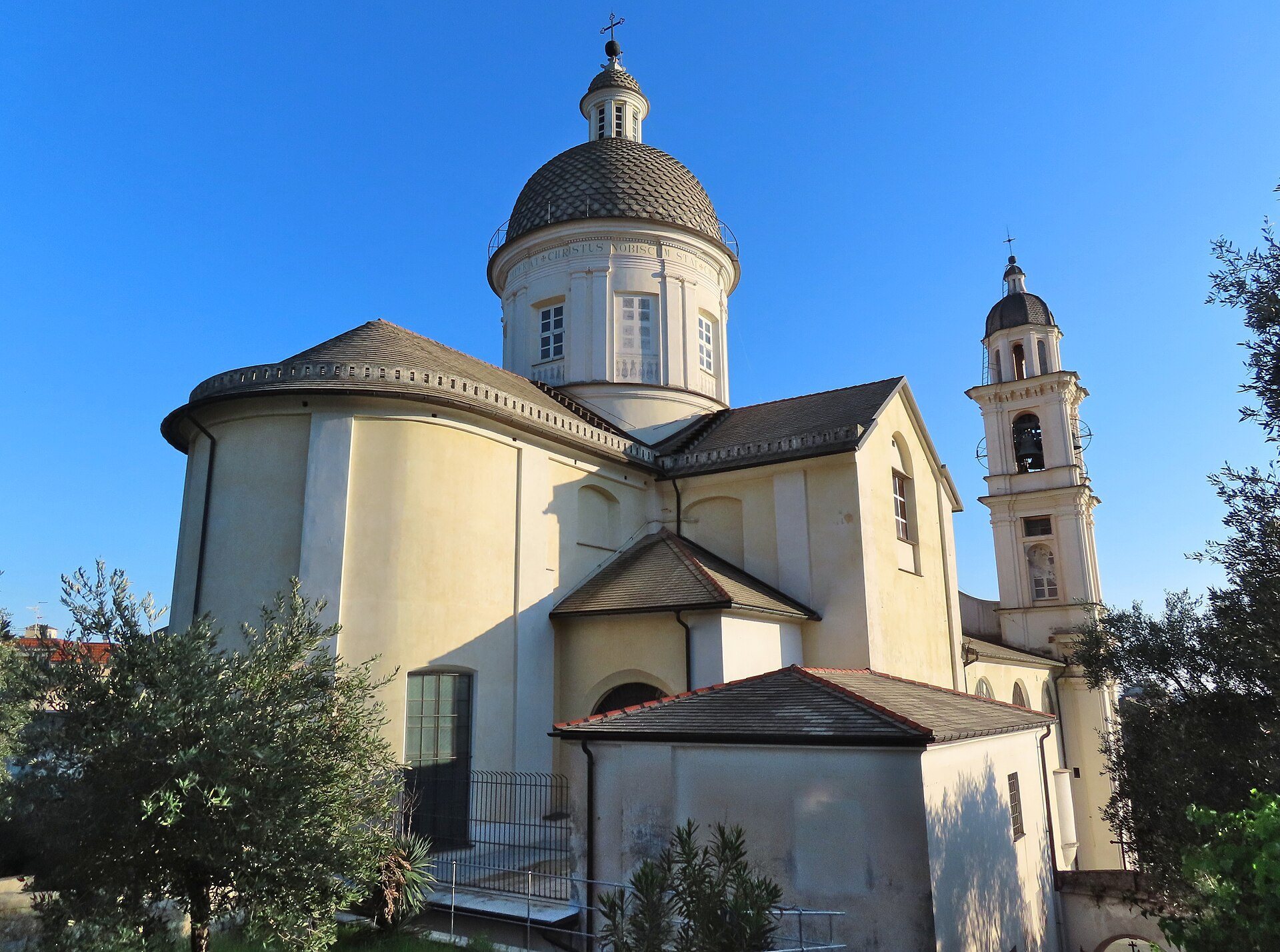
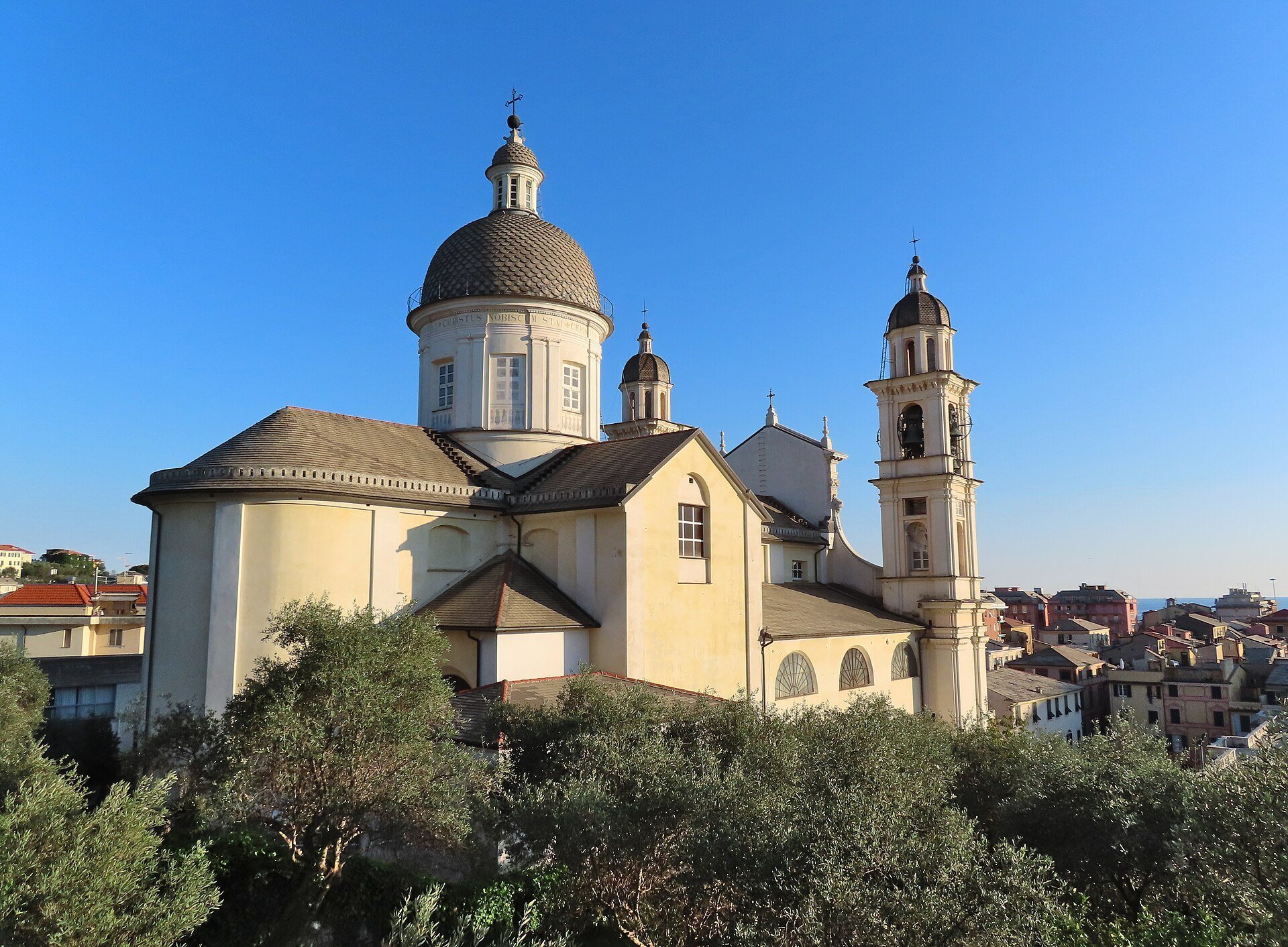
The present church has a cruciform plan. Round arches rest partly on paired columns, while the central nave is covered by a barrel vault divided into three bays by decorative transverse ribs. The narrower side aisles have a sequence of domed vaults. A dome rises above the crossing, and the choir ends in a semicircular apse. Extensive painted decoration covers the vaults. Behind the church, the monumental cemetery contains significant funerary monuments.
Altars on the right side
Fishermen’s Altar
The first altar on the right is dedicated to Saints Peter and Andrew and is known as the Fishermen’s Altar. It contains Sebastiano Galeotti’s eighteenth-century painting of the Primacy of Saint Peter.
Saint Joseph’s Altar
The second right-side altar is dedicated to Saint Joseph. Its painting of the Holy Family is attributed to a painter of probable French origin. The altar was installed in 1855, and the vault fresco shows the pope proclaiming Saint Joseph patron of the Universal Church.
Assumption altar
The third altar is dedicated to the Assumption and to Saints Anthony of Padua, Catherine of Genoa, and Francis Xavier. Restored in 1896, it has a vault representation of the Miracle of Saint Anthony.
Saint Nicholas of Bari’s Altar
The next right-side altar is dedicated to Saint Nicholas of Bari and is regarded as the most valuable for its artistic and architectural qualities. It contains Domenico Piola’s painting of the Risen Christ with Saints Nicholas and Stephen. The vault fresco depicts Saint Charles Borromeo giving First Communion to Saint Aloysius Gonzaga.
Our Lady of the Rosary
The final altar in the right aisle is dedicated to Our Lady of the Rosary. A plaque records its latest restoration in 1882, the year of two paintings by the Chiavari painter Gian Battista Pianello. Pianello also painted the interior dome in 1881, showing the Virgin giving the rosary to Saint Dominic and Saint Catherine. The lateral frescoes depict Pope Pius V announcing the victory of Lepanto and the annual procession of Lavagna’s inhabitants during the feast.
Altars on the left side
Baptism of Jesus altar
The first altar from the main entrance occupies the position of a nineteenth-century baptistery. Its small interior dome contains a fresco of the Baptism of Jesus, with John the Baptist and Jesus.
Farmers’ Altar
The second left-side altar is dedicated to Our Lady of the Guard and is commonly called the Farmers’ Altar. It contains Sebastiano Galeotti’s painting of Our Lady of the Guard with Saint Martin. The vault fresco represents the Marian apparition on Mount Figogna, between Genoa and Ceranesi.
Immaculate Conception altar
The third altar is dedicated to the Immaculate Conception. It is the oldest of the side altars and was restored in 1880. Its vault bears a representation of the Immaculate Conception.
Holy Trinity altar
The next altar is dedicated to the Holy Trinity. Its canvas depicts the Trinity with Saints Bernard and Roch, while the vault fresco shows the Sacred Heart appearing to Mary.
Crucifixion altar
The fifth left-side altar is dedicated to the Crucifixion of Jesus and contains a painting of the subject by Domenico Piola. Gian Battista Pianello painted the lateral frescoes, which continue the theme with the Finding of the Cross and the Translation of the Relics.
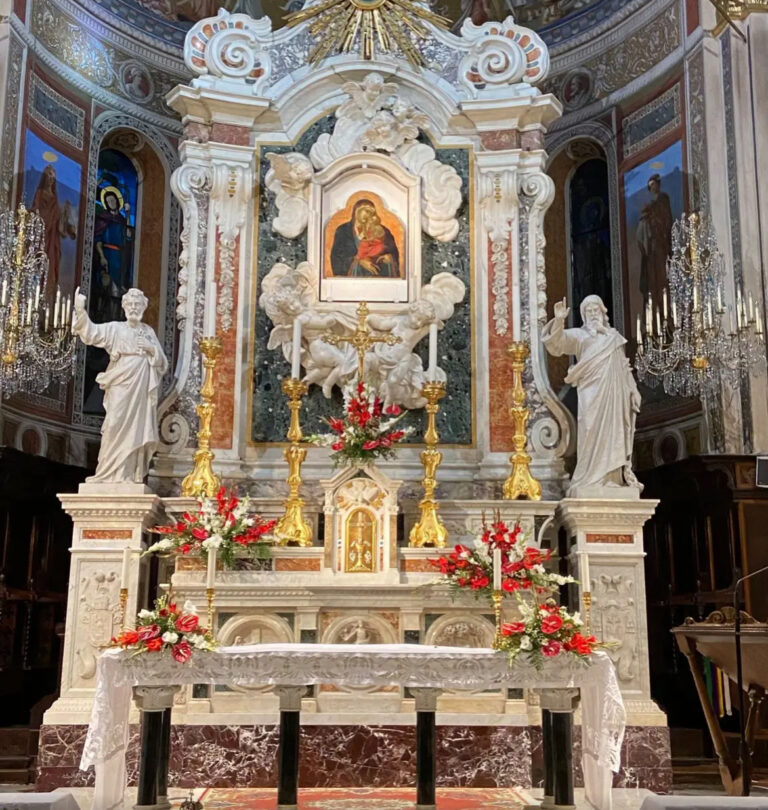
Main altar
The main altar is dedicated to Saint Stephen and was sculpted by the Bocciardi brothers. It includes an eighteenth-century marble statue of the saint by the Genoese artist Pasquale Bocciardo. Carlo Fontana painted the Martyrdom of Saint Stephen and the Discovery of His Body, while Francesco Chiarella produced the frescoes of Saint Stephen’s Ordination and Preaching.