Hill of Crosses: A Catholic Pilgrimage Site and Hillfort in Lithuania
Site at a Glance
- Rating
- 4.6
- Popularity
- High
- Country
- Lithuania
- Primary era
- Medieval
- External website
- Open
- Eras represented
- Classical, Medieval, Modern
- Civilizations
- Grand Duchy of Lithuania
- Site type
- Religious
- Remains
- Sanctuary
On this page13 sections
History
The Hill of Crosses is a Catholic pilgrimage site and historic hillfort in Lithuania, about 12 kilometres north of Šiauliai. Known also as Jurgaičiai or Domantai hillfort, it combines an ancient elevated settlement with a modern tradition of placing crosses that became closely associated with Lithuanian religious and national identity.
Hillfort origins and nineteenth-century traditions
The hillfort dates from the first millennium to the fourteenth century. A castle identified as Kulių was mentioned in 1348 and was reportedly destroyed by crusaders in the same year. The partly artificial hill may have served earlier as a place of prayer and offering. Its precise connection with the later pilgrimage tradition remains uncertain, but written references to the crosses appear by the middle of the nineteenth century, and crosses are documented at the site from 1850.
The Hill of Crosses became associated with the unsuccessful 1831 and 1863 uprisings against the Russian Empire, the imperial state that ruled Lithuania after the partitions of the Polish-Lithuanian Commonwealth. One tradition says that local families placed crosses for relatives killed in the uprisings whose graves they could not find. Another holds that insurgents were executed on the hill. These traditions helped connect the site’s religious practices with remembrance and resistance.
Pilgrimage and national remembrance
By about 1900, the hill had become a sacred destination and was drawing increasing numbers of believers. Services and indulgence observances took place there during the early twentieth century. Between 1918 and 1939, when Lithuania was independent, people also came to pray for peace, for the country, and for relatives who had died during the Wars of Independence.
After Soviet deportations, crosses were erected in memory of Lithuanians who had died in the Gulag. Former political prisoners and other believers also placed crosses on the hill. The site therefore served both as a religious place and as a political symbol opposing Soviet rule. Its meaning became closely tied to the endurance of Lithuanian national identity.
Soviet destruction and peaceful resistance
Soviet authorities considered the hill and its crosses incompatible with their anti-religious ideology. The site was bulldozed repeatedly from 1961 through 1984. Four further demolitions followed the first operation, including campaigns between 1973 and 1975. During the initial clearance, 2,179 crosses were removed. Wooden crosses were burned, iron crosses were sent for scrap, while stone and concrete crucifixes were broken, buried, or submerged in a nearby stream.
The KGB, the Soviet state security and intelligence agency, and the army guarded the hill, blocked roads, detained people carrying crosses, and imposed penalties and imprisonment. Plans to flood the area were also reported. Despite these measures, new crosses appeared, sometimes on the night immediately after a demolition. Their repeated return made the hill a powerful symbol of peaceful religious and national resistance.
Independence and international recognition
The number of crosses increased after Lithuania regained independence. Estimates by 1990 placed the total in the tens of thousands. In the early 1990s, students stopped counting after reaching 50,000, without including the small cross pendants and rosaries attached to larger crosses. By 2007, the hill held about 200,000 crosses.
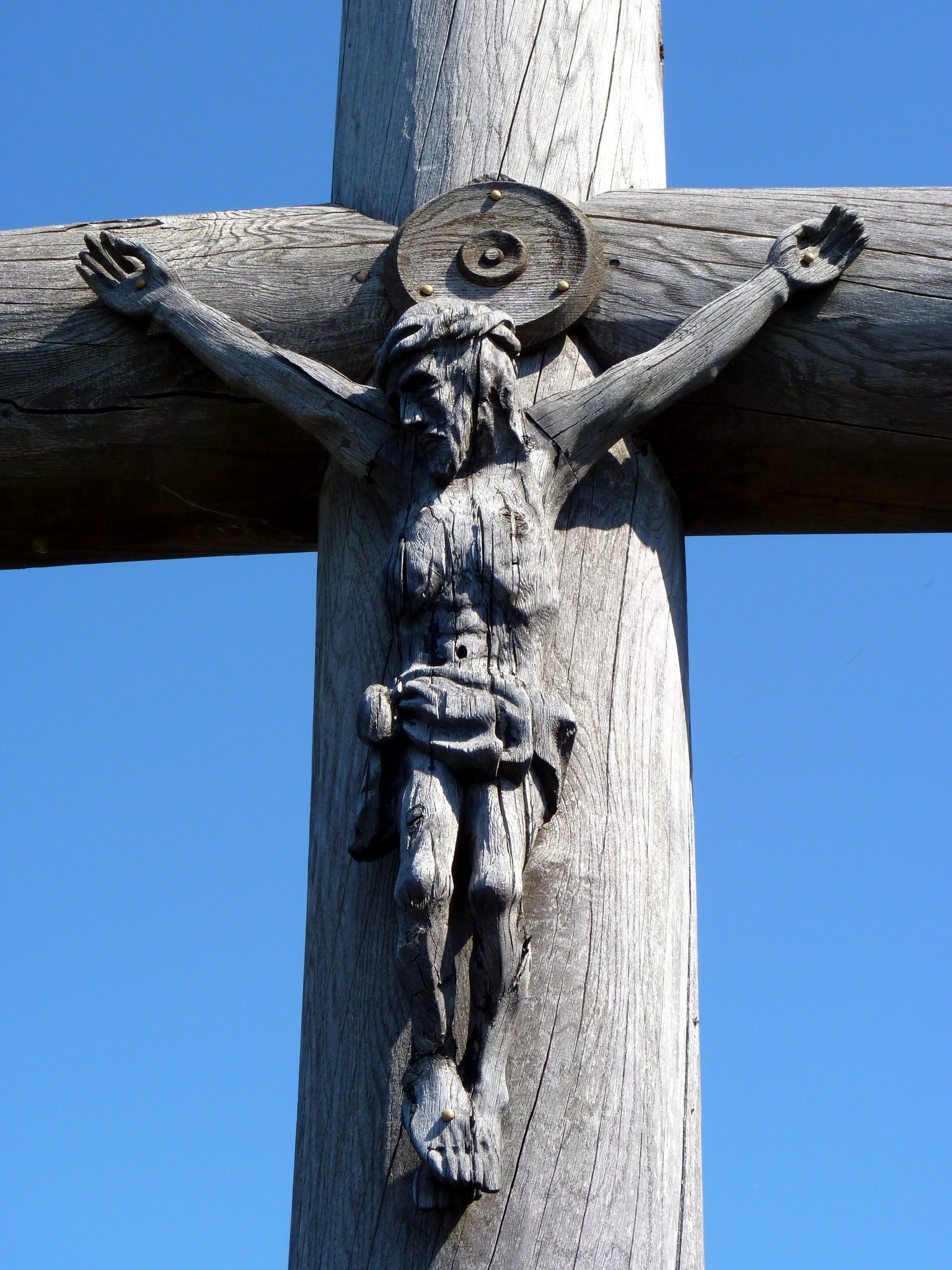
Pope John Paul II visited the site on 7 September 1993 and celebrated Mass before approximately 100,000 worshippers. He entrusted care of the pilgrimage site and the construction of a monastery to the Franciscans, the Order of Friars Minor, a Catholic order associated with prayer, preaching, service, and a life of poverty. A large crucifix donated by the Vatican was installed at the beginning of the small stairway in 1994. A cross associated with Pope Benedict XVI was erected in September 2006.
The Franciscan monastery was built in response to John Paul II’s request. Its foundation stone was laid in the late 1990s, and the building opened in July 2000 after two years of construction. The Order of Friars Minor of the Lithuanian Franciscan Province of St. Casimir is identified with the site’s administration. Since 1997, an indulgence observance has been held on the last Sunday of July. Pilgrims traditionally bring crosses connected with wishes, thanksgiving, commemoration, prayers for health or success, or tribute to historical events.
The Hill of Crosses was designated a national cultural monument of Lithuania on 19 May 1998. Lithuanian cross-crafting and its symbolism were included in UNESCO’s intangible cultural-heritage program in 2001, with the entry renewed in 2008. The tradition is internationally recognized as an expression of Lithuanian religious and national endurance, and the Hill of Crosses is particularly associated with it. A fire affected approximately 50 square metres of the hill on the night of 28 to 29 December 2006. In May 2013, Šiauliai District Municipality adopted rules permitting wooden crosses under 3 metres high to be erected without permits.
Remains
Hillfort and archaeological setting
Hillfort earthworks
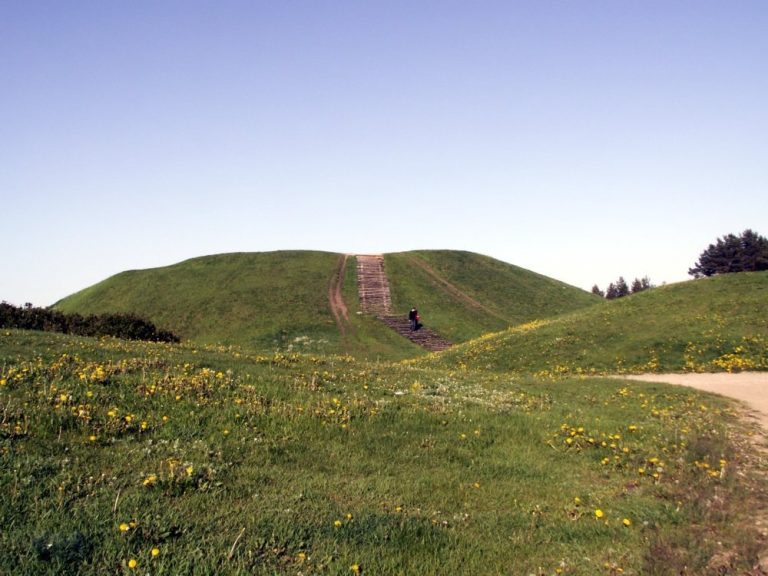
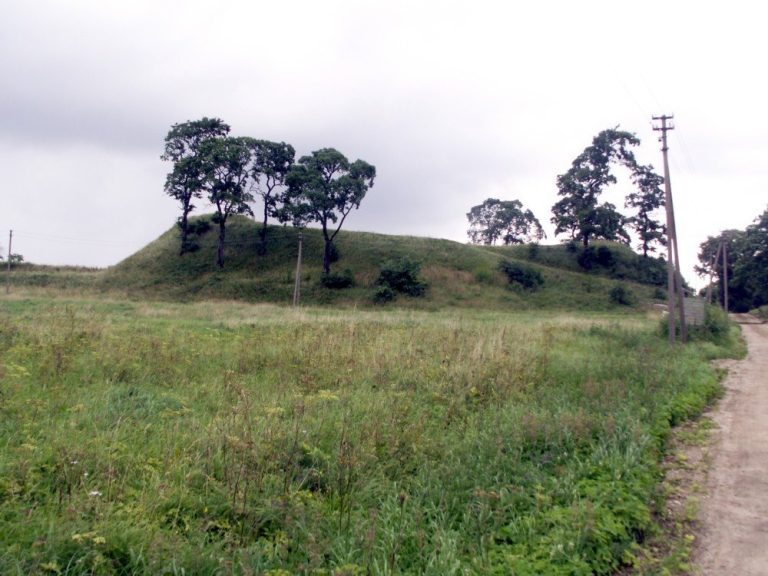
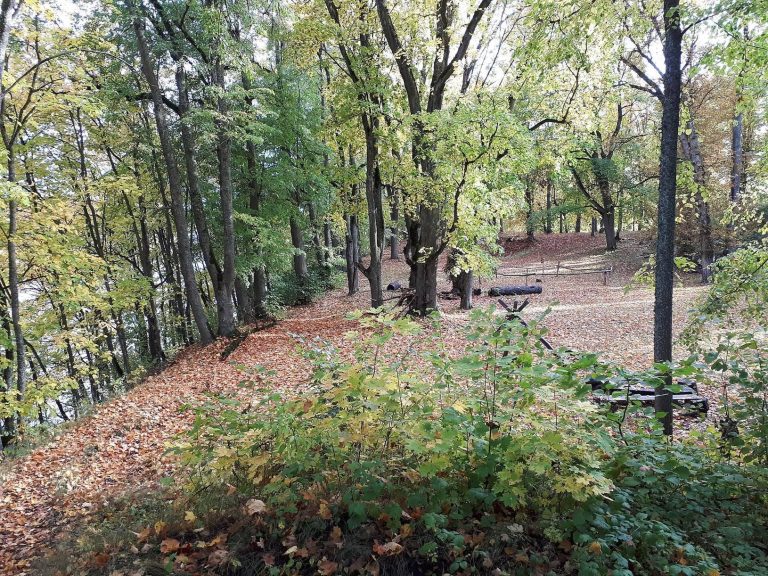
The site occupies a saddle-shaped double hill on the left bank of the Kulpė. The hillfort’s oval summit platform runs east to west and measures approximately 17 metres in length and 25 metres in width. At the eastern end, a rampart extends for 12.5 metres, rises 2.5 metres, and measures 14 metres across. Its outer slope descends 7 metres to a ditch about 10 metres wide and 0.5 metres deep, beyond which lies an outer rampart approximately 19 metres wide and 2 metres high. The western rampart is 17 metres long, 3 metres high, and 15 metres wide. The surrounding slopes are steep and between 6 and 8 metres high.
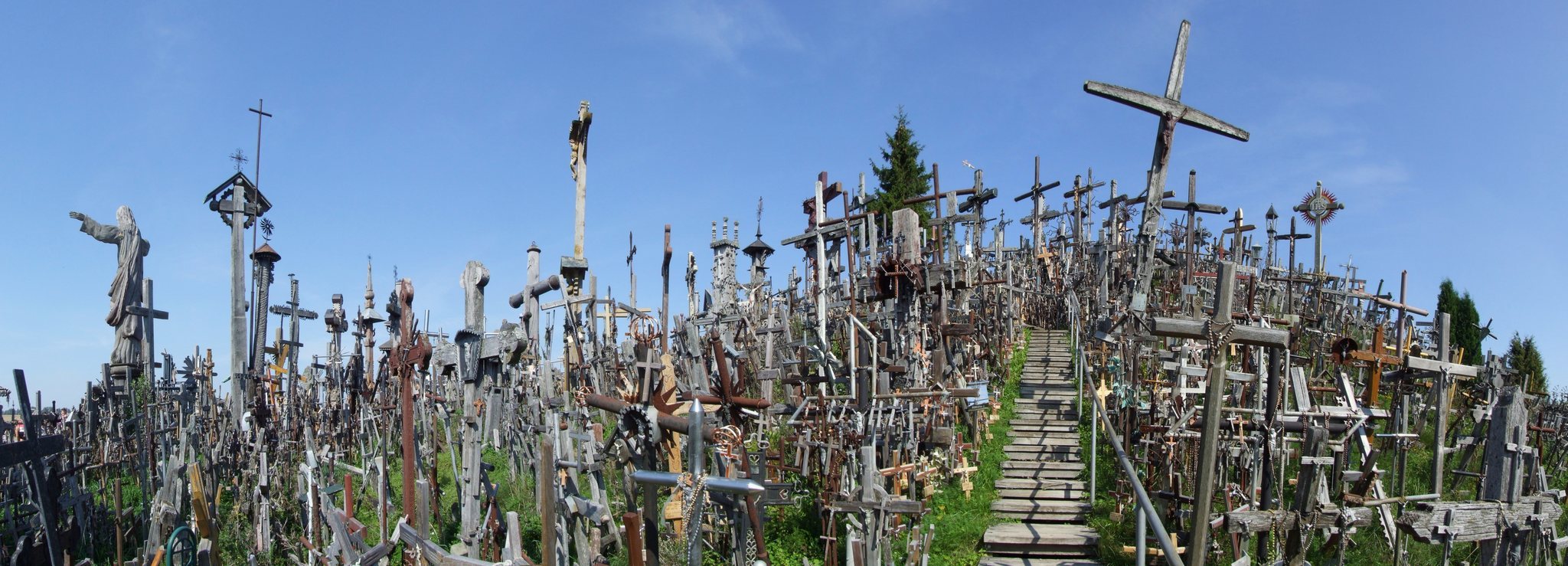
A narrow wooden-plank stairway crosses the hill, while a path runs lengthwise across the hillfort. A chapel formerly stood on the eastern rampart. Repeated placement and removal of crosses since the nineteenth century, together with Soviet demolitions, altered the hillfort’s surface and physical remains.
Settlement and cemetery
A settlement extends across about 3 hectares at the eastern, western, and northern foot of the hill. Archaeological investigations in 1990, 1991, and 1993 identified a cultural layer up to 1 metre thick dating from the thirteenth and fourteenth centuries. Finds included hearths, a silver brooch, iron knives, chisels, an arrowhead, a glass bead, a stone whetstone, plain and wheel-made pottery, animal bones, and clay daub. A cemetery dating from the ninth to twelfth centuries lies about 200 metres southeast of the hillfort.
In 1999, an examination of a 30-square-metre area on the eastern slope found a cultural layer up to 10 centimetres thick. The hill itself covers approximately 0.46 hectares, while the spread of crosses had extended into an adjacent area of about 1 hectare by the early 1990s.
Crosses and commemorative objects
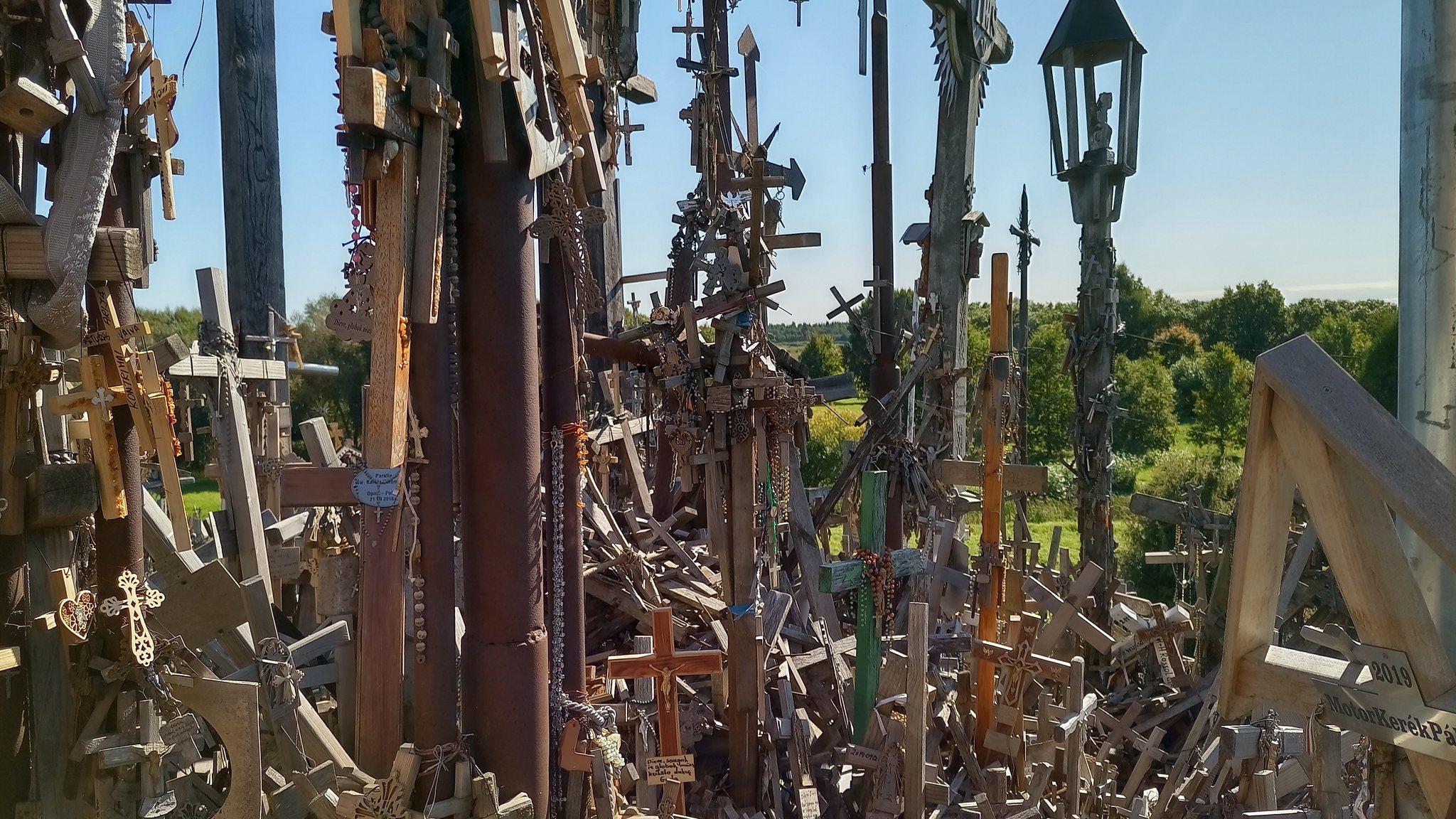
The hill’s surface is covered by a dense openwork of crosses made from wood, metal, stone, and concrete. The assemblage also includes statues of the Virgin Mary and other saints, carvings of Lithuanian patriots, small effigies, cross-pillars, paintings, rosaries, and small cross pendants. Crosses have come from across Lithuania and from other countries, and inscriptions refer to many parts of the world.
Rosaries and small pendants attached to larger crosses produce a light rattling or bell-like sound when moved by the wind. Together, the objects form the material expression of a continuing pilgrimage practice in which crosses mark wishes, thanks, remembrance, prayer, and tribute.
Papal structures
Outdoor altar pavilion
An outdoor altar pavilion was erected for Pope John Paul II’s Mass in 1993. A chapel was also built at the foot of the hill for the papal visit. These structures form part of the modern religious setting associated with the pilgrimage site.
Franciscan monastery
The Franciscan monastery is a two-storey building arranged around a cloister in the form of a Lithuanian cross. Designed by the Italian architect Nunzio Rimmaudo, it contains a small chapel, library, offices, kitchen, refectory, four guest rooms, and sixteen friars’ cells, including fourteen for novices. Large windows behind the altar look toward the Hill of Crosses, while the interior decoration refers to La Verna, the Italian mountain associated with Francis of Assisi and the tradition that he received the stigmata there.