San Giacomo: A Catholic Parish Church in Gaeta
Site at a Glance
- Rating
- 4.6
- Popularity
- Very Low
- Country
- Italy
- Primary era
- Early Modern
- External website
- Open
- Eras represented
- Early Modern, Modern
- Civilizations
- Italian, Kingdom of Naples, Spanish
- Site type
- Religious
- Remains
- Church
On this page21 sections
History
San Giacomo is a Catholic church in Gaeta, Italy, whose parish belongs to the Archdiocese of Gaeta. Known originally as San Giacomo di Terra Rossa, it serves the Porto Salvo district and is dedicated to Saint James the Greater, one of the Twelve Apostles of Jesus. The present church developed from a sixteenth-century parish foundation, underwent major rebuilding after the 1734 siege of Gaeta, and was extensively enlarged and redesigned between 1955 and 1957.
From pilgrim hospital to parish church
In 1529, a pilgrim hospital dedicated to Saint James the Greater stood in the area called all’Arco, beside the main road through the Borgo, now Via dell’Indipendenza. The name Terra Rossa referred to the red soil encountered while excavating its foundations. It also distinguished this institution from three other churches dedicated to Saint James in Gaeta.
Construction of a parish church began in the same area in 1559 on the initiative of Bishop Pedro Lunello. Work was interrupted at first, then resumed in 1565, and the parish was established in 1571. The building was enlarged in 1605 with financial support from Gaeta’s public magistracy. Between 1707 and 1711, the parish of San Sergio temporarily used San Giacomo while its new church, dedicated to the Holy Apostles, was being built.
San Giacomo had become the largest of the four parishes in the Borgo by 1725, serving 2,261 inhabitants. Its position changed sharply during the 1734 siege of Gaeta, a military assault on the city. A Spanish battery was placed near the church, and shelling by the Neapolitan defenders almost completely destroyed the building. Reconstruction continued for several years and was approaching completion in 1742, following the earlier architectural plan.
Parish changes and transferred furnishings
The demolition of the church of the Holy Apostles for military reasons in 1807 led to the incorporation of its parish into San Giacomo. In 1810, furnishings from the suppressed convent churches of Santa Caterina d’Alessandria and San Montano were transferred there. They included two holy-water stoups from Santa Caterina and the high altar, balustrade, and another holy-water stoup from San Montano.
In 1823, the local fraternity of the Secular Franciscan Order moved to San Giacomo from the church of San Francesco. This order is a lay branch of the Franciscan family whose members follow Franciscan spirituality while continuing to live in ordinary society. The church was damaged again during the Second World War, especially around the high altar, and was later repaired.
Twentieth-century enlargement and renewal
Parish priest Paolo Capobianco proposed an expansion in 1954. Work carried out from 1955 to 1957 demolished the rear wall of the Baroque apse, the existing facade, the gallery, the nineteenth-century wooden choir of the Franciscan tertiaries, and the contemporary pipe organ. A larger apse and a new facade were built in a modern style to designs by Antonio Petrilli and Pasquale Marabotto. Archbishop Dionigi Casaroli dedicated the enlarged church on 21 December 1957.
The church subsequently received further modern furnishings and a Mascioni pipe organ. A bell gable was added in 1970. Restoration between 1993 and 1995 removed some modern decoration, replaced the earlier pilasters with fluted white-marble ones, and created the present presbytery. Conservation work in 2010 renewed the interior plaster in a cream color and replaced the marble-slab floor.
Remains
Exterior and overall layout
Modern facade
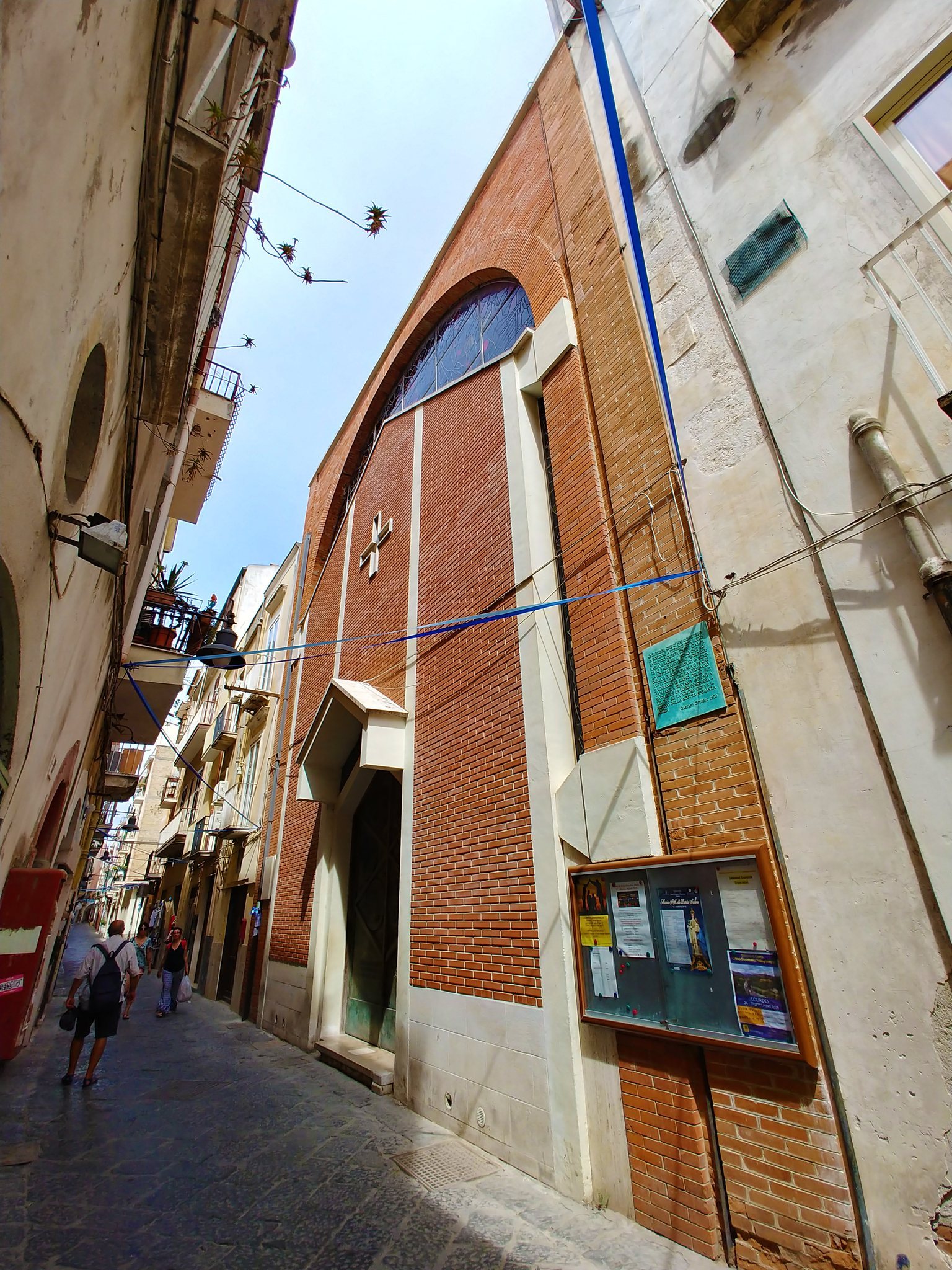
San Giacomo stands along Via dell’Indipendenza. Its facade, built between 1955 and 1957, replaced the eighteenth-century front, which had a central portal with a simple marble frame and three windows. The present front combines red-brick facing with white-plastered reinforced-concrete structural elements. It ends in a flat upper line and contains a large semicircular lunette window that follows the barrel vault of the nave, a cross-shaped window, and two narrow side windows.
A single entrance lies beneath a projecting geometric porch of reinforced concrete with a double-pitched top. Polychrome stained glass by János Hajnal represents the Calling of the First Disciples from the Gospel of Mark. The bronze portal by Angelo Sabbatani is formed from a broad hexagonal upper section joined to a narrower rectangular lower section. Six low-relief roundels on the door show episodes from the life of Saint James.
Bell gable
A reinforced-concrete bell gable, a wall-like structure that contains bells rather than a separate tower, rises beside the church near the facade. Built in 1970, it contains four bells with ornamentation by Angelo Sabbatani.
Modern apse and statue
The rear of the church faces the gulf and Via Giuseppe Buonomo. The modern square apse, built at the same time as the facade, has an eight-part pitched roof and a simple circular lantern. A later platform above the lantern supports Angelo Sabbatani’s bronze statue of the Immaculate Virgin, installed on 2 August 1959. The statue is 3.80 metres high and weighs approximately one tonne.
Nave and side chapels
Baroque nave
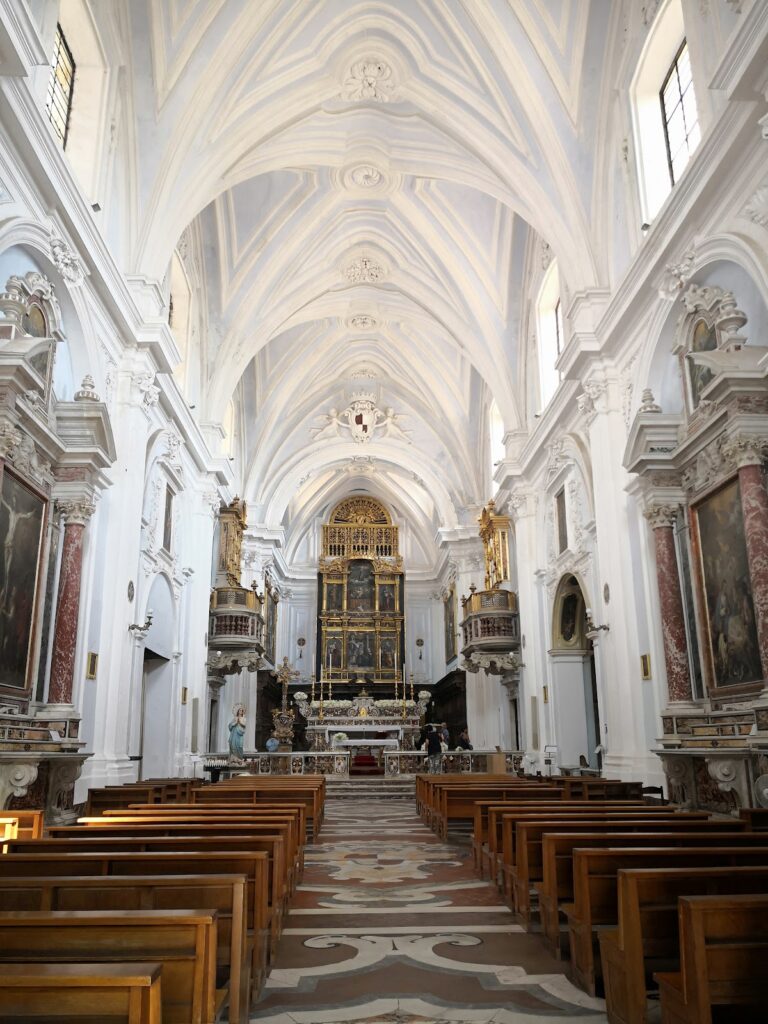
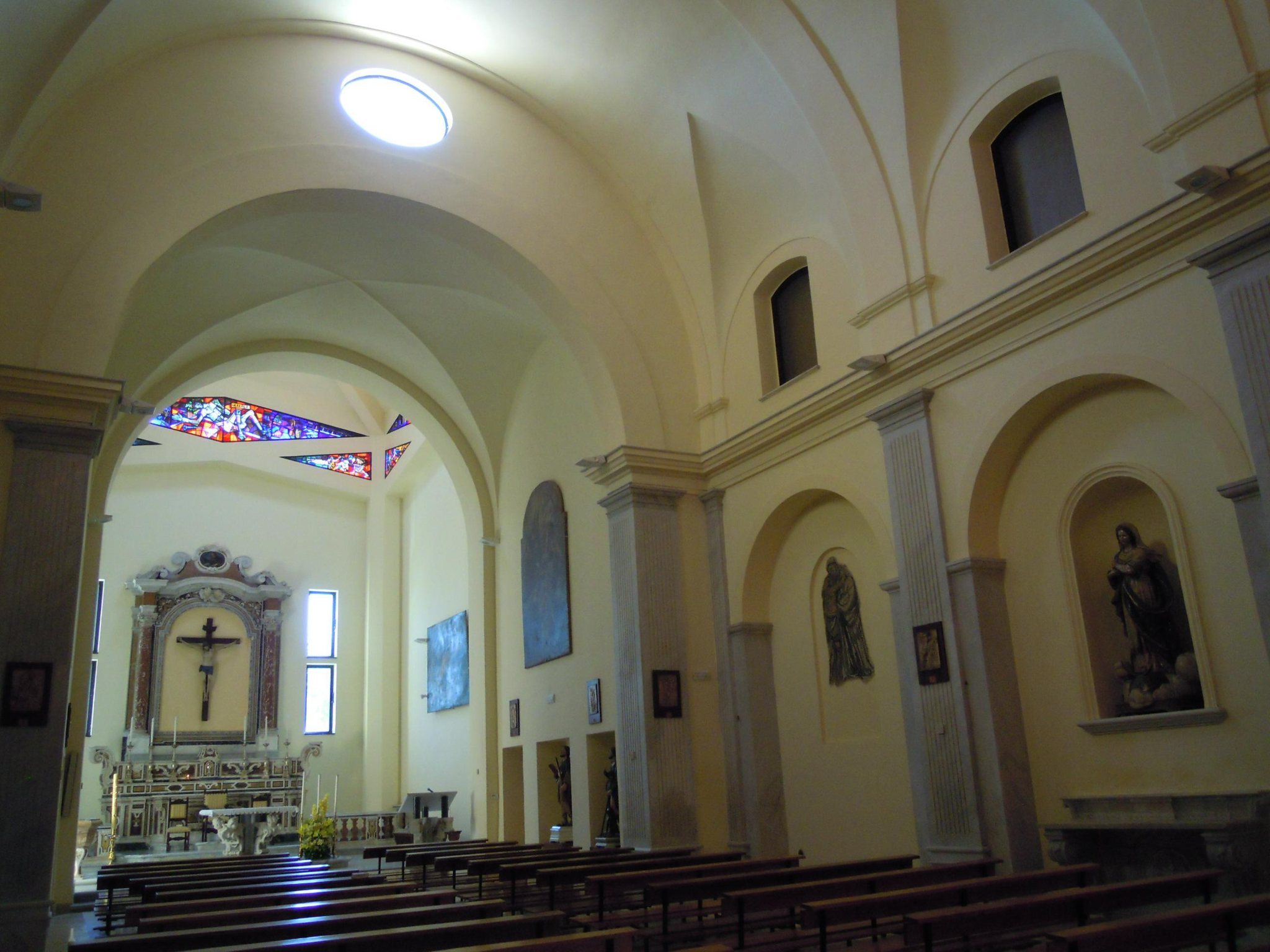
The interior retains a single Baroque nave covered by a barrel vault with semicircular openings, known as lunettes. Rectangular windows illuminate both sides. Eight shallow chapels open from the nave between fluted light-marble pilasters installed during the 1993 to 1995 restoration.
Four chapels, the two central chapels on each side, contain marble altars. Three were made during the 1950s expansion as replacements for earlier imitation-marble altars, using the surviving older altar as a model. The surviving altar is the second on the right and had been acquired before 1806 from Santa Teresa in Formia.
Right-hand chapels
The first chapel on the right is deeper than the others and formerly served as the baptistery. It contains Mario Pagliardini’s 1964 mosaic of the Baptism of Jesus. Pagliardini also made the church’s bronze Stations of the Cross. The chapel opposite contains János Hajnal’s mosaic of the Calvary, which frames a modern crucifix installed in 1995.
The two final chapels, which contain no altars, hold Hajnal’s mosaics of Jesus the Good Shepherd on the left and God the Merciful Father on the right. The first altar on the right supports a dressed statue of Our Lady of Sorrows, carried through the city during the traditional Good Friday evening procession. The second contains an early eighteenth-century polychrome wooden statue of the Immaculate Virgin from the Neapolitan artistic milieu.
Left-hand chapels
The first altar on the left holds a polychrome wooden statue of Saint Joseph with the Child. The next altar contains an early eighteenth-century tabernacle made of polychrome marble and a statue of the Sacred Heart of Jesus.
Holy-water stoups
Two Baroque marble holy-water stoups stand in the counterfacade beside the entrance vestibule. They came from Santa Caterina d’Alessandria and are attributed to Domenico Antonio Vaccaro, around 1705. One bears the wheel associated with Saint Catherine, while the other carries the coat of arms of Bishop José Guerrero de Torres, who occupied the see of Gaeta from 1693 to 1720.
Historic and modern apses
Original Baroque apse
The original square Baroque apse is covered by a cross vault and opens into the larger modern apse. Its right wall contains Santillo Sannini’s 1695 Sacra Conversazione, a devotional composition showing sacred figures together in one setting. The painting presents Christ enthroned above, with the Virgin presenting Saint Francis of Assisi. Saint Anthony of Padua, Saint Montanus, and Saint Elizabeth of Hungary stand below.
Two nineteenth-century statues, representing Saint James the Greater and Saint Roch, occupy square niches beneath the painting. An adjoining room contains a polychrome-marble holy-water stoup from the first half of the eighteenth century. Formerly in the presbytery, it carries the arms of the Albito Piccolomini family and came from the Discalced Carmelite church of Santa Teresa in Formia, which sold it to San Giacomo shortly before the suppression of religious orders in 1806.
Modern apse and presbytery
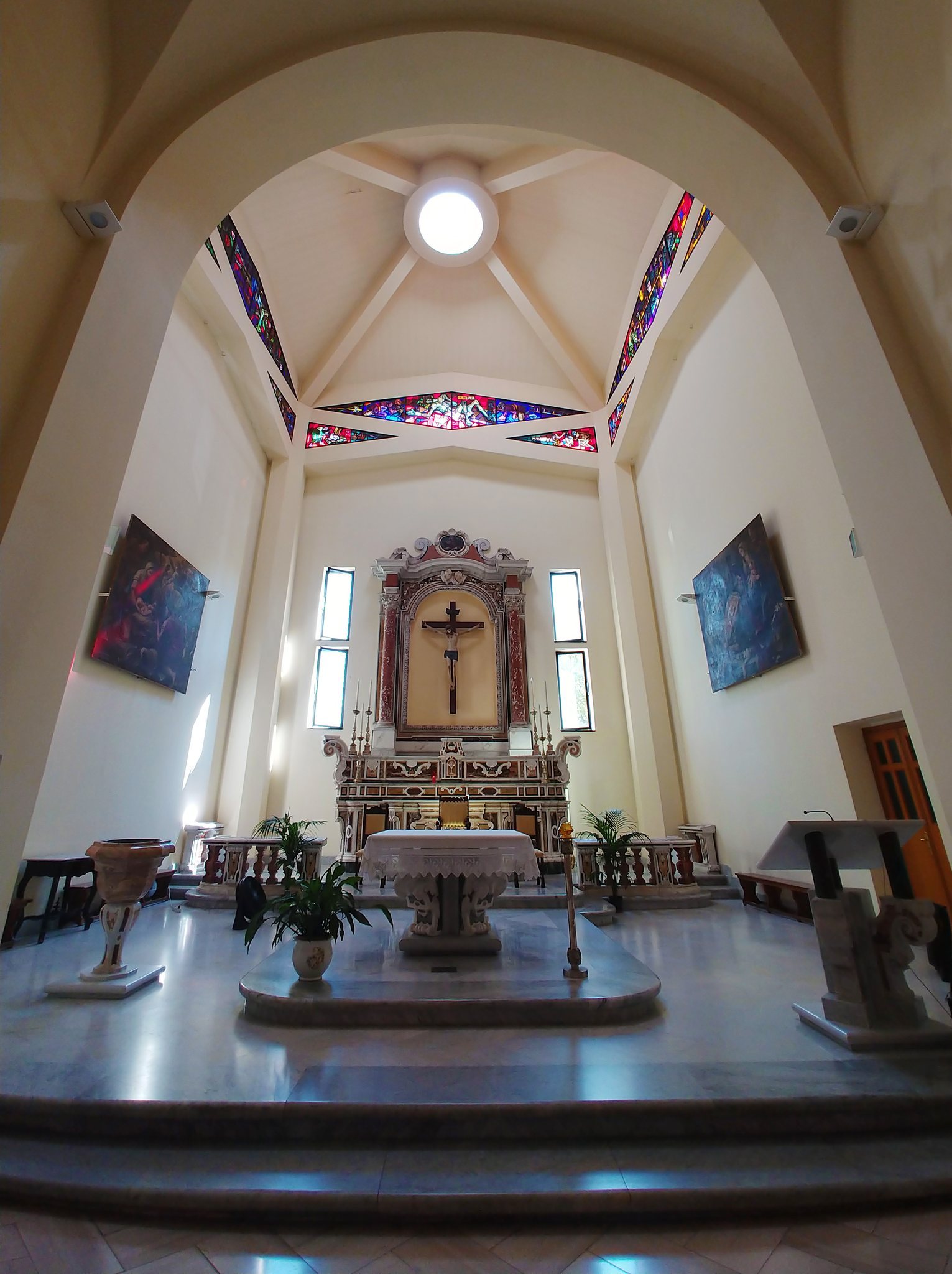
The modern square apse is larger than the original one and has a strongly geometric design. Its projecting reinforced-concrete members are concealed externally beneath plaster matching the walls. The eight-part ceiling contains a circular skylight. Windows in the upper part of each side consist of a central flattened lozenge and two smaller triangular openings.
Hajnal created the stained glass for these openings. The window above the entrance arch is non-figurative. The others depict the Crucifixion above the Baroque altar, Jesus the Vine on the left, referring to the Gospel of John, and the Supper at Emmaus on the right.
The present presbytery, created between 1993 and 1995, fills the modern apse and is raised several steps above the nave. Its central high altar has a mensa supported by four altar angels. The ambo on the right has a similar form, while a Baroque baptismal font stands on the left.
Former San Montano altar
Against the rear wall, between two pairs of rectangular windows opened during the 1990s restoration, stands the former high altar of San Montano. Made around 1673 to 1675, it is a polychrome-marble Baroque altar with a matching balustrade divided into four sections. Its altarpiece, influenced by Cosimo Fanzago and Dionisio Lazzari, has smooth Corinthian columns and floral inlay. The upper section contains a painting of God the Father.
In 1995, an eighteenth-century wooden crucifix from the demolished church of the Holy Apostles was placed where the former altarpiece had stood. Before that move, the crucifix had been in the first chapel on the left.
Paintings and organ
Former church paintings
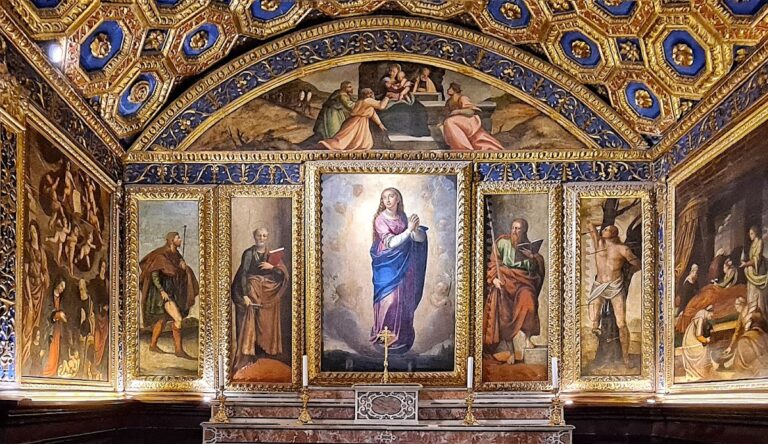
Paintings formerly held by San Giacomo are now in the picture gallery of Gaeta’s Historical and Cultural Center in the Palace of Culture. They include Saint Montanus at Prayer, a seventeenth-century work from San Montano; Saint Andrew with an Angel Indicating to Tobias that He Should Gather a Fish, from the second half of the eighteenth century and formerly in the vanished church of Sant’Andrea; and three panels by Giovanni Filippo Criscuolo, dated 1530 to 1535 and probably once forming a triptych.
The panels depict the Holy Trinity, Saint Peter, and Saint Paul. The latter two stood beside San Giacomo’s high altar until 1955. They were conservatively restored in 1996 and remain damaged in several areas, while the Saint Peter panel has extensive overpainting.
Mascioni pipe organ
The Mascioni pipe organ, opus 873, was built in 1965 and restored by the same firm in 1996. It stands in an arched organ chamber made during the 1950s expansion, on the left wall of the old apse. The instrument has electric transmission with a multiplex system and is entirely enclosed in an expression box, an enclosed chamber whose shutters regulate volume.
Its display consists of 25 non-speaking principal pipes with mitre mouths. The organ has 20 stops, six of them real, and a movable independent console with two manuals and a pedalboard. The console was first placed in the modern apse, later moved into the nave in front of the fourth chapel on the right, and is now beneath the sound-producing body. Its stops are controlled by rocker tablets arranged in one row above the second manual.