The Roman Baths in Bath: A Roman Sacred and Bathing Complex


Site at a Glance
- Rating
- 4.6
- Popularity
- Very High
- Country
- United Kingdom
- Primary era
- Classical
- External website
- Open
- Eras represented
- Classical, Medieval, Early Modern, Modern
- Civilizations
- British, English, Roman
- Site type
- Sanitation
- Remains
- Baths
On this page16 sections
History
The Roman Baths in Bath, United Kingdom, are a Roman sacred and bathing complex developed at the hot springs of Aquae Sulis during the first century AD. The settlement’s name means “the waters of Sulis,” reflecting the earlier Celtic association of the springs with the goddess Sulis, whom the Romans identified with Minerva. A temple was built around AD 60–70, and the bathing complex expanded over the next three centuries. Together, the spring, temple, and baths formed a religious and public centre that remained in use until the end of Roman rule in Britain.
Aquae Sulis and Sulis Minerva
The springs may already have been a Celtic place of worship before the Roman settlement developed. Under Roman rule, worshippers honoured Sulis Minerva, a Romano-British deity created by identifying the local goddess Sulis with Minerva, the Roman goddess associated with wisdom, crafts, and civic protection. Visitors came to the temple and baths from across the Roman Empire. Sacrifices took place at the great altar in the temple courtyard, while private altars provided additional places for religious observance.
A later tradition credited the British king Bladud with discovering the spring and establishing the first baths in 836 BC. Geoffrey of Monmouth recorded this story, which is largely fictional. Its popularity was strengthened by the tale that the waters cured Bladud and his pigs of leprosy. The tradition nevertheless became part of the long cultural history associated with Bath’s springs.
Decline and medieval redevelopment
Following the Roman withdrawal from Britain in the early fifth century, the baths deteriorated. Silting and flooding eventually buried or obscured the Roman structures, and the Anglo-Saxon Chronicle associates their destruction with the sixth century. The springs continued to shape the development of the city, however. In the twelfth century, John of Tours constructed a curative bath over the reservoir of the King’s Spring. Bath’s city corporation later built the Queen’s Bath south of the spring during the sixteenth century.
The springs also attracted royal visitors. Anne of Denmark, queen consort of James VI and I, came to Bath for her health in 1613 and 1615. Her physician, Théodore de Mayerne, treated her in the King’s Bath on 19 May 1613. A natural-gas flame startled her there, after which she used the New Bath, also called the Queen’s Bath. A column commemorated her association with that bath.
Georgian and Victorian Bath
During the eighteenth century, John Wood the Elder and John Wood the Younger built around the springs, enclosing them within the growing Georgian city. The Pump Room served both as a place where visitors drank the waters and as a Neoclassical social salon. Victorian additions continued the architectural tradition established by the Woods.
In 1810, when the hot springs were believed to have stopped flowing, William Smith examined the Hot Bath Spring. He found that the water had moved into a new channel rather than ceased, and restored it to its earlier course. This intervention helped preserve the spring system on which Bath’s historic identity depended.
Excavation, collections, and conservation
The surviving Roman complex was excavated and developed as a museum during the late nineteenth century. It opened as a visitor complex in 1897. The collections include thousands of objects from Aquae Sulis, among them more than 12,000 Roman coins deposited in the Sacred Spring. This is the largest known votive deposit of its kind in Britain. The Beau Street Hoard, found in Bath in 2007, contains more than 17,000 Roman coins.
About 130 curse tablets were found in the Sacred Spring in 1979–80. These thin sheets of lead or pewter carried appeals and curses connected with personal disputes, many involving clothing stolen from bathers. They include some of Britain’s earliest recorded prayers and are listed in the UNESCO Memory of the World Register. In 1965, excavation also brought to light the haruspex stone, an inscribed object dedicated to Sulis Minerva by L. Marcius Memor. A haruspex was a Roman religious specialist who interpreted omens, especially those connected with sacrifice.
The Roman Baths became part of the City of Bath UNESCO World Heritage Site in 1987. Conservation and interpretation have continued through archaeological investigation, protective treatment, and changes to the museum displays. A ventilation system installed in 2006 reduced the movement of corrosive salts through the stonework. The nineteenth-century terrace statues receive periodic protective coatings against acid rain, and stones from the temple pediment were conserved and rearranged in the early 2010s. The Roman Baths Clore Learning Centre opened in 2022, adding underground exhibition and learning spaces linked to the baths by a tunnel.
Responsibility for Bath’s hot springs was assigned to the city by a royal charter granted by Elizabeth I in 1591. Bath and North East Somerset Council now monitors the springs’ pressure, temperature, and flow. Water from the springs is no longer used for bathing in the Roman Baths. After a girl who swam in the former Beau Street swimming baths died from an infection caused by Naegleria fowleri in October 1978, those baths closed for several years. Bathers now use the nearby Thermae Bath Spa and the refurbished Cross Bath, which receive water from more recently drilled boreholes.
Remains
The Roman Baths lie below modern street level and extend beneath nearby streets and squares. The preserved complex brings together four principal elements: the Sacred Spring, the Roman Temple, the Roman Bath House, and a museum containing finds from Aquae Sulis. Roman engineers drove oak piles into the mud for stability and enclosed the spring in an irregular stone chamber lined with lead. By the second century, the complex stood within a wooden building covered by a barrel vault, a continuous curved roof formed by extending an arch along the building’s length.
The spring and temple
The Sacred Spring
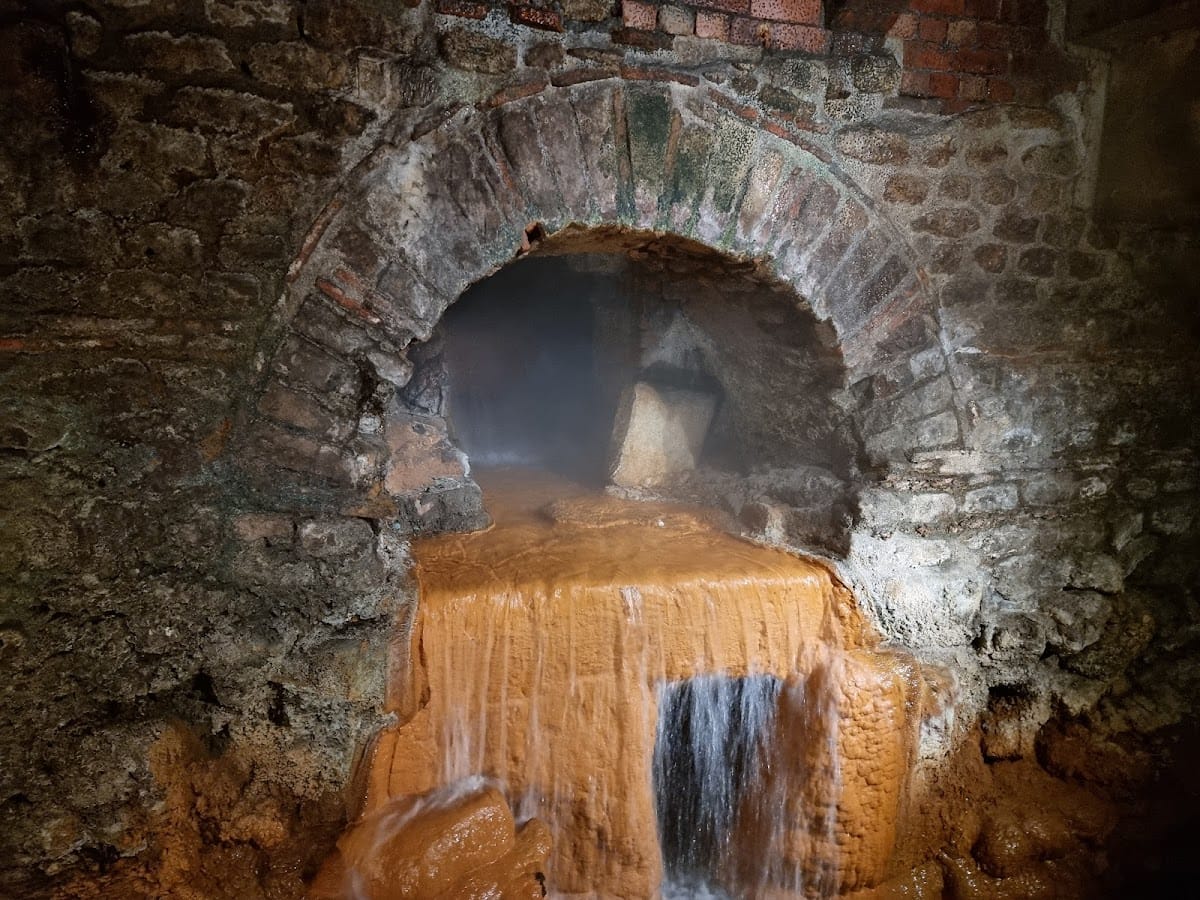
The Sacred Spring is the natural centre of the complex. Water rises at about 46°C at a daily rate of approximately 1,170,000 litres. Rainfall on the Mendip Hills travels through limestone aquifers between approximately 2,700 and 4,300 metres below ground. Geothermal energy heats the water before it returns through fissures and faults, including the Pennyquick Fault.
The water contains high concentrations of sodium, calcium, chloride, and sulphate ions. A Spring Overflow carries surplus water into the original Roman drain and onward to the River Avon, about 400 metres away. Lead pipes distributed hot spring water through the complex by gravity, and substantial parts of the Roman plumbing and drainage system survive. A section of the great drain can be viewed through a glass floor. Finds from it include 34 gemstones and a tin mask. A borehole sunk in the early 1980s provided a cleaner supply of spa water for drinking in the Pump Room.
Objects placed in the spring include more than 12,000 Roman coins and metal vessels called paterae, which may have been used for offering holy water. Some bear the inscription “DSM,” an abbreviation of Deae Sulis Minerva. These objects formed part of the religious activity that took place around the water.
The Roman Temple
The Roman Temple stood beside the spring on a podium more than two metres above the surrounding courtyard. A flight of steps led to its front, where four large fluted Corinthian columns supported a frieze and decorated pediment. The pediment measures about 7.9 metres across and 2.4 metres from its apex to its lower edge. Sections have been re-erected and are displayed in the museum.
At the centre of the pediment is a large head carved from Bath stone. Traditionally called a Gorgon’s Head, it was positioned about 15 metres above people approaching the temple. Its identity remains uncertain. It may represent a water deity such as Oceanus, a local Celtic god, or a deliberate combination of Minerva’s Gorgon attribute with a local water deity. Snakes twist through its beard, wings rise above its ears, and the face has projecting brows and a heavy moustache. Other sculpted motifs include tritons, a dolphin, an owl, women carrying oak-leaf shields associated with Victory, and a star at the top of the composition.
A gilt-bronze head of Sulis Minerva, probably part of the cult statue that stood inside the temple, may date from the first century AD. It was found nearby in 1727 and is displayed in the museum. Gilt-bronze sculpture is rare in Roman Britain, and only two other fragments of this type are known. The haruspex stone, discovered in 1965, was probably used to support the goddess’s statue and carries the dedication by L. Marcius Memor.
The Roman bathing complex
The Great Bath
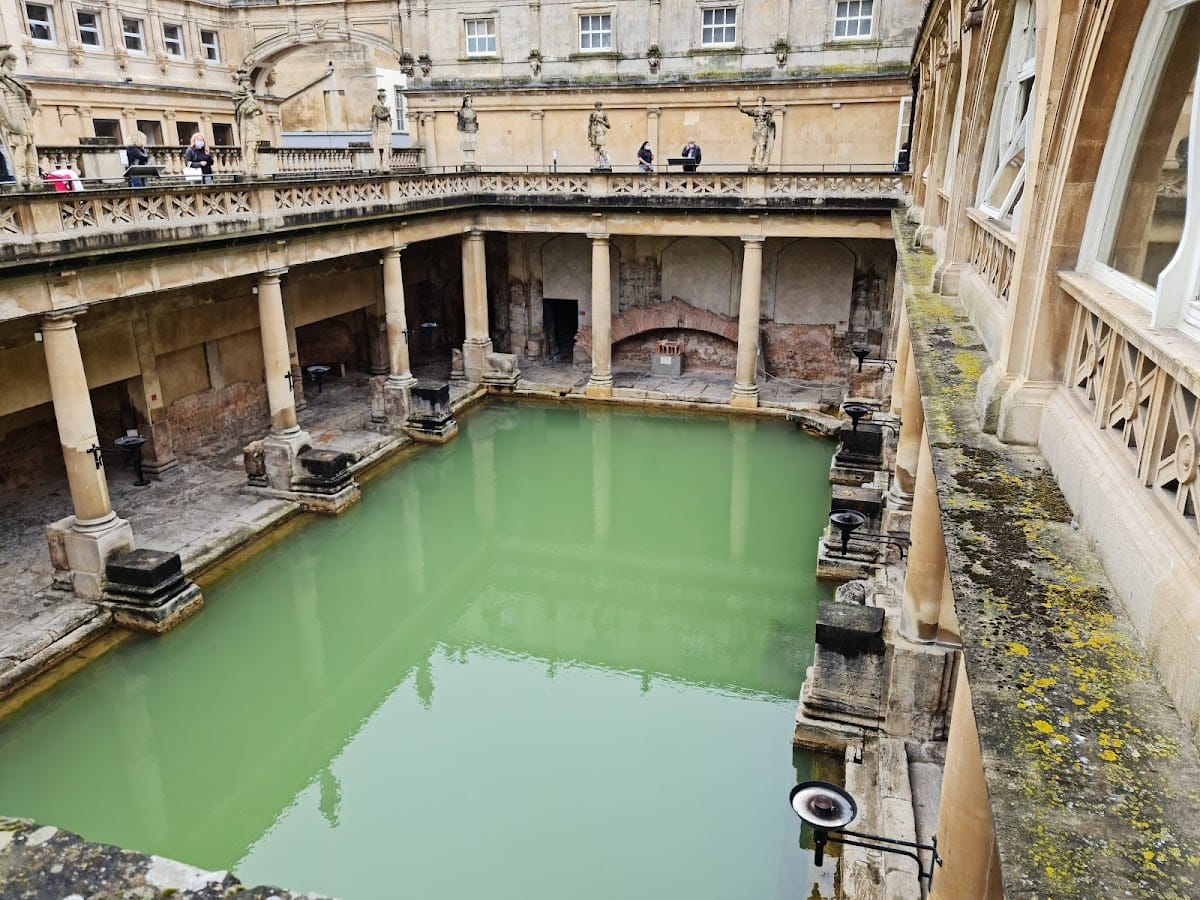
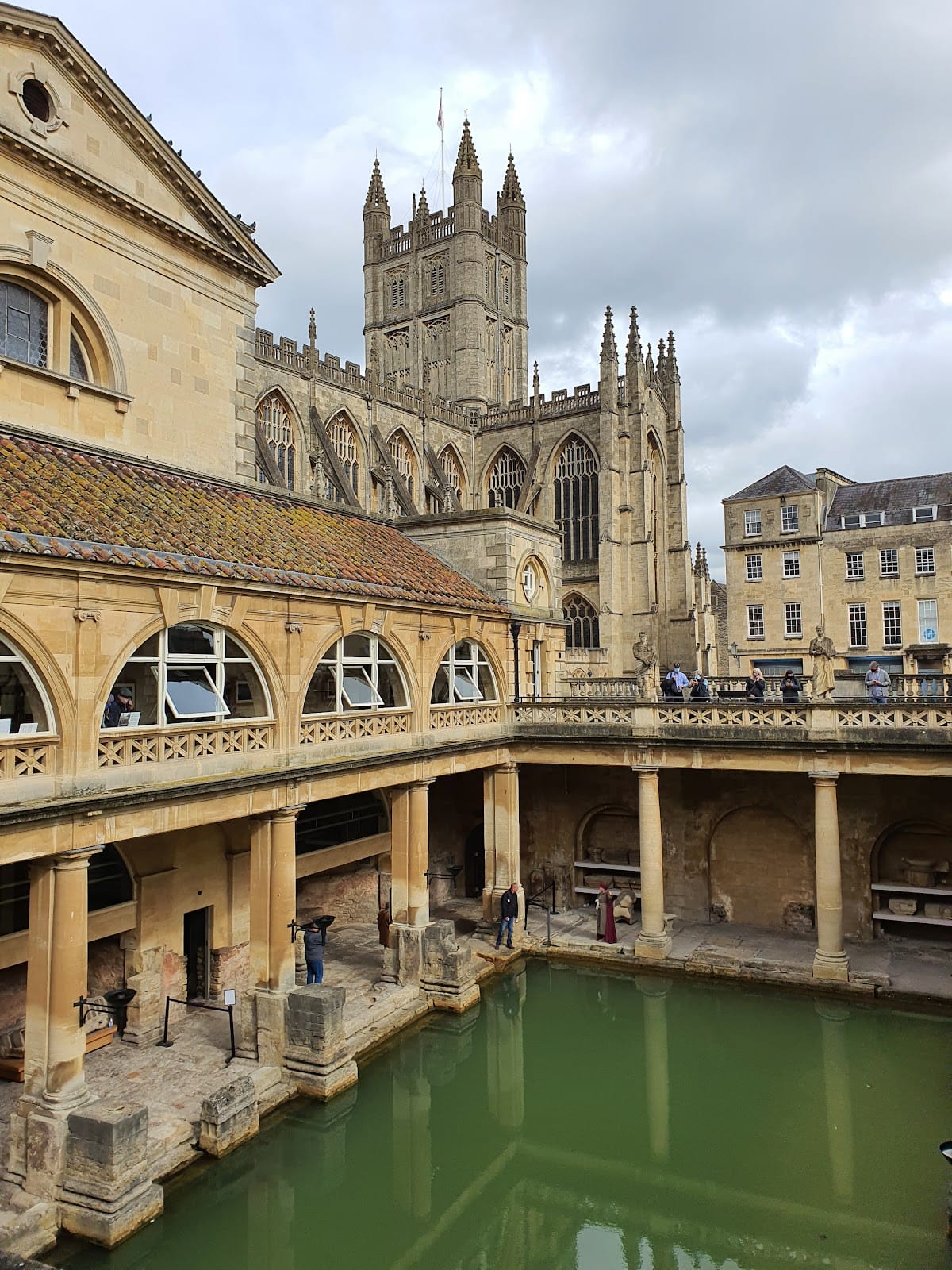
The Great Bath occupies the centre of the bathing complex. The pool is 1.6 metres deep and lined with 45 sheets of lead. Hot spring water enters the pool, and steps descend into it from all sides. Niches around the edge probably held benches and possibly small tables. A broad flat slab where the hot water enters is known as the diving stone.
The pool was once enclosed within an enormous hall with a barrel-vaulted roof about 20 metres high. The surviving bath therefore preserves both the scale of the central pool and evidence of the large covered space that originally sheltered it.
Eastern and western ranges
The bath house changed repeatedly during its approximately four centuries of Roman use. In the eastern range, a large warm bath received water through a pipe from the Great Bath. Beyond it lay heated rooms that grew progressively larger, reaching the complex’s greatest extent during the fourth century AD.
The western range contains a sequence of pools and heated rooms, including a circular cold plunge pool 1.6 metres deep. Several heated rooms retain substantial stacks of supporting brick pillars, known as hypocaust pilae. These held the floors above heated cavities, allowing hot air to circulate beneath them. The complex incorporated hot, lukewarm, and cold bathing areas, known in Roman terms as the caldarium, tepidarium, and frigidarium, together with parts of its Roman heating and drainage systems.
Later buildings and museum displays
Victorian entrance and terrace
Access to the preserved complex begins through a Victorian reception hall and former concert-hall structure built in 1897. It forms an eastern continuation of the Grand Pump Room and has a glass-domed centre with curved corners. Its domed ceiling is decorated with images of the four seasons. The terrace overlooking the Great Bath carries statues of Roman emperors and governors of Britain, carved in 1894 before the complex opened.
Queen’s Bath and Grand Pump Room
The museum and Queen’s Bath, including a bridge across York Street toward the City Laundry, were designed by Charles Edward Davis in 1889. The Queen’s Bath incorporates parts of a seventeenth-century bath. The Grand Pump Room was begun by Thomas Baldwin in 1789, completed by John Palmer after Baldwin’s resignation in 1791, and finished in 1799. Its Abbey Church Yard elevation has four engaged Corinthian columns, entablatures, and a pediment. Baldwin designed the north colonnade, while the similar south colonnade gained an additional upper floor in the late nineteenth century.
Museum and interpretation
The museum preserves thousands of finds from the site, including human remains displayed as archaeological evidence for the lives of people in Aquae Sulis. Reconstructed and interpretive elements help present the surviving remains, including suspended walls above Roman masonry, models of the temple and baths, projected reconstructions, and displays explaining the former rooms and their uses.