Iwaya-ji Temple: A Mountain Sanctuary on the Shikoku Pilgrimage


Site at a Glance
- Rating
- 4.5
- Popularity
- Low
- Country
- Japan
- Primary era
- Early Modern
- External website
- Open
- Eras represented
- Early Modern, Modern
- Civilizations
- Japanese, Tokugawa
- Site type
- Religious
- Remains
- Temple
On this page20 sections
History
Iwaya-ji Temple is a Buddhist temple in Japan, traditionally founded by Kūkai in 815 and associated with Shingon Buddhism, an esoteric tradition centered on ritual, mantra, meditation, and mandalas. It belongs to the Buzan-ha branch of that tradition and is the 45th temple of the Shikoku Pilgrimage of 88 Temples. It is also the seventh site on the Shikoku Thirteen Buddhas pilgrimage. Its mountain name is Kaiganzan, and its principal deity is Fudō Myōō, a protective Buddhist figure associated with immovable resolve and the destruction of spiritual obstacles.
Traditional Foundation
Temple tradition places the foundation of Iwaya-ji in 815, during Kūkai’s search for a sacred place. He is said to have encountered Hokke Sennin, a woman believed to possess supernatural powers. After accepting his teaching, she presented the mountain to him. Kūkai is then said to have carved wooden and stone images of Fudō Myōō. He installed the wooden image as the principal image, placed the stone image in a cave at the Inner Sanctuary, and made the whole rocky mountain the principal object of worship.
The name Kaiganzan is traditionally connected with a poem attributed to Kūkai. In the poem, mountain mist is compared with the sea, while wind moving through the pines is likened to waves. This association reflects the temple’s religious identity as a sanctuary in which the natural mountain itself forms part of the object of worship.
Medieval Associations and Independence
During the mid-Kamakura period, Ippen stayed at Iwaya-ji. Ippen was a thirteenth-century Buddhist religious founder associated with the Ji-shū movement. The temple complex is also depicted in an illustrated biography of him, preserving an early visual record of its religious setting.
At an uncertain date, Iwaya-ji became the Inner Sanctuary of Daihō-ji, the 44th temple on the Shikoku pilgrimage. The relationship continued until 1874, when Iwaya-ji became independent and its first chief priest took office.
Fire and Reconstruction
A fire in 1898 destroyed nearly all the temple buildings, along with historical records, treasures, and other materials. The Niō Gate and the Kokūzō Bosatsu Shrine survived. Kokūzō Bosatsu is a bodhisattva associated with wisdom and memory.
Rebuilding took place over several decades. The Daishi Hall was reconstructed in 1920, followed by the Main Hall in 1927 and the Mountain Gate in 1934. The Bell Tower was rebuilt in 1952, the temple lodging in 1963, and the Seriwari Fudō and Hakusan Gongen pavilions in 1978. Hakusan Gongen is a Buddhist-Shintō mountain deity historically understood as a manifestation of a Buddha or bodhisattva.
Pilgrimage and Religious Practice
Iwaya-ji’s annual festival takes place on the twenty-first day of the third lunar month. Its observances include Goma, a ritual fire ceremony, and Mikage-ku, a memorial service for Kōbō Daishi. The festival also includes rice-cake scattering, the ceremonial unveiling of the Kōbō Daishi statue, and the Ana-zenjō water-offering rite in the sacred cave.
Kōbō Daishi is Kūkai’s posthumous religious name, meaning “Great Master.” The temple’s formal identity includes a principal-image mantra and a pilgrimage hymn. Its pilgrimage registration records the temple’s principal image and Hakusan Myōri Daibosatsu of the Inner Sanctuary.
The Iwaya-ji precincts, a designated part of the Iwaya-ji Way of the Iyo Pilgrimage Route from Daihō-ji, and two preserved sections totaling approximately 1.3 kilometers of the roughly 29-kilometer Jōruri-ji Way became designated cultural properties in 2021 and 2022. These designations cover the temple and associated historic pilgrimage routes.
Remains
Mountain Setting and Approach
The precincts occupy a steep mountain setting at approximately 565 to 567 meters above sea level, between towering conglomerate rock peaks. Kongōkai Peak stands on the right when facing the mountain, while Taizō Peak rises on the left. The buildings appear to be set into the face of a massive rock cliff, making the natural formation an integral part of the sanctuary. By the elevation of its Main Hall, Iwaya-ji is the fourth-highest of the 88 Shikoku pilgrimage temples.
The approach climbs through gates, bridges, stairs, terraces, and sanctuaries associated with the surrounding rock. Countless stone Buddha statues line the route, particularly beyond the red Gokuraku Bridge. At an intermediate point stand statues of the Welcoming Daishi and Fudō Myōō. The Nozomi Miroku stone statue and the cast-bronze Mizuko Jizō statue are each sheltered by simple roofs. Miroku is the future Buddha, while Jizō is a compassionate bodhisattva associated with travelers, children, and the care of the dead.
Stone Pillar Gate
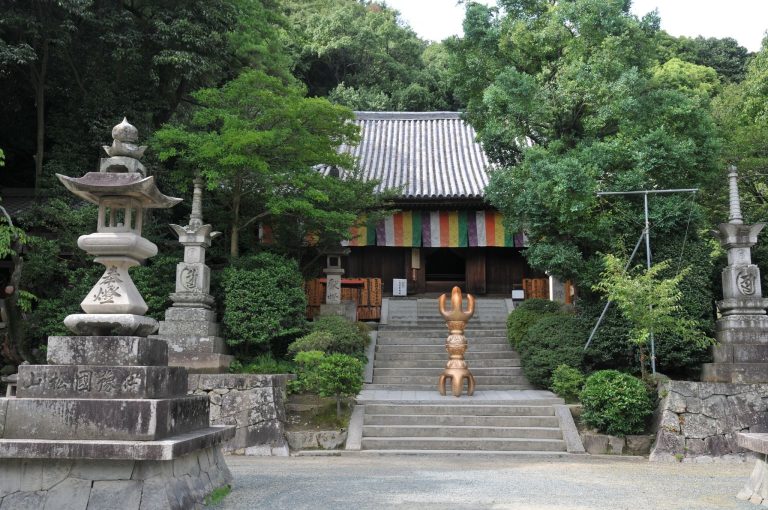
The Stone Pillar Gate has small Kongō Rikishi figures standing on its stone pillars. These guardian figures traditionally protect Buddhist temple entrances. Farther up the steep approach, the Mountain Gate, built in 1934, marks another stage of the ascent, with additional stone steps continuing beyond it.
Lower and Rock-Related Sanctuaries
Kokūzō Bosatsu Hall
The Kokūzō Bosatsu Hall, also described as a shrine, was built in 1747. Nearby are stone statues of Shusui Daishi, the Path-Opening Fudō, and Benzaiten of the Cave. Benzaiten is associated with eloquence, music, and the arts.
Ana-Zenjō Cave
Ana-Zenjō is a cave approximately 20 meters deep directly beneath the Main Hall. Its interior contains stone statues of Jizō used in ancestral memorial services, together with images of Kanaeru Fudō and Kōbō Daishi. Water springs from beneath the Jizō statue, where it is connected with the cave’s water-offering rite.
Niō Gate and the Flying Buddha
The Niō Gate stands on the main approach from the Hacchō-zaka pilgrimage trail and was completed in 1790. It also served as a Bell Tower and as a remote-worship point for the Cave Amida Nyorai, known as the Flying Buddha. From the inner right-hand corner, viewed from the Daishi Hall, the image can be seen clearly. The route beyond the gate passes through mountain forest toward the Inner Sanctuary.
Inner Sanctuary
The Inner Sanctuary contains the Training Ground of the Thirty-Six Attendants, the Seriwari Zenjō cleft-meditation site, and the Kusari Zenjō chain-meditation site. The Seriwari Fudō and Hakusan Gongen pavilions form part of the rock-related religious landscape, with the former rebuilt in 1978.
Upper Precinct
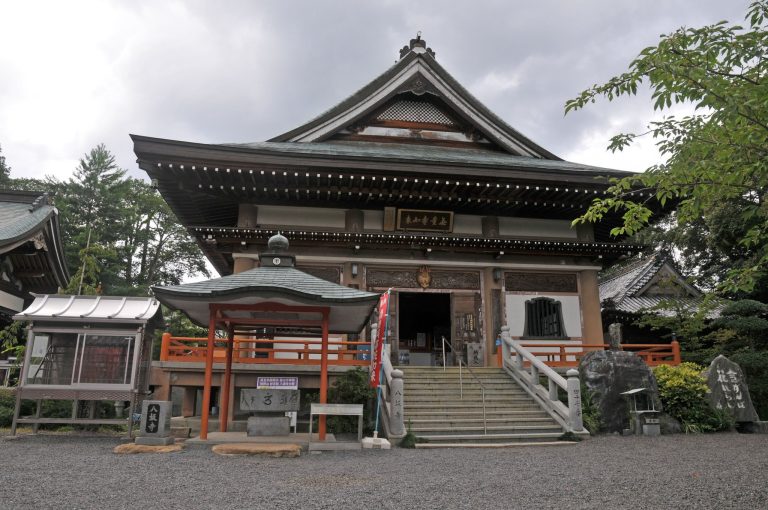
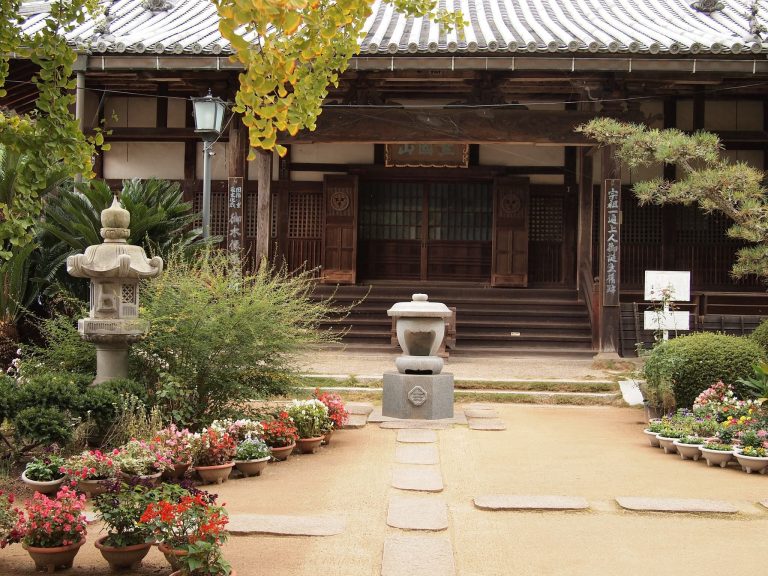
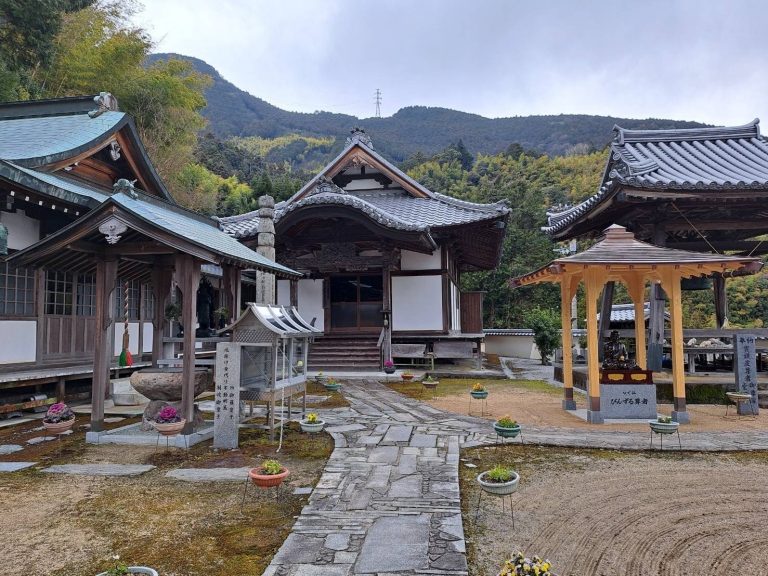
The upper precinct contains the Main Hall, the larger Daishi Hall, the Bell Tower, a purification pavilion, the temple kitchen and administrative office, and the pilgrimage registration office. Their arrangement forms the principal built area within the steep natural setting.
Main Hall
The Main Hall was completed in 1927. Its principal image is a hidden Buddha, or hibutsu, that is not publicly displayed. A seated stand-in image of Fudō Myōō is visible instead, accompanied by the red Seitaka Dōji and the white Kongara Dōji, attendants of Fudō Myōō. The Main Hall is smaller than the Daishi Hall because the entire mountain, rather than the building alone, is revered as the principal object of worship.
Daishi Hall and Bell Tower
The Daishi Hall is dedicated to Kūkai and is larger than the Main Hall. It is an Important Cultural Property. The adjacent Bell Tower was rebuilt in 1952, forming part of the rebuilt group of structures that followed the 1898 fire.
Hokke Sennin Cave and Amida Cave
The site of the Hokke Sennin Cave lies above a ladder to the right of the Main Hall. Farther up and to the left is the Amida Cave, which contains the Flying Buddha, a standing bronze image of Amida Nyorai slightly more than four shaku high. The figure holds a small drum. A shaku is a traditional Japanese unit of length.
Later Additions and Commemoration
Henjokaku Hall
Henjokaku Hall, intended for lay believers, was completed in 2014. A statue of Kurikara Fudō stands at the entrance. Kurikara Fudō is a form of Fudō Myōō represented with a sword-entwined dragon. On the top floor, a seated image of Fudō Myōō faces away from the temple precincts. The hall provides space for Ajikan meditation, sutra transcription, and Buddha-image tracing. Ajikan is a Shingon meditation practice centered on contemplation of the Sanskrit syllable associated with Mahāvairocana Buddha.
Shiki Monument
A stone monument in front of the pilgrimage registration office bears a haiku by Masaoka Shiki, a major modern Japanese poet and literary reformer. In translation, the poem reads, “Summer mountains… Temple No. 45 is Iwaya-ji.”