Nishiarai Daishi: A Shingon Buddhist Head Temple in Tokyo


Site at a Glance
- Rating
- 4.2
- Popularity
- Medium
- Country
- Japan
- Primary era
- Early Modern
- External website
- Open
- Eras represented
- Early Modern, Modern
- Civilizations
- Japanese, Tokugawa
- Site type
- Religious
- Remains
- Temple
On this page19 sections
History
Nishiarai Daishi is a Buddhist temple in Japan, located in Tokyo, and is traditionally said to have been founded by Kūkai in 826 during the early Heian period. Its formal name is Gochizan Henjō-in Sōjiji, and it serves as a head temple of the Shingon Buzan school, a major branch of Japanese esoteric Buddhism. The temple is also known as Kantō’s Kōyasan, the Fire-Prevention Daishi, and the Peony Daishi.
Traditional foundation and medieval settlement
According to temple tradition, Kūkai, the monk associated with the introduction of esoteric Shingon Buddhism to Japan, was traveling through the Kantō region when he received a sacred message from the temple’s principal Kannon. Kannon is the bodhisattva of compassion. Kūkai then carved an eleven-faced image of Kannon and established the temple around it.
A settlement called Nishiarai had developed around the temple by the medieval period. The place-name is traditionally linked to a consecrated-water well west of the main hall. The well is said to have been brought forth by Kūkai, and the tradition of this sacred water became part of the temple’s identity.
Religious role and pilgrimage networks
Nishiarai Daishi came to be regarded as a place where curses, spells, and illness could be removed. Its principal sacred objects are the Eleven-Faced Kannon and an image of Kūkai. The temple remains connected with several pilgrimage traditions, including the Kantō Three Great Daishi temples, the Kantō Eighty-Eight Sacred Places, the Kantō Thirty-Six Fudō pilgrimage as site 26, and the One Hundred Flower Temples of Eastern Japan as Tokyo site 1. It is also the first temple on the New Shikoku Four-Region Eighty-Eight-Temple pilgrimage.
The temple’s regular religious life includes a monthly fair on the twenty-first day and large pilgrimages at New Year. These practices continue the association between Nishiarai Daishi, devotional travel, and the protection attributed to its sacred images.
Fire, rebuilding, and cultural recognition
The main hall built in the middle of the Edo period was destroyed by fire in 1966. The principal sacred images survived, allowing the temple’s central devotional traditions to continue. A new main hall was completed in 1971.
Nishiarai Daishi also preserves a group of important cultural properties. The bronze engraved image of Zao Gongen, a mountain deity associated with the Shugendō tradition, is designated a National Treasure of Japan and is deposited with the Tokyo National Museum. Other Important Cultural Properties include a portrait of Kūkai and a bronze bell. Adachi Ward has designated the Sanzōdō and the main gate as cultural properties.
Remains
Principal temple buildings
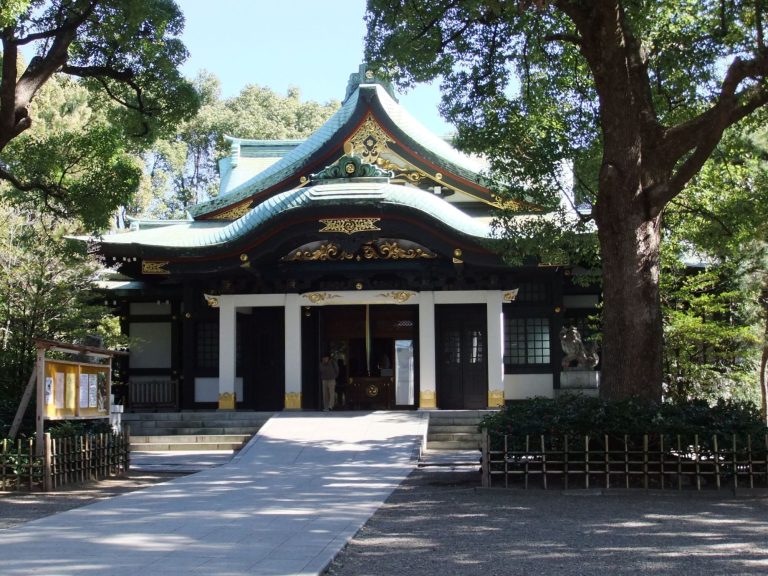
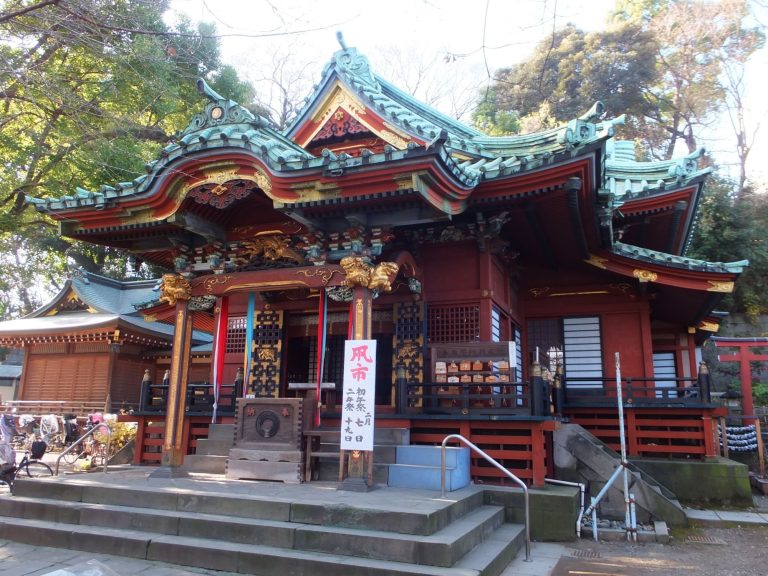
Main hall
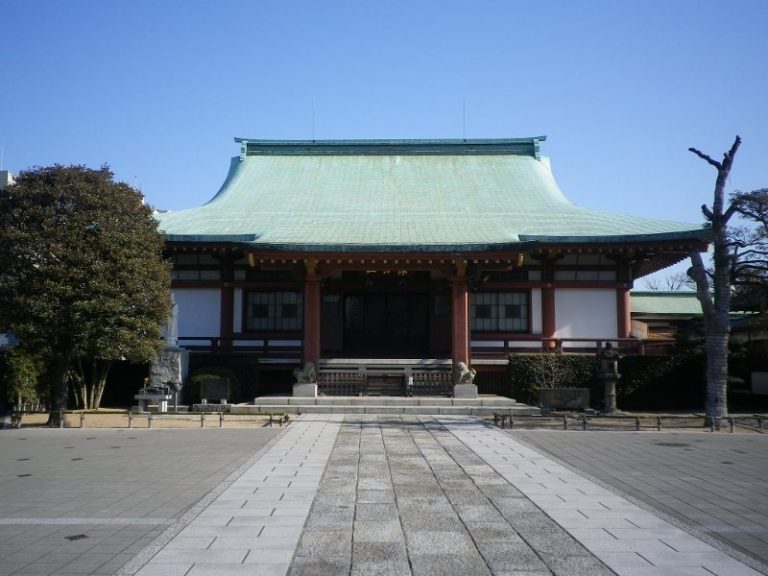
The main hall, rebuilt in 1971, forms the central sacred building of the temple. It enshrines a hidden Eleven-Faced Kannon and a hidden image of Kūkai traditionally said to have been carved by Kūkai himself. Four Heavenly Kings, Buddhist guardian deities associated with the four directions, also occupy the hall, together with an Amida Triad formerly housed in the Sanzōdō. Daily goma fire-prayer rites are conducted here. In this esoteric Buddhist ritual, offerings are placed into a consecrated fire before a sacred image or deity.
Main gate
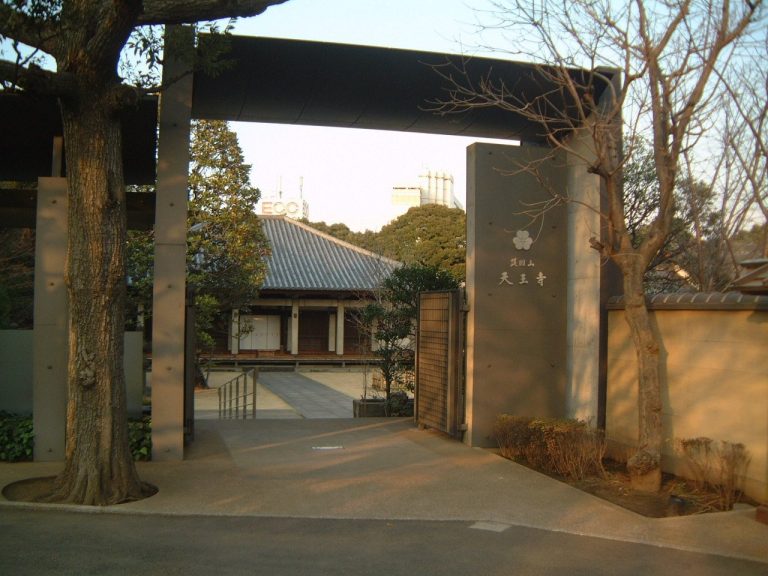
The main gate dates from the late Edo period. Kongō Rikishi guardian statues stand on both sides of the entrance. These muscular Buddhist guardians traditionally protect temple thresholds.
Sanzōdō
The Sanzōdō was built in 1884 as a sazaedō, a multi-level devotional structure arranged around a spiral route. Worshippers once climbed through its interior as part of a pilgrimage circuit. The building is described as the only surviving example of this type in Tokyo, and its interior is now closed to the public.
Okunoin
The Okunoin was established in the late Edo period by inviting and enshrining the Okunoin of Mount Kōyasan, the principal Japanese center associated with Kūkai and Shingon Buddhism. The precinct enshrines Kūkai.
Salt Jizō
The Salt Jizō stands to the left of the main gate. Its entire body is covered with salt. A healing practice holds that applying some of this salt to warts removes them, after which devotees place twice the amount they received before the image. Jizō is a bodhisattva associated especially with protection and the welfare of travelers and children.
Other sacred features
Dainichi Nyorai and pagoda
An open-air seated statue of Dainichi Nyorai is associated with Mount Yudono. Dainichi Nyorai, the central cosmic Buddha of esoteric Buddhism, is represented elsewhere in the precinct by a thirteen-story pagoda.
Jizō and Kannon halls
The temple grounds also include a Mizuko Jizō and the Rokkaku Kannondō. Mizuko Jizō refers to representations connected with the memorial care of deceased or unborn children. The temple’s Kōmyō Hall stands beside Daishimae Station and is used for ceremonies.
Consecrated-water well
The consecrated-water well traditionally associated with Kūkai lies west of the main hall. Its location preserves the physical feature linked to the traditional explanation of the name Nishiarai.
Paintings, manuscripts, and metalwork
Kūkai Performing a Ritual
A large painting titled Kūkai Performing a Ritual is displayed annually on the first Saturday of October during the Hokusai gathering. Measuring 150 by 240 centimeters, it depicts Kūkai praying and is described as one of the largest surviving hand-painted works by Katsushika Hokusai, the prominent Edo-period artist known for woodblock prints and paintings.
Paintings and manuscript
The temple’s cultural-property collection includes Kamakura-period silk paintings of Kūkai, the Tendai master, and the Victorious Mandala. The Tendai master is Zhiyi, the Chinese Buddhist monk traditionally regarded as the founder of the Tiantai school, known in Japan as Tendai. The collection also contains a lacquered hand box decorated with a chrysanthemum motif and a Heian-period manuscript traditionally attributed to Fujiwara Tadamichi.
Bronze bell
The bronze bell bears an inscription dated 1107, corresponding to the seventh year of the Qiantong era of the Liao dynasty. It is deposited with the Tokyo National Museum and forms part of the temple’s wider group of cultural properties.