Hirota Shrine: A Shinto Shrine of Imperial Recognition in Japan


Site at a Glance
- Rating
- 4.5
- Popularity
- Medium
- Country
- Japan
- Primary era
- Modern
- External website
- Open
- Eras represented
- Modern
- Civilizations
- Japanese
- Site type
- Religious
- Remains
- Sanctuary
On this page17 sections
History
Hirota Shrine is a Shinto shrine in Japan, located in Nishinomiya, Hyogo Prefecture. Its foundation is traditionally dated to 201, the first year of Empress Jingū’s reign in Japan’s traditional third-century chronology. The present principal sanctuary follows Shinmei-zukuri, a restrained Shinto architectural style especially associated with Ise Grand Shrine.
Foundation tradition
The shrine’s origin is related in the Nihon Shoki, an early eighth-century chronicle combining court history, genealogical traditions, and accounts of the imperial state’s sacred origins. The tradition says that Amaterasu, a major Shinto kami associated with the sun and the imperial lineage, declared that her benevolent spirit would protect the emperor while her fierce spirit would guide the imperial fleet.
When Empress Jingū’s fleet could not advance near Naniwa, another oracle directed that the fierce spirit should be enshrined at Hirota rather than near the imperial palace. Jingū consequently ordered Hayama Hime, daughter of Yamashiro no Neko, to establish the shrine there. The same episode is connected with the founding of the shrines at Ikuta, Nagata, and Sumiyoshi.
Hirota’s principal deity is the fierce spirit of Amaterasu, understood as a named form of her aramitama, or fierce and transformative spirit. It is regarded as identical with the deity of Aramatsuri-no-miya at Ise. The shrine’s associated deities are Sumiyoshi, Hachiman, Takeminakata, and Takamimusubi. A theory identifies the principal deity with Seoritsu-hime. Prewar accounts described Seoritsu-hime as the principal deity, but the identification remains a theory.
Imperial patronage and medieval associations
Hirota acquired a high position within the court’s religious system. It received the rank of Junior First Rank in 868 and was listed as a Myojin Taisha in the Engishiki, a tenth-century compilation of court regulations and ritual procedures whose shrine register classified major officially recognized shrines. A Myojin Taisha was a major shrine whose deity held particular religious prestige.
During the reign of Emperor Shirakawa, Hirota became one of the Nijunisha, the twenty-two shrines selected for exceptional imperial ritual recognition during the Heian period. Imperial envoys repeatedly brought offerings to the shrine. From the late Heian period, the Shirakawa family, whose members held hereditary leadership of the Department of Divinities, maintained a close relationship with Hirota.
In the medieval period, the shrine became associated with waka poetry, a classical Japanese poetic form, and hosted poetry contests. In 1184, Minamoto no Yoritomo dedicated Hirota Manor in Awaji Province while praying for the defeat of the Taira. A summer festival procession also preserved traditions concerning Empress Jingū’s return from the conquest of Silla. The outward journey reportedly used several hundred boats, while the return proceeded overland with mounted members of several locally prominent families. This procession continued until the Sengoku period, an era of prolonged conflict among rival regional powers from the fifteenth through the sixteenth century.
Rebuilding, relocation, and modern status
Toyotomi Hideyori sponsored a major rebuilding of Hirota’s buildings in 1604, together with the subsidiary Ebisu Shrine, now known as Nishinomiya Shrine. The shrine had originally stood at Takakumahara, at the foot of Mount Kabuto, and was later moved to the bank of the Mitarai River. Flooding led to another relocation, and in 1724 Shogun Tokugawa Yoshimune ordered the shrine moved to Hirotayama. Saidono Shrine entered the precincts in 1727.
Hirota was classified as a Kanpei-taisha in 1871, becoming the first shrine in Hyogo Prefecture to receive that rank under the former prewar state-supported system. It joined the Association of Shinto Shrines’ Beppyo-jinja category in 1948 and is also treated as a major shrine within that association. In 1956, a ceremony transferred the enshrined deity to the main sanctuary, with ritual cloth and provisions offered by Emperor Shōwa.
The Nishinomiya area took its name from Hirota and its associated shrine complex. The name means “western shrine” and historically referred to a sacred district extending from eastern Kobe to western Amagasaki. Nishinomiya Shrine began as Hirota’s outlying subsidiary shrine, called Hama-Nangu; the South Shrine within Nishinomiya Shrine preserves that relationship.
The shrine buildings were destroyed in the Nishinomiya air raid on August 6, 1945. After the war, Hirota moved from Hirotayama to its present site on the eastern side of the former location. A new main hall was completed in 1963 using the former structure of Ise’s Aramatsuri-no-miya, transferred to Hirota. An accidental fire destroyed that hall in 1981, and the present main hall was completed in 1984. Hirota marked its 1,800th anniversary in 2001.
A longstanding annual visit by the Hanshin Tigers’ players, manager, and coaching staff before the official baseball season is associated with prayers for military-style good fortune and victory. The practice dates from the team’s founding.
Remains
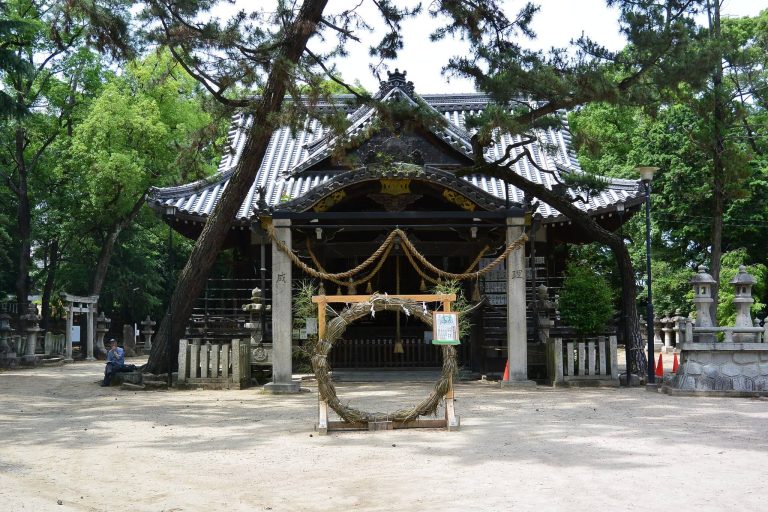
The present Hirota Shrine stands at 7-7 Taisha-cho in Nishinomiya. Its principal sanctuary is arranged in the Shinmei-zukuri style. The current building dates from 1984, when it replaced the sanctuary completed in 1963. That earlier structure had reused the former sanctuary of Ise Grand Shrine’s Aramatsuri-no-miya, whose deity is associated with Amaterasu’s fierce spirit.
Main precinct shrines
Principal sanctuary
The principal sanctuary forms the central sacred building of the present precinct. Its 1984 construction followed the accidental fire that destroyed the 1963 sanctuary. The architectural form connects the rebuilt building with the sanctuary tradition associated with Ise, while its present fabric belongs to the postwar reconstruction of Hirota Shrine.
Saidono Shrine
Saidono Shrine is dedicated to Hayama Hime, who, according to the foundation tradition, enshrined Amaterasu’s fierce spirit at Hirota. Originally located outside the main precinct, it was transferred inside in 1727. Its annual festival is held on May 8.
Iwashizu Shrine
Iwashizu Shrine was formerly independent and claimed identification with an Engishiki grand shrine. It was moved into the Hirota precinct in 1917. Air raids during the Pacific War destroyed its buildings, after which its deity was enshrined together with the main sanctuary. A new shrine building was reconstructed in 1990.
Associated shrines in Nishinomiya
Natsugi Shrine
Natsugi Shrine stands at 5 Natsugi-cho in Nishinomiya. It is an Engishiki shrine dedicated to Natsugi no Okami, who is identified with Mikumari no Okami. Natsugi became a subsidiary shrine of Hirota in 1878.
Okada Shrine
Okada Shrine stands at 4-1 Okadayama in Nishinomiya and claims identification with the Engishiki Okata Shrine. It is dedicated to Okada no Okami, identified with Amenominakanushi, and became a subsidiary shrine of Hirota in 1878. The shrine stands on the campus of Kobe College, and other worshippers require prior written permission for access.
South Shrine
The South Shrine, also called Nangu Shrine, stands within Nishinomiya Shrine. Its deities are Toyotama-hime, Ichikishima-hime, Oyama-kui, and Hayama-hime. The name Nangu appears in the Ryojin Hisho alongside Suwa Grand Shrine, Nangu Grand Shrine, and Aekuni Shrine. The reason for the name is unknown.
Natural and landscape features
Azalea colony
The Hirota precinct contains approximately 20,000 kobano-mitsuba-tsutsuji plants, a three-leaved azalea. The colony was designated a Hyogo Prefecture Natural Monument on March 25, 1969.
Mount Rokko associations
Mount Rokko, traditionally called Mukatsu-mine, was said to have belonged in its entirety to Hirota Shrine’s estate. Rokko-yama Shrine at Ishino Hoden is treated as a subsidiary shrine of Hirota, while Muko-hime Shrine is regarded as a possible former inner sanctuary. The nearby Shingyo-iwa and Kumoga-iwa rocks are associated with Muko-hime Shrine.
Shakegoyama
The eastern foothill area of Mount Rokko known as Shakegoyama was formerly owned by Hirota Shrine’s hereditary priestly family. Its name is regarded as a surviving indication of that connection with the shrine.