Kamenokoyama Kofun: A Keyhole-Shaped Burial Mound in Tokyo


Site at a Glance
- Rating
- 3.9
- Popularity
- Very Low
- Country
- Japan
- Primary era
- Classical
- External website
- Open
- Eras represented
- Classical
- Civilizations
- Yamato
- Site type
- Burial
- Remains
- Burial Mound
On this page7 sections
History
Kamenokoyama Kofun is a burial mound in Japan, located in Ota City, Tokyo. Built during the Kofun period in the late fourth or early fifth century AD, it is the largest mound in the Ebaradai Kofun Cluster, one of 54 burial mounds along the Tama River. Its scale and form indicate the status of the chiefly group that commissioned it.
The Ebaradai chiefly tombs
Kamenokoyama Kofun and Hōraiyama Kofun represent the Ebaradai group of burial mounds. Kamenokoyama is generally regarded as a chiefly tomb constructed after Hōraiyama Kofun. The Kofun period, conventionally dated from around the third to the sixth centuries AD, was an era when large burial mounds expressed the standing of powerful individuals and communities.
The mound’s construction is usually placed between the late fourth and early fifth centuries, although it has also been assigned to the latter part of the fourth century. Its name comes from its side profile, which resembles a turtle. The site is also known as Nishioka No. 46 Kofun.
Protection and investigation
Kamenokoyama Kofun was designated a National Historic Site of Japan in 1928. The surrounding land later became part of the landscaped grounds of Tamagawadai Park. Surveys by Ōta Ward have been carried out, while the burial facility remains unknown. The mound is preserved as an archaeological monument within the park.
Remains
Keyhole-shaped mound
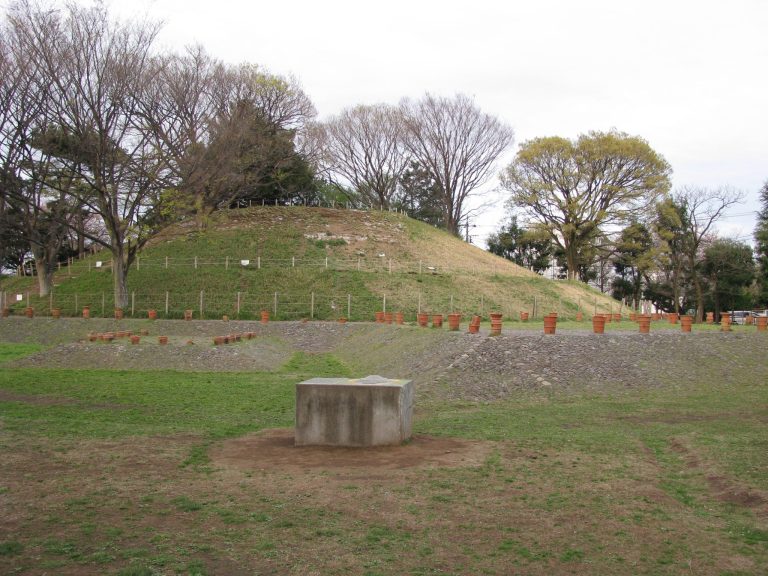
Kamenokoyama Kofun stands on the edge of the Musashino Terrace, on the left bank of the lower Tama River in southwestern Tokyo. It is a keyhole-shaped mound, a form combining a square or rectangular front section with a circular rear section. The mound is oriented toward the northwest, and its front section faces Hōraiyama Kofun. Constructed in two tiers, it measures 107.25 meters in total length.
Circular rear section
The circular rear section is approximately 66 meters in diameter and 10 meters high. Its southern end was partly removed during construction of a water-purification plant, while the rest of the tumulus remains well preserved. The mound’s shape has been compared with Tenno no Mori Kofun in Kyoto and Saki Ryozan Kofun in Nara.
Square front section
The square front section also has two tiers. It is 49.5 meters wide and approximately 7 meters high, forming the projecting part of the keyhole plan. Together with the circular rear section, it gives the mound its distinctive profile and makes Kamenokoyama Kofun the largest kofun in the southern Musashi area and the Tama River basin.