Taisan-ji Temple: A Tendai Buddhist Temple in Kobe


Site at a Glance
- Rating
- 4.2
- Popularity
- Low
- Country
- Japan
- Primary era
- Medieval
- External website
- Open
- Eras represented
- Medieval, Early Modern
- Civilizations
- Ashikaga shogunate, Kamakura shogunate, Tokugawa
- Site type
- Religious
- Remains
- Monastery
On this page16 sections
History
Taisan-ji Temple is a Tendai Buddhist temple in Kobe, Japan, traditionally founded in 716 as an imperial prayer temple under the command of Empress Genshō. Its foundation is now considered more likely to date from the Heian period. The temple’s principal object of worship is Yakushi Nyorai, the Buddhist Buddha of healing and medicine, and it is the 25th station on the New Saigoku pilgrimage route.
Foundation traditions and early history
The Taisan-ji engi attributes the temple’s establishment to Fujiwara no Umakai, a grandson of the seventh-century statesman Fujiwara no Kamatari. Jōe, Kamatari’s eldest son and a Buddhist monk, was designated as the ceremonial founding monk. According to the tradition, Umakai was recovering at hot springs in the Maya Valley near Akashi when Yakushi Nyorai appeared to him in a dream. The Buddha directed him to a place associated with Jōe, where Umakai established a seven-hall compound and enshrined an image of Yakushi Nyorai.
Jōe became a monk in his youth and travelled to Tang China with an embassy. His life and date of death remain uncertain, while the temple’s foundation is generally placed in the Heian period rather than securely in 716. The temple’s original buildings were destroyed by fire in 1285, after which the complex developed through rebuilding and later additions.
Medieval power and prosperity
During the Northern and Southern Courts period, the fourteenth-century conflict between rival imperial courts, Taisan-ji supported the Southern Court side. In 1334, it acted under a directive from Prince Moriyoshi, an imperial prince and military leader associated with that faction. At the time, the temple had warrior monks and comprised 41 cloisters, eight branch temples, and six subordinate shrines.
A fortified installation was also built on a mountain north of the temple to support the forces of Akamatsu Norimura, a samurai commander active in the conflict, during the struggle against the Hōjō. Taisan-ji reached its greatest prosperity during this fourteenth-century period. A surviving document preserves Prince Moriyoshi’s instructions of 1344 concerning the suppression of the Kamakura regime.
Early-modern and modern history
Around 1669, the shogunate ordered the confinement of Kumazawa Banzan at Taisan-ji under the custody of Matsudaira Nobuyuki, lord of the Akashi domain. Banzan was a seventeenth-century scholar of Wang Yangming’s school of Confucian thought. A nearby residence and the period he spent working at the Hanabatake school in Okayama are also connected with the temple’s history.
The Meiji-era anti-Buddhist movement reduced the number of surviving subtemples to five: Ryūzō-in, Jōju-in, Henjō-in, An’yō-in, and Kanki-in. Taisan-ji continues to preserve a religious landscape of native forest. The 55.9-hectare area surrounding the temple is protected as the Taisan-ji Scenic District and has been selected among Hyōgo’s 100 Forests. Spring cherry blossoms and autumn foliage have also made the area a locally recognized scenic site associated with pilgrimage and worship.
The Main Hall is a National Treasure and, as of 2023, the only National Treasure building in Kobe. The Niō Gate, seated statue of Amida Nyorai, painting of the Shaka triad in colors on silk, and other works are designated Important Cultural Properties. The An’yō-in Garden is a nationally designated Place of Scenic Beauty. The temple’s protected holdings also include 11 paintings, nine craft objects such as armor, and three old documents.
Remains
Taisan-ji’s surviving complex combines a rebuilt medieval prayer hall with early-modern buildings, subsidiary temples, gardens, and associated memorial features. The buildings are set within a wooded religious landscape, with the Niō Gate positioned several hundred metres before the inner precinct and the An’yō-in Garden along the approach.
Central temple buildings
Main Hall
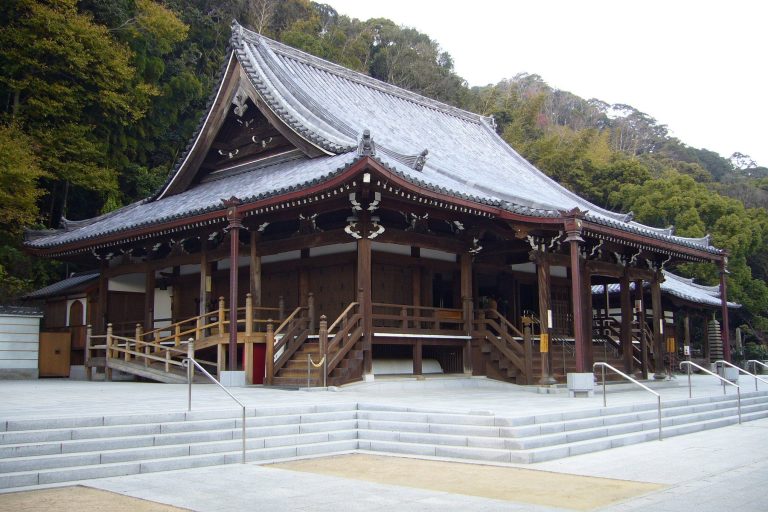
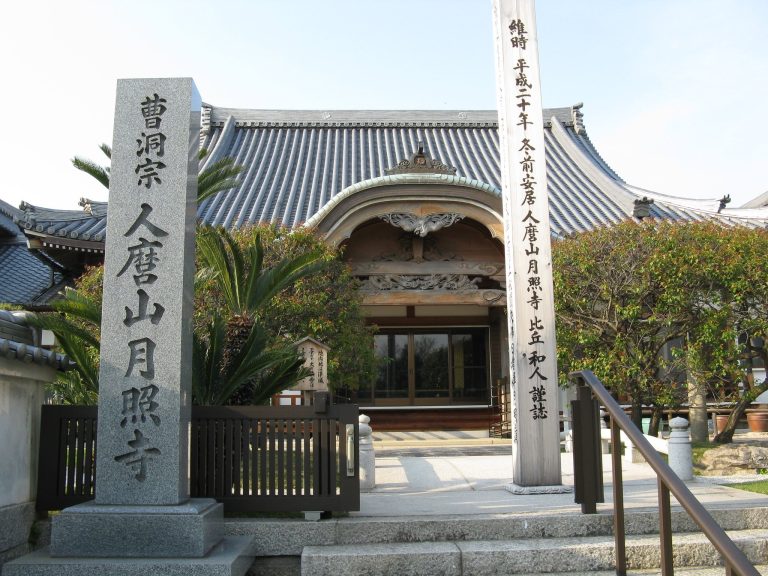
The Main Hall was rebuilt after the 1285 fire and completed in 1293. Its plan separates an outer area for worship from an inner sanctum containing the principal image of Yakushi Nyorai. The arrangement of the images is regarded as a typical example of an esoteric Buddhist prayer hall, reflecting Tendai’s broad ritual tradition. During major repairs in 1964, the roof covering was changed from partial tile roofing to complete copper-sheet roofing.
Three-storey pagoda
A three-storey pagoda beside the Main Hall was built in 1688. Its successive roofs are relatively similar in size, a feature associated with pagodas of the Edo period. The ground floor houses Kongōkai Dainichi Nyorai, protected by the Four Heavenly Kings. Its worship area is not generally open to the public.
Amida Hall
The Amida Hall was also built in 1688 and serves as a training and worship hall for devotional rites in Tendai temples. It contains a seated image of Amida Nyorai, the Buddha of the Pure Land, dating from the beginning of the Kamakura period. The wooden image is 2.74 metres high and resembles the Amida image in the Phoenix Hall at Byōdō-in in both appearance and scale.
Approach and subsidiary buildings
Niō Gate
The Niō Gate is a Muromachi-period rebuilding that now stands several hundred metres before the inner precinct. It was moved from another location. Originally a tall, two-storey gate three ken wide, it lost its upper storey after relocation and acquired a simpler ridge design. Its present form followed dismantling and repairs in 1958, while its guardian statues are no longer present.
An’yō-in Garden
An’yō-in Garden lies along the approach to the inner precinct. Created during the Momoyama period, it is a dry-landscape garden in which arranged rocks, gravel, and limited vegetation evoke a composed landscape without relying on a pond or flowing water. The garden is designated nationally as a Place of Scenic Beauty.
Other temple buildings
The complex includes the Goma Hall, Shaka Hall, Rakan Hall, Kannon Hall, and a bell tower. These are recorded as Edo-period temple buildings where that period is specified. The surviving subtemple buildings of Ryūzō-in, Jōju-in, Henjō-in, An’yō-in, and Kanki-in form additional parts of the historic complex.
Memorial features and associated works
Kumazawa Banzan memorial
A memorial stone for Kumazawa Banzan stands beside a corner of the Main Hall. The temple grounds also contain the remains known as Sokuyūken, identified as the place where Banzan lived in seclusion during his association with Taisan-ji.
Religious art and documents
Taisan-ji preserves a seated wooden Amida Nyorai, a painting in colors on silk depicting the Shaka triad, ritual and craft objects, armor, and three old documents. The Shaka triad represents Shaka, the historical Buddha, with attendant figures. Other associated works include a standing wooden Fudō Myōō, wooden guardian lion-and-komainu figures, a gilt-bronze ritual bell, celadon vessels, and a manuscript of Buddhist chants and sacred formulas. These latter objects are deposited on loan at museums.