Zenkō-ji Temple: A Nonsectarian Buddhist Pilgrimage Center in Japan


Site at a Glance
- Rating
- 4.5
- Popularity
- Very High
- Country
- Japan
- Primary era
- Early Modern
- External website
- Open
- Eras represented
- Early Modern, Modern
- Civilizations
- Japanese, Tokugawa
- Site type
- Religious
- Remains
- Temple
On this page23 sections
History
Zenkō-ji Temple is an independent Buddhist institution in Nagano, Japan, traditionally founded in 644 by imperial command under Emperor Kōgyoku. Its foundation belongs to the Asuka period, although the precise beginnings of the temple remain uncertain. One tradition places the transfer of its principal image to the present site in 642 and the construction of the main hall in 644. Other interpretations associate the early institution with district temples established under Emperor Tenmu and with the local Kanesashi clan.
Foundation traditions and early history
The temple’s hidden principal image forms the center of its foundation tradition. It is said to have been cast in India and brought to Japan through Baekje in 552, during the reign of Emperor Kimmei. After being discarded at Naniwa, it was recovered by Honda Yoshimitsu, taken to Moto-Zenkō-ji in southern Shinano, and eventually transferred to the present site. These episodes explain the image’s religious authority and the temple’s traditional name, but belong to the institution’s origin narrative rather than securely established history.
The earliest institution was described as a simple grass-roofed or temporary hall. Ninth-century roof tiles found within the precinct indicate that a tile-roofed temple stood there by the early Heian period at the latest. The name Zenkō-ji is traditionally connected with Honda Yoshimitsu, although another interpretation derives it from Prince Zenkō, a figure associated with Baekje. The earliest written appearance of the name is generally placed in the mid-tenth-century Sōmyōtatsu Sosei Chūki, while the oldest surviving account of the temple’s origins appears in the Fusō Ryakki, compiled before 1107.
Zenkō-ji predates the division of Japanese Buddhism into separate schools and remains formally nonsectarian. Its administration and maintenance are shared by the Tendai-affiliated Daikanjin and its 25 associated subtemples, and by the Jōdo-affiliated Daihongan and its 14 associated subtemples. Tendai is a major Japanese Buddhist tradition associated with the broad Mahayana teaching tradition of Mount Hiei, while Jōdo, or Pure Land Buddhism, centers devotion on rebirth in Amida Buddha’s Pure Land. The temple has two principal clerical heads, the Daikanjin abbot, known as the Kanju, and the Daihongan abbess, known as the Zenkō-ji Shōnin.
Pilgrimage and medieval patronage
The temple’s inclusive identity helped make it a pilgrimage center for people regardless of Buddhist affiliation, social status, gender, or moral standing. Its reputation for offering salvation to women was especially important at a time when many Buddhist institutions restricted women’s access. Devotion centered on the hope of rebirth in Amida’s Western Pure Land, the realm of Amida Buddha, rather than solely on worldly benefits. From the Kamakura period onward, Zenkō-ji devotion spread throughout Japan, producing many temples called Zenkō-ji or Shin-Zenkō-ji and numerous replicas of its Amida triad.
Fujiwara Kakuchū, a son of the regent and chancellor Fujiwara Tadamichi, is the earliest historically identifiable visitor associated with the temple. He is recorded as having visited in the twelfth century. Zenkō-ji was connected with the Onjō-ji-affiliated temple network and appears in the Azuma Kagami in 1186 as a subsidiary temple linked with an Onjō-ji estate. It possessed estates at Kawai, Mashima, Murayama, and Yoshino. A gate-naming tradition called it “Four Gates and Four Tablets,” assigning separate mountain names and temple titles to its eastern, southern, northern, and western approaches.
A major fire destroyed the temple on 24 March 1179, traditionally ascribed to lightning. Minamoto no Yoritomo ordered reconstruction through the provincial authorities in 1187 and visited Zenkō-ji in 1197. His support reflected personal devotion shared with Hōjō Masako, as well as an effort to consolidate political influence through an already widespread religious movement. The Kamakura shogunate and the Hōjō family continued to support rebuilding. Hōjō Yasutoki donated land in 1239, while his kinsman Nagoe Tomotoki supported reconstruction and founded a New Zenkō-ji in Kamakura, later transferred to Hayama. The Kanazawa branch of the Hōjō family protected both temples, and in 1265 the shogunate assumed direct responsibility for security around Zenkō-ji.
War, destruction, and the journeys of the principal image
Fires and warfare repeatedly damaged the temple during the Kamakura and Muromachi periods. Destructive episodes occurred in 1268, 1313, 1369, 1427, 1477, and 1484. During the fighting of 1369, the principal image was buried for protection. After the 1427 fire it was moved to Yokoyama, now called Shiroyama. The temple and its surrounding settlement were drawn into the conflicts of the Northern and Southern Courts period and the later Muromachi era.
The Zenkō-ji plain became a battlefield during the Sengoku period, an era of prolonged warfare among regional military powers from roughly the fifteenth through the late sixteenth century. Takeda Shingen advanced from Kai, while Uesugi Kenshin defended northern Shinano interests. Zenkō-ji suffered war damage and declined. One tradition says that Shingen moved the temple and its principal image, together with the temple administrator, the Kurita family, to Kōfu, where Kai-Zenkō-ji was established. Another attributes the removal to Kenshin, placing the image first at Jūnen-ji in Echigo and associating later objects with Hōon-ji in Yonezawa and Kumano Shrine in Nanyō. The precise sequence remains disputed.
After the fall of the Takeda, the image passed through territories controlled by Oda Nobutada, Oda Nobukatsu, and Tokugawa Ieyasu. It was taken to Gifu, then to Jimmoku-ji in Owari and possibly to Kōe-ji in Tōtomi, before returning to Kai-Zenkō-ji. Some records instead indicate a direct transfer from Mino to Kai. In 1597 Toyotomi Hideyoshi ordered the image to Kyoto’s Hōkō-ji Great Buddha Hall, whose Great Buddha had been damaged by the 1596 Keichō-Fushimi earthquake. It was installed on the former Buddha’s pedestal, and the building became known as the Zenkō-ji Nyorai Hall.
After Hideyoshi fell ill, officials decided in 1598, the day before his death, to return the image to Shinano. The return was widely interpreted at the time as an escape from supernatural retribution. Toyotomi Hideyori later supported restoration of the Shinano temple complex, although objects other than the principal image remained at Kai-Zenkō-ji.
Edo-period rebuilding and pilgrimage
A fire destroyed the temple complex in 1642. A temporary main hall was completed in 1650, followed by another in 1666. The present main hall was rebuilt in 1707 under the direction of Keiun and is traditionally regarded as the twelfth rebuilding since the foundation.
Pilgrimage expanded greatly during the Edo period. Roads entering Shinano were commonly called Zenkō-ji roads, and many pilgrims visited the temple after travelling to Ise. After 1611, the surrounding settlement developed into a major post town on the Hokkoku Kaidō. Its inns, markets, officials, and transport obligations helped establish the urban core of modern Nagano.
Travelling unveilings began at Ekō-in in Edo in 1692. These public events helped finance construction and repairs while spreading devotion through illustrated explanations of the temple’s origin narrative. Earlier, from the Kamakura period, travelling preachers known as Zenkō-ji hijiri had promoted the cult by displaying replica images and explaining illustrated accounts.
The modern form of the local unveiling ceremony began in 1785 under Tōjun, the 80th Daikanjin abbot. The rites commemorated the third anniversary of the 1783 Asama eruption. Tōjun simplified the distribution of the Yūzū Nenbutsu lineage certificate, called O-ketsumyaku, and distributed it while aiding victims of the eruption and the Tenmei famine. He also released the temple’s stored rice for famine relief. Yūzū Nenbutsu emphasizes the shared merit created through reciting the nenbutsu and transmitting its religious lineage.
Earthquake, modernization, and contemporary religious life
The Zenkō-ji earthquake of 1847 devastated the temple town and burned most of the subsidiary halls and residences. The main hall, Sanmon, and Kyōzō survived, while the Niōmon and other buildings were destroyed or damaged. The Niōmon was rebuilt in 1864, and the present bell tower dates from 1853.
The Meiji Restoration deprived Zenkō-ji of its temple estates. The transfer of the Nagano prefectural office to the city in 1871 and completion of the Shin’etsu railway in 1893 strengthened urban growth around the temple. The present two-headship system of Daikanjin and Daihongan was introduced in 1946. The main hall became a National Treasure in 1953, and the Sanmon and Kyōzō were designated Important Cultural Properties in 1965. The Niōmon and bell tower were later registered as tangible cultural properties. A reforestation project begun in 2007 established a temple forest intended to provide future construction timber.
In 2008, during unrest in Tibet, Zenkō-ji withdrew as the starting venue for the Beijing Olympic torch relay in solidarity with Tibetan Buddhists and to avoid disorder and danger to visitors. It held a memorial service for Chinese and Tibetan victims instead. The temple was subsequently vandalized, and the 14th Dalai Lama donated a Buddha image in November of that year. In 2010, monks from Tashilhunpo Monastery created a sand mandala in the main hall over approximately two weeks before the Dalai Lama’s visit.
In 2020, Daikanjin held a Buddhist service seeking relief from the COVID-19 pandemic, timed to the anniversary of Tōjun’s death. A wooden image of Binzuru was briefly stolen from the main hall in 2023 and recovered the same day. Zenkō-ji continues major observances including the daily morning service called O-asaji, rites commemorating the transfer of the principal image, services connected with Amida devotion and Pure Land rebirth, and ceremonies associated with the Yūzū Nenbutsu tradition. The 2021 Gokaichō was postponed to 2022 because of COVID-19. That unveiling lasted 88 days, and the next was set for 2027. The temple is also an extra station associated with the Saigoku, Bandō, and Chichibu Kannon pilgrimage circuits, as well as several regional pilgrimage traditions.
Remains
The surviving complex is organized along a south-to-north axis. Historical depictions show a linear sequence of the South Great Gate, a five-story pagoda, the central gate and corridors, and the main hall. Archaeological displays and excavations indicate that an earlier temple may have stood farther south than the present complex. The principal approach extends for approximately 460 meters from the former Niten Gate site toward the main hall and is about 8 meters wide.
Central buildings and approach
Main hall
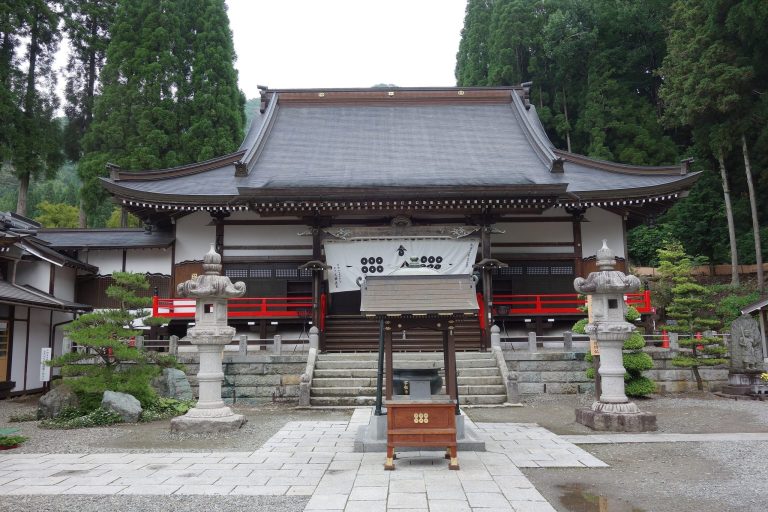
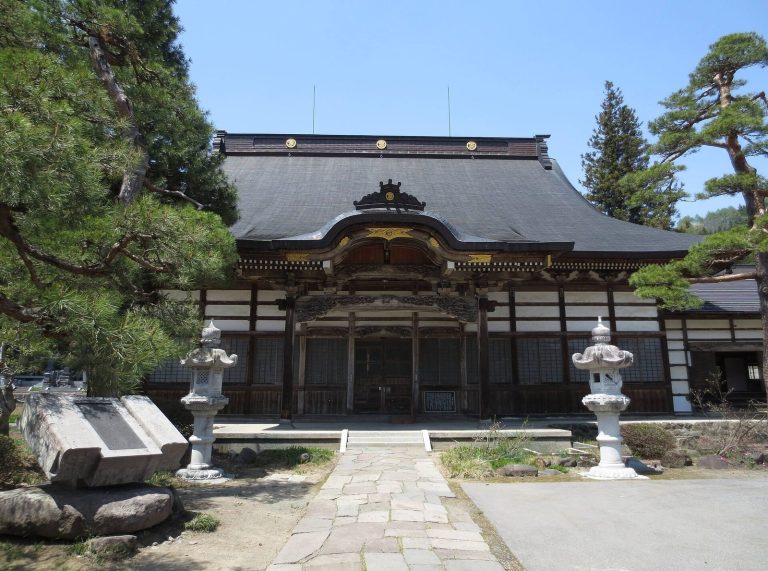
Completed in 1707, the main hall is one of Japan’s largest early-modern Buddhist buildings, with a roof area described as the largest in the country. It measures 24 meters across, 54 meters in depth, and 26 meters in height. Its unusually deep plan contains an open one-bay entrance zone, a four-bay outer worship area, a five-bay inner worship area, an intermediate area, and an innermost sanctuary.
The building appears to have two stories but is architecturally a single-story hall surrounded by a mōkoshi, a secondary roof around the lower part of a Buddhist building. Its cypress-bark roof uses the unusual shumoku-zukuri arrangement, in which two hipped-and-gabled roofs meet at right angles and create a T-shaped ridge plan. The central building has five bays across the front and fourteen along the sides. Including the surrounding mōkoshi, the dimensions become seven by sixteen bays.
The Ruridan altar stands on the western side of the innermost sanctuary, with a perpetual lamp before it. Within the altar is a shrine measuring 93 centimeters high, 84 centimeters wide, and 67 centimeters deep. It encloses the hidden principal image, traditionally regarded as the oldest Buddhist image in Japan. The image is a hibutsu, or hidden Buddha, withheld from public viewing, even from the temple’s chief priest.
The Ruridan itself is 160 centimeters high and 91 centimeters wide. The first Tachikawa Washirō of Suwa made it in 1789, and its doors carry openwork carvings of peacocks, dragons, and other motifs. The inner shrine is wrapped in red-and-gold brocade and covered by two curtains. Between the central and inner worship areas are images of 25 bodhisattvas, Buddhist beings who postpone final enlightenment to aid others. Jizō and Maitreya sit on opposite sides of the intermediate area.
The eastern Three Founders’ Room contains shrine-enclosed images of Honda Yoshimitsu, his wife Yayoi Gozen, and their son Zensa. Its hipped-roof, tile-patterned boarded shrine forms an attached element of the National Treasure building. The O-kaidan meguri begins near this room. Participants descend into a completely dark wooden passage, pass beneath the Ruridan and the principal-image shrine, and emerge near the northern entrance. A lock on a door in the passage is traditionally identified with the key to Amida’s Western Paradise.
The hall also houses images of Enma King and Binzuru. Binzuru is traditionally touched before worshippers touch corresponding afflicted parts of their own bodies, a practice associated with healing. During the Binzuru-mawashi observance on 6 January, the wooden image is carried around the hall.
Sanmon
The Sanmon, or major temple gate, was completed in 1750. Its front tablet reads “Zenkō-ji” and is traditionally attributed to Imperial Prince Kōchō. Five doves are said to be concealed in the calligraphy, while the character for “zen” is sometimes interpreted as resembling a cow.
The upper interior contains a wooden Manjushri riding a lion, the Four Heavenly Kings, restored wall paintings, and images representing the 88 temples of Shikoku. Numerous inscriptions made by visitors from the Edo period through the Shōwa period remain inside. Repairs in 2007 replaced a cypress-bark roof installed during earlier work with the earlier form of shingle roofing made from sawara boards.
Kyōzō
The Kyōzō, a Buddhist sutra repository, was completed in 1759. It is a five-bay square hall with a pyramidal roof. At its center is a rotating repository containing the complete 6,771-volume Tetsugen Ōbaku edition of the Buddhist canon. The repository is about 6 meters high, approximately 4 meters deep, and weighs about 5 tons. Rotating it clockwise is traditionally believed to confer the merit of reading the entire canon. The hall also contains images associated with Fu Dashi and the eminent monks Dengyō and Jikaku. The sutra repository itself dates from 1694.
Niōmon and bell tower
The Niōmon is guarded by paired Buddhist guardian figures made by the modern sculptors Takamura Kōun and Yonehara Unkai. Their arrangement reverses the usual placement: the closed-mouth figure stands on the right and the open-mouth figure on the left. The gate was rebuilt in 1918 after its earthquake-related destruction and repaired in 1977.
The bell tower was rebuilt in 1853 as a six-pillared structure, referring to the six syllables of “Namu Amida Butsu,” a devotional invocation meaning reliance on Amida Buddha. Takahashi Byakuren commissioned and cast the original bell in 1632. It was destroyed in the 1642 fire and recast in 1667. The bell is designated an Important Art Object.
Affiliated precincts and memorial buildings
Daihongan and Daikanjin
Daihongan is the Jōdo-affiliated convent and residence of the abbess. Its precinct includes the Honseiden, treasure hall, memorial hall, Kōmyōkaku, Oku-Shoin, Omote-Shoin, Meishōden, Jukōden, and Manjushri Hall. Daikanjin is the Tendai-affiliated monastic headquarters and residence of the Kanju. Its precinct includes a release pond, gate, halls, memorial buildings, a ritual hall for fire offerings, and a treasure museum.
Japanese War Dead Memorial Hall
The Japanese War Dead Memorial Hall was built in 1906 and rebuilt in its present three-story-tower form in 1970. It commemorates war dead from the Boshin War through the Second World War and houses the Zenkō-ji Museum on its first floor. Displays include former votive tablets from the main hall, permanent-unveiling tablets, calculation plaques, a Kamakura-period-style Amida image attributed to the school of Kaikei, a sand mandala consecrated during the Dalai Lama’s visit, quarter-scale models of the Niō images, and war-related objects recovered from Saipan and Tinian.
Rōkujizō and Nure-botoke
The Rōkujizō group stands east of Daikanjin. Its six Jizō images represent bodhisattvas associated with saving beings in the six realms of Buddhist existence, including hell, hungry spirits, animals, humans, and divine beings. The present group was recast in 1954 after the earlier images, made in 1759, were surrendered for wartime metal collection in 1944.
The Nure-botoke, or “Wet Buddha,” is an image of the life-prolonging Jizō made in 1722 by the Zenkō-ji hijiri Hōyo Enshin through nationwide donations. It is traditionally associated with the memorialization of Yaoya Oshichi. A large incense burner made at Takaoka in 1956 replaced an earlier object surrendered for wartime metal collection. Its smoke is traditionally applied to the body for health and healing.
Southern approach and associated monuments
Stone approach and Komagaeshi Bridge
The approach toward the main hall is paved with stones. The section to the Sanmon uses stones donated in 1713 by the Edo stonemason Ōtakeya Heibei, while the section from the Sanmon to the main hall uses stones from Saikō-ji at Koshimura. Repairs took place in 1810, and the pavement is said to retain 6,479 stones.
Komagaeshi Bridge stands at the entrance to the approach beyond Nakamise street. Its name comes from the tradition that Minamoto no Yoritomo’s horse became trapped there in 1197, after which Yoritomo dismounted and continued on foot. The same tradition connects the bridge with a rule that vehicles could not pass beyond it, regardless of social status.
Former Nyorai Hall site and Seson-in Shakadō
A stone monument opposite the Seson-in Shakadō marks the former site of the Nyorai Hall. Tradition identifies the location as the place of the principal-image altar during the temple’s foundation. Its associated life-prolonging Jizō was made in 1712, damaged in the 1847 earthquake and again in 1891, rebuilt in 1915, and surrendered for wartime metal collection. The present image dates from 1949.
The Seson-in Shakadō houses a life-sized bronze reclining Buddha attributed to the Kamakura period and designated an Important Cultural Property. During the Sengoku period, the image travelled with Zenkō-ji’s principal image, founders’ images, and temple seals. The hall also contains images of Bishamonten, Fudō Myōō, and Marishiten. A small Eko-bashira is erected before it during Gokaichō.
Honzen-dō and Ajari Pond
The Honzen-dō, a small hall belonging to Honkaku-in, stands west of the former main hall site opposite the Shakadō. It is traditionally associated with the Imoidō built west of Honda Yoshimitsu’s residence. Beside it lies the now-dry Ajari Pond, one of the temple’s traditional seven ponds. A local legend connects the pond with Kōen Ajari, a monk who took dragon form and taught Hōnen.
Memorials, legends, and Gokaichō features
Mounds, monuments, and memorial images
Two mounds west of the Sanmon are called the Satō Brothers’ Mounds. Tradition identifies them as memorials to Satō Tsuginobu and Satō Tadanobu, retainers of Minamoto no Yoshitsune. They are designated tangible cultural properties of Nagano. Two natural stones before the main hall are called the Sannō Mound and the Shoshin Mound. Tradition says they cover builders’ tools buried during construction of the present hall as protective objects.
A small hall east of the main hall contains the father image from a group of four memorial Jizō carved from wood associated with the tsunami-destroyed Takada-Matsubara forest after the 2011 earthquake. The mother and child images are kept at Fumon-ji in Rikuzentakata. The precinct also contains a monument to Fujiwara Uneme-no-Suke, regarded as an ancestor of the hairdressing profession. Members of that profession erected it in 1897. Memorial towers commemorate retainers of the Sanada family of Matsushiro, which protected and deeply venerated Zenkō-ji during the Edo period.
The Mujina Lantern is associated with a legend about a badger from Shimōsa that assumed human form, visited Zenkō-ji, and donated a lantern before being recognized at the Hakurenbō lodging house. Numerous additional halls, statues, towers, monuments, and memorial objects occupy the wider precinct.
Eko-bashira and Maedachi Honzon
During Gokaichō, the Eko-bashira is erected before the main hall and later moved to a designated deposit site, where it gradually returns to the soil. The Maedachi Honzon, a substitute manifestation of the hidden principal image, is displayed during the same ceremony. It presents Amida at the center, Kannon on the right, and Seishi on the left beneath one mandorla. Kannon and Seishi are bodhisattvas traditionally regarded as Amida’s attendants.
A five-colored cord called the “Cord of Goodness” connects the Maedachi Honzon to the Eko-bashira. Touching the pillar is traditionally understood to establish a connection with the image. A second, smaller pillar is connected to the reclining Buddha at the Shakadō. The Ruridan and its shrine can be glimpsed briefly during the daily morning service, while the hidden image itself remains concealed.