Itsukahara Kofun: An Early Keyhole-Shaped Burial Mound in Japan


Site at a Glance
- Rating
- 3.2
- Popularity
- Very Low
- Country
- Japan
- Primary era
- Classical
- External website
- Open
- Eras represented
- Classical
- Civilizations
- Yamato
- Site type
- Burial
- Remains
- Burial Mound
On this page9 sections
History
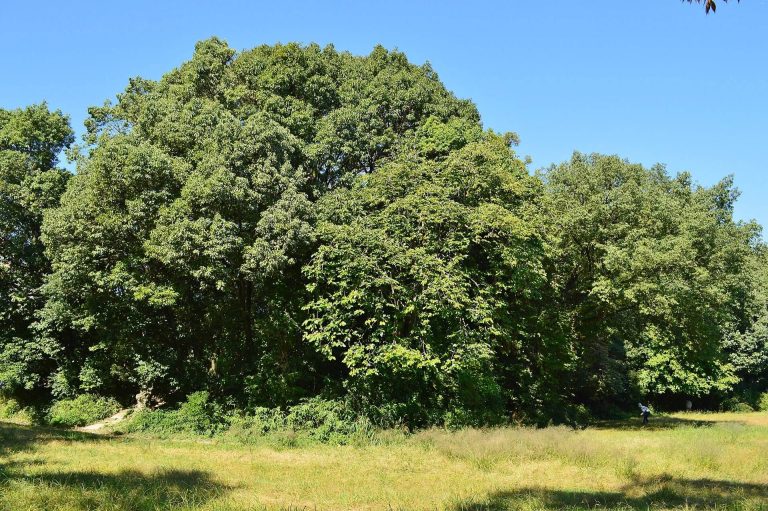
Itsukahara Kofun is a large burial mound in Muko, Kyoto, Japan, built during the earliest phase of the Kofun period, probably in the mid-to-late third century. The Kofun period was an era of monumental burial mounds in Japan, conventionally dated from around the third to the sixth centuries. Itsukahara is regarded as one of the oldest large keyhole-shaped mounds and as the earliest chief’s tomb in the Mukō Hills Kofun cluster.
The early Mukō Hills tombs
The mound stands on a ridge in the southern Mukō Hills, at the southwestern edge of the Kyoto Basin. It forms part of a group of large keyhole-shaped tombs distributed along the hills. Its design has been interpreted as an early model for the standard arrangement later used in royal tombs of the Kinai, the historical core of central Japan around the ancient capitals in the Kyoto and Nara area.
Several features connect Itsukahara with later developments in monumental tomb design. Its sloping flat surface resembles that of Hashihaka Kofun, while the shape of its projecting front section resembles Higashida Otsuka Kofun. The combination of a three-tiered rear section and a two-tiered front section is among the earliest known examples of a form later used at Nishitonozuka and Andonyama.
Investigation and designation
Investigation of Itsukahara Kofun took place over several decades. The Kyoto Prefectural Board of Education surveyed the mound in 1967 and 1968, Tezukayama University carried out an electrical survey in 1968, and the Kyoto University archaeological laboratory conducted further surveying in 1977. Excavations followed in 2000 and 2001, and again from 2013 through 2018, involving Ritsumeikan University, the Mukō City Center for Buried Cultural Properties, and associated archaeological teams.
On March 1, 2016, Itsukahara Kofun became part of the Otokuni Kofun Cluster, designated as a National Historic Site of Japan. Eight mounds, including Itsukahara, were added to the previously designated sites of Tennō no Mori Kofun, Kaideyama Kofun, and Terado Otsuka Kofun, and the enlarged designation received its present name.
Remains
Overall layout and construction
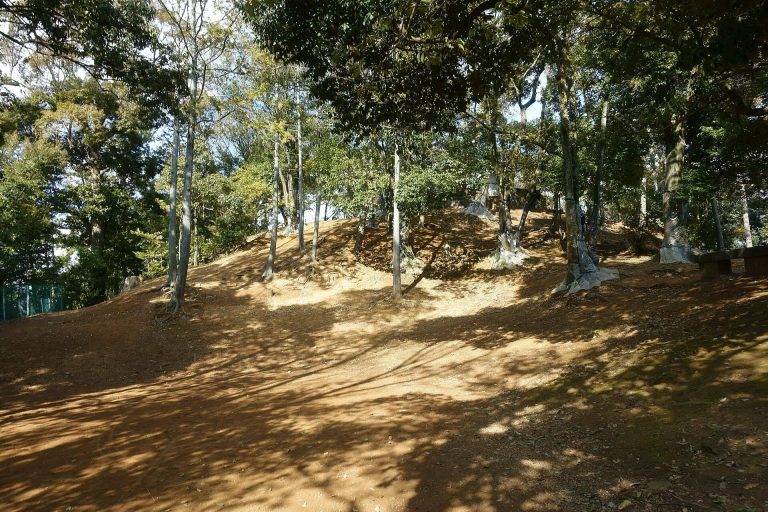
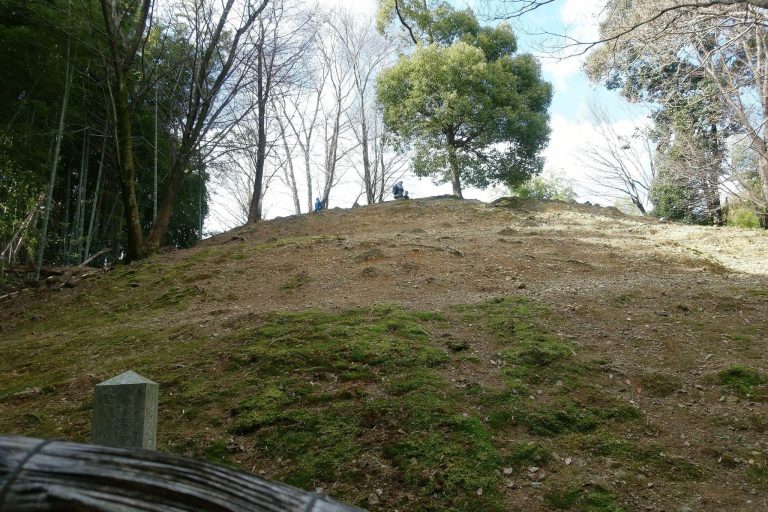
Itsukahara Kofun is a zenpo-koen-fun, or keyhole-shaped mound, consisting of a circular rear section joined to a projecting front section. The front section faces south and opens outward in a fan-shaped form. The reconstructed mound measures 91.2 meters in length. Its rear section is about 55 meters in diameter and 8.7 meters high, while the front section is 40.5 meters long, 33 meters wide, and 4.0 meters high. The connecting constriction is 15 meters wide and 2.1 meters high.
The rear section was formed in three tiers and the front section in two. Built mainly from piled earth, the rear mound forms an almost perfect circle. A distinctive sloping flat surface runs partway up the mound’s slope. Stones known as fukiishi, which helped protect and stabilize earthen mound surfaces, were detected on the exterior. The northwestern part of the rear mound’s base was cut away during residential development, but the mound as a whole remains comparatively well preserved.
Burial facilities and later interment
Main stone chamber
The principal burial facility lies at the center of the summit of the circular rear section. It is a pit-type stone chamber built entirely by stacking naturally rounded river stones. The chamber is 6.2 meters long and 1.3 meters wide, with an estimated depth of more than 1.5 meters. Its interior has not been excavated. The chamber is considered the first excavated example of a large keyhole-shaped mound whose stone burial chamber was constructed solely from natural stones.
Peripheral clay coffin
A later burial was found at the western foot of the rear mound. It consisted of a clay coffin made from haniwa, clay objects placed around or on some burial mounds. The coffin’s haniwa have an unusual globular upper section and are identical to those from Myokenyama Kofun, regarded as the fourth chief’s tomb in the Mukō Hills sequence. They date to around the middle of the fourth century. The buried person may have been related by blood to the occupant of Itsukahara Kofun, and another theory proposes a kinship connection with the occupant of Myokenyama Kofun. The form of these haniwa may also have provided a basis for the Tango-type cylindrical haniwa found in the Tango region.
Investigated summit feature
Before excavation, electrical surveying indicated a possible additional burial pit at the center of the front section’s summit. The suspected feature lay parallel to the mound’s main axis and measured approximately 5 meters from east to west by 7 meters from north to south. Excavation did not establish it as a large burial facility.