Kōsō Hachiman Shrine: Guardian Shrine of Moji


Site at a Glance
- Rating
- 4.1
- Popularity
- Low
- Country
- Japan
- Primary era
- Modern
- External website
- Open
- Eras represented
- Modern
- Civilizations
- Japanese
- Site type
- Religious
- Remains
- Sanctuary
On this page8 sections
History
Kōsō Hachiman Shrine, also known as Kōsō Hachimangu, is a Shinto shrine in Kitakyushu, Japan, that enshrines Emperor Ojin, Empress Jingu, and the three Munakata goddesses. Its foundation tradition begins in 859 and connects the shrine with the court-sponsored spread of Hachiman worship, a major Japanese religious tradition associated with Emperor Ojin and especially important among warrior communities and ruling houses.
Foundation and the Moji Barrier
In 859, the monk Gyōkyō of Daianji in Yamato received an oracle that Hachiman would protect the imperial capital. The following year, Emperor Seiwa, a ninth-century Japanese emperor linked with the establishment of major Hachiman institutions, sent Kiyohara, the deputy governor of the Dazai, as an imperial envoy. The Dazai was the central government office responsible for governing Kyushu and overseeing its relations with the Asian mainland. Kiyohara was to transfer Hachiman to Mount Otokoyama in Yamashiro, where Iwashimizu Hachimangu was later established.
When the procession stopped at Moji Barrier beneath the mountain later associated with Kōsō Hachiman Shrine, auspicious clouds and eight descending banners were said to have appeared. Gyōkyō reported the omen to the court, and Emperor Seiwa ordered a division of Hachiman to be enshrined at the site, together with a helmet traditionally attributed to Empress Jingu. The shrine consequently became a guardian of the strategically important Moji Barrier.
Warrior patronage and medieval estates
In 1185, during the Battle of Dan-no-Ura, Minamoto no Noriyori visited the shrine, dedicated a bow bound with wisteria, and prayed for victory. The battle was the decisive defeat of the Taira by the Minamoto during the Genpei War. Afterward, Noriyori and his younger brother Minamoto no Yoshitsune were traditionally credited with constructing shrine buildings.
During the Kamakura period, the Moji clan adopted the shrine as its tutelary shrine. It also served as the principal shrine for six Moji townships: Kusubaru, Yanagi, Ozumi, Ikawa, Kishi, and Katano. In 1336, after his victory at the Battle of Tatarahama, Ashikaga Takauji donated shrine buildings and estate lands. Takauji later founded the Muromachi shogunate and was a leading military ruler during the transition from Kamakura to Muromachi rule.
Throughout the Muromachi and Sengoku periods, the western Japanese Ōuchi clan provided sustained patronage. Ōuchi Yoshioki, Ōuchi Yoshitaka, and Ōuchi Yoshinaga each donated estate lands. After the Ōuchi house fell, Mōri Motonari, then the leading lord of the Chugoku region, also constructed shrine buildings.
The Kokura domain and modern destruction
In the early modern period, the shrine lay within the Kokura domain. It first received the patronage of the Hosokawa family and later that of the Ogasawara family. Under Ogasawara rule, it ranked as the domain’s leading guardian shrine, known as the shrine protecting the domain’s prosperity. The lords regularly offered ritual cloth, commissioned construction, and donated estate lands.
During the Second Choshu Expedition at the end of the Edo period, Choshu soldiers invading the Kokura domain burned the main sanctuary and plundered the shrine treasures. In 1868, Mōri Motonori rebuilt the main sanctuary. The resulting complex expressed connections across the former domains: the Kokura domain built the worship hall, while the Choshu domain built the main sanctuary.
The shrine was classified as a village shrine in 1872 and promoted to prefectural shrine in 1922, a higher classification under the prewar state shrine system. As Moji Port developed into one of Japan’s leading port towns, the shrine underwent large-scale expansion. An air raid on Moji in June 1945 destroyed the entire complex. The buildings were rebuilt in 1958, after which the shrine was listed as a Beppyo Shrine by the Association of Shinto Shrines, a formal category for shrines regarded by the association as having particular institutional or religious importance.
Kōsō Hachiman Shrine is also known for its exceptionally broad parish area in Moji Ward. The historically defined area extended beyond the present core of the ward to almost all of Moji Ward except Tsunemi, as well as parts of eastern Kitakyushu around Adachi, Furu-senba, Bashaku, and Kamishironomizu. Its principal special rites include the conch-shell welcoming rite and the conch-shell releasing rite. Every fifty years, a grand festival permits worshippers to view the sacred object traditionally identified as Empress Jingu’s helmet. Observances took place in 1958 and 2008, with the next scheduled for 2058.
Remains
The shrine stands at the foot of a mountain historically revered as sacred and associated with the clouds and eight descending banners of its foundation tradition. Its surviving organization centers on three sanctuaries, while the present buildings reflect the postwar rebuilding that followed the destruction of the expanded prewar complex.
Sanctuaries and sacred object
The enshrined deities are arranged among three sanctuaries. Emperor Ojin occupies the First Sanctuary, Empress Jingu the Second Sanctuary, and the three Munakata goddesses the Third Sanctuary. The Munakata goddesses belong to a Shinto tradition associated with maritime protection and northern Kyushu. The sacred object traditionally identified as Empress Jingu’s helmet remains enshrined at the shrine and is shown to worshippers only during the special fifty-year grand festival.
Historic complex and reconstruction
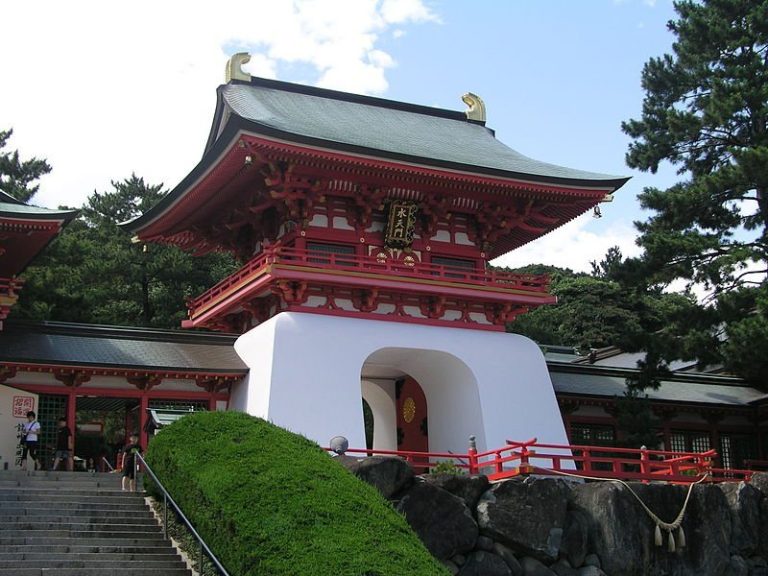
Before the 1945 air raid, the expanded complex included the main sanctuary, worship hall, shrine office, a two-story gate, surrounding corridors, an offering hall, and a votive-tablet hall. The air raid destroyed these buildings. The 1868 reconstruction had already given the complex a cross-domain character, with the Kokura domain represented by the worship hall and the Choshu domain by the main sanctuary. The shrine buildings were rebuilt again in 1958.
Stone tower associated with Taira no Tomomori
A stone tower within the shrine grounds is traditionally regarded as the grave of Taira no Tomomori, who was said to have drowned during the Battle of Dan-no-Ura. According to the tradition, local people recovered his body after the battle and performed memorial rites in the mountains where the Hachiman shrine stood. The stone tower was later moved into the shrine grounds. It is a commemorative funerary feature rather than a confirmed archaeological tomb.