Tamura Shrine: The Ichinomiya of Former Sanuki Province


Site at a Glance
- Rating
- 4.3
- Popularity
- Medium
- Country
- Japan
- Primary era
- Early Modern
- External website
- Open
- Eras represented
- Early Modern, Modern
- Civilizations
- Japanese, Tokugawa
- Site type
- Religious
- Remains
- Sanctuary
On this page16 sections
History
Tamura Shrine is a Shinto shrine in Takamatsu, Japan, dedicated to five kami collectively known as Tamura Okami. It served as the ichinomiya, the highest-ranking traditionally recognized shrine, of former Sanuki Province, and its worship developed around abundant springs and a sacred well.
Origins and water worship
The shrine’s beginnings are uncertain. One tradition says that a deity was first enshrined on a raft floating in the Sada-mizu Well, after which the Buddhist monk Gyoki established a shrine building there in 709. Gyoki was a Nara-period monk associated with religious organization and temple construction. Another tradition connects the site with Ichinomiya-ji, a Buddhist temple founded by the monk Gien during the Taiho era, from 701 to 704. In its early history, the temple and shrine were regarded as one building.
The well-centered foundation tradition reflects the importance of the area’s springs. It has also encouraged the interpretation that the original object of worship was a local water or dragon deity. The shrine has acquired several names, including Tamura Taisha, Ichinomiya Shrine, Sada-mizu Daimyojin, Ichinomiya Daimyojin, and Tamura Daimyojin. The name Tamura comes from the locality and is not connected with the warrior Sakanoue no Tamuramaro.
Imperial patronage and provincial status
The imperial court repeatedly promoted Tamura Shrine’s divine rank during the Heian period. In 850 it received Junior Fifth Rank, Lower Grade, and in 861 it entered the roster of government-supported shrines. Further promotions followed in 865, 875, and 877. The shrine was reportedly raised to Senior First Rank in 1201.
The 927 Engishiki, a compilation of court rites, regulations, and shrine registers, lists it as Tamura Shrine of Kagawa District in Sanuki Province. It was classified as a Meishin Taisha, a major shrine included in that register, and was one of three such shrines in Sanuki. Its position as the province’s ichinomiya established its regional standing.
A dedicatory tablet associated with the shrine bears the words “Senior First Rank Tamura Daimyojin.” Emperor Go-Uda issued it in July 1284, linking the shrine’s late thirteenth-century status with imperial recognition.
Medieval regulation and early modern change
In 1460, Hosokawa Katsumoto sponsored building work and donations at the shrine. He also established the “Wall Code of Tamura Taisha, the Ichinomiya of Sanuki Province,” a set of 26 rules for shrine personnel and affiliated parties. Katsumoto was a powerful military and political leader of the Muromachi period.
Warfare during the Tensho era, from 1573 to 1592, destroyed the sutra repository. Sengoku Hidehisa, a warlord and daimyo of the Sengoku period, subsequently donated a fief of 100 koku, a historical measure of rice-based land revenue. The shrine later received further land donations and continued to receive the devotion of the Matsudaira family, the rulers of the Takamatsu domain during the Tokugawa period. It also served as a place of prayer for the domain.
In 1679, the Takamatsu-domain Matsudaira family separated Ichinomiya-ji from the shrine complex. The temple was later moved elsewhere, taking its Shikoku pilgrimage station, its honji, or Buddhist counterpart of the shrine deity, and a statue of Sho-Kannon with it. Tamura Shrine consequently ceased to be a station on the Shikoku pilgrimage.
Modern status and living traditions
Under the modern shrine-ranking system, Tamura Shrine became a National Shrine of the Middle Rank in 1871. It is now a Beppyo Shrine under the Association of Shinto Shrines. Its pilgrimage affiliations include station 11 of the New Shikoku Mandala Pilgrimage, station 6 of the Fifteen Shrines of Sanuki, and the Sanuki Seven Lucky Gods pilgrimage, on which it enshrines Hotei.
The main annual observances take place on May 8 and October 8. During the special Okacho rite on May 8, a mosquito net is lowered into the well beneath the inner sanctuary so that the deity of the deep pool remains enclosed there. It is raised on October 8. In Takamatsu and former Kagawa District, a related custom survives in which one corner of a household mosquito net is left untied before May 8.
The shrine’s transmitted sacred treasures are designated a national Important Cultural Property under the name “Ancient Sacred Treasures of Tamura Shrine.”
Remains
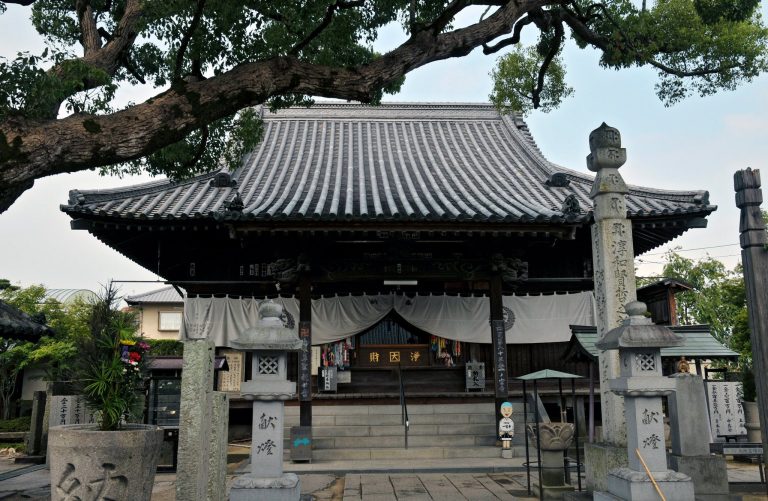
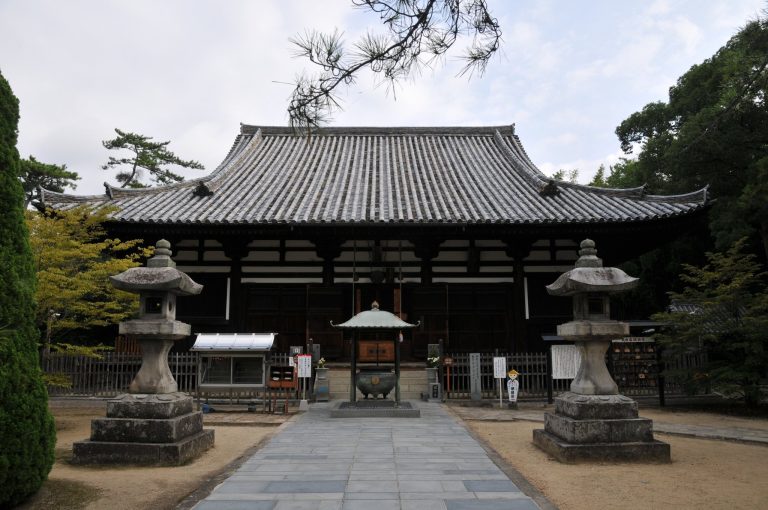
Tamura Shrine stands in a spring-rich setting whose central sacred feature is a deep pool beneath the inner sanctuary. The surviving complex includes the sanctuary buildings, wells and stones connected with shrine traditions, subsidiary shrines, memorial monuments, and carved stone figures.
Sanctuary and sacred waters
Inner sanctuary
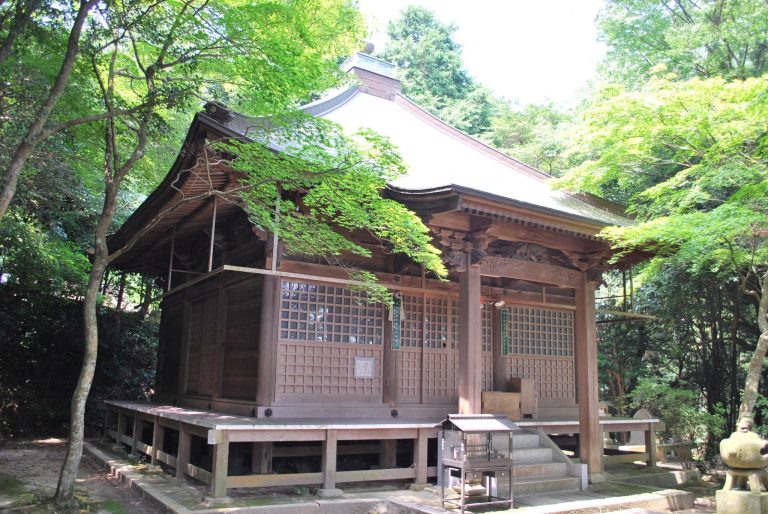
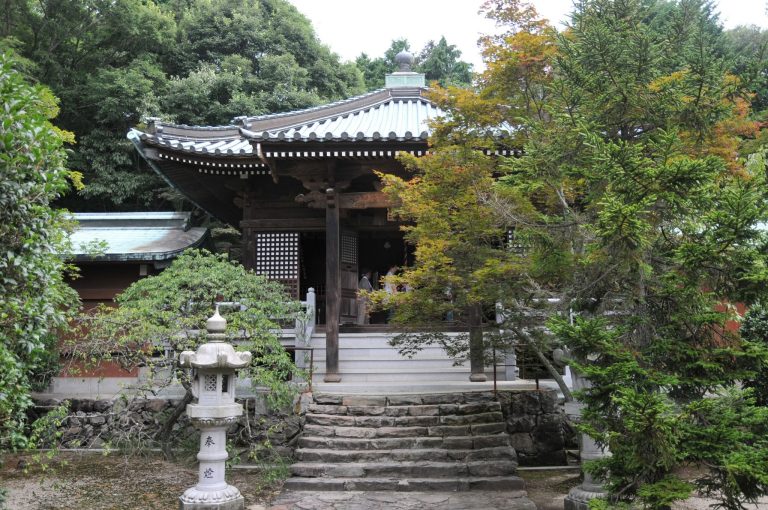
The inner sanctuary was constructed in 1710 above the deep pool associated with the Sada-mizu Well. It has a two-layered structure. The front portion connects with the main sanctuary and contains the divine seat. A fence blocks access to the structure, while dense vegetation makes much of it difficult to see. The well lies beneath the sanctuary floor and is identified with the well described in the shrine’s foundation tradition.
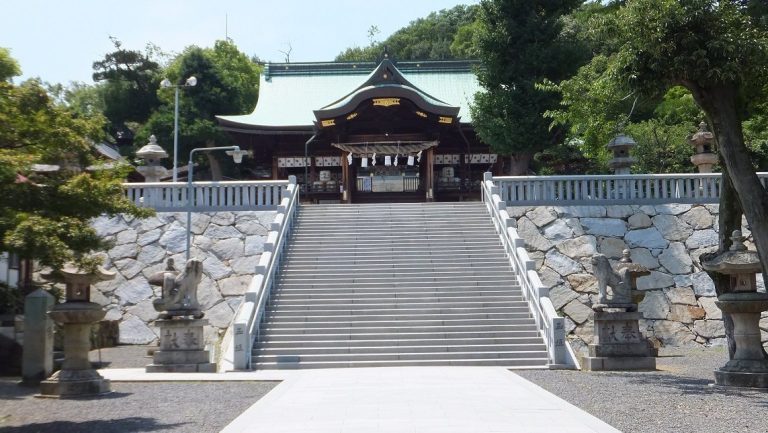
Main sanctuary and worship hall
The main sanctuary follows the Kasuga-zukuri style, a compact shrine form with a projecting front gable associated with the Kasuga tradition. The worship hall was rebuilt in 1877 in the irimoya-zukuri style, whose roof combines a central gabled ridge with hipped roof planes.
Traditional wells and stones
Hanaizumi, also called Hananoi, is a well at the western edge of the grounds. Shrine tradition identifies it as the place where Yamato totohi momoso hime-no-Mikoto washed her hands. Tamoto Well, or Tamotoi, lies east of the shrine. Tradition says that when the princess suffered from a high fever, an attendant soaked her sleeve there and offered her the water. Yasumiishi, a resting stone about 100 metres east of the shrine, is traditionally identified as the place where she rested.
Monuments, images, and subsidiary shrines
Stone memorials and figures
The grounds contain a monument to naval boy aviators and another commemorating pioneers who died overseas. Other stonework represents the dog, monkey, and pheasant associated with the Momotaro story, together with Kibitsuhiko-no-mikoto and Yamato totohi momoso hime-no-Mikoto. Stone images of the Sanuki Seven Lucky Gods are also present.
Subsidiary shrines
Numerous subsidiary shrines occupy the grounds, including Hime-no-miya, Awashima Shrine, and Inari Shrine.
Associated places and written heritage
Amakudari
Amakudari lies approximately 2 kilometres south of Tamura Shrine. It was the former site of a temporary festival sanctuary where Tamura Okami was believed to have appeared. Amakudari Shrine now stands at that location.
Wall Code and sacred treasures
The “Wall Code of Tamura Taisha” survives as a site-related written document containing 26 articles. The shrine’s other preserved sacred treasures are grouped as the Ancient Sacred Treasures of Tamura Shrine.