Kongōbu-ji Temple: Head Temple of Kōyasan Shingon Buddhism in Japan


Site at a Glance
- Rating
- 4.5
- Popularity
- Medium
- Country
- Japan
- Primary era
- Medieval
- External website
- Open
- Eras represented
- Medieval, Early Modern, Modern
- Civilizations
- Ashikaga shogunate, Japanese, Kamakura shogunate, Tokugawa, Toyotomi regime
- Site type
- Religious
- Remains
- Monastery
On this page25 sections
History
Kongōbu-ji Temple is the head temple of the Kōyasan School of Shingon Buddhism in Japan, in the mountain settlement of Koya. Kūkai, the founder of Shingon Buddhism in Japan, established the Kōyasan religious center in 816 with permission from Emperor Saga. He sought the mountain as a place for Shingon practice and imagined its surrounding peaks as the eight petals of a lotus, creating a physical expression of a mandala world. Shingon is an esoteric Buddhist tradition centered on ritual, sacred formulae, mandalas, and the attainment of Buddhahood in the present body.
Kūkai and the first monastic center
In the broad historical sense, Kongōbu-ji once referred to the entire sacred mountain and its monastic precinct. Since the Meiji period, the name has denoted the head-temple complex where the chief abbot of Kōyasan Shingon Buddhism resides. A medieval foundation tradition says that Kūkai was guided to the mountain by two dogs belonging to Kariba Myōjin, a local mountain deity, and received the mountain from Niutsu Myōjin. Both deities became revered as protectors of the foundation and were enshrined at the sanctuary in Danjōgaran.
Kūkai began marking a sacred boundary around Kōyasan in 819 and planned the principal monastic buildings within a second double boundary. Donations financed the work rather than direct state support, and construction proceeded slowly because of the mountain’s remoteness and Kūkai’s other responsibilities, including work on Manno Pond and the establishment of the Shugei Shuchi-in academy. Only a few buildings were completed during his lifetime, and none of those original structures survives.
After Kūkai entered permanent meditation at Okunoin in 835, the monk Kangen reported seeing him apparently alive in meditation. At Kangen’s request, Emperor Daigo granted Kūkai the posthumous title Kōbō Daishi in 921. These events helped establish the belief that Kūkai continued to dwell at Okunoin and worked for the peace of the world and the welfare of humanity. In 835, Kōyasan had also been designated a jōgakuji, a temple with a status comparable to that of a government temple. Kūkai’s nephew and disciple Shinzen later expanded the complex, including the first version of Konpon Daitō, around 887.
Decline and medieval restoration
A dispute over the Thirty-Volume Booklet, a collection of esoteric scriptures copied from teachings Kūkai had received in China, caused the second abbot, Mukū, to leave Kōyasan with his followers. The mountain was almost deserted for about twenty years. Tōji abbot Kangen eventually settled the dispute, returned the scriptures to Tōji, and served at the same time as abbot of Kōyasan. The mountain thereafter remained subordinate to Tōji until the Meiji Restoration.
In 994, a lightning-caused fire destroyed most of the complex. Official mismanagement during the attempted rebuilding led the monks to withdraw to Amano at the foot of the mountain, beginning another period of decline. Restoration began around 1016 under Jōyo, also known as Kijin Shōnin, a mendicant monk associated with Kōfuku-ji. He gathered mendicant monks from different traditions, later known collectively as Kōya hijiri. Their preaching spread pilgrimage to Kōyasan, Pure Land devotion, and veneration of Kōbō Daishi. The Hijiri were itinerant religious practitioners who preached, raised donations, performed memorial services, and carried Kōyasan traditions to communities unable to make the pilgrimage.
Fujiwara no Michinaga made a pilgrimage to Kōyasan in 1023, followed later by Emperor Shirakawa and Emperor Toba. Imperial and aristocratic support encouraged the rebuilding of halls, the expansion of temple estates, and the foundation of further monasteries. By the twelfth century, the mountain had become a major religious center. It reportedly contained sixteen monastic residences in 1048 and about 300 Gakuryō and 2,000 Gyōnin and Hijiri by 1148. At its height, approximately 2,000 halls and other buildings stood across Kōyasan.
The monastic community developed three principal groups. The Gakuryō specialized in Shingon doctrine, scholarship, and rites. The Gyōnin performed ascetic practices and handled administration, construction, security, and estate management. The Hijiri preached, solicited donations, sold medicines and talismans, and promoted burial and the deposition of hair at Kōyasan. These groups gave the mountain a broad institutional and devotional base.
Reform, neutrality, and conflict
Kakuban, later known as Kōgyō Daishi, became abbot of Daidenbō-in and Kongōbu-ji in 1134 under Emperor Toba’s patronage. His reforms to doctrine and practice, including the teaching that Dainichi and Amida were ultimately identical, provoked opposition from conservative Gakuryō monks. After the Kirimomi Disturbance in 1140, Kakuban and his followers left for Negoro-ji, where their movement developed into Shingi Shingon Buddhism.
Kōyasan maintained neutrality during the wars between Taira and Minamoto forces and avoided major wartime destruction. It became a refuge for monks and a place where the remains of defeated Taira warriors were deposited. Warriors and aristocrats also established hermitages, halls, and memorial foundations on the mountain. During the Kamakura period, the approach road known as Chōishi-michi was rebuilt. Between 1265 and 1285, donors from the imperial and aristocratic classes, especially the Kamakura shogunate and its leading retainers including Adachi Yasumori, replaced wooden stupa-shaped markers along the route with stone markers.
Hōjō Masako founded Zenjō-in in 1211 to pray for the deceased Minamoto no Yoritomo; Kongō Sanmai-in later replaced it. Kōyasan also became associated with Yoritomo’s son Jōkyō, who entered the mountain in 1220, and the Kamakura shogunate subsequently provided substantial patronage. During the conflicts between the Northern and Southern Courts, Kōyasan again maintained neutrality. Emperor Go-Daigo donated Aizen-dō in 1334, while Ashikaga Takauji exempted the mountain from certain taxes and duties and protected it from provincial military officials.
Gakuryō factions at Hōshō-in and Muryōju-in developed the Hōmon and Jumon schools. Around 1412, they promoted a major reorganization of Shingon learning known as the Ōei scholarly consolidation. Tensions between the Gakuryō and Gyōnin later intensified, leading to armed conflict in 1464.
Fire, war, and early modern rebuilding
A great fire in 1521 destroyed more than 300 halls, including Konpon Daitō and the Kondō, as well as more than 3,900 monks’ residences and related buildings. The Hijiri continued to raise funds throughout the country, but political instability during the Sengoku period delayed comprehensive reconstruction.
Oda Nobunaga regarded Kōyasan as a major independent power because it controlled extensive estates and maintained a large armed monastic force. After men connected with Araki Murashige took refuge on the mountain, Nobunaga executed 1,383 Kōya hijiri and prepared a military campaign against Kōyasan. His death in 1582 prevented the attack from reaching its intended conclusion.
Toyotomi Hideyoshi then demanded submission, the return of estates, and disarmament. Mokujiki Ōgo, a monk of warrior origin, negotiated with Hideyoshi and secured Kōyasan’s survival, although its landholdings were reduced. Hideyoshi later confirmed 21,000 koku of temple estates and helped rebuild twenty-five halls, including Konpon Daitō and the Kondō. In 1593 he commissioned Seigan-ji as a memorial temple for his mother, Ōmandokoro. It was first called Teihatsu-ji because her tonsure was deposited there and was later renamed Seigan-ji. Seigan-ji and Kōzan-ji were merged in 1869 to form the present Kongōbu-ji, making the former Seigan-ji the principal institutional predecessor of the modern head temple.
Hideyoshi also supported Kōzan-ji, while the temple later associated with his son Toyotomi Hidetsugu became known for Hidetsugu’s ritual suicide in 1595. In 1594, the Tokugawa family established a formal relationship with the former Renge-in, renamed it Daitoku-in, and made it their memorial temple and lodging institution at Kōyasan.
Tokugawa administration and the Meiji transformation
Under the Tokugawa shogunate, Kōyasan received 21,000 koku of temple estates. The Gakuryō received 9,500 koku and the Gyōnin 11,500, while the Hijiri received no regular allocation apart from 200 koku assigned during the reign of Tokugawa Iemitsu for rites at the Tokugawa mausoleums. In 1606, the Gyōnin attacked Daitoku-in over its architectural privileges and destroyed its decorative gable latticework. The shogunate ruled that the Gyōnin could not interfere with Hijiri buildings and required the Hijiri, who had adopted Jishū practices, to return formally to Shingon Buddhism. This decision effectively ended the traditional role of the itinerant Kōya hijiri.
A record from 1646 lists 1,865 institutional residences at Kōyasan, including 210 Gakuryō establishments, 1,440 Gyōnin establishments, 120 Hijiri establishments, 42 guest-monks’ residences, and 53 others. By the late seventeenth century, craftsmen and townspeople had also begun to live permanently on the mountain.
The Meiji government’s separation of Buddhism from local religious traditions abolished the Gakuryō, Gyōnin, and Hijiri divisions. In 1871, Kōyasan’s 21,000 koku of estates were returned to the government, autonomous administration ended, and local government and police facilities were established. In 1873, the mountain also surrendered approximately 3,000 hectares of forest. Women had traditionally been prohibited from entering Kōyasan. The legal basis of that prohibition was abolished in 1872, but the remaining boundaries were not fully removed until 1906, when Kongōbu-ji formally allowed women to reside on the mountain.
The loss of estates and forests caused monks to leave or return to secular life, and many temples closed. Fires destroyed seventy halls in 1879, fifty temples and 130 houses in 1884, and numerous temples and residences in major fires on 23 and 24 March 1888. In 1891, the community decided to consolidate more than 680 temples into approximately 130. Protection of Kōyasan’s cultural property intensified in the 1890s. Important objects were assessed in 1891 and 1893, a treasure exhibition was held at Kongōbu-ji in 1894, and the Imperial Museum investigated and repaired Kōyasan treasures in 1898.
Modern preservation and the living mountain community
The Reihōkan treasure museum opened in 1921, and Kōyasan University was established in 1926. A fire on 26 December 1926 destroyed the Kondō, its principal image, and six associated statues. Typhoon Muroto in 1934 caused extensive damage to trees and destroyed the lantern hall in front of the mausoleum. In the postwar period, a cultural-property fire-protection water system extending approximately 10,000 meters was installed across the mountain.
The Kōyasan Cultural Property Preservation Society was established in 1957 and later organized the integrated protection of the mountain’s cultural assets. Kōyasan, including Kongōbu-ji and its associated sacred areas and pilgrimage routes, became part of the UNESCO World Heritage property Sacred Sites and Pilgrimage Routes in the Kii Mountain Range in 2004.
The present mountain community includes Kongōbu-ji, Hōju-in, Danjōgaran, Okunoin, ten valley districts, Kōyasan University, the Reihōkan, and numerous branch and lodging temples. The number of temples is given as 117 excluding Kongōbu-ji and Hōju-in, although some survive only as institutional names; fifty-two operate as lodging temples. Kōyasan remains linked with the Eighteen Head Temples of Shingon Buddhism, the special pilgrimage designation of the Saigoku Thirty-Three Kannon sites, and the Shinto-Buddhist Sacred Sites Pilgrimage Route. The Kōyasan Founding 1,200th Anniversary Great Dharma Assembly was held in 2015.
Remains
Kongōbu-ji is understood through the traditional idea of “one mountain, one temple precinct,” in which the entire sacred mountain forms the temple’s wider territory. Kōyasan occupies a basin-like plateau at approximately 800 meters above sea level, surrounded by mountains reaching about 1,000 meters. More than one hundred temples are concentrated within this mountain settlement. Its principal areas are arranged with Danjōgaran to the west, the Kongōbu-ji headquarters compound to the northeast, Okunoin and its cemetery to the east, and ten valley districts containing branch temples and monastic residences.
Danjōgaran and the western sacred area
Danjōgaran occupies the western-central part of Kōyasan and is one of its two principal sacred areas, together with Okunoin. Kūkai began developing it as the main center of Shingon ritual practice. Its planned buildings were arranged along a north-south axis, with the central gate, lecture hall, and monks’ quarters forming the principal sequence. The eastern Konpon Daitō represents the Womb Realm and the western Saitō the Diamond Realm. A mandala is a diagrammatic representation of a Buddhist sacred universe, while these two realms express complementary aspects of esoteric reality. The planned arrangement was completed around 887, fifty-two years after Kūkai entered permanent meditation.
Daimon
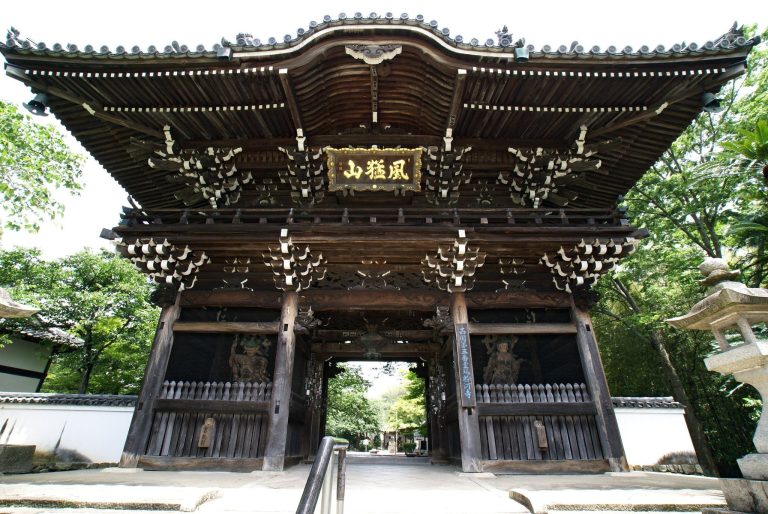
Daimon stands at the western end of the mountain precinct and faces the direction associated with the Western Pure Land. Rebuilt in 1705, the present entrance is a two-story gate with five bays and three entrances. It rises 25.1 meters high. Its Kongō Rikishi statues were made by the sculptors Kōi and Hokkyo Unchō and are described as the second-largest pair in Japan after those at Tōdai-ji’s Great South Gate.
Chūmon
Chūmon was founded in 819 and burned in 1843. The present gate was completed on 2 April 2015 during the works marking the 1,200th anniversary of Kōyasan’s foundation. It was rebuilt nearer to the Kondō than its predecessor, whose foundations remain visible. The surviving statues of Jikokuten and Tamonten were repaired, and new statues of Zōchōten and Kōmokuten were made, forming a gate with four guardian deities.
Kondō
The Kondō is Kōyasan’s principal worship hall. Its first building was begun in 819 and traditionally completed in 838. The sixth building, reconstructed in 1860, burned on 26 December 1926 with its secret principal image and six other statues. The present seventh Kondō was completed in 1932 as a fire-resistant reinforced-concrete structure faced externally with cypress. It has an irimoya roof, which combines a hipped lower section with gabled ends, and measures approximately 23.8 meters across and 30 meters along the ridge direction. It is 23.73 meters high, and its interior paintings were made by Kimura Buzan.
The principal image has traditionally been called Yakushi Nyorai, although it has also been identified as Ashuku Nyorai because both the former and present images were secret images. The image made by Takamura Kōun was first displayed from 2 April to 21 May 2015. Its iconography was identified as Ashuku while its formal designation remained Yakushi. A replica of the Blood Mandalas associated with Taira no Kiyomori was installed in the Kondō in 2015. The two originals, traditionally connected with Kiyomori’s blood and a dedication in 1156, are preserved in the Reihōkan.
Saitō
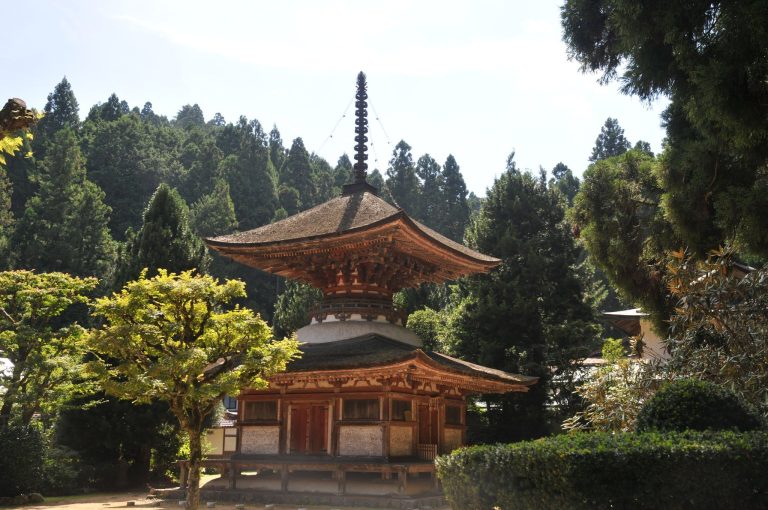
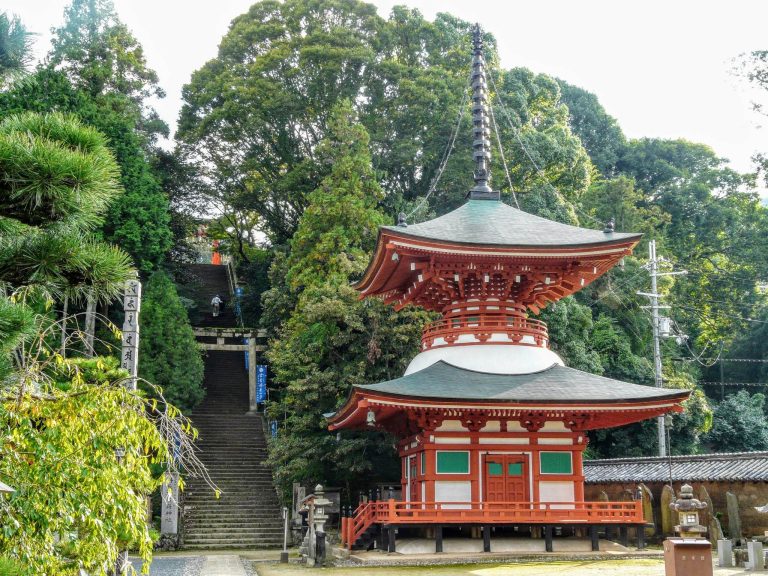
Saitō is a two-story tahōtō, a Japanese pagoda form with a square lower story and circular upper story. It represents the Diamond Realm in the paired design with Konpon Daitō. The first tower was built in 887, while the present fifth tower was reconstructed in 1834. It is 27.27 meters high and contains a Diamond-Realm Dainichi image together with four images of the four Womb-Realm Buddhas.
Konpon Daitō
Konpon Daitō began as the principal training hall of Shingon esoteric Buddhism and was completed in 887 as Japan’s earliest tahōtō. Repeated fires led to the construction of the present tower in 1937. It is a two-story reinforced-concrete building approximately 50 meters high and about 30 meters square, with a square first floor and circular second floor. Its interior forms a three-dimensional mandala containing a seated Womb-Realm Dainichi and the four Diamond-Realm Buddhas Ashuku, Hōshō, Amida, and Fukujoju.
Other Danjōgaran features
Kujakudō was first established in 1200 and rebuilt in 1983 to commemorate successful rainmaking prayers for Emperor Go-Toba at the Shinsen-en garden. The original peacock deity image by Kaikei is preserved in the Reihōkan, while a newly made image stands in the hall. Rengeike Pond takes its name from lotus flowers that reportedly bloomed there until the Shōwa period. Its island shrine was traditionally established around 1771 with an image of the Dragon King of Goodness and a Buddhist relic to address drought; the bridge and shrine were repaired in 1996.
The sanctuary called Miyashiro, formally the main sanctuary of Sannō-in, was rebuilt in 1522. It contains three shrine buildings dedicated respectively to Niutsu Myōjin and Kehi Myōjin, Kōya Myōjin and Itsukushima Myōjin, and the Twelve Princes with 120 attendant deities. Sannō-in, the worship hall of Miyashiro, was founded before 1174 and rebuilt in 1845. These Myōjin shrines express the historical integration of local mountain-deity worship with Shingon Buddhism.
Several features preserve traditions associated with the mountain’s restoration and religious history. The Pine of Ascension and Ladle Grass are linked to the story that the monk Nyoho of Myōoin ascended from the pine to the Pure Land of Maitreya in 1149. The Upside-Down Wisteria is associated with Jōyo’s vow to restore Kōyasan, after he planted a wisteria upside down and its unexpected growth was taken as a sign of revival. Junteidō, founded around 973 by Shinzen at Emperor Kōkō’s request, was rebuilt in 1883 and contains a Juntei Kannon traditionally said to have been made by Kūkai for his own ordination.
Miedō began as Kūkai’s private Buddha hall, was destroyed in the 1843 fire, and was rebuilt in 1847. Its principal image is a portrait of Kōbō Daishi attributed to Shinnyo Shinnō, while portraits of Kūkai’s ten principal disciples hang in the outer sanctuary. The Three-Pronged Pine between the Kondō and Miedō is associated with the vajra that Kūkai is traditionally said to have thrown from Ningbo in China in 806. The present tree is the seventh replacement and was planted during the Heisei period. The Meeting Cherry is linked to a tradition in which an old monk who appeared to Taira no Kiyomori after he rebuilt the Great Pagoda was understood to have been Kūkai.
The Great Pagoda Bell was completed during Shinzen’s time after Kūkai ordered its construction. The present bell was cast in 1547, weighs approximately six tons, and has a diameter of about seven shaku. It is called Kōya Shirō and is struck 108 times in five daily sessions. Aizen-dō was founded in 1334 at Emperor Go-Daigo’s request for prayers for peace and the safety of the imperial body. The present hall was rebuilt in 1848, and its principal image is an Aizen Myōō said to be life-sized in relation to Emperor Go-Daigo.
Fudō-dō was founded in 1197 by Gyōshō at the request of Princess Hachijō-in, the daughter of a retired emperor. Its present building dates from the early fourteenth century and is the second-oldest surviving building on Kōyasan after the tahōtō of Kongō Sanmai-in. It was moved from Isshin-in Valley to its present location in 1908. Its cypress-bark roof is protected by a drencher system that covers it with a film of water during a fire.
Kongōbu-ji headquarters compound
The Kongōbu-ji headquarters compound stands northeast of Danjōgaran. Its main hall, the Shuden, was rebuilt in 1863 as a shoin-style building measuring approximately 54 meters east-west and 63 meters north-south. Rainwater-storage barrels stand on its cypress-bark roof and help reduce the risk of fire spreading across the roof.
Shuden and associated halls
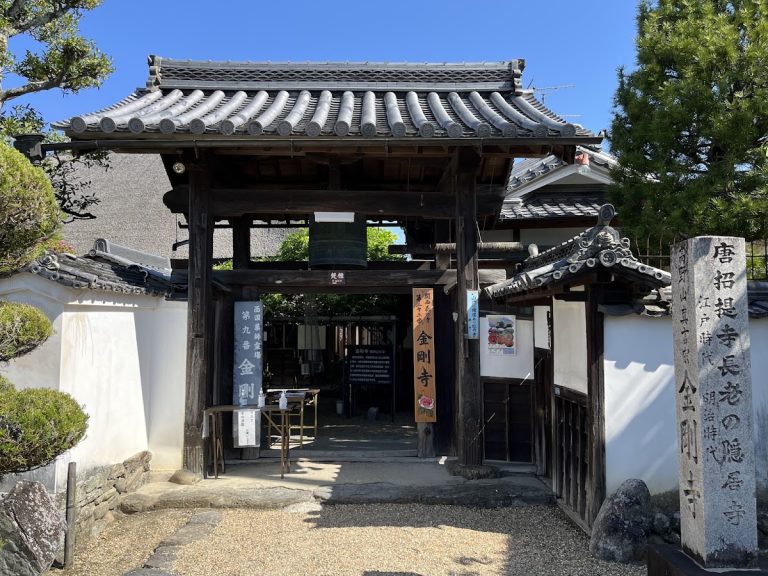
The compound’s main gate was rebuilt in 1593, and its belfry was probably rebuilt in 1864. A separate scripture storehouse, donated in 1679, contains a Shaka triad. Within the Shuden are the Great Hall, Plum Room, Willow Room, Upper Audience Room, Child’s Room, Inner Study, Hearth Room, and Kitchen. The Willow Room is also called the Hidetsugu Suicide Room because Toyotomi Hidetsugu died there in 1595.
The Separate Hall was built in 1934 and is linked to the Shuden by a long covered corridor. Its sliding screens depict seasonal birds and flowers, as well as scenes of Kūkai’s journey to China and the founding of Kōyasan. The Inner Hall, also built in 1934, occupies the former site of Kōzan-ji.
Banryūtei and modern facilities
Banryūtei was laid out in 1984 as a rock garden covering 2,340 square meters. One hundred and forty granite stones from Shikoku represent a male and female dragon rising through white sand from Kyoto to protect the Inner Hall. Shinbetsuden, also built in 1984, is a reinforced-concrete reception building with an irimoya roof. Its two rooms contain 91 and 78 tatami mats and can be combined into a hall of 169 mats. The Ajikan Meditation Hall was built in 1967 at the request of the 401st abbot and is used for instruction and practice in Ajikan, a Shingon breathing and meditation method.
Okunoin and the eastern cemetery
Okunoin, meaning the inner sanctuary, begins at Ichinohashi on the eastern side of the monastic settlement. A path and cemetery extend for approximately two kilometers through Nakanohashi to Gobyōbashi. The crossing of three rivers and bridges expresses passage from the ordinary world to the sacred realm. Estimates place the number of stone memorials along the approach at more than 100,000 or more than 200,000.
Gobyōbashi and bone deposition
The practice of depositing cremated bones or hair at Okunoin is known as bone ascent or bone elevation. Its earliest recorded documentary example is attributed to 1108, when Emperor Horikawa’s hair was deposited with the Lotus Sutra. Gobyōbashi, also called the Bridge of Ignorance, crosses the Tamagawa. Its thirty-six bridge boards plus the bridge as a whole make thirty-seven, symbolizing the thirty-seven deities of the Diamond Realm. The bridge is thought to date from the late Heian period.
Ritual buildings and the mausoleum
The Okunoin Goma Hall houses images of Fudō Myōō, Bishamonten, and Kōbō Daishi. The Offering Office prepares food for Kūkai and houses Daikokuten. The Living Offering rite is performed twice daily, at 6:00 a.m. and 10:30 a.m.; the food remains vegetarian and excludes meat and fish.
The Okunoin Scripture Storehouse was built by Ishida Mitsunari in 1599. Its plaque bears Mitsunari’s inscription, while the reverse records Mokujiki Ōgo’s involvement. Inside is a rotating octagonal scripture repository containing 6,285 fascicles of the Korean Tripitaka. The Lantern Hall, built in 1964, contains the Undying Fires, traditionally maintained for nearly a thousand years. These are the Prayer Lamp associated with Jōyo and the Shirakawa Lamp associated with Emperor Shirakawa.
Kōbō Daishi’s Mausoleum is a three-bay, four-sided hōgyō structure, meaning that it has a pyramidal roof, and is covered with cypress bark. A sacred fence encloses it. Two small shrines east of the mausoleum honor Niutsu Myōjin and Kōya Myōjin, while a third shrine to the west honors White-Beard Inari.
Associated temples, mausoleums, and collections
Tokugawa Family Mausoleums
The Tokugawa Family Mausoleums stand in Gonomuro Valley. Built in 1643 by Tokugawa Iemitsu, they contain two halls dedicated to Tokugawa Ieyasu and Tokugawa Hidetada. After Daitoku-in was abolished and merged with another temple during the Meiji period, the mausoleums came under Kongōbu-ji’s administration.
Kongō Sanmai-in
Kongō Sanmai-in is one of Kōyasan’s branch temples and contains a tahōtō built around 1223. It is described as Japan’s second-oldest surviving example of this pagoda form after the one at Ishiyama-dera.
Reihōkan
Reihōkan opened in 1921 as a museum for treasures belonging to the mountain’s temples. Its large storehouse was added in 1961, a new wing in 1984, and another storehouse in 2003. The original wooden museum building, registered in 1998, is described as Japan’s oldest surviving wooden museum.
The museum preserves most of Kōyasan’s nationally designated art objects, including 21 National Treasures, 148 Important Cultural Properties, seventeen Wakayama Prefecture cultural properties, and two important art objects, comprising more than 50,000 items. The collection includes a Nirvana Painting dated 1086, a painting of the Dragon King of Goodness attributed to Jōchi, six surviving Kamakura-period Eight Great Youths of Fudō attributed to the school of Unkei, and a 1486 carved sandalwood Buddhist shrine with an attached bronze case. It also contains Kūkai’s 797 manuscript Sangō Shiiki, the Gold-and-Silver-Character Sutra, a Lotus Sutra manuscript, documentary scrolls known as the Hōkanshū and its sequels, and the late-Heian lacquer and mother-of-pearl inlaid chest called Sawachidori.
The Kongōbu-ji precinct is a nationally designated historic site divided into six areas. Daimon, Danjōgaran, the headquarters area, and Okunoin received designation in 1977, while the Tokugawa Family Mausoleums and Kongō Sanmai-in precinct were added in 2002. Fudō-dō, Daimon, Konpon Daitō, and numerous associated buildings and works are protected under Japan’s cultural-property system.