Noge Ōtsuka Kofun: A Fifth-Century Japanese Burial Mound


Site at a Glance
- Rating
- 3.9
- Popularity
- Low
- Country
- Japan
- Primary era
- Classical
- External website
- Open
- Eras represented
- Classical
- Civilizations
- Japanese
- Site type
- Burial
- Remains
- Burial Mound
On this page9 sections
History
Noge Ōtsuka Kofun is a fifth-century Japanese burial mound in Setagaya City, Tokyo, Japan. Built during the Kofun period, an era of ancient state formation conventionally dated from approximately the third to the sixth centuries, it formed part of the Ebaradai Kofun Group, a cluster of burial mounds along the Maruko River. The mound is regarded as a representative example of this group, which was surrounded by numerous other kofun, or burial mounds generally built for members of ruling or elite classes.
Names and nineteenth-century investigation
The mound became known in the late Edo period as Higashi-Otsuka. It was later also called Kaminoge Kofun and Todoroki Golf Links Kofun. Its occupant remains unknown, while the mound itself is dated to the fifth century. One description places its construction at the beginning of that century.
Archaeological investigation took place in 1897. A stone coffin and a large quantity of grave goods were found, and the excavated objects were initially deposited in the Imperial Museum, later renamed the Tokyo National Museum. Goto Moriichi, a Japanese archaeologist who reported on ancient burial mounds, compiled the investigation results in a formal report published in 1936.
Heritage protection and collections
Noge Ōtsuka Kofun was designated a Tokyo Metropolitan historic site in 1952, initially under the category of designated former historic place. Its status changed to historic site in 1975, and it is also recorded as Setagaya Ward archaeological site no. 127.
The excavated objects were designated Tokyo Metropolitan tangible cultural property in 2001. That designation was lifted after the national designation of the material held in Setagaya in 2016. The Setagaya Ward collection is kept at the Setagaya Local History Museum, while another group is owned by the National Institutes for Cultural Heritage and kept at the Tokyo National Museum. The Setagaya collection became a National Important Cultural Property in 2016, followed by the Tokyo National Museum collection in 2017. Additional material is held at the Unane Archaeological Materials Room.
Remains
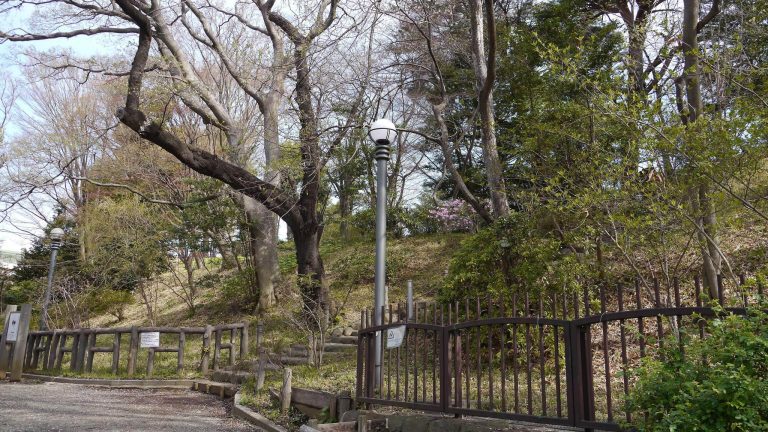
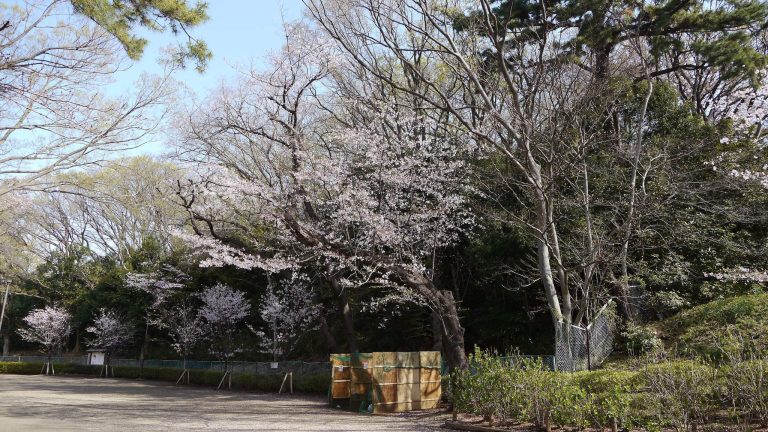
Noge Ōtsuka Kofun stands in Tamagawa Nogemachi Park in Noge 1-chome, on the Musashino Plateau at an elevation of approximately 30 to 33 metres. It is a scallop-shaped mound, with a large circular rear mound and a smaller projecting front section. The total length is approximately 82 metres, the rear mound measures about 66 metres in diameter, and the mound rises around 11 metres. Stone facing, which stabilized and finished the mound surface, and clay haniwa, funerary objects placed on or around burial mounds, were identified on the mound. A horseshoe-shaped surrounding ditch was also found.
Burial facilities and grave goods
First burial facility
Four burial facilities were placed in the rear mound. The first contained a split-bamboo-shaped wooden coffin, a long and narrow coffin made like a lengthwise section of bamboo, set within a packed-clay enclosure. This coffin was unusually narrow and elongated, measuring 8.2 metres in length and approximately 0.6 to 0.8 metres in width. Its grave goods included cuirasses, helmets, neck and shoulder armour, an iron sword, 19 straight iron swords, more than 25 iron arrowheads, iron knives, an iron sickle, and a quiver or arrow case. Other objects included an inward-facing-floral-pattern bronze mirror, bronze bracelets, 19 stone imitations of implements such as knives and hand axes, more than 30 combs, and more than 2,000 beads and other ornaments.
Second and third burial facilities
The second and third facilities also contained split-bamboo-shaped wooden coffins within clay enclosures. Two ornaments came from the second facility. The third produced 159 iron objects and 14 stone imitations. These materials form part of the nationally designated excavated collection, which preserves objects from several of the mound’s burial spaces.
Fourth burial facility
The fourth facility contained a box-shaped stone coffin. Its contents included curved beads, tubular beads, millstone-shaped beads, iron blades and swords, fragments of armour, and numerous steatite imitations of implements. The imitations included stone footwear, stands, cups, trays, steaming vessels, axes, and 233 stone knives. The knives are classified into 14 types and serve as archaeological material used to identify fifth-century kofun. The nationally designated material from this facility includes two iron objects and two crystal spherical beads.
Mound finds and pottery
Additional objects recovered from the mound include 11 haniwa fragments, three Sue ware fragments, and four Haji ware stemmed cups. Sue ware was high-fired pottery often characterized by a gray surface, while Haji ware was generally low-fired earthenware. The nationally designated excavated material also includes 41 iron objects, two bronze objects, 19 stone imitations, 32 beads or other ornaments, and 20 combs from the first burial facility, together with the finds from the second, third, and fourth facilities. These objects are distributed among the Setagaya Local History Museum, the Tokyo National Museum, and the Unane Archaeological Materials Room.