Hinata Yakushi Temple: A Historic Center of Yakushi Worship in Japan


Site at a Glance
- Rating
- 4.4
- Popularity
- Low
- Country
- Japan
- Primary era
- Early Modern
- External website
- Open
- Eras represented
- Early Modern
- Civilizations
- Tokugawa
- Site type
- Religious
- Remains
- Temple
On this page9 sections
History
Hinata Yakushi Temple is a Koyasan Shingon Buddhist temple in Isehara, Japan, known as a sacred center of worship of Yakushi Nyorai, the Buddha associated with healing and medicine. Tradition dates its foundation to 716 and credits the Buddhist monk Gyoki with its establishment, while the temple’s actual foundation is generally estimated to have taken place around the tenth century. Its principal Yakushi triad belongs stylistically to the early Heian period, placing the temple within the religious and artistic world of Japan between 794 and 1185.
Foundation and Heian development
The temple’s formal name is Hojo-bo. It was formerly called Hinatayama Ryosenji, while the name Hinata Yakushi reflects its enduring association with Yakushi worship. The traditional foundation story was already known in the medieval period. It appears in the inscription on the temple bell and in the Azuma Kagami, a medieval chronicle of the Kamakura shogunate and its ruling circle.
The complex was developing by approximately the tenth century. In 952, Emperor Murakami, whose reign lasted from 946 to 967, granted the temple a bell. This royal association provides historical evidence for the growth of the religious establishment during the Heian period. The temple’s earliest literary reference is connected with a poem by the Heian poet Sagami, probably written between 1020 and 1024 while she lived in Sagami Province with her husband, Oe no Kimiyori, the provincial governor. Her reference indicates that Hinata Yakushi was already flourishing as a sacred site by the later Heian period.
Kamakura religious connections
Hinata Yakushi continued to hold an important place in regional religious life during the Kamakura period, which lasted from 1185 to 1333. The Azuma Kagami records prayers at Ryosenji in 1192 for the safe childbirth of Hojo Masako, the wife of Minamoto no Yoritomo. Their child was Minamoto no Sanetomo, who later became shogun. The chronicle also records Yoritomo’s personal visit to Hinatayama in 1194, when he prayed for the recovery of his daughter Ohime from illness.
At one stage, Hinata Yakushi was an imperial-prayer temple and became one of the region’s major centers of Yakushi devotion. It is sometimes counted among the Three Great Yakushi of Japan. Together with Mine no Yakushi, Takaosan Yakuoin, and Arai Yakushi, it is also associated with the Four Great Yakushi of the Musashi-Sagami region.
Temple institution and Meiji transformation
Before the early Meiji anti-Buddhist movement, which separated Buddhist and Shinto institutions and destroyed many religious buildings and images, Ryosenji was a large temple complex with numerous subordinate residences. Late-Edo-period records list 13 residences, including Hojo-bo, and mention others that had already become defunct. The institution was also described as having 12 subordinate residences at the end of the Edo period.
Religious practice at the complex combined Buddhist and Shinto traditions. Associated sites included Seven Gongen Shrine and Toshogu Shrine. The anti-Buddhist movement of the early Meiji period brought the loss of most of the complex’s halls and residences. The Main Hall, bell tower, and Nio Gate survived among the remaining major buildings, while Hojo-bo, formerly the residence of Ryosenji’s highest-ranking monk, inherited the temple’s institutional status.
Modern preservation and continuing worship
The present bell was cast in 1340 after earlier bells had been recast, including one in 1153, because the bell granted in 952 had deteriorated. Its inscription remains an important historical record for the temple. In modern times, Hinata Yakushi has continued to attract worshippers seeking healing, especially for eye disease.
A major repair of the Main Hall began in January 2011 and continued for more than five years. It was described as the building’s third major repair in approximately 350 years. On April 25, 2016, the temple was recognized as a component cultural property within a Japan Heritage designation. The complex includes nine nationally designated Important Cultural Properties, along with numerous properties designated by Kanagawa Prefecture and Isehara City.
Remains
Valley setting and surviving complex
Hinata Yakushi stands in the Hinata valley at the foot of the eastern Tanzawa Mountains. The temple grounds form part of a satoyama landscape, a traditionally managed rural woodland environment, surrounded by mixed forest. Zelkova and tabunoki trees grow in the area, together with planted cedar woodland. An estimated 800-year-old cedar called the Banner-Hanging Cedar stands within the grounds. The tree and the surrounding natural woodland are designated as natural monuments by Kanagawa Prefecture.
The surrounding woodland is maintained as a forest protection area known as the Forest of Hinata Yakushi. Its physical setting includes protected forest and maintained paths extending through the woodland. These landscape features form the natural environment around the surviving religious buildings and the former Ryosenji complex.
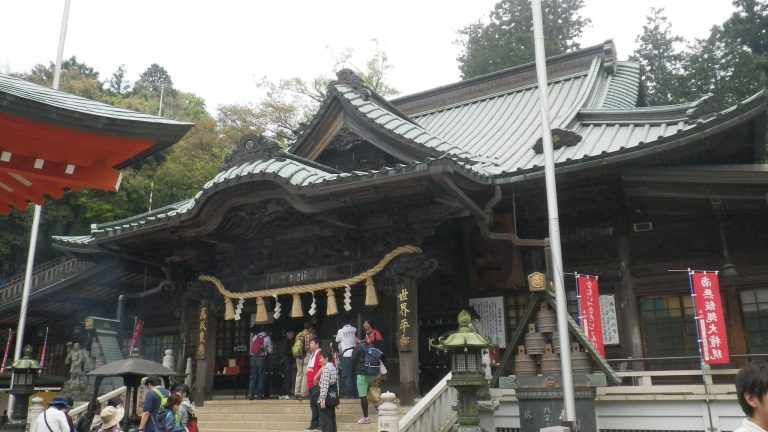
Main Hall
The Main Hall, also called the Yakushi Hall, is the surviving principal hall of the former Hinatayama Ryosenji complex and was inherited by Hojo-bo. It is a thatched building with a hip-shaped roof, measuring seven bays across the front and five bays in depth. A bay is a structural interval between columns, so these measurements describe the hall’s timber framework as well as its overall plan.
The front two bays in depth form an earthen-floored outer worship area, while the rear three bays make up the inner sanctuary. Old timber from the preceding hall was reused in columns, beams, and other structural members. Although the building has undergone several repairs, its present form derives from a major repair that used one hundred standing trees donated from the Tanzawa Mountains by the shogunate in 1660, together with materials from the earlier hall.
Treasure Hall and Buddhist images
The Treasure Hall stands to the left of the Main Hall and houses Buddhist images dating from the Heian through Kamakura periods. The principal Yakushi triad was moved there from the Main Hall. It is a hidden image, meaning that it is opened for public viewing only on specified occasions. The triad was made in the early Heian period using hatchet carving, a technique that deliberately leaves broad chisel marks visible, producing a faceted surface.
A Yakushi triad normally places Yakushi Nyorai between two attendant bodhisattvas. At Hinata Yakushi, these attendants are Nikko and Gakko. The Treasure Hall also contains a seated Yakushi Nyorai, standing Nikko and Gakko Bodhisattvas, a seated Amida Nyorai, standing Four Heavenly Kings, and standing Twelve Divine Generals. These images date from the Kamakura period and are Important Cultural Properties.
The seated Amida image measures 273 centimeters in height, while the seated Yakushi measures 215 centimeters. Both are unusually large Buddhist sculptures for the Kanto region. Together with other works preserved by the temple, they form a collection of 23 Buddhist images and provide material evidence of the complex’s long history as a center of Buddhist worship.