Tennō-ji Temple: A Tendai Buddhist Temple in Tokyo


Site at a Glance
- Rating
- 4.3
- Popularity
- Low
- Country
- Japan
- Primary era
- Modern
- External website
- Open
- Eras represented
- Modern
- Civilizations
- Japanese
- Site type
- Religious
- Remains
- Temple
On this page11 sections
History
Tennō-ji Temple is a Tendai Buddhist temple in Japan, located in Yanaka, Tokyo. Its formal name is Gokoku-zan Soncho-in Tennō-ji, while its earlier name was Choyo-zan Kanno-ji, also known as Yanaka Kanno-ji. The temple’s origins are traditionally linked with the thirteenth-century Buddhist reformer Nichiren and with the religious development of the area that later became part of historic Edo.
From Nichiren hermitage to temple
The foundation story connects Nichiren with stays at the home of a local landholder while he traveled between Kamakura and Awa. The landholder became Nichiren’s follower and established a thatched hermitage. After Nichiren enshrined a mandala representing the Lotus Sutra, Nichigen developed the small religious establishment into a temple.
Tennō-ji originally belonged to the Nichiren school, a Japanese Buddhist tradition centered on devotion to the Lotus Sutra. From an early period it was associated with the Fuju-fuse movement, a strict Nichiren faction that rejected exchanges of offerings with followers of other religions and Buddhist schools. This position brought the temple into conflict with the Tokugawa shogunate. Knowledge of the temple’s earlier history is limited, while its principal surviving account of the early period was written in 1648 by Nichicho, the ninth Nichiren-school abbot.
Shogunal patronage and conversion
Nichicho entered the temple in 1621. In 1641, under the protection of Tokugawa Iemitsu, the third shogun of the Tokugawa shogunate, together with Eishoin and Kasuga no Tsubone, Tennō-ji received 29,690 tsubo of land. A tsubo was a traditional Japanese unit of land area measuring approximately 3.3 square meters. The grant made the temple a place of prayer for the shogunal house.
The shogunate’s persecution of the Fuju-fuse movement transformed Tennō-ji’s religious identity. In 1698, during the tenure of the fifteenth Nichiren-school abbot, the temple was forcibly converted to Tendai Buddhism, a major Japanese school derived from the Chinese Tiantai tradition. The fourteenth and fifteenth abbots were exiled to Hachijojima. Rinnoji-no-miya Kōben, an imperial prince who held an important Buddhist ecclesiastical office, acted to prevent the temple’s abolition. Keiun, a senior Tendai cleric who later helped revive Zenkoji, became its first Tendai abbot. Tennō-ji adopted Bishamonten, a Buddhist guardian deity associated with protection and military power, as its principal object of worship, while the former Nichiren founder images were transferred to Zuirin-ji.
Lotteries and the attempted Nichiren restoration
In 1700, the shogunate authorized a lottery at Tennō-ji to support the temple’s activities. Alongside Meguro Fudo and Yushima Tenjin, it became known as one of the Three Great Lotteries of Edo. Although the shogunate issued a prohibition in 1728, the lottery continued with permission until the Tenpo reforms of the 1840s brought a final ban in 1842.
In 1833, Nikkei, a priest from Chisen-in at Hokekyo-ji, led an effort to restore Tennō-ji to the Nichiren school and revive the name Choyo-zan Kanno-ji. His daughter served as a lady-in-waiting in the shogunal women’s quarters, and several senior officials supported the campaign. Rinnoji-no-miya Shun’nin, another imperial prince holding that ecclesiastical title, intervened against the change. The temple instead received the name Gokoku-zan Tennō-ji.
War, destruction, and later changes
During the Boshin War, the Japanese civil war of 1868–1869 between shogunate supporters and the army of the new imperial government, Tennō-ji’s grounds became a camp for shogunal forces. Fire during the conflict involving the Shogitai destroyed all the temple buildings except the main residence and the five-story pagoda.
Part of the precinct was transferred to Tokyo Prefecture in 1874 and became Yanaka Cemetery. A measured drawing of the pagoda had been prepared in 1870; the structure was repaired in 1884 and donated to the Tokyo City government in 1908. It was destroyed in the 1957 Yanaka Five-Story Pagoda arson-suicide incident. A Bishamonten Hall was completed in 1961, and Tennō-ji received the rank of a special Tendai temple in 1979.
Remains
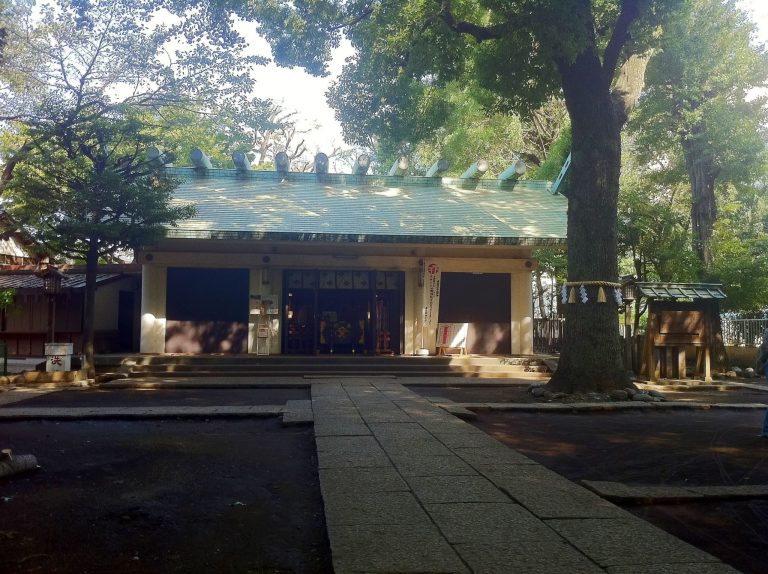
Tennō-ji stands at the edge of the extensive Yanaka Cemetery, in a natural setting. The general entrance is marked by a main gate. The surviving complex includes the main hall, the lecture hall known as Jozen-do, the guest hall Kyaku-den, Bishamonten Hall, and religious objects associated with both its Nichiren and Tendai phases.
Temple buildings
Main hall
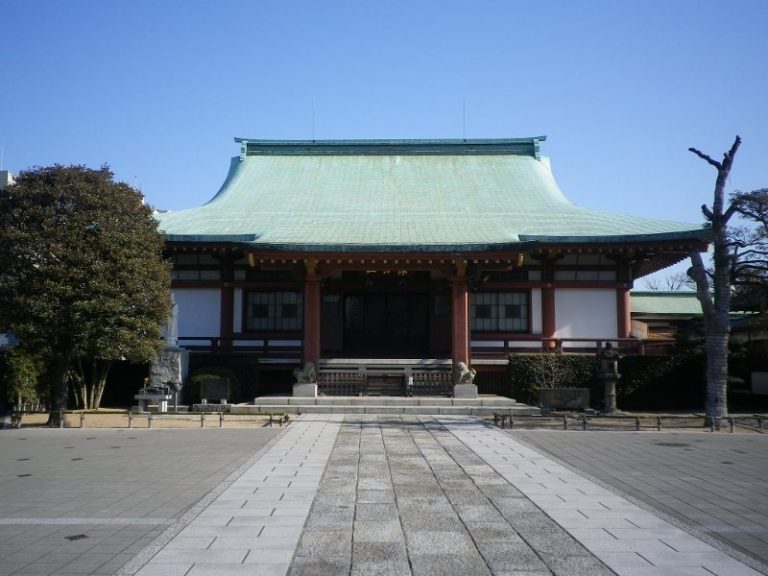
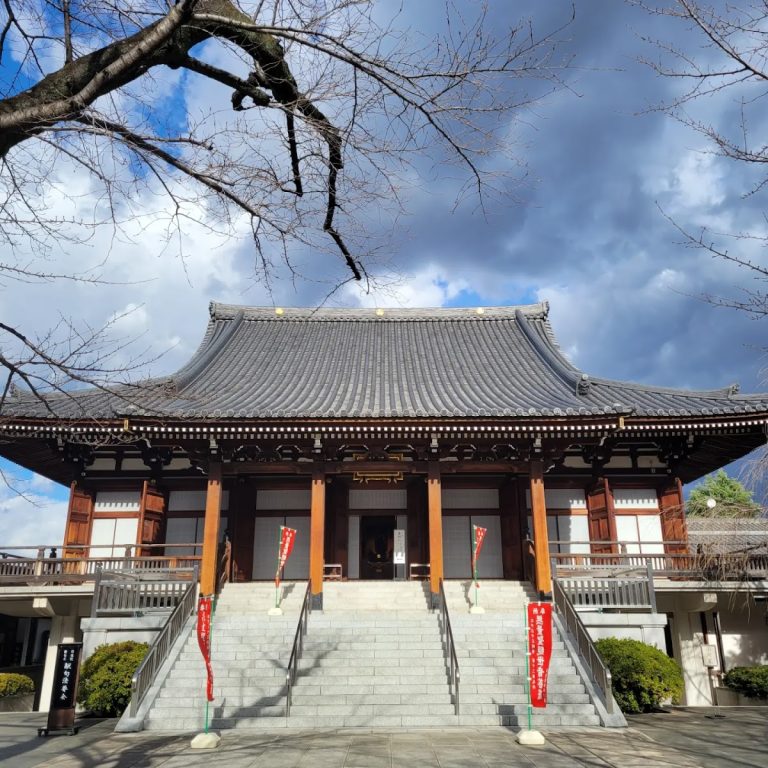
The present main hall is an old-fashioned-style building modeled on Jurin-in Temple in Nara. Tennō-ji venerates images of Amitabha Buddha, the Buddha of the Pure Land tradition, and Bishamonten. Bishamonten also represents the temple in the Yanaka Seven Lucky Gods pilgrimage, a local circuit dedicated to seven auspicious deities.
Jozen-do and Kyaku-den
Behind the main hall stands Jozen-do, a lecture hall completed in 1998. The complex also contains Kyaku-den, a guest hall. Together these buildings form part of the present temple arrangement around the main hall.
Bishamonten Hall
Bishamonten Hall was completed in 1961, following the destruction of the five-story pagoda in 1957. Its presence reflects the continuing centrality of Bishamonten within the Tendai identity adopted by Tennō-ji after the temple’s conversion in 1698.
Pagoda and historic objects
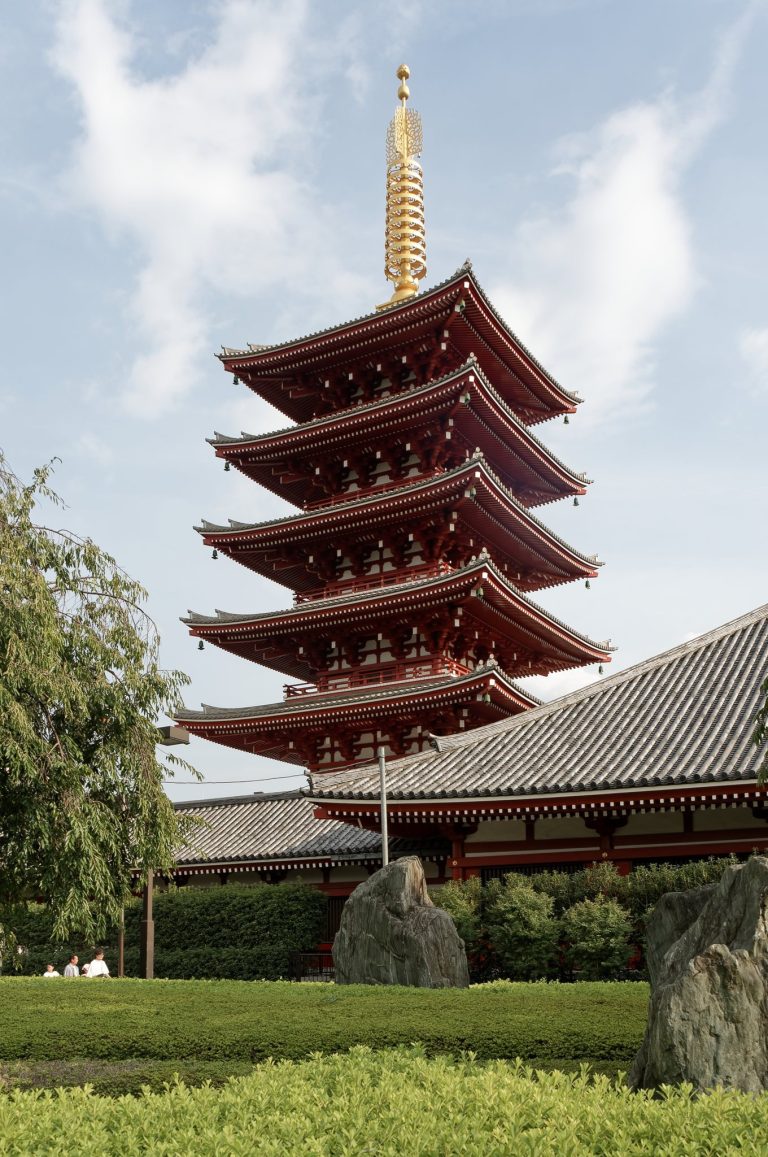
A five-story pagoda was erected at Tennō-ji in 1644. The Meiwa Fire, a major Edo fire in 1772, destroyed it, and a carpenter from Yushima who had originated in Omi rebuilt the structure in 1791. After repairs in 1884 and its transfer to the Tokyo City government in 1908, the pagoda was destroyed by fire in 1957.
A temple bell was cast in 1643, and a statue of Shakyamuni Buddha was cast in 1690. The temple’s principal Buddhist imagery and architectural components preserve the succession of its Nichiren and Tendai phases, including the transfer of the former Nichiren founder images to another temple after the 1698 conversion.