Sensō-ji Temple: Tokyo’s Historic Buddhist Temple and Pilgrimage Centre


Site at a Glance
- Rating
- 4.6
- Popularity
- Very High
- Country
- Japan
- Primary era
- Early Modern
- External website
- Open
- Eras represented
- Early Modern, Modern
- Civilizations
- Tokugawa
- Site type
- Religious
- Remains
- Temple
On this page25 sections
History
Sensō-ji Temple is a Buddhist temple in Tokyo, Japan, traditionally founded in 628 and dedicated to Shō Kannon, a form of the bodhisattva of compassion. Also known as Asakusa Kannon, it is regarded as Tokyo’s oldest-established temple and is the head temple of the independent Shō-Kannon school. The temple was formerly affiliated with the Tendai school, a major Japanese Buddhist tradition, before becoming institutionally independent in 1950.
Traditional foundation
Sensō-ji’s foundation tradition begins with two fishermen, Hinokuma Hamanari and Takenari. In 628, they recovered a small golden image of Kannon from the Sumida River, then known as the Miyato River. Haji no Nakatomo, the headman of their village, became a Buddhist monk, converted his home into a temple, and devoted himself to the image. The tradition identifies this early foundation site with the area now occupied by the Kaminarimon-itchinomiya shopping district.
In 645, the monk Kaishō, also called Katsumi in the foundation tradition, reorganized the temple. After receiving a revelation in a dream, he declared the Kannon image a hibutsu, a sacred Buddhist image permanently concealed from public view. For this reason, Sensō-ji regards Kaishō as its founder or founding figure. The hidden image is traditionally described as a gold statue about 5.5 centimetres high, although its appearance cannot be verified because it is never displayed.
Another tradition links the image with a Kannon statue once enshrined at Iwaidō beside the Nariki River in present-day Hanno. That statue was reportedly swept away by flooding about a century before the foundation of Sensō-ji and may have reached the Sumida through connected waterways. The temple’s public object of worship is instead a maedachi, a substitute image displayed when the principal image is hidden.
Early Buddhist development
Ennin, a monk associated with Enryaku-ji and the Tendai tradition, is traditionally said to have visited Sensō-ji during the early Heian period, in either 828 or 857. He is credited with making the public substitute image for worship in place of the concealed original. Sensō-ji therefore also regards Ennin as its restorer or reviving founder.
In 942, Taira no Kinmasa, who had been appointed governor of Musashi, is traditionally said to have renovated the temple’s principal complex and established or rebuilt major gates, including Kaminarimon and Niōmon, now called Hōzōmon. The earliest documented references to Sensō-ji appear in the Kamakura-period Azuma Kagami. In 1181, carpenters from Asakusa were summoned to work on Tsurugaoka Hachiman-gu in Kamakura. In 1192, monks from Sensō-ji took part in a memorial service for Emperor Go-Shirakawa, and Lady Nijō described visiting the temple in 1290.
Tokugawa patronage and the Edo period
Tokugawa Ieyasu designated Sensō-ji an official prayer temple of the shogunate in 1590 and granted it land producing 500 koku, an Edo-period measure of rice yield used to calculate land revenue. This patronage helped the temple attract extensive support and develop into an important pilgrimage centre during the Edo period.
Fires repeatedly damaged the complex, including major conflagrations in 1631 and 1642. With assistance from the third shogun, Tokugawa Iemitsu, the five-story pagoda was rebuilt in 1648 and the main hall in 1649. The temple also became closely connected with the commercial and entertainment life of Asakusa. Around 1685, Sensō-ji authorized local residents to establish stalls beside subsidiary temples in return for cleaning duties within the precincts. These stalls developed into Nakamise.
By the middle of the Edo period, the western area called Okuyama had become a venue for street performances and popular entertainment. The relocation of Edo’s three theatres to Asakusa between 1843 and 1844 strengthened this function and reinforced the district’s connection with popular urban culture.
Religious and civic separation
The Meiji government’s separation of Buddhism and Shinto in 1868 made the institution now called Asakusa Shrine independent from Sensō-ji. It was initially renamed Sansha Myōjin Shrine, received village-shrine status in 1872, and adopted the name Asakusa Shrine in 1873. The shrine stands within the wider historic precinct and preserves the connection with the three figures traditionally associated with the foundation of Sensō-ji.
In 1873, the temple grounds were incorporated into Asakusa Park after temple and shrine lands were taken into public ownership. The park expanded during the following decades, but its designation was removed in 1947. The land returned to Sensō-ji ownership in 1951. Part of the former park, including the Hyōtan Pond area, was later sold to help finance reconstruction of the main hall after wartime destruction.
Earthquake, war, and reconstruction
Much of Asakusa burned during the Great Kantō earthquake of 1923. Local fire brigade leaders organized evacuees within Sensō-ji and used a bucket brigade, limiting the temple’s losses largely to several buildings. The main hall and five-story pagoda were nevertheless destroyed during the Tokyo air raid of 10 March 1945.
The main hall was rebuilt in reinforced concrete in 1958, followed by Kaminarimon in 1960, Hōzōmon in 1964, and the five-story pagoda in 1973. Asakusa temporarily declined after the war as entertainment diversified and other Tokyo districts expanded, but local commercial efforts helped restore its importance as a historic popular district.
Archaeological investigations have established the temple site as a multi-period deposit containing evidence from antiquity through the medieval and Edo periods. Excavation before reconstruction of the pagoda in 1970 produced important results and helped establish systematic archaeology at medieval and early-modern urban sites in Japan. Later excavations by Taito Ward authorities repeatedly revised interpretations of the site in relation to documentary history.
Continuing religious life
Sensō-ji conducts daily ancestor memorial services and regular prayers for protection from misfortune. Monthly observances take place on the fourth day of each month, with major services on 24 January, 24 May, and 24 September. The annual cycle also includes Hari-kuyō, a memorial service for worn and broken needles held on 8 February, and Kinryū no Mai on 18 March and 18 October.
Other continuing observances include the Sanja Matsuri of Asakusa Shrine in May, Shimanrokusennichi and the Hōzuki Market on 9 and 10 July, a lantern memorial service for the dead on 15 August, and the Hagoita Market during the year-end fair from 17 to 19 December. The public substitute for the hidden Kannon image is shown during the annual opening ceremony on 13 December, while the principal image remains concealed.
Sensō-ji’s religious role also extends to medical and social welfare. Sensō-ji Hospital developed from a relief clinic established in the Nembutsudō in 1910 for victims of flooding. It was reorganized as the present hospital in 1952, inspired by Kannon’s vow to relieve suffering.
Remains
Approach and entrance gates
The precinct is arranged along an approach of approximately 250 metres, running from Kaminarimon through Nakamise-dōri to Hōzōmon and the main hall. The defined temple area contains the principal hall, five-story pagoda, subsidiary halls, gates, gardens, monuments, and the adjacent Asakusa Shrine. The sequence of entrance structures and commercial frontage gives the site a clear axial organization.
Kaminarimon
Kaminarimon is the outer entrance gate. It is a gabled, eight-legged structure formally called Fūraijinmon, a name referring to the statues of Fūjin and Raijin housed in its front bays. Fūjin is the wind deity and Raijin the thunder deity. On the reverse are statues of the golden dragon Kinryū and the heavenly dragon Tenryū.
The first Kaminarimon is traditionally attributed to Taira no Kinmasa in 942. The gate was moved to its present position in 1635, rebuilt after successive fires, and destroyed in 1865. The current reinforced-concrete gate was completed in 1960 after a donation by Kōnosuke Matsushita, founder of Matsushita Electric Industrial Company. Prayers to Kannon had been associated with his recovery from illness.
The heads of the Fūjin and Raijin statues survived the 1865 fire, while their bodies were remade in 1874. The figures were repaired and repainted when the gate was rebuilt in 1960, and Kinryū and Tenryū were installed in 1978. A large central lantern hangs beneath the gate. It bears “Kaminarimon” on its front and the formal name Fūraijinmon on its reverse. The lantern is folded during the Sanja Matsuri and when severe weather threatens.
Nakamise-dōri
Nakamise-dōri forms the principal approach between Kaminarimon and Hōzōmon. Rows of shops line the approximately 250-metre street, with 35 shops on the western side and 54 on the eastern side. Their merchandise includes sweets, souvenirs, traditional goods, and other items.
The commercial street developed from temporary stalls permitted around 1685 beside Sensō-ji’s subsidiary temples. In exchange, local residents undertook cleaning duties within the precincts. The approach was paved in 1817, rebuilt with red-brick Western-style buildings in 1885, and reconstructed in reinforced concrete after the 1923 earthquake. The 1945 air raid destroyed the shops apart from much of their frontage, after which the street was repaired.
Hōzōmon
Hōzōmon is the inner entrance gate between Nakamise-dōri and the main hall. Formerly called Niōmon, it is a two-story gate with an irimoya roof, a traditional form combining a gable with hipped roof slopes. Three central passages occupy its lower level, while the outer bays contain paired Niō, Buddhist guardian figures traditionally placed at temple entrances.
The present gate was rebuilt in reinforced concrete in 1964 through a donation from Yonetarō Ōtani and his wife. Its upper story serves as a repository for temple treasures, including the National Treasure decorated Lotus Sutra in ten volumes and the complete Issaikyō collection of Buddhist scriptures, which is designated an Important Cultural Property.
The two Niō statues on the front are approximately 5.45 metres high. Large lanterns hang from the gate, and two enormous straw sandals are fixed to its rear face. These sandals are traditionally understood as protective devices against evil. They require approximately 2,500 kilograms of straw, and tall rice varieties are specially cultivated in Murayama for their manufacture. Replacements are offered about every ten years.
Main hall and pagoda
Main hall
The main hall, also called Kannondō or Kannon Hall, is dedicated to Kannon. The 1649 building was a large representative example of early-modern temple architecture and held National Treasure status before it was destroyed in the air raid of 10 March 1945. The present hall was rebuilt in reinforced concrete in 1958 with donations from throughout Japan.
Between 2009 and 2010, the roof was renewed with lightweight titanium tiles in three colours. Their treatment reproduces the mottled appearance of traditional clay tiles. In the outer sanctuary, ceiling paintings by Kawabata Ryūshi and Dōmoto Inshō accompany the central sacred arrangement.
At the centre of the inner sanctuary stands an eight-roofed miniature shrine. Its upper chamber contains the hidden principal Kannon image, while its lower chamber houses the maedachi image traditionally attributed to Ennin. The lower chamber also contains Kannon images donated by Tokugawa Ieyasu, Tokugawa Iemitsu, and Prince Kōjun, a son of Emperor Nakamikado and a chief abbot of the Tendai school.
A richly embroidered curtain called the Mitobuchō hangs before the miniature shrine. Images of Brahma and Indra stand on either side, while Fudō Myōō and Aizen Myōō occupy shrines at the rear. Another Kannon image, known as the “Rear Kannon,” is placed behind the miniature shrine. The hall’s large Shinbashi lantern is approximately 4.5 metres high, 3.5 metres wide, and 600 kilograms in weight. The Tokyo Shinbashi association has offered it since the hall’s 1958 reconstruction, and it is folded when severe weather threatens.
In 2020, a replacement “Bestowing Fearlessness” tablet was installed. Carved from a single zelkova board, it measures about 4 metres wide, 1.3 metres high, and 15 centimetres thick, and weighs approximately 700 kilograms. The recessed lettering is more than 5 centimetres deep. Tendai monk and calligrapher Hōdō Shunkai wrote the inscription, and Nanbu Hakuun carved it in the Inami tradition. The tablet reproduces one made in 1727 that was destroyed in the 1945 air raid.
Five-story pagoda
The pagoda’s early history is traditionally connected with the rebuilding attributed to Taira no Kinmasa in 942, when a three-story pagoda is said to have been erected. A five-story pagoda was built in 1648 after earlier fires. That structure stood east of the main hall and was destroyed in the 1945 air raid. Its stone foundations remain visible east of the hall, where a marker identifies the former location.
The present five-story pagoda was rebuilt in reinforced concrete in 1973, west of the main hall and near the traditionally identified site of the earlier three-story pagoda. Its base is approximately 5 metres high, while the tower rises about 48 metres. An aluminum-alloy roof was later replaced with three-colour titanium tiles in 2017. The base contains a memorial hall for ancestral tablets, and the uppermost level houses a Buddhist relic brought from Isurumuniya Temple in Anuradhapura, Sri Lanka, in 1966.
Eastern and western precinct structures
Nitenmon
Nitenmon stands east of the main hall and faces east. This gabled, eight-legged gate was built in 1618 as the entrance to a Tōshō-gū shrine dedicated to Tokugawa Ieyasu. The shrine burned in 1642 and was never rebuilt, while Nitenmon survived the Second World War. It was restored in 2010 and returned to its original architectural style during that work.
The gate’s statues were changed after the separation of Shinto and Buddhism. The present figures, Jikokuten and Zōchōten, are two of the Four Heavenly Kings and were transferred in 1957 from the mausoleum of Tokugawa Ietsuna at Ueno. Nitenmon is designated an Important Cultural Property.
Denbōin
Denbōin lies west of Hōzōmon and serves as Sensō-ji’s honbō, the principal administrative and residential complex of a temple. Its buildings include a main gate, reception and formal rooms, a kitchen, a reading room, and the chief priest’s residence. The reception hall contains an Amida Buddha group and memorial tablets for Tokugawa shoguns and former Sensō-ji priests.
The grounds include a large strolling garden traditionally attributed to Kobori Enshū and laid out during the Kan’ei period. A path encircles a two-part pond, with stone lanterns and stone towers distributed through the landscape. The garden was designated a national Place of Scenic Beauty in 2011. The grounds also contain Ten’yūan, a late-Edo-period tea house copied from the Omotesenke Fushin’an and originally located in Nagoya, as well as Chingodō, a shrine dedicated to tanuki. Chingodō’s original building dates from 1883 and the present structure from 1913.
A tuff-stone sarcophagus from the Kofun period was discovered within the Sensō-ji area in 1869 and is displayed in the Denbōin garden. The find forms part of the archaeological evidence preserved within the wider temple grounds.
Yōgōdō and Rokkaku-dō
Yōgōdō, northwest of the main hall, was rebuilt in reinforced concrete in 1994 to mark 1,200 years since Ennin’s birth. Its inner sanctuary contains Kannon surrounded by eight guardian Buddhas, while its outer sanctuary is dedicated to Daikokuten, a deity of prosperity and one of Japan’s Seven Lucky Deities.
Beside Yōgōdō stands Rokkaku-dō, a hexagonal wooden shrine dating from the sixteenth century and dedicated to Higiri Jizō. Nearby are a stone bridge dated 1618, a bronze statue of Amida Nyorai dated 1693, and a hōkyōintō, a small Buddhist memorial pagoda, dated 1761.
Awashimadō
Awashimadō was established during the Genroku period as a shrine to Awashima Myōjin, a protector of women. After the Second World War, it temporarily served as Sensō-ji’s main hall. The building was restored and moved to its present location in 1994. Its interior contains images of Amida Buddha, Awashima Myōjin, Kokūzō Bosatsu, and Toriko Jizō.
A rainwater barrel near Awashimadō is associated with a tradition that the hidden Kannon image was buried there during the war. The hall also has a stone lantern linked with the belief that children who crawl beneath it will be protected from insect bites and smallpox.
Bentendō and its bell tower
Bentendō stands on Bentenyama, a low hill southeast of the main hall. The hill was formerly in a pond that was later filled and converted into a park. The present Bentendō is a reinforced-concrete building dating from 1983. It is named for Benzaiten, a deity associated with music, eloquence, and good fortune.
Bentendō preserves an image popularly called the Old Benten because of its white hair. Beside it is a bell tower containing the Tokinokane bell, cast in 1692 on the order of Tokugawa Tsunayoshi. The bell was preserved during wartime metal collection and continues to be rung each morning and at the New Year.
Yakushidō and Zenizuka Jizōdō
Yakushidō is a square hall south of Yōgōdō, dedicated to the seated Yakushi Nyorai. Tokugawa Iemitsu built it in 1649 northwest of the main hall, and it was moved to its present location in 1994.
Zenizuka Jizōdō stands in the northwestern part of the precinct. Rebuilt in 2019 after the original was destroyed in the Great Kantō earthquake, it contains six Jizō images associated with prayers for commercial success. Jizō is a Buddhist bodhisattva particularly associated with protection, children, travelers, and the dead.
Asakusa Shrine and commemorative heritage
Asakusa Shrine
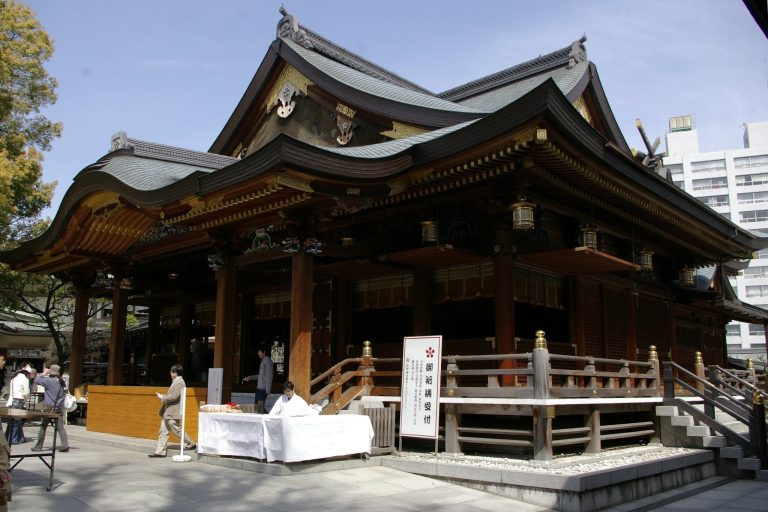
Asakusa Shrine stands east of the main hall. Its worship hall, offering hall, and main sanctuary are designated Important Cultural Properties. The shrine enshrines the three figures traditionally connected with the foundation of Sensō-ji, preserving the institutional and religious relationship between the two neighbouring establishments after their formal separation in the Meiji period.
Monuments and votive art
The precinct contains numerous commemorative monuments. They include busts of Yonetarō Ōtani and his wife, a rebuilt statue of the kabuki actor Ichikawa Danjūrō IX in the role of Shibaraku, a 1746 memorial to the jōruri performer Miyakoji Bungo no Jō, a 1796 Bashō haiku monument, a 1957 reconstruction of an 1860 lost-and-found marker, and a 1962 monument recording the lyrics and music of the children’s song “Hato Poppo.”
Other monuments commemorate silent-film narrators, deceased comedians, firefighters who died in service, and the social-welfare worker Uryū Iwako. The Benshi memorial mound dates from 1958, the monument to deceased comedians from 1982, and the reconstruction of Uryū Iwako’s 1901 statue from 1955. The grounds also contain a 2005 monument connected with the manga series Kochira Katsushika-ku Kameari Kōen-mae Hashutsujo, a 1912 monument to firefighters who died in service, and the Asakusa Great Peace Tower, first erected in 1963 and rebuilt in 2019.
Edo-period votive paintings form another part of Sensō-ji’s artistic heritage. Works are attributed to Tani Bunchō, Kikuchi Yosai, Suzuki Kiitsu, Utagawa Kuniyoshi, Kanō Kazunobu, and Shibata Zeshin. Archaeological excavations have taken place at the pagoda site and in the Sensō-ji, Sensō-ji West, Kaminarimon, Matsukiyamachō, and Sensō-ji Hospital archaeological areas.