Saginomiya Hachiman Shrine: A Historic Hachiman Shrine in Tokyo


Site at a Glance
- Rating
- 4.2
- Popularity
- Low
- Country
- Japan
- Primary era
- Early Modern
- External website
- Open
- Eras represented
- Early Modern
- Civilizations
- Japanese, Tokugawa
- Site type
- Religious
- Remains
- Sanctuary
On this page11 sections
History
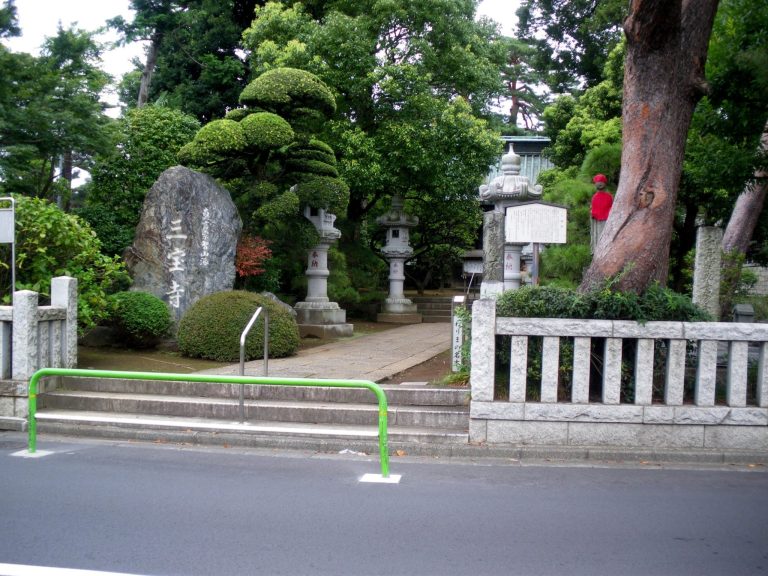
Saginomiya Hachiman Shrine is a Shinto shrine in Japan, located in Nakano City, Tokyo. Traditionally founded in 1064 by the Minamoto military leader Minamoto no Yoriyoshi, it is a Hachiman shrine whose principal deity is Emperor Ojin, an imperial figure associated with the Hachiman religious tradition of protection and warfare. The shrine was established after Yoriyoshi’s victory in the Former Nine Years’ War, a campaign in northeastern Japan, as an expression of gratitude and a prayer for peace in the state and for the Minamoto clan.
Foundation and local identity
The shrine was formerly called Saginomiya Daimyojin. It served as the tutelary shrine of the former Kamisaginomiya and Shimosaginomiya villages, and its earlier name is associated with the origin of the place-name Saginomiya. A record compiled in 1884 relates that large old trees once filled the precincts and sheltered many egrets. Local residents consequently used the names Sagi no Mori, meaning “egret grove,” and Saginomiya Daimyojin.
Saginomiya Hachiman Shrine and Takamatsu Hachiman Shrine in Takamatsu, Nerima, were established as a north-south pair on opposite sides of the Kamakura Kaido, the historical road network linking Kamakura with settlements and strategic routes in eastern Japan. Because Saginomiya was founded first, Takamatsu Hachiman Shrine was known as Wakamiya Hachiman Shrine.
Edo-period patronage and religious change
In 1645, Imagawa Naofusa, the local lord, changed the shrine’s name to Hachiman Shrine. From 1649, the Edo shogunate granted it slightly more than seven koku, a historical measure of rice and agricultural yield, through a vermilion-seal endowment. Saginomiya was the only shrine in present-day Nakano Ward to receive such a grant.
Before the modern period, the shrine’s honji-butsu was an Eleven-Headed Kannon. This was a Buddhist-Shinto concept in which a Buddhist figure was understood as the underlying form of a local kami. Fukuzo-in served as the shrine’s adjacent betto temple, an institution responsible for Buddhist administration and ritual duties at a shrine in the premodern system of combined worship. By the nineteenth century, the shrine had lost this tradition, while the Eleven-Headed Kannon at Fukuzo-in came to be regarded as the former principal image.
Modern reorganization and continuing traditions
After the Second World War, Saginomiya Hachiman Shrine was reorganized as a religious corporation under the Religious Corporation Law. In 1950, it received the former state-owned precinct land. The shrine buildings were rebuilt in the 35th year of the Showa era, the period of Emperor Hirohito’s reign from 1926 to 1989, and further rebuilding or renovation followed in the 56th and 63rd years of that era. An Inari Shrine and a Mitake Shrine believed to have stood nearby were moved into the precincts during the 42nd and 43rd years of the Showa era.
The annual festival takes place on weekends in the latter half of August. Its ceremonies include kagura, ritual music and dance for the kami, performed in the kagura hall, as well as processions carrying each neighbourhood’s mikoshi, or portable shrine, through the surrounding streets. The accompanying musical tradition, Saginomiya Hayashi, was registered by Nakano Ward as an intangible folk cultural property in April 1982.
Remains
Precinct and shrine buildings
Main shrine complex
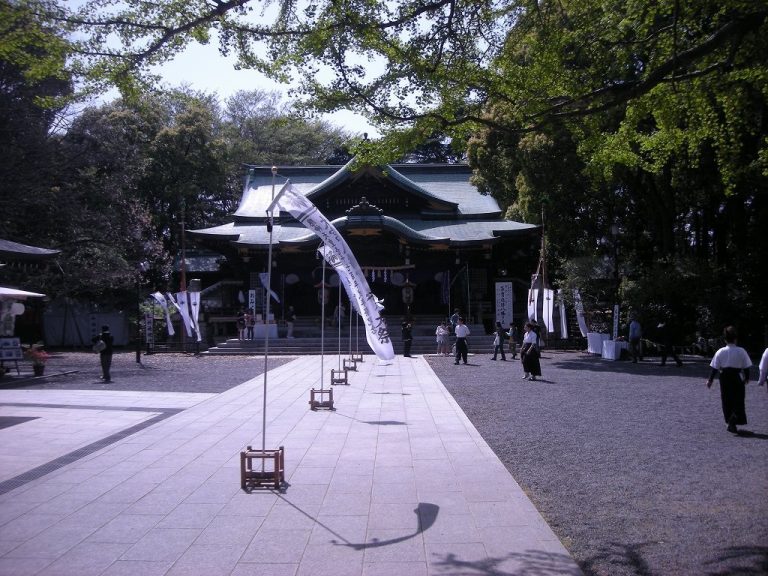
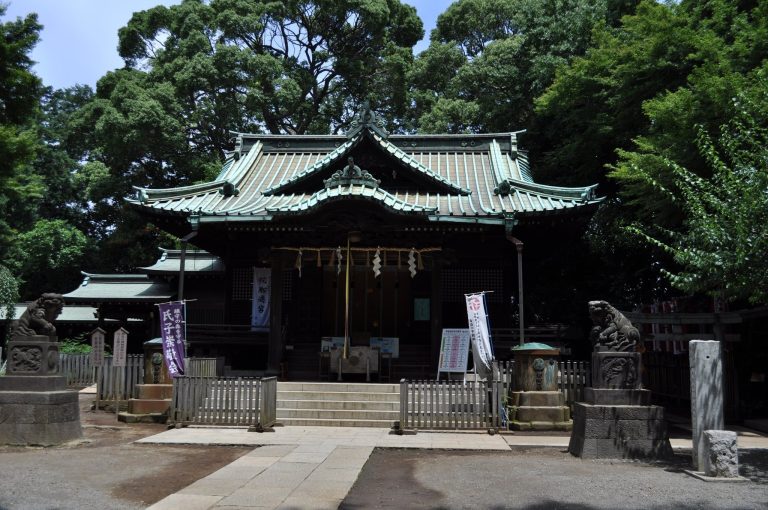
The shrine stands in the Shirasagi district of Nakano within precincts measuring 1,049 tsubo, approximately 3,462 square metres. The principal buildings include the shrine building, offering hall, and worship hall. They were rebuilt in the 35th year of the Showa era and underwent additional work in the 56th and 63rd years, leaving the present complex shaped by successive twentieth-century rebuilding and renovation.
Stone torii
A stone torii, the gateway marking the approach to a Shinto shrine, was erected in 1780. The Great East Japan Earthquake of 2011 damaged it, after which the gateway was rebuilt in an iron alloy. Its present material therefore reflects a modern reconstruction of an Edo-period shrine feature.
Six Shrines
The precincts contain a combined group known as the Six Shrines. It brings together an Inari Shrine dedicated to Ukanomitama, a kami associated with food, grain, and rice; a Mitake Shrine dedicated to Kushimachi no Mikoto; a Suga Shrine dedicated to Susanoo; a Kitano Tenman Shrine dedicated to Sugawara no Michizane; an Awashima Shrine dedicated to Sukunahikona; and a Hoso Shrine dedicated to Okuninushi.
Relocated Inari and Mitake shrines
Separate Inari and Mitake shrines also stand within the precincts. They are believed to have been relocated from nearby during the 42nd and 43rd years of the Showa era, adding distinct local shrines to the wider group of buildings and sacred spaces.
Fukuzo-in Kannon
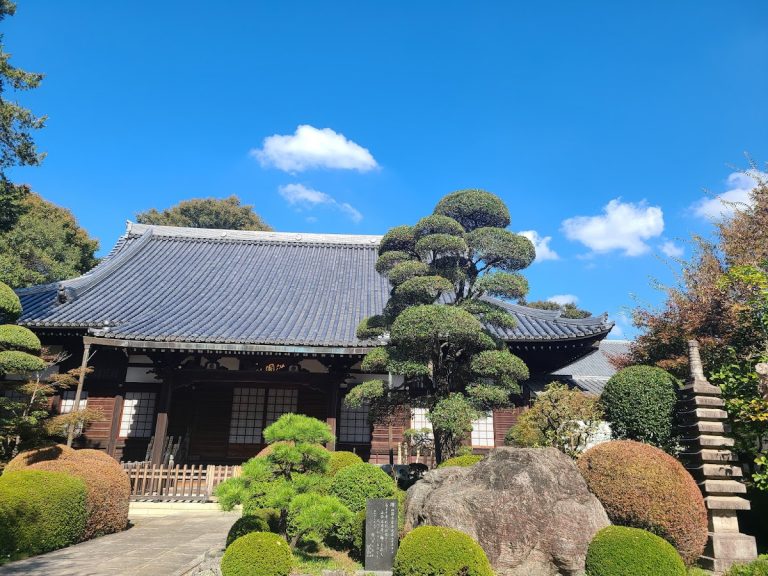
At the adjacent Fukuzo-in stands a statue of an Eleven-Headed Kannon. The Buddhist image is thought to be the former honji-butsu of Saginomiya Hachiman Shrine and preserves the religious connection between the shrine and its former administrative temple. Nakano Ward designated the statue a tangible cultural property in September 1995.