Nagayama Kofun: A Keyhole-Shaped Burial Mound in Japan

Site at a Glance
- Rating
- 3.6
- Popularity
- Very Low
- Country
- Japan
- Primary era
- Classical
- External website
- Open
- Eras represented
- Classical
- Civilizations
- Yamato
- Site type
- Burial
- Remains
- Burial Mound
On this page8 sections
History
Nagayama Kofun is a keyhole-shaped burial mound in Sakai, Osaka Prefecture, Japan, constructed in the early fifth century during the Kofun period. A kofun is a monumental Japanese burial mound, and a keyhole-shaped mound combines a circular rear section with a projecting square front. Nagayama Kofun forms part of the Mozu Kofun Group and probably predates the nearby keyhole-shaped mound identified as the mausoleum of Emperor Nintoku, about 50 metres to the northwest.
Burial mound and historical interpretation
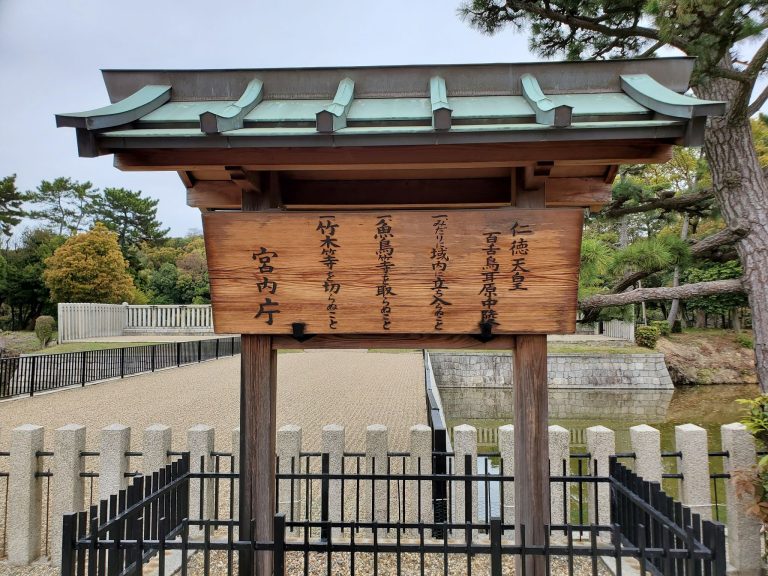
The Imperial Household Agency manages Nagayama Kofun as an auxiliary mound associated with Emperor Nintoku’s mausoleum. An auxiliary mound is a secondary burial mound linked to a larger imperial or elite tomb, but that classification does not by itself establish that Nagayama Kofun was merely subordinate. Its substantial size and distinctive shape instead indicate that it was probably an independent burial mound. Because the mound has not been fully investigated, its internal structure, grave goods, and precise character remain unknown.
During the Edo period, the mound was known by names meaning “Long Mountain Mound” and “Long Mountain.” Local traditions identified it as the tomb of either Wani, a figure associated with the transmission of Chinese writing and learning to ancient Japan, or Yamato Takeru, a legendary prince and warrior of early Japanese tradition.
Investigation and protection
A preliminary investigation in 2012, carried out before management fencing was installed, confirmed the extent of the eastern moat. It also showed that the moat’s shoulder had been altered from the early-modern period onward, while indicating that archaeological remains may be well preserved beneath the lower deposits of the eastern moat.
The moat was designated the Sakai City Historic Site “Nagayama Kofun Moat” on April 11, 2016. On July 6, 2019, Nagayama Kofun became part of the Mozu Kofun Group component of the UNESCO World Heritage property Mozu-Furuichi Kofungun: Ancient Mounded Tombs of Japan.
Remains
Nagayama Kofun has a south-facing square front section joined to a circular rear section, creating its characteristic keyhole plan. A surrounding moat encloses the mound, while the edges of both the mound and moat remain comparatively well preserved. The site includes stone surfacing, meaning stones laid over the slopes, and haniwa, clay cylinders or figures arranged on or around burial mounds.
Mound structure
Keyhole-shaped mound
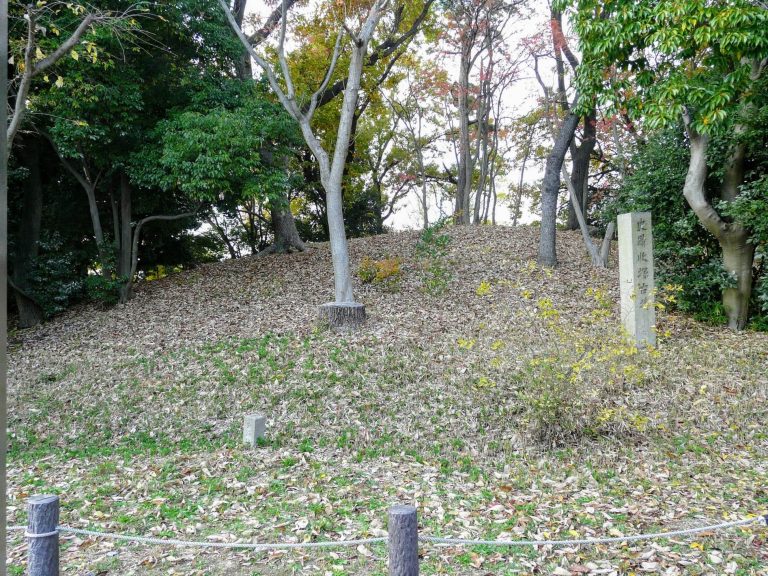
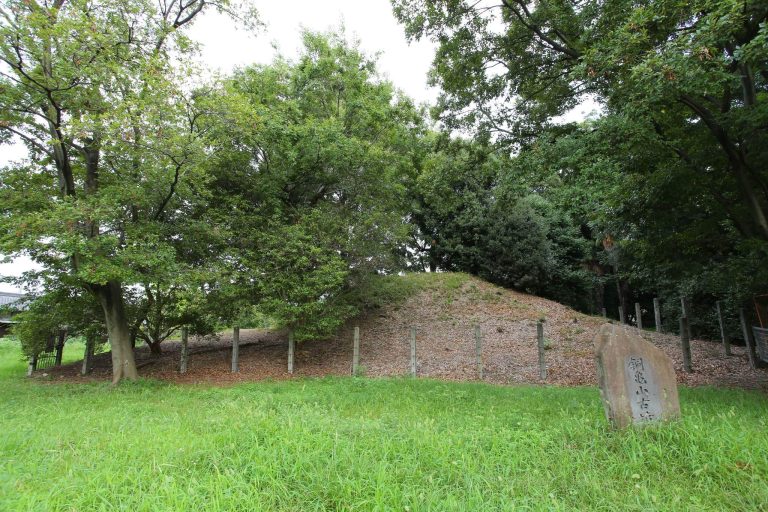
The mound is approximately 100 metres long. Its rear circular section is about 63 metres in diameter and rises 10.3 metres high. The south-facing front section is approximately 68.5 metres wide and also reaches 10.3 metres. A projecting structure stands at the constricted section on the western side. The mound appears to have two visible tiers, although its unusually high profile leaves open the possibility that it originally had three.
Stone surfacing and haniwa
Stone surfacing covers the mound, and haniwa figures or cylinders were placed on it. A cylindrical haniwa was reportedly found in 1928 on the embankment at the western end of the front section. It may have formed part of a line of haniwa arranged along the mound.
Moat and eastern crossing
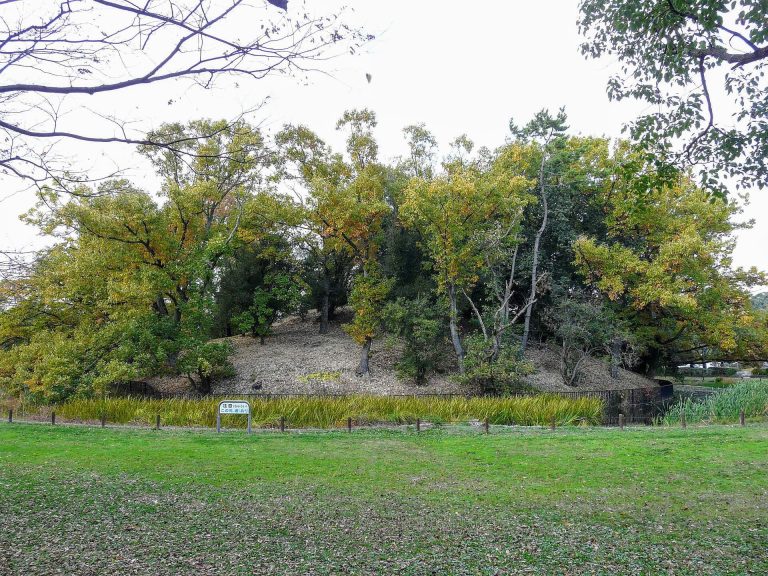
The moat surrounds the keyhole-shaped mound. On the eastern side of the constricted section, an earthen crossing embankment spans the moat, although its inclusion in the original construction remains uncertain. Investigation of this eastern area revealed later alteration to the moat’s shoulder and suggested that earlier archaeological remains survive beneath its lower deposits. The southern side of the moat is bordered by Osaka Prefectural Route 2, the Osaka Central Loop Route, which crosses part of the moat.