Banna-ji Temple: Ashikaga Clan Temple and Medieval Residence in Japan


Site at a Glance
- Rating
- 4.3
- Popularity
- Medium
- Country
- Japan
- Primary era
- Medieval
- External website
- Open
- Eras represented
- Medieval, Early Modern
- Civilizations
- Ashikaga shogunate, Kamakura shogunate
- Site type
- Religious
- Remains
- Temple
On this page13 sections
History
Banna-ji Temple is a Shingon Buddhist temple in Ashikaga, Japan, developed from the fortified residence of the Ashikaga family in the late twelfth century. Its principal image is Dainichi Nyōrai, the central Buddha of esoteric Japanese Buddhism, and its formal name is Kongōzan Niō-in Hokkebō Banna-ji. The temple became the Ashikaga clan’s religious institution and remains a functioning Buddhist temple.
From Estate to Ashikaga Residence
In the mid-twelfth century, Minamoto no Yoshiyasu received a shōen, a privately controlled medieval estate with income and administrative privileges, in this part of Shimotsuke Province. He established a fortified residence there. His third son adopted the name Ashikaga from the estate and became Ashikaga Yoshikane.
Yoshikane served Minamoto no Yoritomo during the Genpei War, the late-twelfth-century conflict between the Taira and Minamoto clans that ended with Minamoto-led military rule. Yoshikane later became Yoritomo’s brother-in-law and received the governorship of Shimotsuke Province in 1185. After retiring in 1195, he entered Buddhist monastic life under the name Gishō. In 1196, he installed a statue of Dainichi Nyōrai in his residence, transforming the compound into Banna-ji. Devotion to Dainichi Nyōrai was especially important in Shingon, a Japanese school of esoteric Buddhism centered on ritual, sacred images, mandalas, and esoteric teachings.
Expansion and Medieval Development
In 1234, Ashikaga Yoshiuji greatly expanded the temple and developed it as the Ashikaga clan’s religious institution. The original main hall was built during this phase. After a lightning strike caused the building to burn, Ashikaga Sadauji rebuilt it in 1299.
During the Kamakura period, the era of Japan’s first durable warrior government, and the Nanboku-chō period, the fourteenth-century struggle between rival Northern and Southern imperial courts, Banna-ji was a subsidiary institution of Tsurugaoka Hachiman-gu in Kamakura. The main hall was extensively remodeled between 1407 and 1432. By the Sengoku period, a time of prolonged warfare among regional powers, the Ashikaga clan’s influence had greatly declined and the temple fell into near ruin.
Religious Continuity and Heritage Protection
Banna-ji became independent from the Buzan branch of Shingon Buddhism in 1951 and continues as the head temple of the Dainichi branch. Its traditional Setsubun procession, known as Yoroidoshi, is said to derive from Ashikaga Yasuuji’s gathering of 500 mounted warriors during the Kamakura period. Local textile-industry volunteers revived the event as a warrior procession in 1915.
The approximately 40,000-square-metre precinct was designated a National Historic Site in March 1922 as the “Ashikaga Clan Residence Site.” The temple was selected in 2006 as one of Japan’s Top 100 Castles under the name “Ashikaga Residence.” Its main hall was designated a specially protected historic temple building under the 1908 Ancient Shrines and Temples Preservation Law, became an Important Cultural Property under the 1950 Law for the Protection of Cultural Properties, and was elevated to National Treasure status in 2013.
Remains
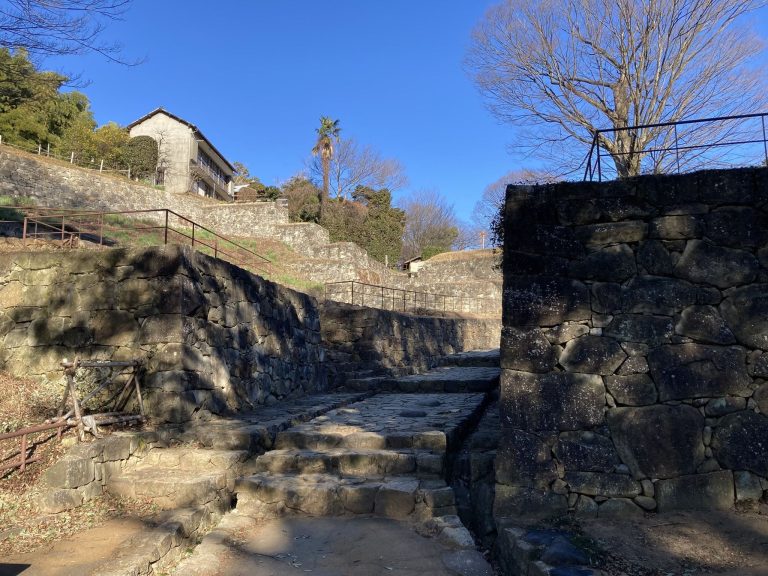
Banna-ji preserves the layout of the Ashikaga clan’s former fortified residence. Earthen ramparts and moats enclose the precinct, while gates were established on all four sides. Four fortified gates dating from the 1500s survive together with the defensive earthworks and moat, giving the temple’s grounds the physical character of a medieval samurai residence.
Principal Temple Buildings
Main Hall
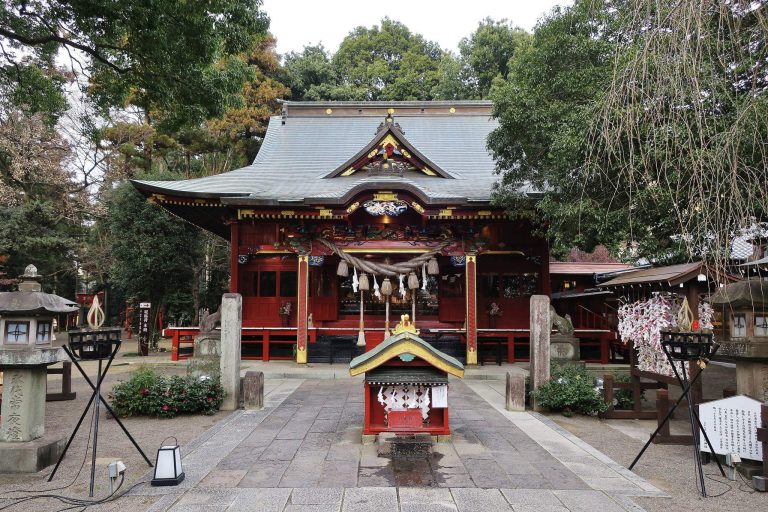
The main hall is a five-by-five-bay building, meaning that its structure is divided into five intervals in each direction between the main posts. It has an irimoya roof, which combines a central gable with hipped lower slopes, and the roof is covered with tiles. Rebuilt in 1299 and remodeled between 1407 and 1432, the hall has a plan suited to esoteric Buddhist worship. The front two bays form the outer sanctuary, while the rear three bays are divided between the inner sanctuary and side sanctuaries.
The building is primarily based on Japanese Zen-style forms, with tightly packed bracket complexes, waisted columns, lattice-panelled doors, and vertically boarded walls. It also incorporates traditional Japanese-style elements, including a coffered ceiling and a plank floor. The hall is regarded as an important early Zen-style Buddhist hall at an esoteric Buddhist temple and as an early surviving example of Zen-style architecture in the Kantō region.
Bell Tower and Sutra Repository
The bell tower and sutra repository are among the recorded structures within the temple precinct. Together with the main hall, they represent the buildings associated with the temple’s religious functions and surviving architectural composition.
Mausoleum and Tahōtō Pagoda
A mausoleum and a Tahōtō, a two-story Japanese Buddhist pagoda form, are also recorded within the grounds. These structures form part of the temple’s range of commemorative and religious buildings.
Gates and Bridges
Surviving Fortified Gates
The east gate, west gate, and Guardian Kings’ Gate are among the named structures associated with the enclosed precinct. The four surviving gates from the 1500s, together with the moat and earthen ramparts, preserve the defensive organization of the former residence.
Drum Bridge
The drum bridge is another recorded feature of the temple grounds. It belongs to the group of structures that connect the precinct’s religious buildings with its enclosed residential and defensive layout.
Images and Temple Treasures
Banna-ji’s principal image is a statue of Dainichi Nyōrai. A wooden statue of Dainichi Nyōrai dates from the Muromachi period, the era of the Ashikaga-led warrior government that ruled much of Japan from the fourteenth to the sixteenth century. The temple’s cultural-property inventory also includes wooden seated statues of successive Ashikaga shoguns and a wooden seated statue of Fudō Myōō, a wrathful Buddhist deity associated with protection and the destruction of spiritual obstacles.