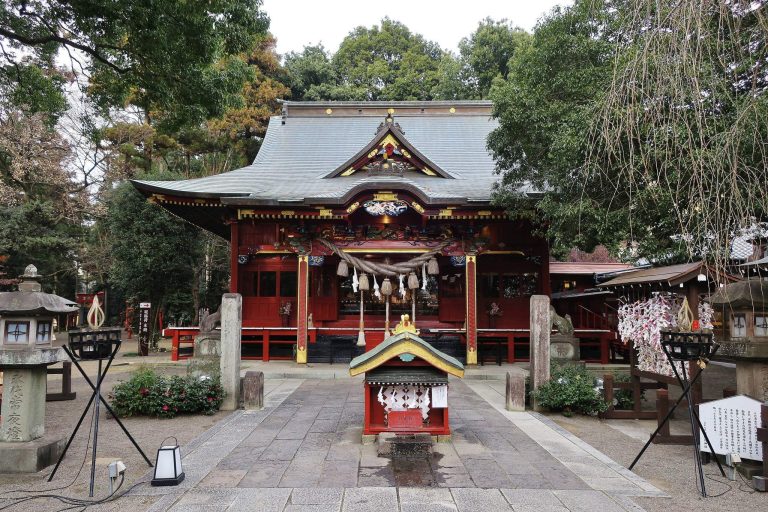
Ashikaga Castle: A Japanese Mountain Fortress in Tochigi
Site at a Glance
- Rating
- 4.1
- Popularity
- Low
- Country
- Japan
- Primary era
- Early Modern
- External website
- Open
- Eras represented
- Medieval, Early Modern
- Civilizations
- Japanese
- Site type
- Military
- Remains
- Castle
On this page7 sections
History
Ashikaga Castle is a Japanese mountain castle in Ashikaga, Japan, established on Mount Ryogai in 1054 during the late Heian period, the final phase of Japan’s classical court era before warrior governments became dominant. It was founded by Ashikaga Naruyuki, regarded as the founder of the Fujiwara-descended Ashikaga family, and was also known as Ryogaiyama Castle, Iizukayama Castle, Koya Castle, and Kurisaki Castle.
From the Ashikaga to the Nagao family
The castle was controlled by the Ashikaga family and passed to the Nagao family from 1512. Although its origins were placed in the eleventh century, the surviving fortification plan reflects a sixteenth-century arrangement. For that reason, the castle is generally understood in practical terms as having been built or substantially renewed by Nagao Kagenaga after the Nagao takeover.
Ashikaga Castle was abandoned at the end of the sixteenth century. Four conflicts associated with it are known from 1455, 1564, 1584, and around 1590, each described as a Battle of Ashikaga Castle.
The four conflicts associated with the castle
The first conflict developed in 1455 after Ashikaga Shigeuji, the Kamakura kubo, a military deputy of the Ashikaga family in eastern Japan, killed Uesugi Noritada, the Kanto kanrei, a senior deputy responsible for assisting the Kanto kubo in governing the Kanto region. Nagao forces serving the Uesugi family became involved. A copy of a letter dated May 13, 1455, states that Ashikaga Yoshiaki had gone to the castle and directed Iwamatsu Ukyo to prepare a strategy. Letters from August 29 describe preparations for the expected arrival of Uesugi troops in the Ashikaga estate. The surviving evidence does not clarify whether the opposing forces merely confronted one another or fought an actual battle.
The second conflict began in November 1564 between Uesugi Kenshin, a major warlord from Echigo who campaigned widely in the Kanto region, and Sano Masatsuna. During Kenshin’s attack on Karasawayama Castle, held by the Sano family, his forces reportedly burned areas that included Ashikaga, Tatebayashi, and Nitta before establishing a camp at Numajiri. Nagao Masanaga, who was defending the area, then joined the Uesugi side as part of the Ashikaga warrior contingent from Shimotsuke, a historical province corresponding broadly to present-day Tochigi Prefecture.
The third conflict took place in 1584 as the Hojo family’s invasion of Shimotsuke intensified. A commendation issued by Hojo Ujikatsu records fighting at Ashikaga Castle between Nagao Akikage and Sano Munetsuna. Around 1590, a fourth conflict was connected with Toyotomi Hideyoshi’s campaign against the Hojo stronghold at Odawara. Hideyoshi, the warlord who unified Japan in the late sixteenth century, led that campaign, while a commendation from Hojo Ujinao praised the military achievements of several retainers at Ashikaga Castle without naming their opponents.
Historic designation
Ashikaga Castle became a designated historic site of Ashikaga City on July 25, 1970. This status reflects the importance of its surviving mountain fortifications and the site’s association with the Ashikaga and Nagao families and with conflicts that shaped control of the Kanto region.
Remains
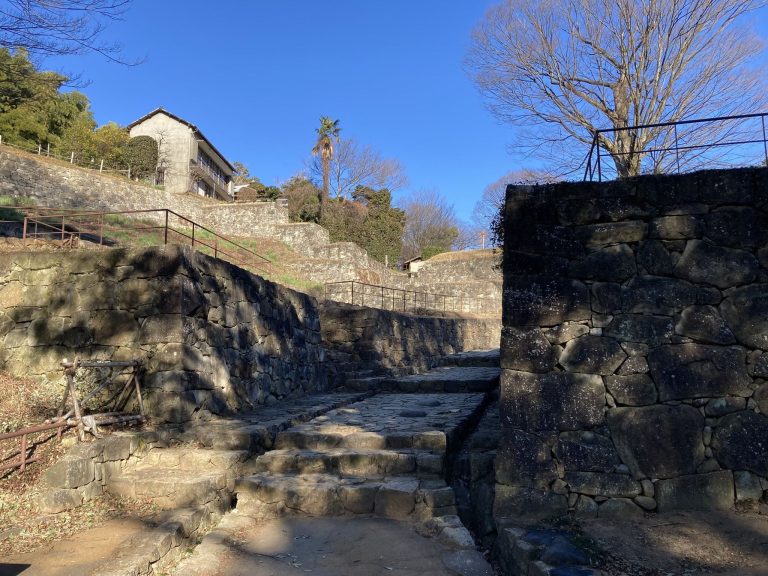
Ashikaga Castle occupies elevated ground on Mount Ryogai. Its surviving physical organization consists of fortified enclosures, ditches cut across ridges, and lower enclosures placed along the hillside. Together, these features express the castle’s sixteenth-century structural arrangement as a mountain fortification.
Fortified enclosures and ridge defenses
The principal remains are fortified enclosures, or kuruwa, combined with ridge-cut ditches known as horikiri. A kuruwa was a defended area within a Japanese castle, while a horikiri was cut across a ridge or approach to obstruct movement. Their survival defines the castle’s defensive framework on the elevated terrain of Mount Ryogai.
Lower hillside enclosures
Lower enclosures extend along the hillside beneath the principal fortified areas. These koshikuruwa, or lower fortified enclosures, form part of the castle’s surviving defensive layout and show how the site’s organization continued down the mountain slope.