Ninna-ji Temple: Imperial Head Temple of the Omuro Shingon School


Site at a Glance
- Rating
- 4.4
- Popularity
- Medium
- Country
- Japan
- Primary era
- Early Modern
- External website
- Open
- Eras represented
- Medieval, Early Modern
- Civilizations
- Tokugawa
- Site type
- Religious
- Remains
- Monastery
On this page24 sections
History
Ninna-ji Temple is a Buddhist temple in Kyoto, Japan, founded through the Japanese imperial court and completed in 888. It is the head temple of the Omuro branch of the Shingon school, a Japanese Buddhist tradition centered on esoteric ritual, mantra, mandala, and initiation practices. Its principal deity is Amida Nyorai, Amitabha Buddha, and its founder is Emperor Uda.
Foundation and imperial patronage
Construction began in 886 at the request of Emperor Koko. After Koko died in 887, his son Emperor Uda brought the work to completion in 888. The temple was first called Nishiyama Goganji and later received the name Ninna-ji, taken from the imperial era name then in use.
Yusen of the Tendai school served as the first head priest. After Emperor Uda entered monastic life at Ninna-ji in October 899, he received Shingon ordination at To-ji. The Shingon monk Kangen then became head priest, and the temple developed into a Shingon institution.
In 904, Emperor Uda established monastic quarters called Omuro in the southwestern part of the grounds and began living there. Ninna-ji consequently became known as the Omuro Gosho, meaning the Omuro Imperial Palace. Its abbots were thereafter drawn largely from Emperor Uda’s descendants. In 952, the retired Emperor Suzaku moved to Ninna-ji and died there later that year.
Prince Shoshin, a son of Emperor Sanjo, became the first holder of Kengyo, a senior supervisory office placed above the abbot. Ninna-ji thus became a monzeki temple, a Buddhist temple traditionally headed by a member of the imperial or aristocratic family. Imperial princes and other members of the Imperial family served as its monzeki abbots until the nineteenth century. The two non-imperial abbots, Hosuke and Hoson, also held exceptional social rank.
Growth, fire, and medieval destruction
Imperial and aristocratic devotion continued to shape the temple. In 1010, Kannon-in Kanjodo was built at the devotional request of Minamoto no Rinshi, the wife of Fujiwara no Michinaga. A fire in April 1119 destroyed the main hall, the east and west corridors, the bell tower, the sutra repository, the three-sided monks’ quarters, Kannon-in, and Kanko-in. The main hall was rebuilt that December, while Kannon-in and Kanko-in were reconstructed by 1122.
In 1144, a Peacock King Hall was built at the request of the retired Emperor Toba. The Peacock King, a Buddhist protective deity, was associated with rituals intended to avert natural disasters. Ninna-ji continued to receive imperial and aristocratic patronage and was regarded as one of Japan’s leading Buddhist institutions.
The temple declined to some extent during the Muromachi period. During the Onin War, a civil conflict fought from 1467 to 1477, soldiers of the Eastern Army burned the entire complex. The Amida triad and other principal images had been moved beforehand to Shinko-in, an affiliated temple, and survived. Ninna-ji then transferred its base, together with its principal image, to Saiho-ji at the western foot of Futago-oka.
Early-modern reconstruction
Ninna-ji recovered through major grants of land revenue. Toyotomi Hideyoshi granted it 860 koku in 1591, and Shogun Tokugawa Hidetada granted a further 1,500 koku in 1617. On July 24, 1634, the twenty-first abbot, Prince Kakushin, asked Shogun Tokugawa Iemitsu to support reconstruction, and the request was approved.
During rebuilding of the Kyoto Imperial Palace in the Kan’ei era, the palace’s Shishinden, Seiryoden, and Jogoten were transferred to Ninna-ji. The reconstruction of the complex was completed in 1646. The monk who assisted the monzeki helped determine the design of the eaves tiles, the arrangement of the rebuilt complex, and the images to be enshrined in the main hall. He also sponsored the sutra repository, which preserved Buddhist scriptures, esoteric ritual manuals, and the temple’s historical documents.
In 1827, Prince Saijin, the twenty-ninth monzeki abbot, established the Omuro Eighty-eight-Site Pilgrimage for people unable to travel to Shikoku. Sand was brought from the eighty-eight sites of the Shikoku pilgrimage, a circuit of Buddhist sacred places traditionally associated with Kobo Daishi, the posthumous name of the monk Kukai. Eighty-eight small halls were established on Mount Joju, with the sand placed inside them.
End of the monzeki tradition
In 1867, the thirtieth abbot, Prince Junnin, renounced his monastic vows and became Prince Komatsu. No later member of the Imperial family became abbot, ending Ninna-ji’s history as a monzeki temple and its use as the Omuro Gosho.
A fire destroyed the palace buildings, including the Shishinden, in 1887. They were rebuilt in 1914 to designs by Kameoka Suekichi. Between January and later in 1945, former Prime Minister Fumimaro Konoe visited Ninna-ji several times to discuss a proposal for Emperor Hirohito to abdicate and enter monastic life at the temple. The plan also considered a residence for the emperor after monastic retirement. The inscription on the plaque in Reimeiden Hall is traditionally regarded as Konoe’s final calligraphy.
In 1946, the Omuro branch separated from the Dai Shingon school, and Ninna-ji became its head temple. The temple also heads the Omuro-ryu school of ikebana, a flower-arrangement tradition founded by Emperor Uda. Ninna-ji forms part of the Historic Monuments of Ancient Kyoto, inscribed as a UNESCO World Heritage Site in 1994. The Ninna-ji Imperial Palace site is a National Historic Site, while the Omuro cherry trees and the Ninna-ji Imperial Palace Gardens are National Places of Scenic Beauty.
Remains
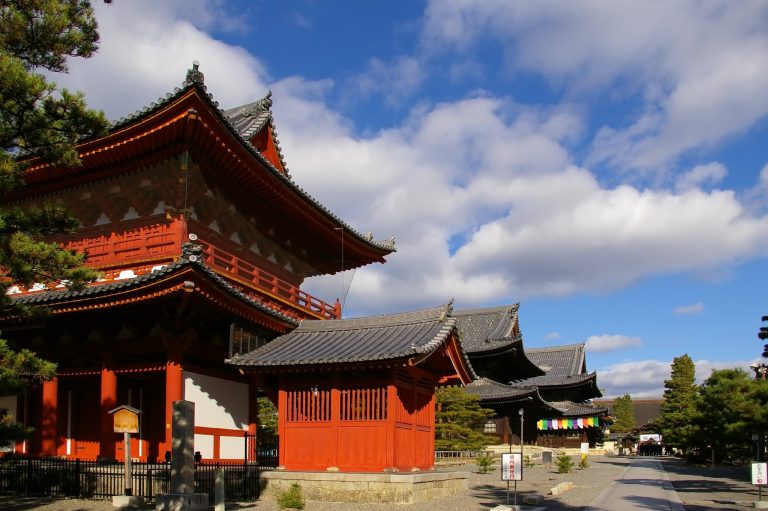
The complex is divided by walls into several sections. A broad route extends from the Two-Emperors Gate in the south toward the Central Gate and separates the principal areas. Wooden pavilions joined by galleries occupy the southwest beside a decorative pond. North of the Central Gate stand the Kondo, the five-story pagoda, and other principal buildings. The surviving arrangement combines religious structures with palace architecture transferred from the Kyoto Imperial Palace during the seventeenth-century reconstruction.
Palace buildings and religious structures
Kondo
The Kondo, or Main Hall, is an early-modern palace building originally constructed as the Shishinden of the Kyoto Imperial Palace in 1613. It was moved to Ninna-ji during the Kan’ei-era rebuilding and adapted for Buddhist worship. The original cypress-bark roof was replaced with tile, while lattice-like shutters and gilded metal fittings preserve features of its former palace function.
Miei-do
The Miei-do, or Founder’s Hall, was built from materials taken from the Kyoto Imperial Palace’s Seiryoden, also constructed in 1613. It enshrines images of Kobo Daishi, Emperor Uda, and Prince Shoshin.
Pagoda and gates
The five-story pagoda dates from 1644 and rises 36.18 metres. The Kannon-do, Central Gate, bell tower, Miei-do Central Gate, and Honbo Main Gate mainly date from 1641 to 1645. The Niomon, or Two-King Gate, is another early-modern structure from the same rebuilding period.
Kyozo
The Kyozo is a revolving sutra repository built in the Zen style. It contains 768 boxes for Buddhist scriptures.
Tea pavilions and sacred grounds
Ryokaku-tei
Ryokaku-tei is a tea pavilion relocated between 1661 and 1750 from the residence of the Edo-period painter Ogata Korin. Its unusual design includes a wing wall beneath the sloping roof and a crawl-through entrance opening inside the pavilion. A tea pavilion, or chashitsu, is a small building designed for preparing and serving tea.
Hito-tei
Hito-tei was built for Emperor Kokaku between 1830 and 1867. Its entrance has a high lintel that allowed guests to enter without bending down.
Kyusho Myojin
Kyusho Myojin is a Shinto shrine that protects the temple grounds. Originally located south of the complex, it was moved to its present position in 1212. Its central sanctuary is associated with the deities of Iwashimizu Hachimangu, the left sanctuary with those of the Kamo shrines, and the right sanctuary with those of Matsunoo Taisha, Hirano Shrine, and other shrines.
Sculpture, painting, and written treasures
Buddhist images
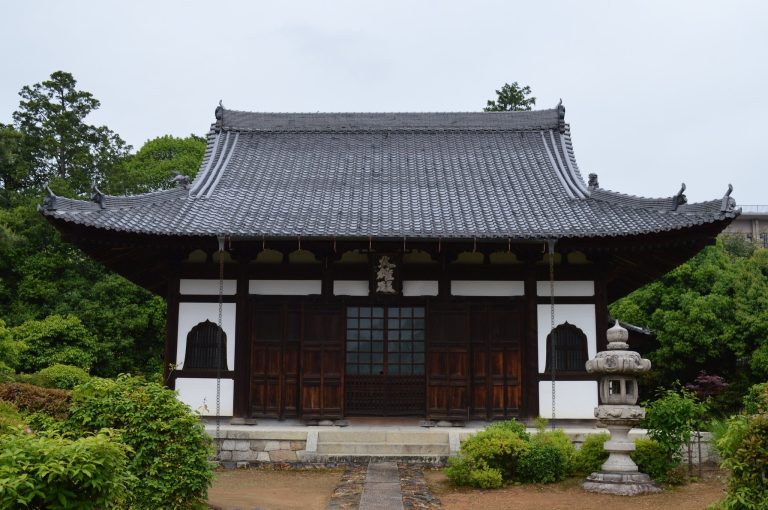
The wooden Amida Nyorai triad, with Kannon and Seishi as attendant bodhisattvas, was originally enshrined in the Kondo and is now kept in the temple’s Treasure Hall. The Heian-period group is traditionally identified as the principal image from the temple’s foundation in 888.
Reimeiden houses memorial tablets of successive Ninna-ji abbots and contains a wooden seated statue of Yakushi Nyorai, the Buddha associated with healing and medicine. Prince Kakugyo, son of Emperor Shirakawa, commissioned the sandalwood statue in 1103. The sculptors Ensei and Choen made the figure, which is 11 centimetres high, or about 24 centimetres with its halo and pedestal. The halo represents the Seven Medicine Buddhas with the bodhisattvas Nikko and Gakko, while each side of the pedestal bears three of the Twelve Heavenly Generals. Details of the image were clarified during a Kyoto National Museum investigation in 1986, and it became a National Treasure in 1990.
Ritual and lacquer objects
A silk painting of the Peacock King is traditionally said to have served as the principal image in the temple’s Peacock Sutra Ritual, which was performed to avert natural disasters. The early Heian-period lacquer collection includes a Hōsōge Makie jewel box, an important early example of makie, a technique in which powdered gold or silver is applied to lacquer to create decorative designs.
Sutras and historical records
The Thirty-Volume Sutras consist of thirty small booklets brought from Tang China by Kobo Daishi, some in his own handwriting. The imperial court bestowed their lacquered box, which is an important example of Heian-period lacquerwork. Ninna-ji also preserves the Omuro Records of Succession, six Kamakura-period volumes concerning successive imperial princes of the temple.
The collection includes parts of Ishinpo, Japan’s oldest medical text, including late-Heian-period manuscript sections, as well as Kamakura-period manuscripts of Newly Revised Materia Medica, a Chinese medical work.
Archaeological discoveries
Excavations at the former Kondo site produced 120 inscribed copper plates in a copper box, a gilt-bronze ritual wheel, and a set of four copper ritual stakes. Finds from the former En-do site include gold, silver, white porcelain, and celadon containers. One celadon lid is missing, and the gold container was stolen in 1947. An attached arabesque roof tile bears an impressed mark reading To-ji.
Gardens, paintings, and pilgrimage route
Gardens and screen paintings
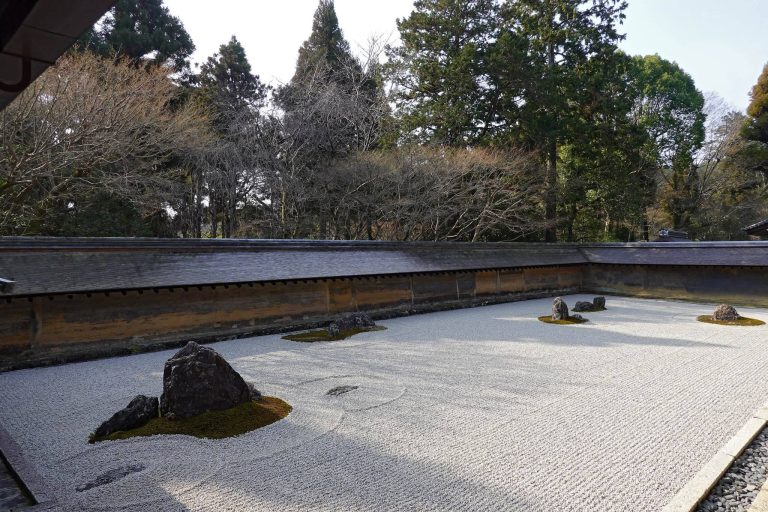
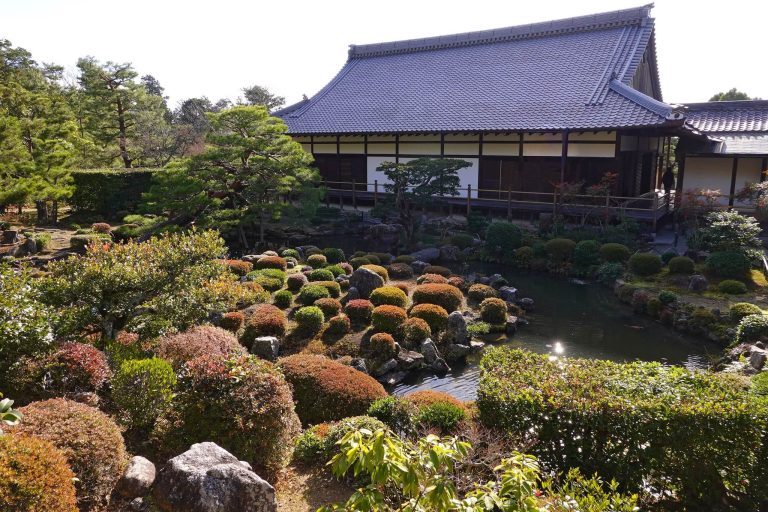
The complex includes a garden enclosed by walls and associated with a pond, along with painted screen walls. Edo-period works include barrier paintings in the inner rooms and screen paintings attributed to artists such as Maruyama Okyo, Kishi Ganku, and Tosa Mitsushige.
Omuro cherry grove
The Omuro cherry grove contains about 200 double-flowering trees. Hard bedrock limits their root depth, keeping the trees approximately two to three metres high. Their flowering generally occurs after April 20. The grove is a National Place of Scenic Beauty and one of Japan’s selected 100 best cherry-viewing sites. Research has also examined propagation of the trees through cloning.
Omuro Eighty-eight-Site Pilgrimage
The Omuro Eighty-eight-Site Pilgrimage follows a roughly three-kilometre mountain route on Mount Joju. Its eighty-eight small halls reproduce the number and religious arrangement of the Shikoku pilgrimage. Each hall enshrines the corresponding principal deity together with Kobo Daishi, and completing the circuit is presented as conferring the religious benefit of the full Shikoku pilgrimage.