Raijinyama Kofun: A Keyhole-Shaped Burial Mound in Japan
Site at a Glance
- Rating
- 4
- Popularity
- Low
- Country
- Japan
- Primary era
- Classical
- External website
- Open
- Eras represented
- Classical, Medieval
- Civilizations
- Yamato
- Site type
- Burial
- Remains
- Burial Mound
On this page6 sections
History
Raijinyama Kofun is a keyhole-shaped burial mound in Japan, built by the ruling elite of the Kofun period in the late fourth or early fifth century AD. Located in Uematsu, Natori, it is the largest known kofun in the Tohoku region and is regarded as the tomb of a regional ruler who controlled the Sendai and Natori plains.
A Change in Regional Rule
The mound belongs to a period when the burial traditions of the Natori Plain appear to have changed. Earlier leaders were buried in square-front, square-back tombs associated with the Iinosaka Kofun Group. Raijinyama Kofun was built in a different location and introduced the keyhole-shaped form, representing a succeeding generation of regional rulers.
Its political setting extended beyond the Natori Plain. The contemporary Tomizuka Kofun in Sendai was another large mound associated with power across the Sendai Plain and possibly toward the Osaki Plain. Raijinyama Kofun’s size and position therefore place it within a broader network of regional authority, although the individual buried within it cannot be identified.
Recognition and Preservation
Archaeologist Matsumoto Hikoshichiro reported the mound in 1930 under an earlier name connected with the Uematsu hilltop. A prefectural topographic survey in 1950 measured its principal axis at more than 160 meters, establishing it as the largest known kofun in the Tohoku region at that time.
Raijinyama Kofun became a National Historic Site on December 28, 1956. The protected area was enlarged in 1968 to include the nearby Kozuka Kofun and medieval remains such as a moat and earthworks, and the site was developed as a historic park. Prefectural excavation followed in 1976 and 1977, while a six-year improvement program for the historic park began in 1981. Objects recovered from Raijinyama Kofun were designated tangible cultural properties by Natori City in 1972.
The burial facility has not been excavated and its form remains unidentified. Partial subsidence on the rear circular mound after the 2011 Tohoku earthquake led to the hypothesis that it may contain a clay-lined burial chamber or a wooden coffin placed directly in a shaft grave.
Remains
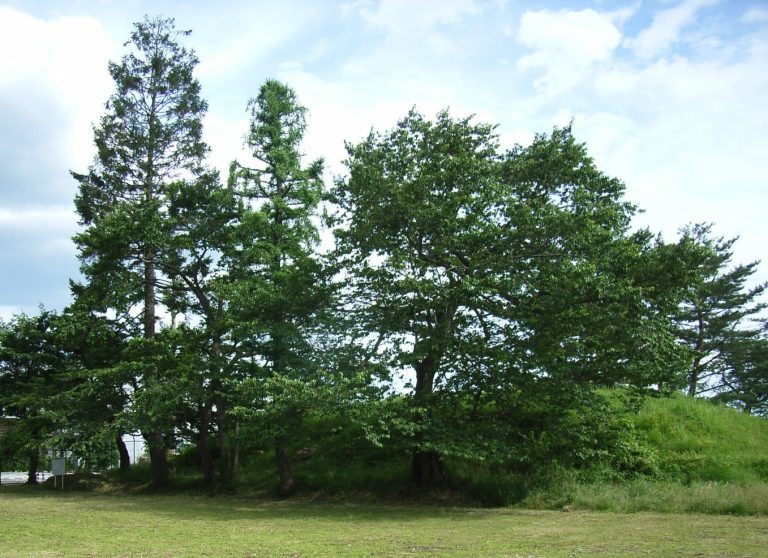
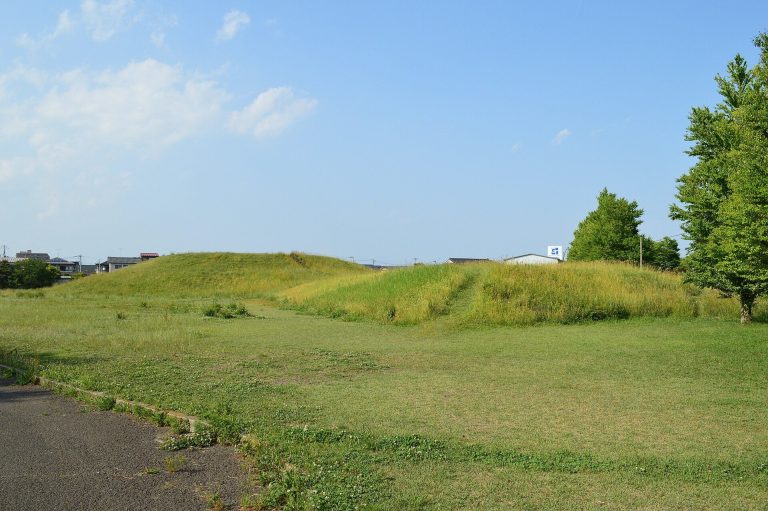
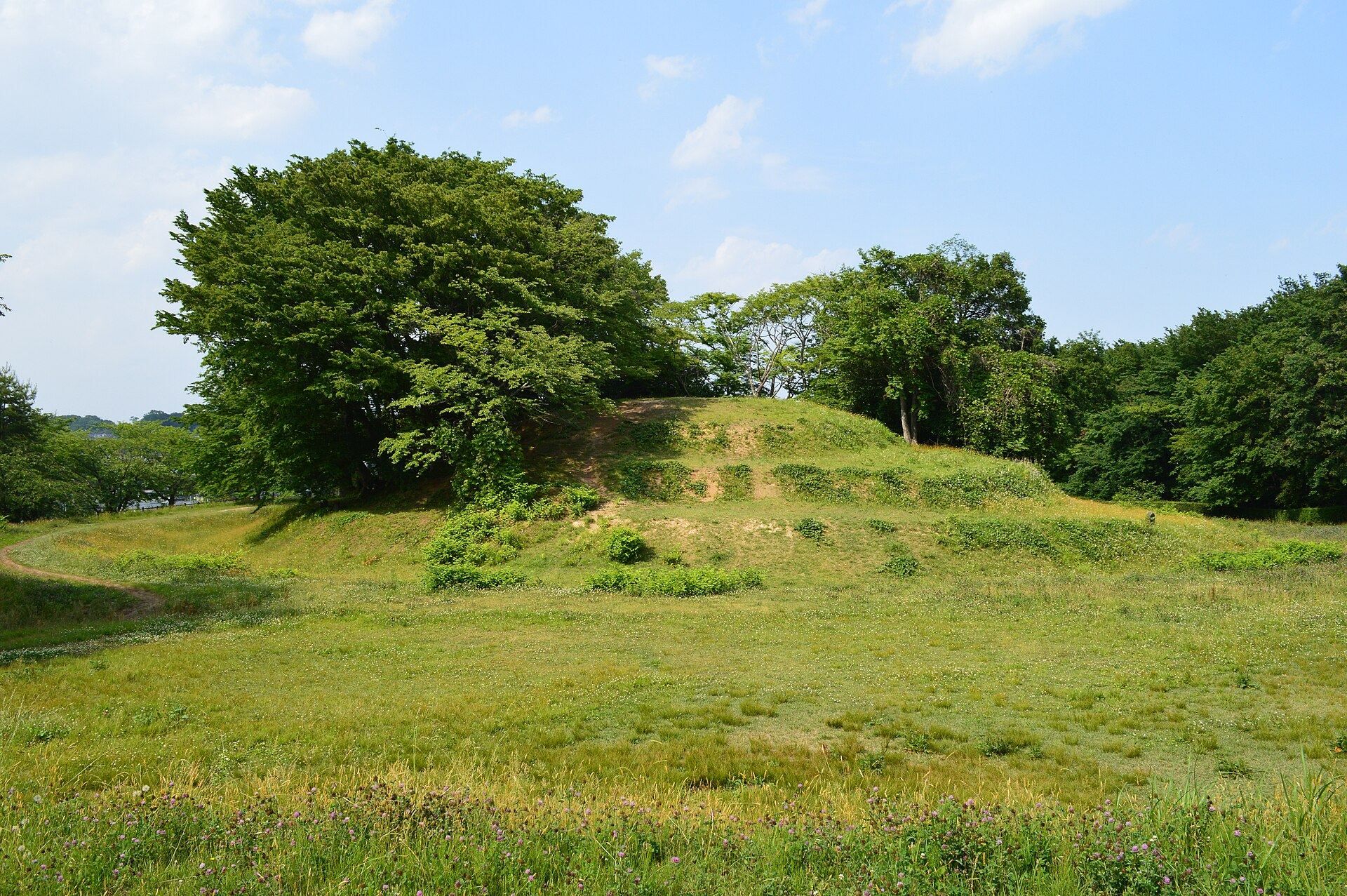
Raijinyama Kofun occupies the eastern end of a tongue-shaped spur of Aijima Hill, which extends from the Takadate Hills above the Natori and Sendai plains. The mound is organized as a keyhole shape, with a circular rear section and a square front projecting toward the southwest. It was formed largely by cutting into the natural hill and reusing the excavated earth as fill.
The Main Burial Mound
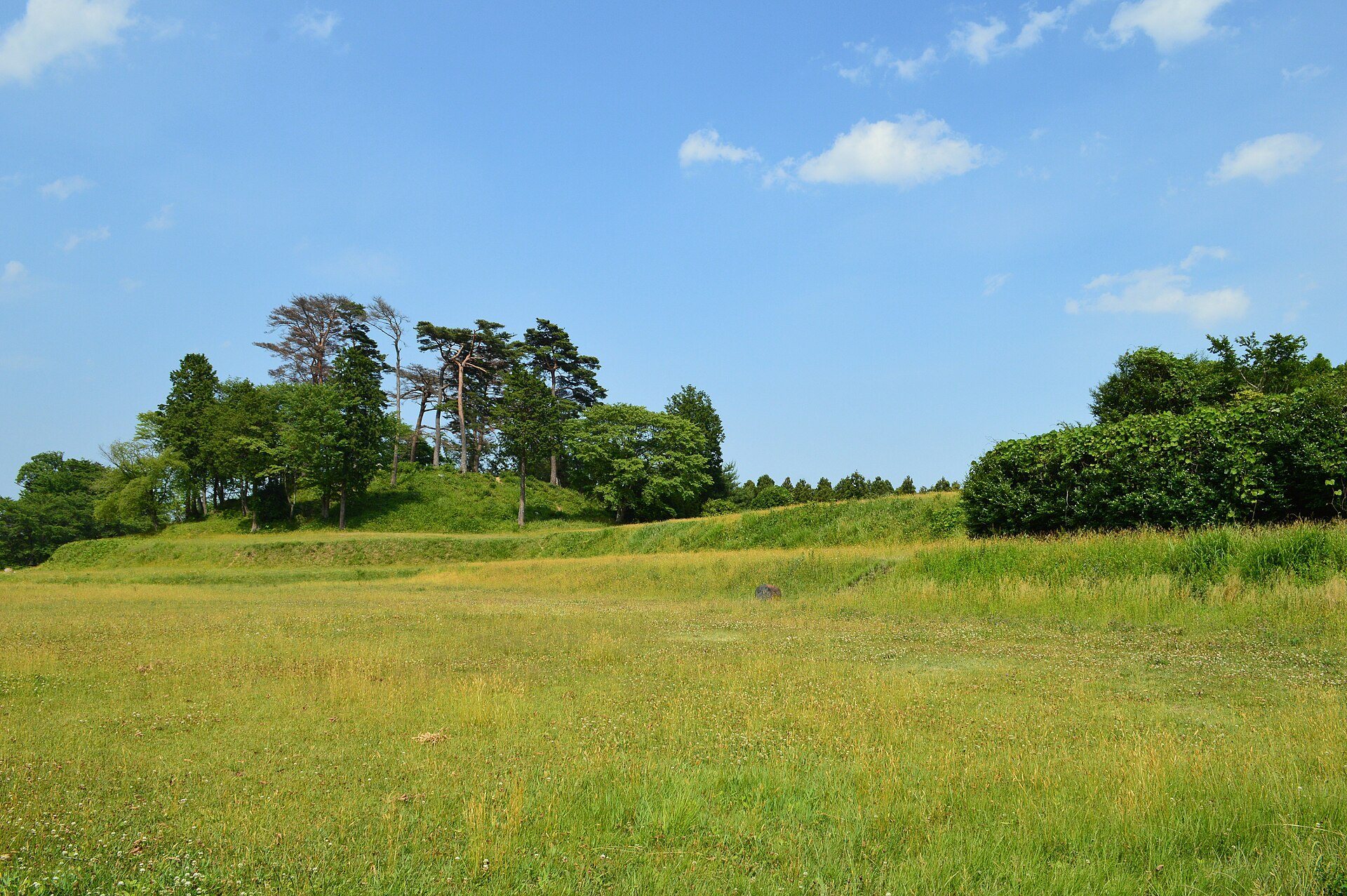
The main mound is approximately 168 meters long. Its rear circular section is about 96 meters in diameter and 12 meters high, and is built in three stages. The square front measures approximately 72 meters in length, reaches about 96 meters at its greatest width, and rises roughly 7.2 meters. It is built in two stages, creating a stepped form across the mound.
The exterior slopes were covered with fukiishi, a stone revetment used to protect and reinforce a burial mound. Jar-shaped haniwa, clay objects placed on and around ancient burial mounds, were probably arranged around the foot of each terrace. A surrounding embankment and moat formed part of the complex, which measures approximately 210 meters from north to south and 140 meters from east to west when these features are included.
Later cultivation reduced part of the square front, and another portion has been converted into a cemetery. A small shrine dedicated to a thunder deity stands on the summit of the rear circular section. The name Raijinyama, meaning “Thunder-God Mountain,” derives from this shrine.
Excavated material includes bottom-perforated jar-shaped Haji ware, jar-shaped haniwa, and fragments of Sue ware. Haji ware is unglazed earthenware, while Sue ware is high-fired gray pottery associated with kiln production and introduced ceramic technology. The objects and the mound’s construction methods support a date in the late fourth or early fifth century AD.
Kozuka Kofun and Medieval Features
Kozuka Kofun lies immediately north of Raijinyama Kofun’s rear circular section. It is a circular mound approximately 54 meters in diameter and 8 meters high, built in three stages and covered with a stone revetment. A moat surrounds it, and its relationship to the main mound identifies it as a subsidiary burial mound associated with Raijinyama Kofun.
Medieval moat and earthwork remains are also included within the designated site area, adding later defensive and land-use features to the archaeological landscape around the ancient burial mounds.