Myōhō-ji Temple: A Nichiren Buddhist Temple in Kamakura
Site at a Glance
- Rating
- 4.3
- Popularity
- Low
- Country
- Japan
- Primary era
- Early Modern
- External website
- Open
- Eras represented
- Medieval, Early Modern
- Civilizations
- Ashikaga shogunate, Tokugawa
- Site type
- Religious
- Remains
- Temple
On this page20 sections
History
Myōhō-ji Temple is a Nichiren Buddhist temple in Kamakura, Japan, traditionally founded in 1253 during the medieval period. It is associated with Matsubagayatsu, the place where Nichiren, the thirteenth-century monk whose teachings formed the basis of the Nichiren Buddhist schools, is traditionally believed to have kept a hut after arriving from Awa Province. Myōhō-ji, Ankokuron-ji, and Chōshō-ji all claim this association, but the exact location cannot be established conclusively.
Nichiren and the hermitage tradition
Temple records state that Nichiren lived at the site until he left for Minobu in 1272. A monument at Myōhō-ji links the hut with his repeated chanting of the daimoku, a devotional formula formed from the title of the Lotus Sutra, and with the composition of Risshō Ankokuron. That treatise argued that social peace depended on establishing correct Buddhist teaching. The monument also associates his activity at Nagoe with the propagation of his teachings until 1271.
The historical interpretation of the hermitage has not always been the same. The government’s earlier position distinguished the Myōhō-ji hut from an earlier hut at Ankokuron-ji, suggesting that Nichiren established the Myōhō-ji hut after returning from exile in Izu in 1263. The temple’s annual August Yakuyoke Shōga ceremony commemorates the traditional Matsubagayatsu Persecution. According to the associated tradition, Nichiren escaped his persecutors into a forest near Nagoe toward Zushi and was fed ginger by a white monkey.
Refoundation and medieval memory
The site was originally occupied by Honkoku-ji, which was later transferred to Kyoto. Myōhō-ji’s substantial refoundation is associated with Nichiei, its fifth chief abbot and a successor regarded as the temple’s effective founder. In 1357, Nichiei rebuilt the temple to commemorate his father, Prince Morinaga, and to pray for his posthumous welfare. Temple tradition also says that Nichiren entrusted the site to Nichiei.
Nichiei was a natural son of Prince Morinaga and Minami no Ōnkata, and an uncle of Ashikaga Takauji. Prince Morinaga was a son of Emperor Go-Daigo and supported the Kenmu Restoration, the fourteenth-century attempt to restore direct imperial rule. Go-Daigo appointed him Seii Taishōgun, a military office traditionally regarded as Japan’s highest military authority, but he was later imprisoned and killed in 1335. Minami no Ōnkata had attended him while he was held prisoner by the Ashikaga in a cave at the site now occupied by Kamakura-gū. Nichiei and his mother were buried at Myōhō-ji, while a nearby site in Nikaidō is also associated with Prince Morinaga’s grave.
Institutional disputes and scholarly activity
The relationship between Myōhō-ji and Chōshō-ji was already described as strained in the Shinpen Kamakurashi, commissioned by Tokugawa Mitsukuni in 1685. In 1787, a shogunate tribunal granted Myōhō-ji the right to claim Nichiren’s hermitage site. This decision formed part of the temple’s long effort to secure its position within the Matsubagayatsu tradition.
In the early sixteenth century, the eleventh abbot, Nitchō, became known as a learned monk through works including Nichiren Shōnin Chūga-san and Hokekyō Keiunshō. He later founded Keiun-ji in Kamakura’s Zaimokuza district. The temple was also identified with the former Honkoku-ji lineage of the Nichiren school. That school’s former head-temple and branch-temple system was dissolved in 1941.
Edo-period prosperity and religious activity
During the Edo period, the era of Tokugawa rule from the early seventeenth century to the nineteenth century, Myōhō-ji prospered under its thirty-second and thirty-third abbots, Nichiō and Nichiji. Both had studied at the Mito Tokugawa family’s Buddhist academy. The shogunal family, the three senior collateral branches known as the Tokugawa Gosanke, and the Hosokawa family offered the temple protection and veneration.
The temple’s red-painted main gate, Niō gate, and Hall of Scriptures were reportedly prepared for a visit by Shogun Ienari. A shogunal reception room remained on the grounds until the middle of the nineteenth century. Myōhō-ji also attracted worshippers among the common people of Edo. Its activities included traveling unveilings in Edo and a river segaki ceremony at Eitai Bridge on the Sumida River. A segaki is a Buddhist rite for the spirits of the dead, especially those believed to lack descendants or proper offerings. The ceremony was intended to console people who had drowned and was described as the first of its kind in Japan.
Modern protection
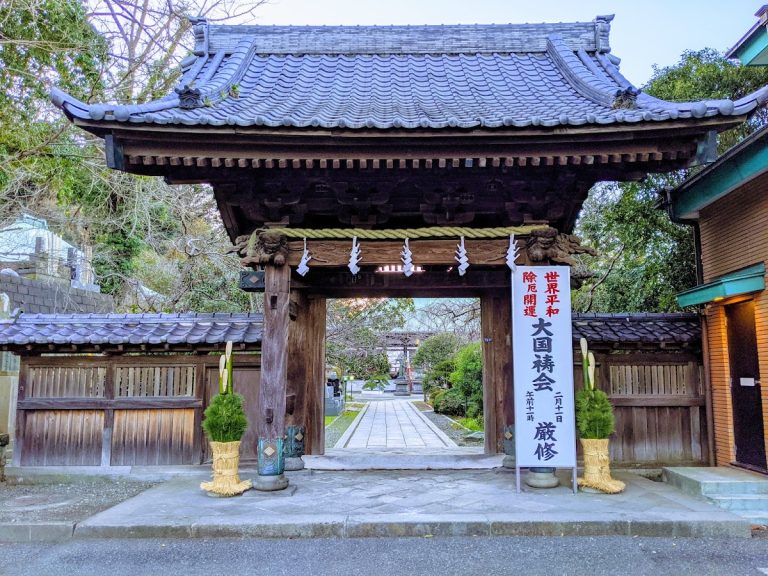
Myōhō-ji’s main gate received designation as a Kamakura City cultural property in 1995, bringing protection to an important part of the temple complex. The grounds continue to preserve the buildings, memorials, graves, and traditions associated with Nichiren, Nichiei, Prince Morinaga, and the temple’s later patrons.
Remains
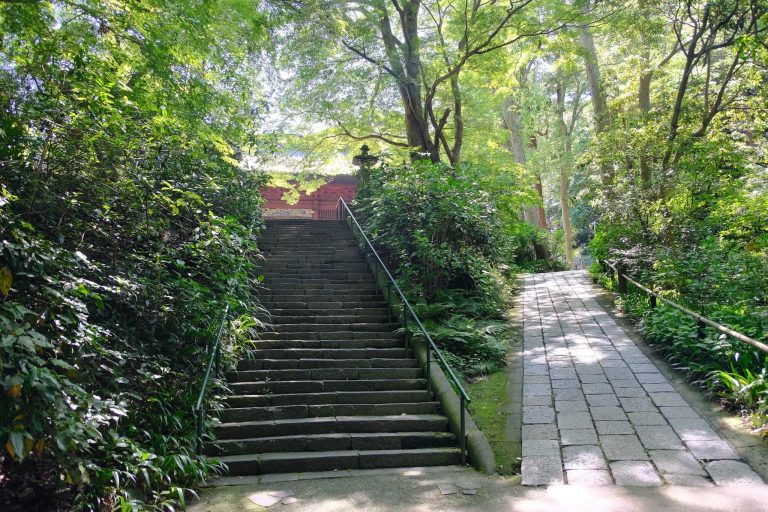
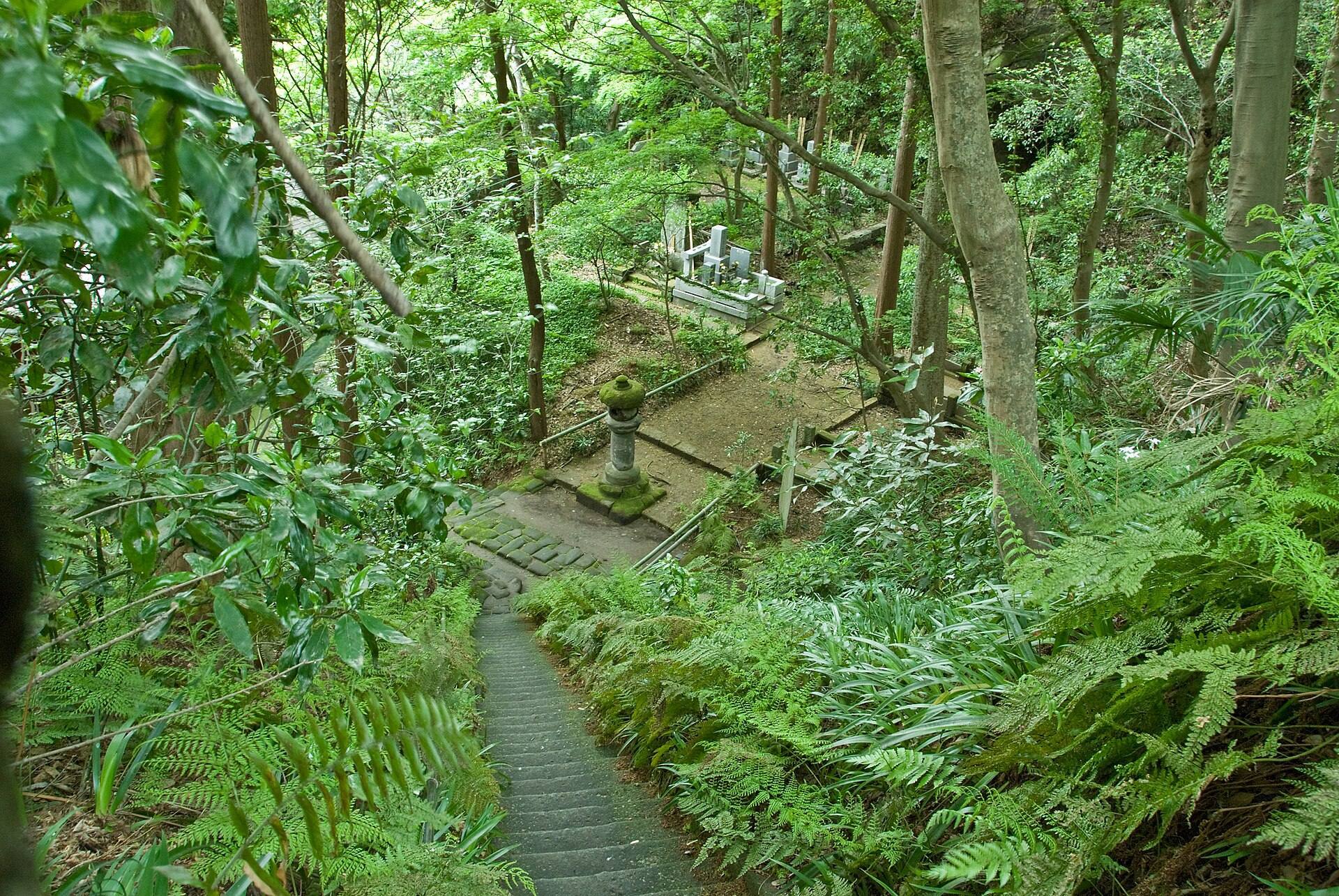
Myōhō-ji extends from its entrance buildings toward the moss-covered stairway and the higher sacred areas beyond it. The complex includes the main hall, Daigakuden, Niō gate, Hokkedō or Hall of Scriptures, bell, caves, graves, cenotaphs, and the remains of the former Shakadō or Hall of Shaka. A newer staircase runs beside the fifty-step stone stairway, whose moss is protected by keeping the older route closed.
Entrance and lower buildings
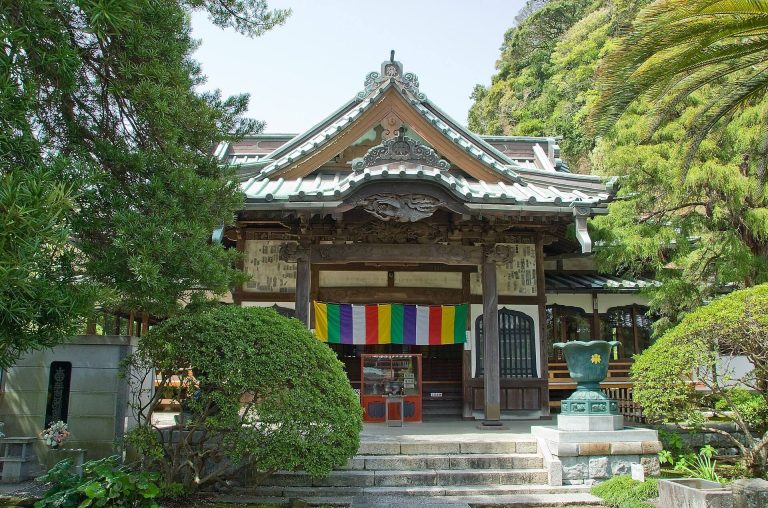
Main hall
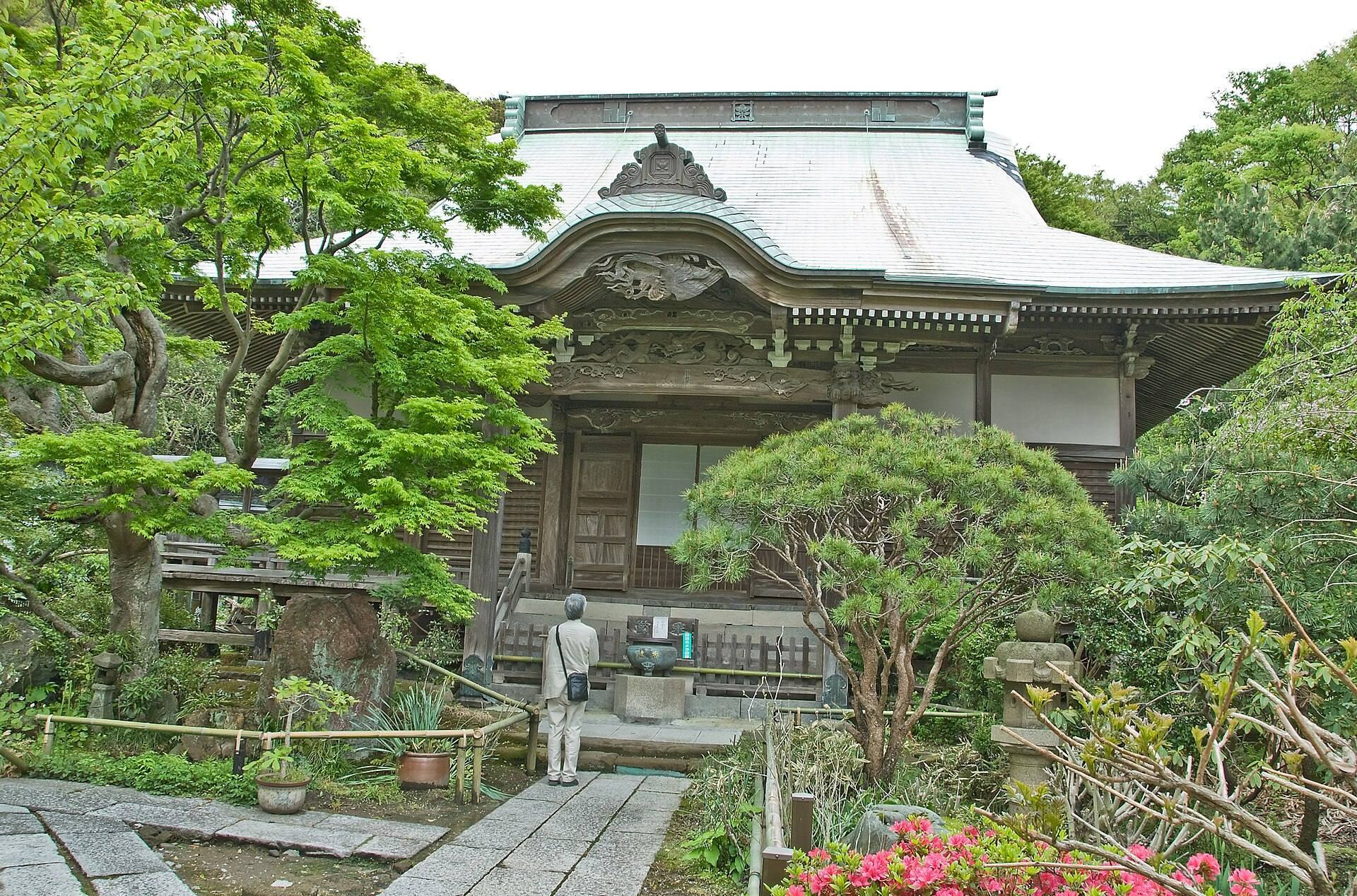
The present main hall stands near the entrance. It was built during the Bunsei era, a named period of the late Edo period, by the Hosokawa family to pray for the posthumous welfare of a young daughter who had died. The hall is closed to the public and contains an effigy of Prince Morinaga together with a small bone fragment said to be a relic of Nichiren.
Daigakuden
The Daigakuden stands to the left of the main hall. Inside are a statue of Shaka Nyorai, the Japanese Buddhist name for Shakyamuni Buddha, a statue of Katō Kiyomasa, and a statue of Inari Myōjin. The Katō Kiyomasa image was formerly enshrined in the keep of Kumamoto Castle and was donated by the Hosokawa family. Inari is a Japanese kami associated especially with rice, harvests, and food.
Niō gate and moss-covered stairway
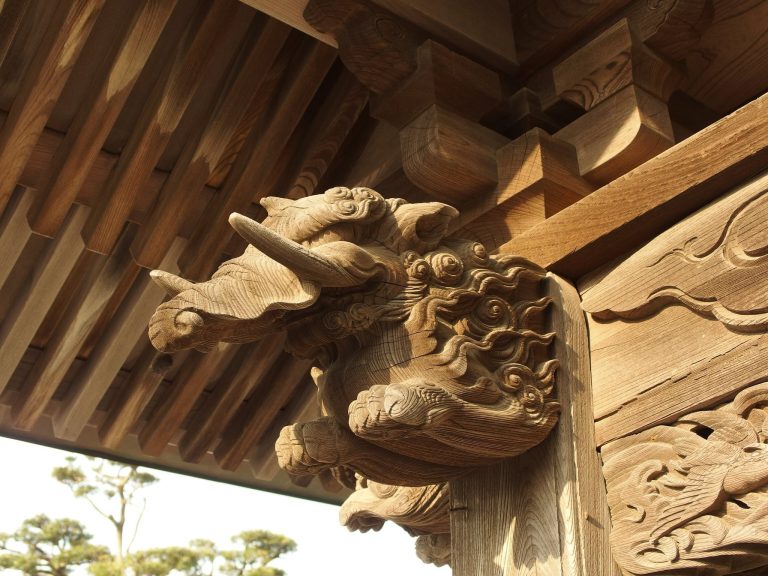
The Niō gate, a Buddhist entrance guarded by paired guardian-king figures, leads toward the stone stairway traditionally associated with the nickname “Kokedera,” or “Moss Temple.” The stairway has fifty steps and is covered with moss. Its closure protects the moss, while the newer staircase beside it provides an alternative route through this part of the complex.
Caves
Two caves lie at the foot of the moss-covered stairs. One contains a statue of Nichiren. The other functions as a mausoleum for priests who lived at Myōhō-ji, giving the lower approach a direct connection with the temple’s religious community.
Upper sacred buildings and hermitage sites
Hokkedō
The Hokkedō, or Hall of Scriptures, stands above the moss-covered stairway and to the right of the former Shakadō site. Built during the Bunka era by the Mito family, it contains an image of the Disaster-Averting Founder made by Nichiei. Its position places one of the temple’s principal religious buildings within the higher part of the complex.
Former Shakadō and bell tower area
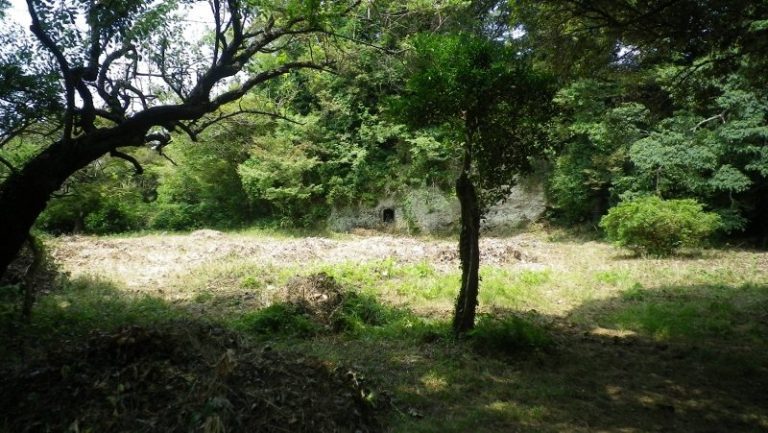
The remains of the former Shakadō, or Hall of Shaka, lie near the Hokkedō. Beside the former hall stands a Japanese sago palm traditionally said to have been planted by Nichiei himself. The former inner sanctuary and the traditional hut location, called the “Site of the Small Hermitage,” lie to the left of the Shakadō remains, up steps beside the bell tower. This area is identified with the place where Nichiren is traditionally said to have lived for more than twenty years.
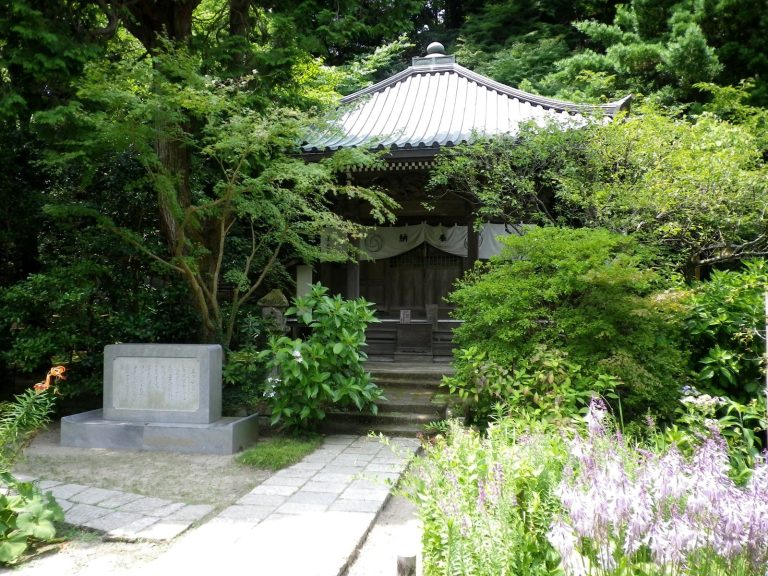
Hermitage monument
Above the Hokkedō is a monument marking the alleged location of Nichiren’s hut. Its inscription connects the site with his arrival at Nagoe in 1253, his chanting of the daimoku, his writing of Risshō Ankokuron, and his teaching activity until 1271. The monument preserves the temple’s claim within a landscape where the precise position of the hermitage remains disputed.
Memorials and graves
Prince Morinaga memorials
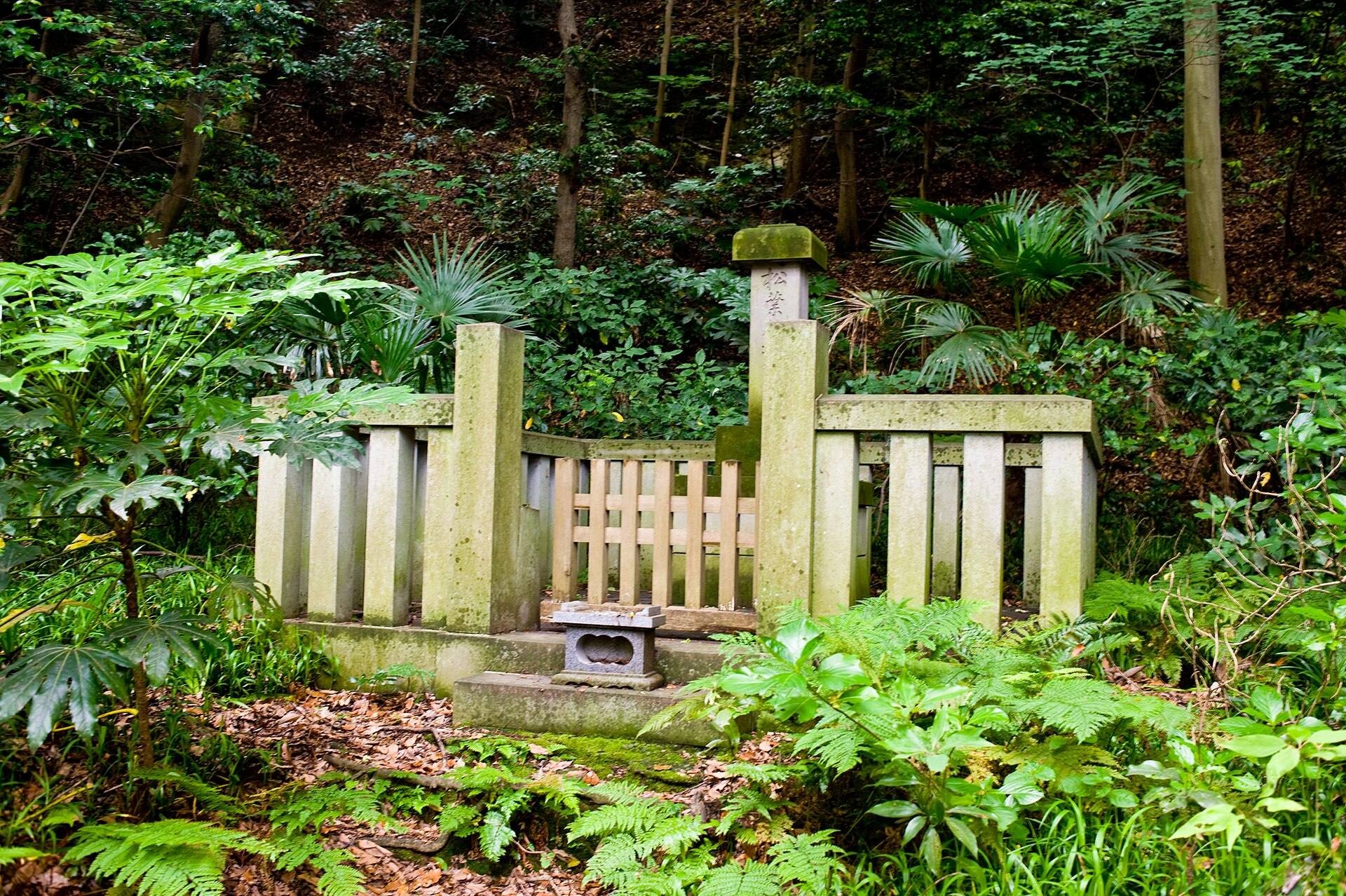
A memorial and cenotaph complex for Prince Morinaga and his wife stands beyond the Hokkedō. A cenotaph commemorates a person whose body is buried elsewhere or whose grave is represented separately. Prince Morinaga’s grave is identified on the mountaintop to the right of the small-hermitage site. The graves of Minami no Ōnkata and Nichiei are on the mountaintop to its left.
Another grave identified as Prince Morinaga’s lies at the former site of Richikō-ji in Nikaidō. The Imperial Household Agency manages that grave as his official grave, while Myōhō-ji preserves the separate memorial relationship linking Prince Morinaga with Nichiei and the temple’s refoundation.
Satsuma memorial
A memorial for people killed in the burning of the Satsuma domain residence during the late Edo period stands to the left of the Niō gate. It originally stood at a Myōhō-ji subtemple within the Satsuma residence and was moved to its present location in 1995.
Other commemorative features
The grounds contain a memorial mound for dance fans, where they are ritually commemorated, as well as the temple’s bronze bell. Together with the caves, graves, cenotaphs, and monuments, these features preserve the complex’s continuing use as a place of Buddhist devotion and memorial practice.