Hōkongō-in Temple: A Historic Risshū Buddhist Temple in Kyoto


Site at a Glance
- Rating
- 4.2
- Popularity
- Low
- Country
- Japan
- Primary era
- Medieval
- External website
- Open
- Eras represented
- Medieval
- Civilizations
- Tokugawa
- Site type
- Religious
- Remains
- Monastery
On this page12 sections
History
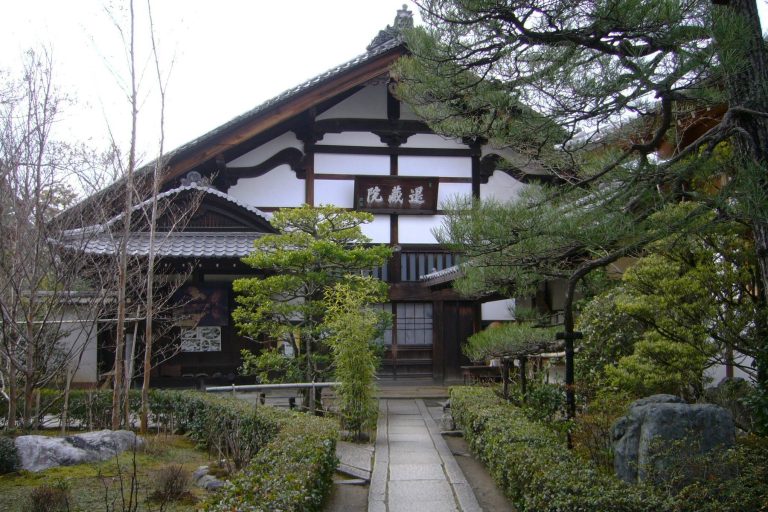
Hōkongō-in Temple is a Buddhist temple of the Risshū school in Kyoto, Japan, with origins around 830 and a history rooted in the late Heian period. The Risshū tradition emphasizes monastic discipline and the formal observance of Buddhist precepts. The temple stands at the eastern foot of the scenic hills known as the Twin Hills and is formally called Goi-san Ten’anji Hōkongō-in.
From Mountain Villa to Ten’anji
Around 830, the court minister Kiyohara no Natsuno built a mountain villa at the site. After his death, the property was converted into a temple known as Twin Hills Temple. Emperors Saga, Junna, and Ninmyō are recorded as having visited it. During Ninmyō’s visit, he climbed the mountain behind the temple and awarded it the rank of “fifth rank.” The mountain and the temple’s mountain title consequently became Goi-san.
In 858, Emperor Montoku sponsored the construction of a temple compound. The institution was then renamed Ten’anji and classified as a teigakuji, an officially recognized Buddhist temple within a prescribed category of the early imperial temple system. The temple later declined, but its fortunes changed during the late Heian period.
Taikenmon-in and the Late-Heian Revival
In 1130, Taikenmon-in, the Buddhist name of Fujiwara no Tamako, revived the institution and gave it the name Hōkongō-in. A prominent woman of the late Heian court, she had been the empress-consort of Emperor Toba and the mother of Emperors Sutoku and Go-Shirakawa. After entering religious life, she became closely associated with the temple’s renewed foundation.
During Hōkongō-in’s most prosperous period, its religious and architectural arrangement centered on a Pure Land garden, a sacred landscape designed to evoke the Buddhist Pure Land through a pond and an image hall. A western hall housed a large seated image of Amida Buddha, while a southern building was known as the Nine-Amida Hall. Taikenmon-in’s residence stood to the east of the complex.
Risshū Revival and Later Damage
In 1279, the monk Enkaku Juman revived Hōkongō-in as a Risshū temple and made it a center of Yūzū Nenbutsu. This practice centers on reciting Amida Buddha’s name, with the devotional merit of one person understood to benefit others.
The temple suffered major damage during the Ōnin War, the fifteenth-century conflict that divided the Muromachi government and devastated parts of Kyoto. It was damaged again by the war fires of the Tenshō era and by the Keichō earthquake. In 1617, a monk named Shōchin rebuilt the main hall and the sutra repository.
Excavation and Continuing Associations
Archaeological excavation in 1970 revealed the remains of the late-Heian Pure Land garden, including its layout around a pond. The garden was subsequently restored. Hōkongō-in’s principal Amida image was designated a National Treasure in 2020, while its artificial waterfall holds designation as a National Special Place of Scenic Beauty.
Taikenmon-in’s tomb lies in the cemetery north of the temple. Since the Meiji period, the tomb has been separated from Hōkongō-in and administered by the Imperial Household Agency as the mausoleum of Emperor Toba’s empress Tamako. Its present approach is from the north side of the hill rather than through the temple. Hōkongō-in is also associated with the Kansai Flower Temples Pilgrimage as its thirteenth temple and with the Kyoto Thirteen Buddhist Deities Pilgrimage as its tenth.
Remains
Pure Land Garden
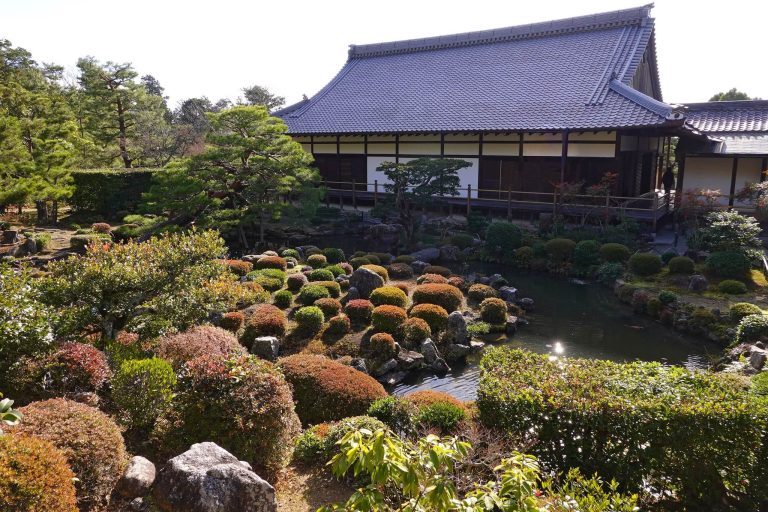
The surviving garden occupies the site’s historic religious landscape at the eastern foot of the Twin Hills. It is a Pure Land-style garden arranged around a pond, with an artificial waterfall incorporated into the design. The waterfall is regarded as Japan’s oldest artificial waterfall and is designated a National Special Place of Scenic Beauty.
The garden’s late-Heian layout was uncovered during the 1970 excavation and later restored. Its pond-centered arrangement preserves the physical basis of the landscape associated with Hōkongō-in’s medieval prosperity. The former western Amida hall, southern Nine-Amida Hall, and Taikenmon-in’s eastern residence belong to the documented medieval compound layout.
Sacred Images and Objects
Seated Amida Buddha
The wooden seated Amida Buddha is a late-Heian sculpture in the Jōchō style, a major eleventh-century manner known for serene figures and refined proportions. The image measures 2.27 metres in seated height and is regarded as the presumed principal image of the former hall that housed a jōroku Amida, meaning an image made to the traditional sixteen-shaku scale for major Buddhist figures. It is one of three Jōchō-style Amida images, alongside those at Byōdō-in and Hōkai-ji, and became a National Treasure in 2020.
Eleven-Headed Kannon
The wooden seated Eleven-Headed Kannon is kept in a shrine cabinet. Its four-armed seated form is unusual, and the figure contains a copper reliquary for sacred relics. A red-lacquer inscription on the underside states that the sculpture was produced in 1316 and that printed Buddhist images were deposited within it in 1319.
The deposits include a 1319 votive text concerning the image’s creation, five scrolls of printed Eleven-Headed Kannon images, and 1,000 individual printed images. They also contain 461 sheets with dharanis, lists of participants in devotional connections, and names of eminent monks from several Buddhist traditions. A printed seed-syllable mandala and another known as the Kesa Mandala are included as well, with one bearing an ink inscription dated 1319.
Jizo and Monju
The wooden standing Jizo and the wooden seated monk-form Monju are both late-Heian sculptures. Jizo is associated with protection and the guidance of beings, while Monju represents Buddhist wisdom.
The wooden seated Jizo is approximately one jō six shaku in size. Gold leaf was formerly applied to its eyes, giving rise to the name “Gold-Eyed Jizo.” The image is also known as “Key Jizo” and “Wish-Granting Jizo.” It is normally not publicly displayed, and a Buddhist service for it is held on the twenty-third day of each month.
Lotus Incense Burner
The lotus-form incense burner is made of Ko-Kiyomizu ware, a traditional type of Kyoto ceramic, and is shaped as a lotus flower. It is deposited at the Kyoto National Museum rather than kept at Hōkongō-in.