Jingo-ji Temple: A Shingon Buddhist Head Temple in Kyoto


Site at a Glance
- Rating
- 4.4
- Popularity
- Medium
- Country
- Japan
- Primary era
- Early Modern
- External website
- Open
- Eras represented
- Early Modern, Modern
- Civilizations
- Japanese, Tokugawa
- Site type
- Religious
- Remains
- Monastery
On this page15 sections
History
Jingo-ji Temple is a Shingon Buddhist temple in Japan, located on Mount Takao in northwestern Kyoto. Established in 824 through the union of two earlier temples, it became a protected private institution dedicated to state protection through Buddhist ritual and the favor of the Hachiman deity. Its principal image is Yakushi Nyorai, the Buddha associated with healing and relief from illness.
Foundations in the Early Heian Period
The temple developed from Jingan-ji and Takaosan-ji, two private institutions connected with the Wake clan. Jingan-ji was founded by Wake no Kiyomaro, a senior court official active from the late Nara period into the early Heian period. Kiyomaro was associated with the relocation of the capital to Heian-kyo and with the temple’s foundation tradition. The original site of Jingan-ji remains connected with several proposed locations, including Mount Nijo in Kawachi Province and Mount Otoko in Yamashiro Province. Its foundation has been placed around 780 or during the Enryaku era, while a land donation in 793 provides its latest possible foundation date.
Takaosan-ji stood on the site occupied by Jingo-ji today. It is first known from an event in 802, when Wake no Hiroyo invited Saicho, the founder of the Tendai school, to lecture there on the Lotus Sutra in memory of Wake no Hiromushi. The temple’s foundation circumstances are otherwise uncertain. Tradition links it with the transfer of the deity Atago Gongen from Takamine to Mount Atago and with mountain temples later known as the Five Atago Temples.
Kukai, the monk traditionally regarded as the founder of Shingon Buddhism in Japan, lived at Takaosan-ji in 812 and held an abhisheka, an esoteric Buddhist initiation or consecration ceremony, there. In 824, the government recognized the combined institution as a protected private temple and gave it the formal name Jingo-koku-so Shingon Temple. The stated reason for exchanging the estates was ritual pollution at Jingan-ji. Another interpretation regards the change as the replacement of the Wake family temple by the more prestigious Takaosan-ji, which was associated with both Saicho and Kukai. The standing Yakushi Nyorai image formerly belonging to Jingan-ji was transferred to the new institution and became its principal image.
Decline and Medieval Revival
After Kukai, his disciples Jitsue and Shinzei served as heads of the temple. Fires in 994 and 1149, together with other disasters, repeatedly damaged the institution, and Jingo-ji had declined by the end of the Heian period.
The medieval revival began when the monk Mongaku visited in 1168 and found the sanctuary associated with Hachiman and Kukai in a decayed condition. He rebuilt the Yakushi Hall, the Noryoden associated with Kukai’s former residence, and the Fudo Hall. His effort to obtain further estates from Retired Emperor Go-Shirakawa resulted in his exile to Izu Province in 1173, which effectively suspended reconstruction. Go-Shirakawa later granted land in Kaseda Estate in Kii Province in 1183, and Minamoto no Yoritomo granted additional estates in 1184. Jingo-ji eventually held eight estates, providing the financial base for the work to continue.
Go-Shirakawa visited Jingo-ji in 1190. Mongaku also served as a political intermediary between Go-Shirakawa and Yoritomo, but involvement in the San Saemon Incident led to his exile to Sado Province. He returned to Kyoto in 1202, was exiled again in 1203 or 1205 to Tsushima, or according to another tradition to Oki Province, and died in exile. Go-Toba is said to have transferred control of the temple to a monk and confiscated its estates for distribution among court women and close retainers.
Restoration and Imperial Patronage
After the Jokyu War of 1221, a conflict that ended with the defeat and exile of the retired emperor Go-Toba, Go-Takakura-in ordered Jingo-ji’s restoration. Confiscated estates were returned to the monk Jokaku, a disciple of Mongaku. A Buddhist teaching assembly was held under Myoe in 1225, and restoration was completed in 1226. A major dedication ceremony, the Takao Grand Buddhist Service, followed for Kitashirakawa-in, the widow of Go-Takakura-in.
The restoration brought a dispute over control of the temple. Kitashirakawa-in installed her nephew Shūzen as head and sought to make Jingo-ji an imperial prayer temple. The plan failed after opposition from Prince Dōshin and the extinction of Go-Takakura-in’s imperial line. Myoe, a restorer of the Kegon school and the reviver of Kozan-ji, was Jokaku’s nephew and had also lived at Jingo-ji.
Emperor Go-Uda protected the temple during the late Kamakura period because of its association with Kukai, and Emperor Go-Daigo also favored it. Warfare in the Tenbun era, from 1532 to 1555, completely burned Jingo-ji.
Early Modern Reconstruction and Modern Change
Tokugawa Ieyasu returned 1,500 chōbu of the temple’s former estate in 1601. In 1615, the monk Ryugen entered from Yashima-dera, and Kyoto shoshidai Itakura Katsushige, a high-ranking Tokugawa official responsible for overseeing Kyoto and its imperial court, supervised a major reconstruction completed in 1623. By the middle of the Edo period, Jingo-ji had recovered to seven halls, nine branch temples, and fifteen monks’ quarters.
The Meiji government’s separation of Buddhism and Shinto resulted in the destruction of the nine branch temples and fifteen monks’ quarters. Two affiliated temples and all subordinate temples were transferred to other institutions, and Jingo-ji declined. In 1874, the shrine dedicated to Wake no Kiyomaro was renamed Go-o Shrine, given the status of a special class imperial shrine, and moved to its present location in 1886.
Businessman Yamaguchi Gendo donated a new main hall, a Tahoto pagoda, the Ryu-o Hall, a mausoleum for Wake no Kiyomaro, and a tea house in 1935. Part of the former estate was returned by the government as temple precinct land in 1952. Jingo-ji is now a head temple of the Koyasan Shingon branch and belongs to several pilgrimage networks, including the Saigoku Yakushi pilgrimage, the Eighteen Ancient Buddhist Pagodas pilgrimage, and the Shinto-Buddhist pilgrimage route.
The temple and its associated cultural properties include sixteen National Treasures of Japan. Many of these treasures and Important Cultural Properties are deposited at the Kyoto National Museum or Tokyo National Museum and are displayed at Jingo-ji during the annual temple-treasure airing event in May. Throwing unglazed earthenware discs to avert misfortune is regarded as a practice that originated at Jingo-ji. Together with Makio at Saimyo-ji and Toganoo at Kozan-ji, the temple’s area forms the Three Ridge Areas, known for their autumn foliage.
Remains
Mountain Setting and Precinct Layout
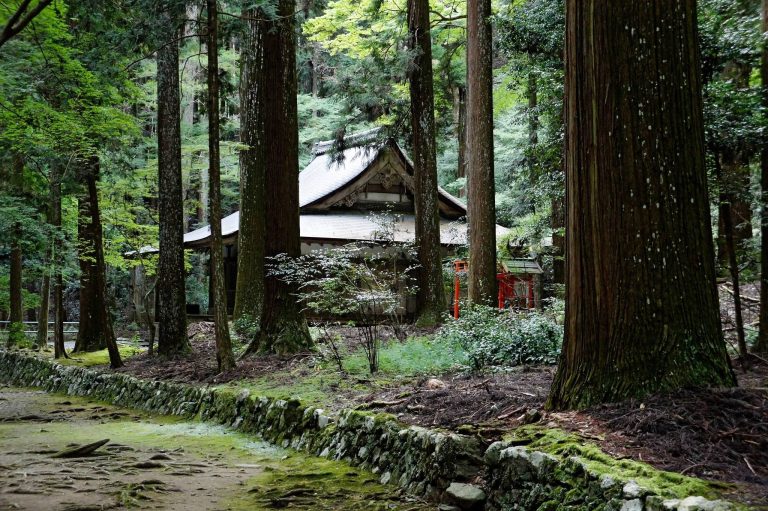
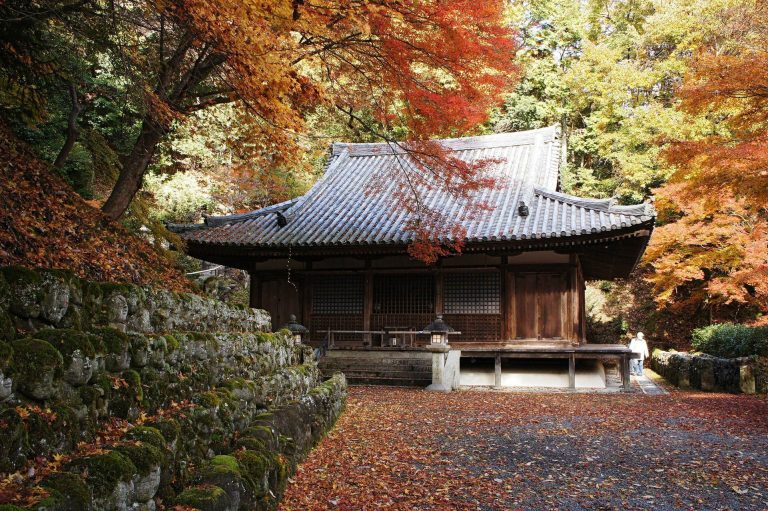
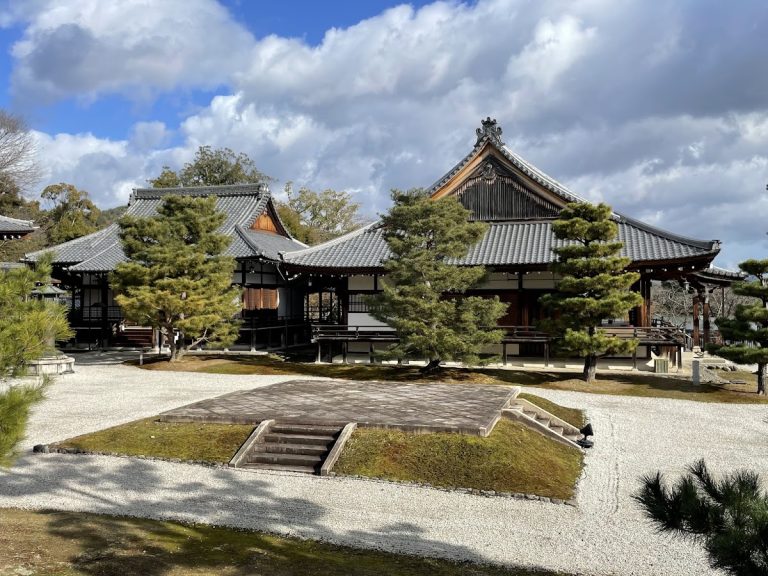
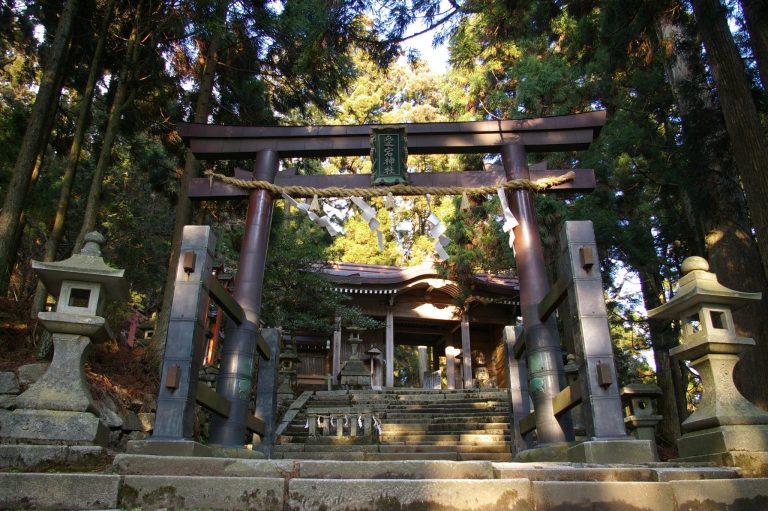
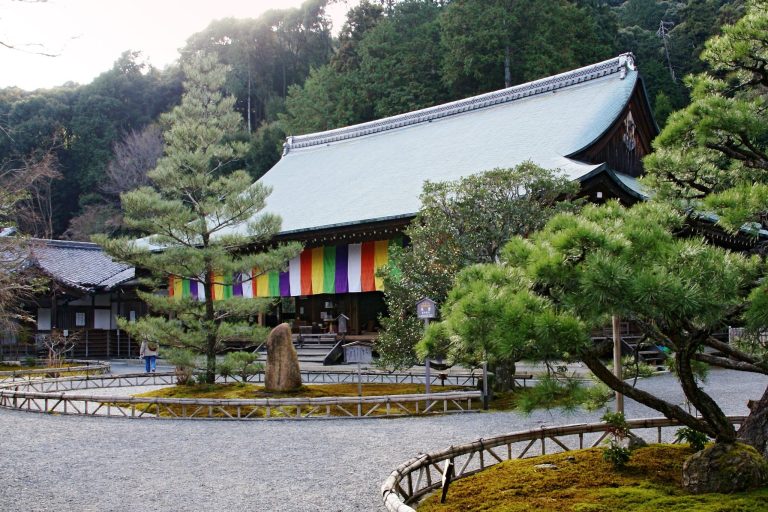
Jingo-ji occupies a level area cut into the middle slope of Mount Takao in the Atago mountain range. The precinct lies above the Kiyotaki River and is reached from Takao Bridge by a long approach and stairway. The temple gate, or Romon, faces west. From the gate, the buildings extend across the mountainside, with the Shoin, the mausoleum of Wake no Kiyomaro, the bell tower, and the Myo-o Hall on the right. The Godai Hall and Bishamon Hall stand farther into the precinct and face south. The Daishi Hall lies behind Bishamon Hall, while stairs north of the Godai Hall rise to the main hall and the Tahoto pagoda on higher ground. Jizo-in occupies the western edge of the grounds.
Surviving Buildings
Romon and Early Edo Buildings
The Romon, Bishamon Hall, Godai Hall, and bell tower belong to the reconstruction completed in 1623. The building now used as Bishamon Hall was formerly identified as the main hall. The Godai Hall houses statues of Fudo Myoo and other wrathful Buddhist deities. A ceremonial well called an Akai is installed within the precinct.
Main Hall and Tahoto Pagoda
The present main hall and Tahoto pagoda were built in 1934. The main hall houses the central image of Yakushi Nyorai, the Buddha of Healing. The pagoda stands on higher ground behind the main hall, forming part of the upper arrangement of the precinct.
Daishi Hall
The construction date of the Daishi Hall is unrecorded, and the date of the present building is uncertain. It was regarded as the only original building to survive the Onin War. The hall stands behind Bishamon Hall and preserves one element of the temple’s earlier architectural history within the later precinct.
Religious and Material Treasures
Yakushi Nyorai and Kukai’s Name List
Jingo-ji’s National Treasure holdings include the principal Yakushi Nyorai image and Kukai’s 812 Name List of Abhisheka Initiates. The list records people and deities who received abhisheka at Takaosan-ji under Kukai. It also provides evidence of Kukai’s calligraphic skill.
Jingo-ji Sutras
A Buddhist sutra translated by Gunabhadra was handed down at Jingo-ji. It formed part of the Buddhist corpus known as the Jingo-ji Sutras, which originally contained more than 5,400 volumes. A reported 2,317 volumes remain, while the others were dispersed outside the temple.
Kin’un Gorge and Protective Practice
In the open area before Jizo-in, small unglazed clay cups are traditionally thrown toward the Kiyotaki River valley. The act is intended to avert misfortune. The valley, known as Kin’un Gorge, includes a view of the gorge and cliffs above the river, placing this practice within the mountain landscape of the temple precinct.