Kōzan-ji Temple: A Kamakura-Period Buddhist Monastery in Kyoto


Site at a Glance
- Rating
- 4.2
- Popularity
- Medium
- Country
- Japan
- Primary era
- Early Modern
- External website
- Open
- Eras represented
- Medieval, Early Modern, Modern
- Civilizations
- Japanese, Kamakura shogunate, Tokugawa
- Site type
- Religious
- Remains
- Monastery
On this page16 sections
History
Kōzan-ji Temple is a Buddhist temple in Japan, in the mountainous Toganō area of Kyoto, whose present foundation dates to 1206 during the Kamakura period. The monastery was established by the monk Myōe with the support of the retired Emperor Go-Toba and became a major center for the revival of Kegon Buddhism, a tradition based on the Avataṃsaka Sutra and its teachings on the interdependence of all phenomena.
Early religious foundations
Toganō was regarded as a suitable place for mountain asceticism, and small religious establishments existed there from an early period. Tradition attributes the foundation of a temple on the site to an imperial order issued by Emperor Kōnin in 774. Names associated with this early institution include Toganō-ji and Toganō-bō, but the historical basis of the foundation story remains uncertain. During the Heian period, the institution became a branch temple of nearby Jingo-ji and was known as Jingo-ji Jūmujin-in. It appears to have served primarily as a secluded place for religious practice.
Myōe and the refoundation of 1206
The effective founder and principal restorer of the present temple was Myōe, a Kegon monk of the Kamakura period who had been connected with Jingo-ji and had studied under Mongaku. In November 1206, Go-Toba granted him the Toganō estate for an independent monastery and presented a plaque bearing the words “the temple of the high mountain first illuminated by the rising sun.” This grant is regarded as the foundation of Kōzan-ji in its present form. The name refers to a passage in the Avataṃsaka Sutra comparing the first rays of the rising sun reaching the highest mountain with the radiance desired for the temple.
Myōe sought to revive Kegon Buddhism and emphasized the aspiration for enlightenment together with obedience to Buddhist precepts. He strongly criticized Hōnen’s teaching of exclusive nenbutsu, the devotional recitation of a Buddha’s name, especially Amida’s name, as the sole practice for rebirth in the Pure Land. Despite this disagreement, Myōe and Hōnen remained on friendly terms. Myōe also established a meditation hermitage at Kōzan-ji.
A tradition connected with the Jōkyū disturbance of 1221 relates that court forces fled into the mountains and that Myōe was captured by Hōjō Yasutoki, a leading regent of the Kamakura shogunate. His preaching is said to have helped calm the violence. The tradition places Myōe within the political and religious tensions of the early Kamakura period, when warrior government and new Buddhist movements were reshaping Japanese society.
Tea cultivation and medieval reputation
Myōe is traditionally said to have received tea seeds from Eisai, who had obtained them during study in Southern Song China, and planted them at Toganō. Cultivation continued after Myōe’s death. Another tradition holds that he distributed seeds at the request of residents of Uji, from where tea growing spread more widely. By the late Kamakura period, tea from Toganō was highly regarded, including among warriors in eastern Japan.
During Muromachi-period tea-tasting contests, tea from Toganō was called honcha, or principal tea, while tea from other regions was called hicha. These terms identified the place of origin rather than a difference in quality. The claim that Kōzan-ji preserves Japan’s oldest tea garden has not been verified. The present tea plot was created in the 1960s by Uji tea producers to commemorate Myōe, although an earlier cultivation area remains within the temple grounds.
Destruction, recovery, and institutional change
A main hall built in 1219 received a sixteen-foot Rushana Buddha and Four Heavenly Kings made by Unkei and his pupils in 1223. The sculptures had originally belonged to Jizō Jūrin-in, a memorial temple established by Unkei, and were moved to Kōzan-ji after that temple burned in 1218. They were later destroyed in a fire during the Muromachi period.
Kōzan-ji repeatedly suffered destruction through warfare and fire. The temple burned during the Ōnin War of 1467–1477, a conflict that divided the Muromachi government and devastated Kyoto. Grants from Oda Nobunaga, Toyotomi Hideyoshi, and Tokugawa Ieyasu supported its recovery. The Meiji Restoration brought further damage, and nearly all of the Kamakura-period buildings were lost except the structure identified with Sekisui-in.
Kōzan-ji originally maintained both Kegon and Shingon teachings. After the Meiji Restoration, Shingon became its sole formal affiliation. In 1966, the temple left the Omuro branch of Shingon Buddhism, an institutional branch associated with Ninna-ji, in protest against the sale of land at Narabigaoka by the Ninna-ji authorities. It thereafter became an independent temple related to Shingon Buddhism.
In 1975, the abbot, who was a master of the thousand-day mountain-circuit practice, made Kōzan-ji a brother church with the Catholic Church of Saint Francis. The partnership was described as the first of its kind in world religious history. The grounds are designated a national historic site, and in 1994 the temple became part of the UNESCO World Heritage property “Historic Monuments of Ancient Kyoto.”
Medieval plan and surviving records
A picture plan made in 1230, about two decades after Myōe’s refoundation, preserves evidence of the medieval compound. It shows a main gate, main hall, three-storied pagoda, Amida Hall, Rakan Hall, bell tower, scripture storehouse, and a shrine for the tutelary deity. Jingo-ji preserves the plan, which is designated an Important Cultural Property. A cataloguing project begun in the late 1960s comprehensively recorded Kōzan-ji’s holdings. The temple’s literary documents number approximately 12,000, many dating from the Heian and Kamakura periods. Most designated cultural-property holdings other than buildings are deposited with the national museums in Tokyo and Kyoto, while the temple maintains a storehouse for artworks and documents.
Remains
Mountain setting and compound layout
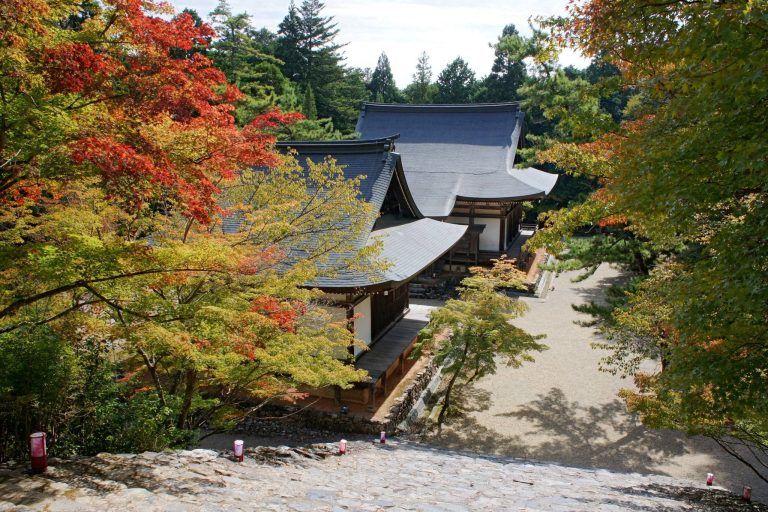
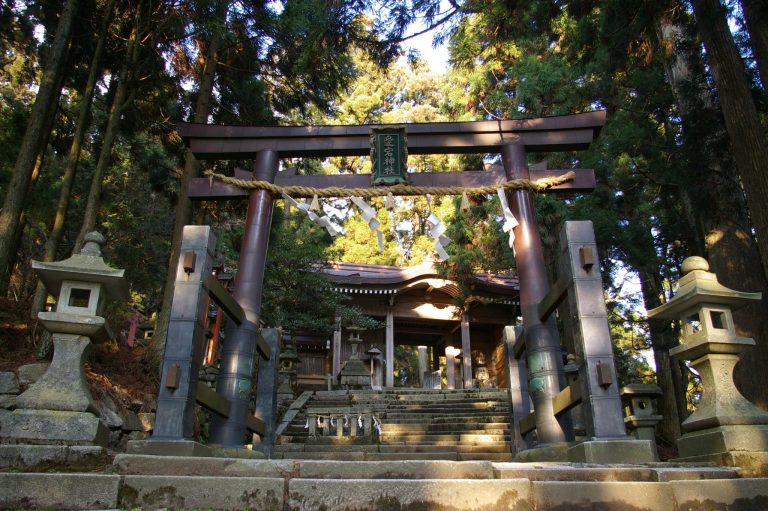
Kōzan-ji occupies a mountainside beside the Kiyotaki River, among forested hills. From the direction of Jingo-ji, the approach follows the Shūzan-kaidō before branching toward the temple. A narrower rear approach rises beside moss-covered stone walls, and two stone lanterns mark the position of the former main gate. The medieval compound shown in the 1230 plan included a large gate, main hall, three-storied pagoda, Amida Hall, Rakan Hall, bell tower, scripture hall, and tutelary shrine. Stone revetments along the route from Sekisui-in to the Founders Hall preserve traces of former halls and subsidiary residences.
Surviving buildings
Sekisui-in
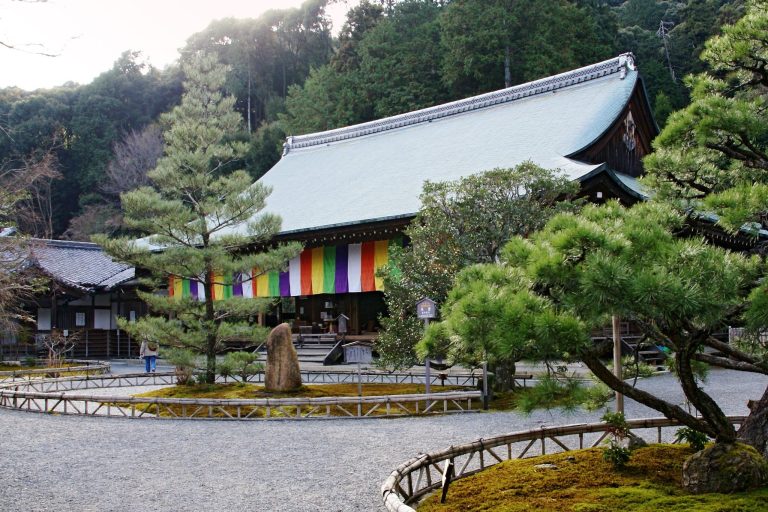
Sekisui-in is the oldest surviving building associated with Kōzan-ji and dates from the early Kamakura period. It served as a scripture storehouse and was known as the Eastern Scripture Hall. The original Sekisui-in was destroyed by a flood in 1228, after which the Eastern Scripture Hall inherited its name. The surviving building was moved to its current position during reforms in 1889. Its irimoya roof, which combines a central gable with sloping hipped sections, is covered with shingles. The south side overlooks the Kiyotaki River. The building was originally associated with two Shinto deities and later acquired features of a residence.
Main Hall
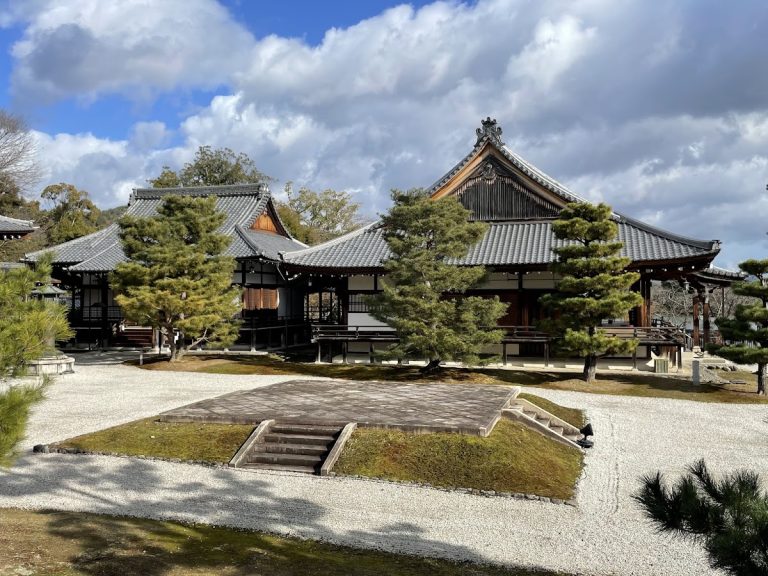
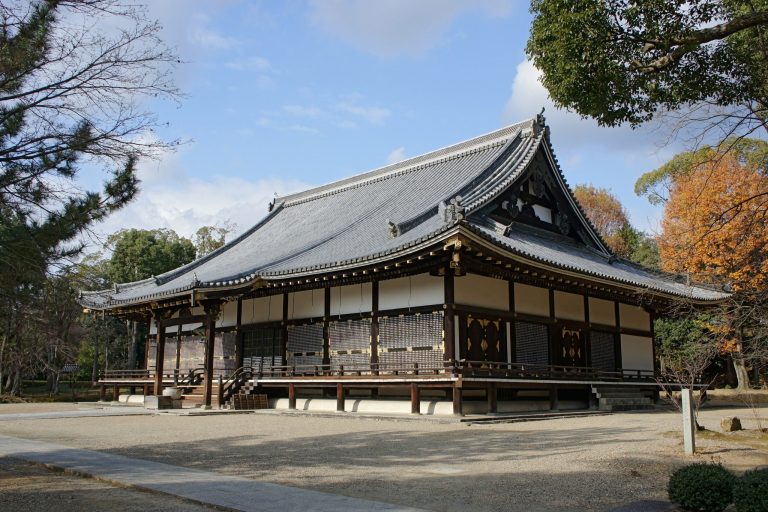
The main hall stands farther within the forest, higher on the mountainside, on a level area reached by steep stone steps. Its copper-covered irimoya roof resembles that of Sekisui-in. The original hall burned during the Muromachi period, and the present building was transferred from Ninna-ji to Kōzan-ji around the beginning of the Edo period, approximately during the 1620s–1640s. It houses the image of Sakyamuni Buddha, the temple’s principal object of worship.
Founders Hall and mausoleum
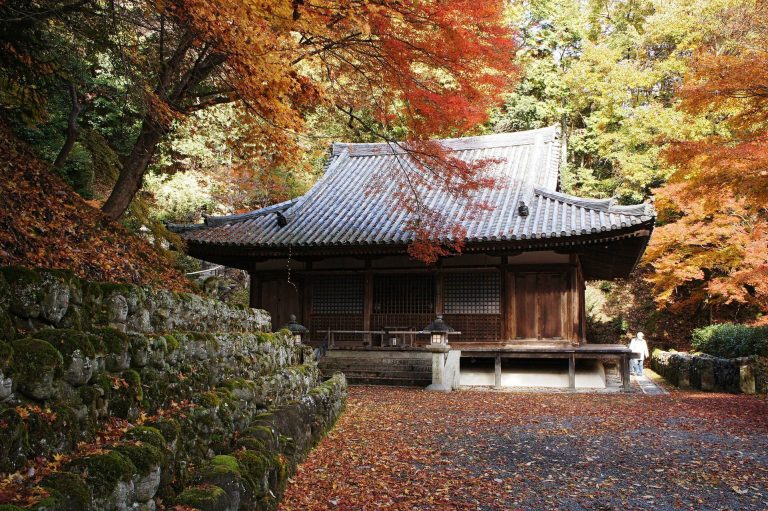
The Founders Hall, or Kaizandō, is dedicated to Myōe and contains a seated wooden image of him. The original hall burned during the Muromachi period, while the present structure dates from the Edo period. A mausoleum beside the hall contains Myōe’s grave.
Tea house and storehouse
Ikō-an, a tea house, was completed in 1931, seven hundred years after Myōe’s death. Below the Founders Hall is a three-story concrete storehouse for the temple’s artworks and documents. The present tea plot lies on the grounds, while the earlier cultivation area was on the opposite bank of the Kiyotaki River. The current plot is thought to occupy the former site of Jūmujin-in, a residential building for monks.
Picture scrolls and paintings
The four uncoloured ink scrolls known as Chōjū-jinbutsu-giga are National Treasures. The first scroll portrays rabbits, frogs, monkeys, and other animals acting like people. The second presents animals in a naturalistic manner, while the third combines caricatures of people taking part in contests and games with animal caricatures. The fourth contains vigorously drawn human figures. The first two scrolls are generally dated to the late Heian period and the last two to the Kamakura period. Their production and subjects remain debated, and the artist is unknown, although the monk Kakuyū has been proposed. The temple displays copies, while the originals are deposited with the Tokyo National Museum and Kyoto National Museum.
The National Treasure Kegon-shū Soshi Eden consists of seven picture-scroll sections depicting the lives of the Silla monks Uisang and Wonhyo, regarded as founders of Korean Kegon Buddhism. The National Treasure Myōe Shōnin-zō, also called the Tree-top Meditation Portrait, shows Myōe as a small figure meditating within a mountain landscape rather than in a conventional monumental portrait. It dates from the Kamakura period. The National Treasure Butsugen Butsumo-zō, a late-twelfth- or early-Kamakura-period image of the Buddhist mother figure Butsugen Butsumo, was one of Myōe’s devotional images and bears an inscription written by him.
Other paintings and manuscripts include images of the Maitreya and Mañjuśrī bodhisattvas, the Kegon Kaie Shoshōju mandala with Vairocana Buddha, other bodhisattvas, and sixty-one Kegon holy beings, a life-sized portrait of Myōe, and a painting of Shunwayashin from the Avataṃsaka Sutra. The nearly four-metre-long Shōgunzuka Engi-emaki depicts a legend associated with the founding of Heian-kyō. Other works portray Konoe Kanetsune, the six Zen patriarchs, and the Chinese monk Amoghavajra.
Muromachi-period works include paintings of the Shinto deities Kasuga Myōjin and Sumiyoshi Myōjin, as well as a fragment showing a conversation between Myōe and the monk Enkū of Kennin-ji. Three late-seventeenth-century Edo-period copies depict Myōe preaching to Hōjō Yasutoki. A mandala from the period of the Northern and Southern Courts shows Amida as the Buddha worshipped at Kumano Hongū Taisha and illustrates honji suijaku, the theory that Japanese kami were local manifestations of Buddhas.
Manuscripts and Buddhist sculpture
The National Treasure Yupian manuscript preserves the first half of the twenty-seventh section of a Chinese character dictionary created during the Liang period and copied during the Tang period. Because the Chinese original was lost early in China, the Japanese manuscript is especially important. Tenrei Banshō Meigi is regarded as the only surviving old manuscript of the character dictionary attributed to Kūkai, the monk who established Shingon Buddhism in Japan; its colophon records copying in 1114. The National Treasure Meihō-ki is a copy of a Tang-period collection of Buddhist tales and is considered its oldest surviving copy because the work disappeared in China.
Important Cultural Properties include a late-Nara-period dry-lacquer seated statue of Bhaisajyaguru, originally the central figure of a triad. The attendant statues of Suryaprabha and Chandraprabha left the temple during the Meiji period and are now held by institutions in Tokyo. A Kamakura-period wooden statue of Myōe is kept in the Founders Hall. Other sculptures include wooden deer, pairs of komainu, or guardian figures, a wooden horse, and a life-sized wooden dog. The deer, regarded as messengers of Kasuga Myōjin, are thought to have stood before a deity’s altar. Several animal sculptures have been attributed to the sculptor Tankei.
Standing wooden statues of Byakkōshin and Zenmyōshin date from the early Kamakura period and are traditionally attributed to Tankei. Byakkōshin is painted entirely white, including the clothing and pedestal, to symbolize Himalayan snow, while Zenmyōshin retains vivid colours. Further Kamakura-period objects include small figures of Byakkōshin and Zenmyōshin, six small guardian figures, a life-sized puppy, and two deer. The deer were placed in the Eastern Scripture Hall in 1235 to guard images of Kasuga and Sumiyoshi deities.
Temple archive
The Kōzan-ji archive, an Important Cultural Property, contains 9,293 Buddhist scriptures and records transmitted by the temple from the Heian period through the early modern period. Kōben Yume-no-Ki comprises seventeen records of Myōe’s dreams from 1196 to 1223 and preserves religious experiences that strongly influenced his thought. The Kamakura-period text Daitō Tenjiku Riteisho, apparently written by Myōe when he was about thirty-three, sets out a proposed journey to India through Chang’an in China. Together with the picture plan and the temple’s artworks, these records preserve the intellectual and religious history of Kōzan-ji beyond its surviving buildings.