Yakuri-ji Temple: A Shingon Buddhist Temple and Pilgrimage Station in Japan


Site at a Glance
- Rating
- 4.3
- Popularity
- Medium
- Country
- Japan
- Primary era
- Early Modern
- External website
- Open
- Eras represented
- Early Modern, Modern
- Civilizations
- Tokugawa
- Site type
- Religious
- Remains
- Temple
On this page16 sections
History
Yakuri-ji Temple is a Shingon Buddhist temple in Takamatsu, Japan, traditionally founded by Kukai in 829. Shingon is an esoteric Buddhist tradition centered on ritual, mantra, mandala, and the veneration of Buddhist deities. Formally called Gokenzan Kanjizai-in Yakuri-ji, the temple belongs to the Daikakuji branch of Shingon and serves as the eighty-fifth station of the Shikoku 88-temple pilgrimage, a circuit traditionally associated with Kukai, also known as Kobo Daishi.
Foundation traditions and sacred identity
Yakuri-ji’s foundation tradition places Kukai on Mount Goken in 829, where he practiced the Kokuzo Gumonjiho, an esoteric meditation and ritual practice associated with memory and learning. Five swords were said to have fallen from heaven. Zao Gongen, a syncretic Japanese mountain deity associated with Shugendo and Buddhist worship, then appeared and revealed the mountain as a sacred place.
Kukai is said to have buried the swords in the mountain’s middle peak and carved a large image of Dainichi Nyorai into the rock as the mountain’s protector. Dainichi Nyorai is the central cosmic Buddha of Shingon Buddhism. The temple was initially called Yakuni-dera, meaning “Temple of Eight Provinces.” According to the same tradition, Kukai planted eight roasted chestnuts before traveling to China. When he returned in 806, the chestnuts had grown into eight large trees, and the temple’s name was changed to Yakuri-ji, incorporating the word for chestnut.
A thousand-armed Kannon associated with Kukai was connected with the temple’s foundation. Kannon is the bodhisattva of compassion, and the thousand-armed form expresses the ability to respond to many beings. The temple’s principal image later became Sho Kannon, and the institution adopted the name Kanjizai-in.
Destruction and rebuilding
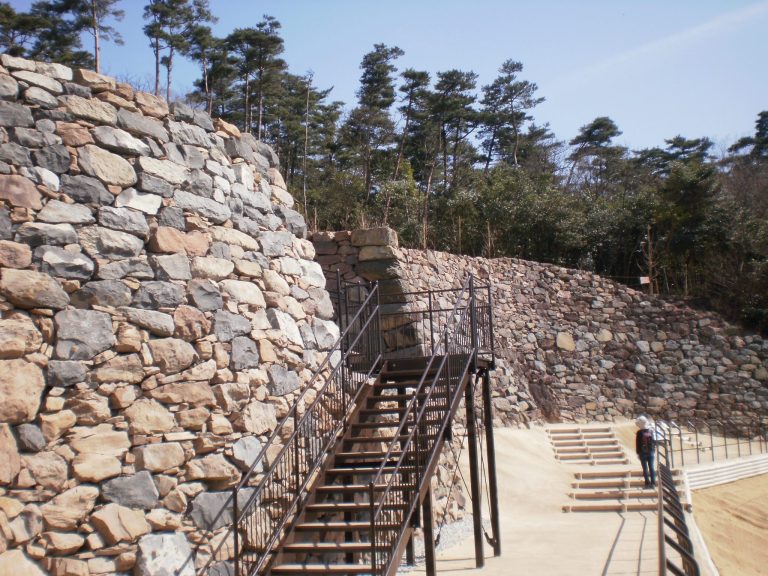
During the Tensho-era conflicts, Chosokabe Motochika’s forces invaded the area in 1583 and fought Nakamura Soboku at nearby Yakuri Castle. The fighting destroyed nearly all of Yakuri-ji’s buildings. The main hall was rebuilt during the Bunroku era, between 1593 and 1596.
In 1642, Takamatsu lord Matsudaira Yorishige rebuilt the main hall and brought the present principal image of Sho Kannon to the temple. An earthquake in 1706 caused Mount Goken’s eastern peak to collapse. The complex was subsequently moved to its present position and reconstructed. A foundation tablet records the rebuilding of the Niten-mon and main hall in 1709 under Matsudaira Yoritoyo, the third lord of Takamatsu.
Kangi-ten worship and modern history
Yakuri-ji is also known as “Yakuri’s Shoten,” reflecting its role as a major center of Kangi-ten devotion. Kangi-ten, also called Shoten, is a Buddhist devotional form associated with prosperity, worldly benefits, and the fulfillment of wishes. The temple’s image was formerly the devotional image of Tofukumon-in, a seventeenth-century imperial consort. She is said to have given it to the Buddhist practitioner Mokujiki Iku, also known as Enku, who enshrined it at Yakuri-ji in 1677. The image is treated as secret and is opened for public worship at intervals of fifty years.
In 1939, Hase Yoshio, founder of the modern religion Reiha no Hikari, meditated on Mount Goken for three weeks. On the twentieth day, he experienced what he described as a divine revelation and healing. The temple has continued to combine its role as a pilgrimage station with Kangi-ten worship. It also contains two forms of a “New Shikoku 88-temple” pilgrimage, one arranged as a group and another distributed around the temple grounds.
The ginkgo tree at Yakuri-ji received designation on March 23, 1978. Later interventions included construction of the Tahoto pagoda in 1984, completion of the O-mukae Daishi statue in December 2010, and a year-long opening of the Daishido in 2014.
Remains
Mountain approach and sacred boundary
Yakuri-ji occupies the western slopes of Mount Goken, below its rocky summit, with the mountain rising directly behind the main hall. The mountain is associated with five sword-shaped peaks. Its eastern peak, identified in tradition as the fifth sword, is said to have collapsed and rolled down to the area called Sai-no-Kawara.
Approach features
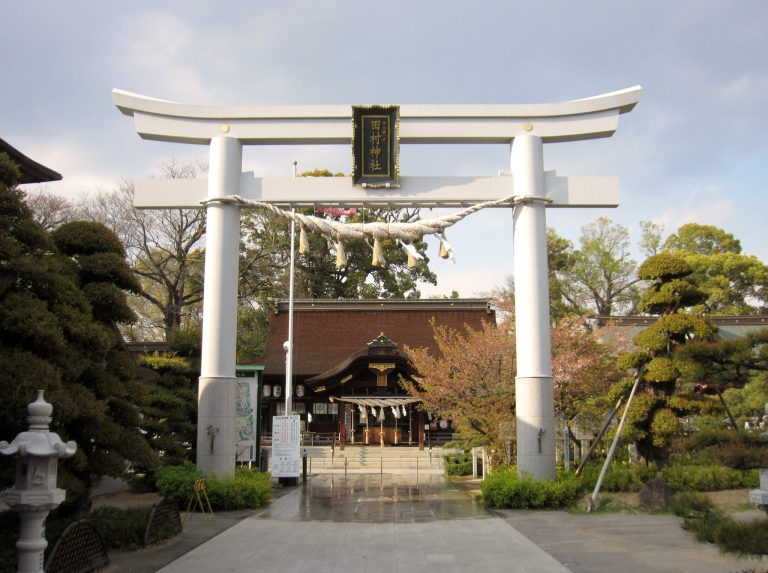
The mountain approach begins beside the lower cableway station and includes a first torii, a traditional Japanese gate marking entry into a sacred area. The route passes the small Wakamiya Shrine and the Daishi Gochisui spring. A second torii carries a plaque dedicated to Kangi-ten. Farther along stands a third torii with another Kangi-ten plaque.
Sai-no-Kawara and O-mukae Daishi
Sai-no-Kawara lies below the O-mukae Daishi statue and is regarded as the boundary between the human world and the sacred area. Several stone images stand beneath a large rock. The O-mukae Daishi is positioned opposite the cableway station, with the temple between them, and forms a viewing area overlooking Takamatsu.
Temple buildings
Niten-mon and main hall
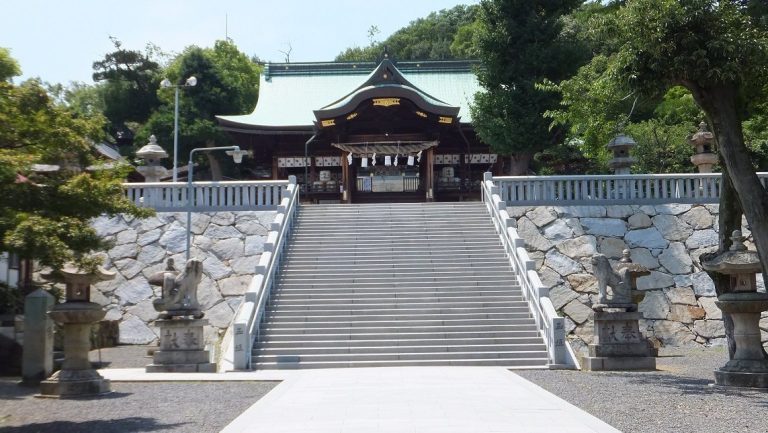
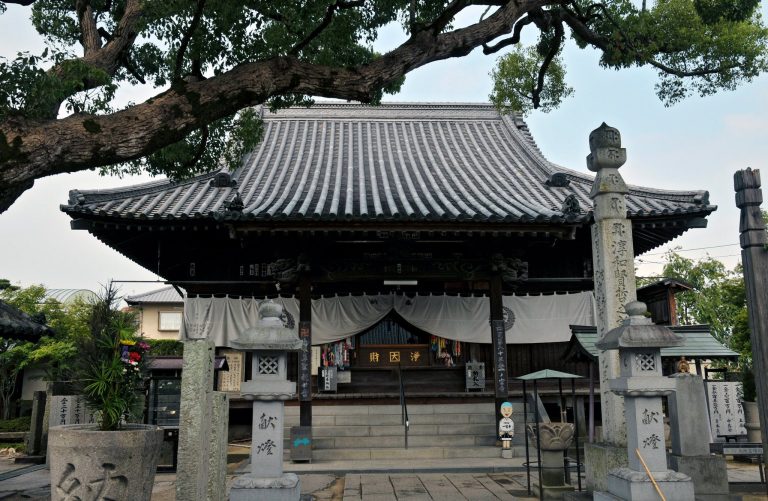
The compact temple gate is a Niten-mon, a gate guarded by two heavenly kings. It contains statues of Jikokuten and Tamonten. Beyond it, the main hall stands ahead, while the pilgrimage office lies to the left and the Daishido and Tahoto are farther to the right.
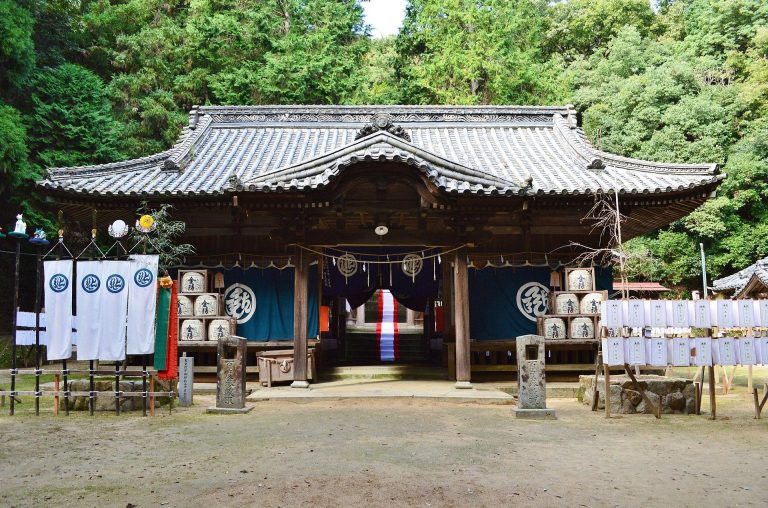
The main hall enshrines Sho Kannon as its principal image, accompanied by Fudo Myoo and Aizen Myoo. The images are opened during the first three days of each New Year. At other times, the doors of the image cabinet remain open enough for worshippers to view the figures through the front opening.
Daishido and Tahoto
The Daishido, or Founder’s Hall, also allows the image cabinet to be viewed through open doors. The Tahoto, a multi-tiered Buddhist pagoda form built in 1984, contains a seated image of Dainichi Nyorai of the Diamond Realm. Its interior is opened during the first three days of the New Year.
Kangi-ten and fire-ritual halls
The Kangi-ten Hall enshrines the Great Double-Bodied Kangi-ten King at the center. Juichimen Kannon stands on the right and Gundari Myoo on the left. Worshippers may enter after notifying the temple office. A fire-ritual hall continues from the left side of the Kangi-ten Hall and enshrines Kangi-doji. Near it stands a torii marked “Kangi-ten Shrine,” while another with the same wording is positioned in front of the cableway’s upper station.
Images, bell, and sacred trees
Devotional images and bell tower
A standing metal statue of Juichimen Kannon is positioned to the left of the main hall. Worshippers traditionally walk around it while praying. Elsewhere in the precinct, a stone tower is dedicated to Zuigu Bodhisattva, with worship including the invocation “Namu Zuigu Bosatsu” recited three times.
The bell tower contains a bell first rung in 1958 after the earlier bell had been requisitioned for wartime material. A poem by Shukaso-dojin is inscribed on the bell in connection with its religious purpose.
Bodhi tree and ginkgo
The present bodhi tree is a Chinese linden of the linden family, approximately fifty years old. It is distinct from the Indian bodhi tree associated with the Buddha’s enlightenment. Tradition holds that Kukai planted the original tree, which was designated as a natural monument.
The designated Yakuri-ji ginkgo is approximately 24.5 meters high. Its trunk measures 4.3 meters in circumference at breast height, and its crown measures approximately 12.5 by 13.5 meters.
Precinct layout
From the gate, the main hall lies directly ahead, the office is on the left, and the Daishido and Tahoto stand farther to the right. From the cableway station, the route passes the main temple office and its west gate before continuing toward the Tahoto, Daishido, and Kangi-ten Hall. The main hall is situated above and to the right of the Kangi-ten Hall. The Living-Wood Kannon stands along the Yakuri New Road outside the principal approach.