Shōfuku-ji Temple: A Buddhist Pilgrimage Temple in Kasama, Japan


Site at a Glance
- Rating
- 3.9
- Popularity
- Low
- Country
- Japan
- Primary era
- Modern
- External website
- Open
- Eras represented
- Modern
- Civilizations
- Japanese
- Site type
- Religious
- Remains
- Temple
On this page10 sections
History
Shōfuku-ji Temple is a Buddhist temple in Kasama, Japan, traditionally founded in 651 on Mount Sashiro. Affiliated with the Fumon sect, an independent branch of Shingon Buddhism, it is dedicated to Senjū Kannon, the thousand-armed form of Kannon associated with compassion and the ability to respond to many kinds of suffering. The temple is the 23rd site on the 33-temple Bandō pilgrimage route in the Kantō region and is also known as Sashiro Kannon.
Foundation on Mount Sashiro
The circumstances of the foundation remain uncertain. Temple tradition relates that a hunter encountered Kannon in a tree on Mount Sashiro and carved the image directly into the living wood. The founder and the early abbots are unknown, and no surviving records identify them. The temple originally had a different mountain name.
The original complex stood near the summit of Mount Sashiro and is said to have received a charter from Emperor Kōtoku, the seventh-century ruler whose reign is associated with the Taika reforms. At the height of its development, Shōfuku-ji was among the largest temples in the Kantō region, with more than 100 monks’ quarters.
Conflict and Kasama Castle
During the Kamakura period, Shōfuku-ji came into conflict with the neighboring Tokuzo-ji on Mount Nunobiki. The Utsunomiya clan tried to settle the dispute, but neither temple accepted a compromise. The clan then burned both temples and built Kasama Castle on Mount Sashiro.
Shōfuku-ji was rebuilt inside Kasama Castle as a prayer temple for the Kasama clan. During the Sengoku period, an era of prolonged warfare among rival military powers, the Kasama rebelled against their Utsunomiya overlords. They also refused to join Toyotomi Hideyoshi’s 1590 Siege of Odawara, the campaign that brought the Odawara-based power in the Kantō region to defeat. The Kasama clan was subsequently destroyed, and the temple declined.
Domain patronage and Meiji decline
After Kasama Domain was established during the Edo period, the temple was rebuilt once more within Kasama Castle. It was renovated during the Genroku era, from 1688 to 1704, and served as the official prayer temple of the Kasama domain lord, a daimyō who administered the domain under the feudal system of Tokugawa rule.
In the early Meiji period, the separation of Shinto and Buddhism and the abolition of Shugendō, a mountain religious practice combining Buddhist, Shinto, and other elements, brought further decline. The abolition of the han system, the domain structure of Tokugawa rule, also ended the patronage of the Kasama daimyō. The temple was lost, its principal image was sold into private hands, and other Buddhist statues and objects associated with the former castle were dispersed or transferred to a temple in the area now occupied by Sashiro Park.
Reconstruction and restoration of the temple name
A major reconstruction campaign took place during the 1920s. On April 15, 1930, a new hall was built at the present location at the foot of Mount Sashiro. Buddhist statues other than the principal image were transferred there, and the temple resumed responsibility for issuing red-seal pilgrimage stamps, the temple marks collected on the Bandō pilgrimage.
The new hall was first called Sashiro Kannon-dō and registered as a detached precinct of the temple that had organized the reconstruction. In 1983, it became an independent temple with a Sōtō-derived affiliation and was renamed Kanzeon-ji. The name Shōfuku-ji was restored in 2012.
The seated Kannon has tangible-cultural-property status under Ibaraki Prefecture. The small gilt-bronze Kannon, Fudō Myōō, and Bishamonten have tangible-cultural-property status under Kasama City. Fudō Myōō is a Buddhist wisdom king associated with protection and the destruction of obstacles, while Bishamonten is a guardian deity associated with protection, warfare, and prosperity.
Remains
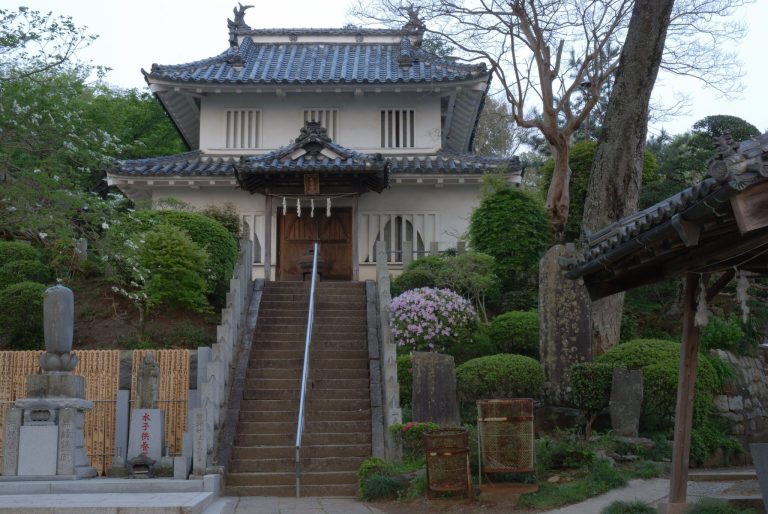
The present temple stands at the foot of Mount Sashiro, in contrast to the original temple and the later prayer temple connected with Kasama Castle, which occupied the summit or its vicinity. The principal surviving building is the hall erected on April 15, 1930. Formerly known as Sashiro Kannon-dō and later as Kanzeon-ji, it houses the principal image and the Buddhist statues transferred during the reconstruction.
Principal hall and Buddhist images
Seated Kannon
The principal image is a 58-centimeter-high wooden seated statue of Kannon Bosatsu, represented as an eleven-headed, thousand-armed Kannon. It was made using yosegizukuri, a technique in which separately carved wooden blocks are joined together, and it has crystal eyes. The halo is older and is believed to date from the late Heian period.
The statue’s date and attribution are not settled. It is catalogued as a work of the mid-Kamakura period, while an examination completed in April 2019 placed its manufacture at the end of the Heian period and attributed it to a pupil of the sculptor Unkei, a major Kamakura-period maker of powerful Buddhist images.
Gilt-bronze Kannon
Inside the principal image was a 7.7-centimeter gilt-bronze standing statue of Eleven-Headed, Thousand-Armed Kannon. The small figure was made by lost-wax casting, a process in which a wax model is encased, melted out, and replaced with molten metal. Many of the hands projecting from its body were damaged by a fire during the early Kamakura period.
Fudō Myōō and Bishamonten
A 102-centimeter wooden standing statue of Fudō Myōō bears an ink inscription stating that it was dedicated to Gokuraku-ji in 1444. It was moved to Gensho-in during the early Meiji period and enshrined at Shōfuku-ji in 1930 as an attendant to the principal image. The statue was restored at the Nara National Museum in 1987.
A 110-centimeter wooden standing statue of Bishamonten carries a similar ink inscription. It states that the image was dedicated to Gokuraku-ji in 1444, transferred to Gensho-in in the early Meiji period, and enshrined in 1930 as an attendant to the principal image. It too was restored at the Nara National Museum in 1987.