Tachiki Shrine: A Historic Shinto Shrine in Kusatsu, Japan


Site at a Glance
- Rating
- 4.3
- Popularity
- Low
- Country
- Japan
- Primary era
- Medieval
- External website
- Open
- Eras represented
- Medieval, Early Modern
- Civilizations
- Ashikaga shogunate, Tokugawa
- Site type
- Religious
- Remains
- Sanctuary
On this page12 sections
History
Tachiki Shrine is a Shinto shrine in Kusatsu, Shiga, Japan, traditionally founded in 767 during the reign of Empress Shōtoku. It is associated with Takemikazuchi-no-Mikoto, a kami linked especially with martial power, and is regarded as an old shrine in Shiga. The shrine was established beside the historic highway network at Kusatsu-juku, where the Tōkaidō met the Nakasendō.
Foundation and sacred tradition
Shrine tradition says that Takemikazuchi-no-Mikoto arrived at the site while traveling from Kashima Jingū in Hitachi Province to Kasuga Shrine in Yamato Province. Local villagers built a hall from unprocessed timber and enshrined the deity there. Takemikazuchi then planted a persimmon whip in the ground and declared that he would remain permanently at Mount Mikasa in Yamato if the whip took root.
When the whip grew into a tree, the villagers began to worship it and constructed a shrine. They honored the deity as Tachiki Daimyōjin, using Daimyōjin, an honorific title for a prominent or revered kami. The name Tachiki is traditionally linked to this sacred tree. The shrine is also regarded as a sibling institution of Kasuga Taisha, the major shrine in Nara associated with deities connected with the Fujiwara family and the ancient capital, although the tradition places Tachiki’s foundation in 767 and Kasuga Taisha’s in 768.
Imperial patronage
During a severe drought in 777, Emperor Kōnin ordered Nakatomi no Morouo, a court official associated with religious rites, to conduct a rain-prayer ceremony at Tachiki Shrine. Rain reportedly followed. The emperor is then said to have ordered a new shrine building, granted the deity the first-rank shinkai, a rank traditionally given to kami within Japan’s state-supported religious system, and presented the shrine with an imperial plaque bearing the title Tachiki Daimyōjin.
The shrine is also said to have received the first-rank divine rank from Emperor Kanmu in 786. A record preserved at the shrine assigns the granting of that rank to 1557, creating a different chronology for the title. One interpretation therefore places the beginning of the Tachiki Daimyōjin title after that date.
Warriors, domains, and highway travel
In 801, Sakanoue no Tamuramaro, the Sei-i Taishōgun, or military commander appointed to lead campaigns against peoples beyond the imperial court’s direct control, stopped at the shrine while preparing for a campaign against the Emishi. He prayed for safe travel and protection from calamity and donated a copy of the Daihannya-kyō, the Mahaprajnaparamita Sutra, a large Buddhist scriptural collection used in ritual and devotional settings.
In 1487, Ashikaga Yoshihisa, the Muromachi shogun, established a military encampment at Kagi in Kurita District for his campaign against Rokkaku Takayori. He prayed at Tachiki Shrine for lasting military success and donated a four-legged gate.
In 1645, Ishikawa Tadamune, lord of the Zeze Domain, donated shrine land producing 23 koku of rice. This historical unit measured agricultural production by an amount conventionally regarded as enough rice to support one person for a year. Tadamune also sponsored associated shrines within the precinct, and successive lords of Zeze continued to make donations.
The shrine’s position at Kusatsu-juku brought it into the regular movement of travelers along the Tōkaidō and Nakasendō. During sankin kotai, the Tokugawa-period system requiring regional lords to alternate residence between their domains and Edo, daimyos traveling through Kusatsu-juku reportedly prayed at the shrine for safe journeys. Tradition holds that they suffered no accidents or disasters as a result. The same setting helped establish the shrine’s associations with protection from misfortune, good fortune, and traffic safety.
Modern classification
In 1876, Tachiki Shrine was classified as a village shrine. It was raised to the higher gōsha rank in 1881, a historical shrine category above the village-shrine classification. In 1938, it was designated a shrine eligible to receive offerings of ritual food and cloth.
Remains
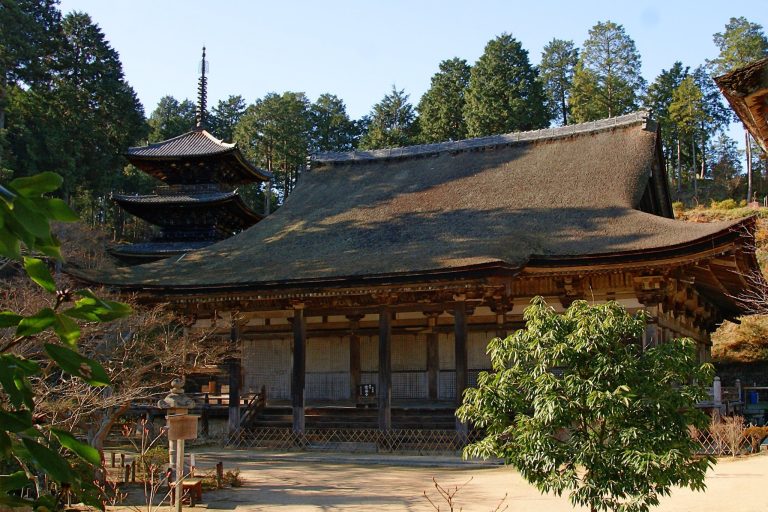
Tachiki Shrine’s surviving features include a main sanctuary in the three-bay nagare-zukuri style, the present shrine gate, the traditionally venerated persimmon tree, and associated shrines within the precinct. Nagare-zukuri is characterized by a roof whose front slope extends over the entrance.
Main sanctuary and sacred tree
Main sanctuary
The main sanctuary follows the three-bay nagare-zukuri form. Its architectural tradition relates to the shrine’s foundation story, which describes an earlier hall built by local villagers from unprocessed timber for the enshrinement of Takemikazuchi-no-Mikoto.
Persimmon tree
The persimmon tree is associated with the whip that Takemikazuchi-no-Mikoto is said to have planted at the shrine’s foundation. Its growth became the basis of local veneration and is linked in shrine tradition to the establishment of Tachiki Shrine.
Gate and associated shrines
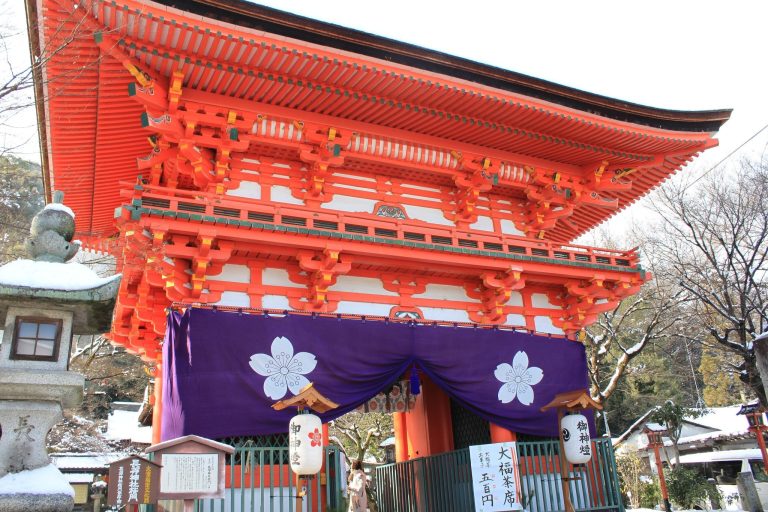
Four-legged gate
The present shrine gate is identified with the four-legged gate donated by Ashikaga Yoshihisa in 1487. Its survival connects a visible element of the precinct with the shrine’s medieval association with military prayer.
Associated shrines
Associated shrines were constructed within the precinct under the patronage of Ishikawa Tadamune in 1645. They form part of the architectural complex supported by the Zeze Domain and its successive lords.